🚀 A CloudSEK se torna a primeira empresa de segurança cibernética de origem indiana a receber investimentos da
Leia mais
.avif)

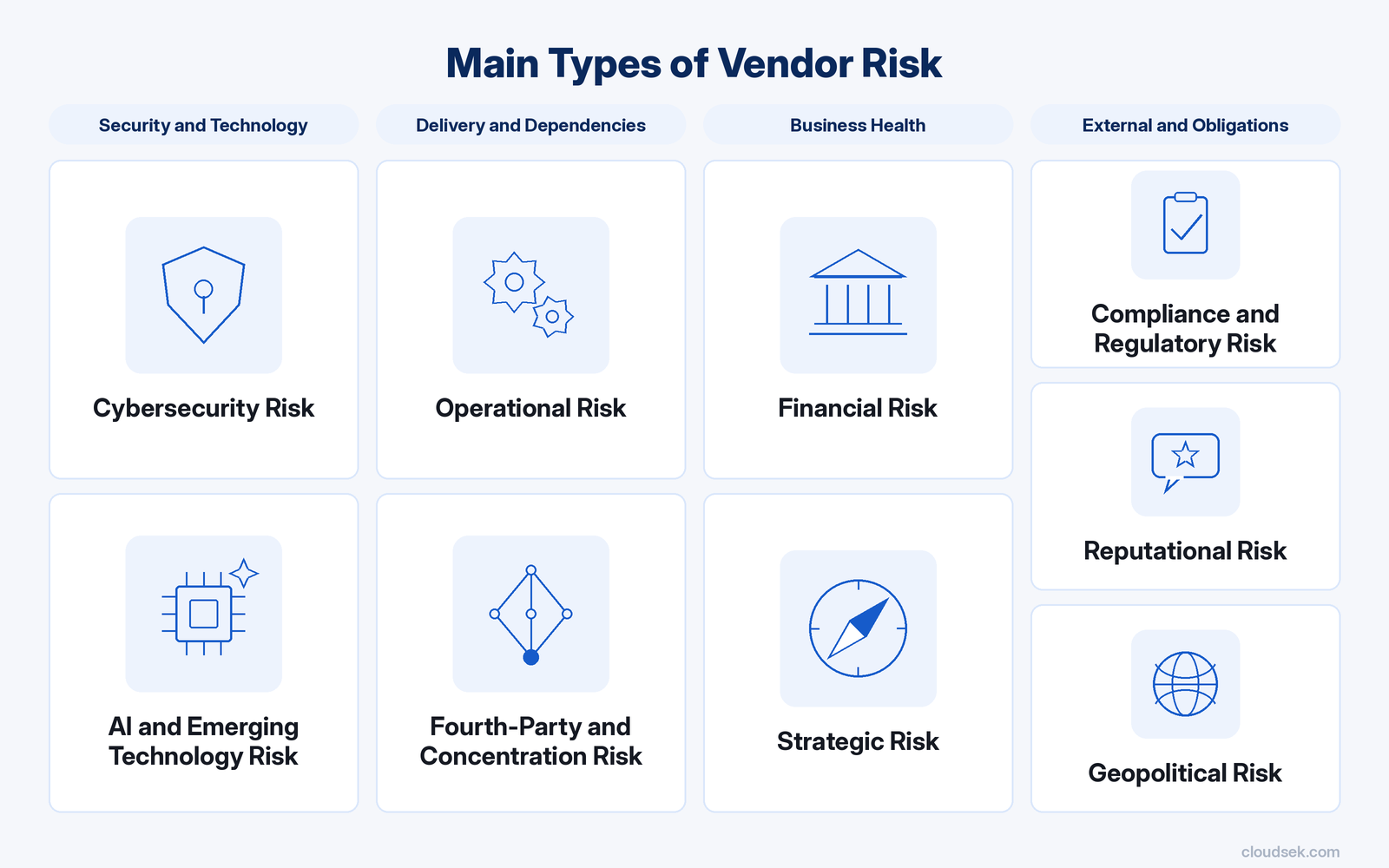
The nine practical categories of vendor risk are cybersecurity, operational, compliance and regulatory, financial, reputational, strategic, fourth-party and concentration, geopolitical, and AI and emerging technology risk. These categories cover risks that originate from or are amplified through third-party relationships.
The distinction lies in what creates the exposure, how it appears in the relationship, and which signals indicate a change.
Vendor risk is the possibility that reliance on an external supplier or service provider will adversely affect the organization using it. That exposure stems from activities, capabilities, services, or dependencies that sit partly outside direct organizational control.
As one part of broader third-party risk, this narrower scope covers suppliers and service providers whose actions or operating circumstances affect the organization relying on them. Their capabilities and dependencies also shape the exposure carried through the relationship.
A single event may produce several consequences, while its initiating condition determines the category.
Cybersecurity risk begins with something under a vendor’s control that gives an attacker a usable route toward another organization. That route may involve an identity, internet-facing asset, service, API, or remote connection. If an attacker obtains an authorized account, its existing permissions may provide a path to systems beyond the vendor’s environment.
CERT-EU reported in September 2026 that Australian authorities estimated TeamPCP had compromised more than 1,000 organizations and enabled the exfiltration of at least 300 GB of data during large-scale supply-chain compromises. The estimate reflects the reported campaign and should not be generalized to every organization connected through a supplier relationship.
Monitor for:
Dependence on an external service creates operational risk once a required business process can no longer function at the expected level. Loss of availability, degraded performance, insufficient capacity, or slow recovery may interrupt that process even while the organization’s own systems remain healthy. A payroll platform failure during a processing window is one example: the required activity stops because the external service is unavailable at the point of need.
Service-level results and continuity tests help establish whether delivery remains dependable. Capacity constraints and restoration capability show how much disruption the dependent process may have to absorb.
The WTO’s September 9, 2026 Goods Trade Barometer placed its container-shipping index at 99.6, the only component below the 100 trend baseline in that release. The figure provides macroeconomic context, not a vendor outage rate.
Outsourcing an activity does not automatically transfer the obligations attached to it. Compliance and regulatory risk arises from duties the organization still carries when another company performs the underlying work. Contracts and control evidence establish part of that responsibility, while reporting duties and jurisdictional requirements shape what the engagement must support.
On August 24, 2026, the U.S. Department of Justice announced a $1.8 million settlement involving allegations that a data-center contractor submitted false claims concerning services for the SEC. The settlement resolved allegations. The DOJ stated that there had been no determination of liability.
Evidence to check:
Sustained delivery depends partly on the financial capacity behind the engagement. Liquidity pressure, insolvency, deteriorating credit conditions, or financing problems can weaken that capacity before service visibly deteriorates. Financial risk therefore concerns whether sufficient resources remain to maintain operations over the life of the relationship.
The central question is viability. Enough financial headroom must remain to support the people, infrastructure, insurance, and other resources behind the engagement.
The UK Insolvency Service recorded 1,931 company insolvencies in England and Wales in July 2026. The total was 5% above June and 5% below July 2025. Those figures describe the wider economic environment rather than the probability of failure for an individual vendor.
Visible association between a supplier’s conduct and the organization that selected it creates reputational risk. Stakeholders may connect misconduct at a customer-facing vendor with the company relying on that provider. Public perception can shift even though the organization’s own employees did not cause the event.
A 2026 peer-reviewed study covering 17,816 firm-year observations found systematic changes in disclosure tone following cyber breaches. The authors interpreted those changes as potentially related to credibility and reputation management. The figure refers to the study sample, not breach prevalence.
Credible public controversy, established misconduct, customer-impacting behavior, and material adverse reporting warrant review. Allegations should remain separate from verified findings.
Strategic fit weakens as the direction of a vendor relationship moves away from the objective it was intended to achieve. Roadmap changes or ownership shifts may alter that fit. A different operating model or loss of a required capability can create the same mismatch while day-to-day delivery continues normally.
A discontinued capability central to a planned transformation program illustrates the problem. The service may remain operational, yet the relationship no longer supports the business outcome for which it was selected.
The South African Reserve Bank Prudential Authority’s August 24, 2026 supervisory report identifies alignment with business strategy and defined objectives or KPIs as considerations for strategic partnerships. It also addresses governance, continuous performance monitoring, and exit strategies while reporting persistent maturity gaps across institutions.
Decision test:
Separate vendor relationships can still converge on the same downstream dependency. Several direct suppliers may rely on one subcontractor, cloud platform, infrastructure layer, or specialist service. This structure creates fourth-party and concentration risk because apparent diversification at the direct-vendor level may conceal a common point of failure underneath it.
Organization → Vendor A / Vendor B / Vendor C → Shared downstream provider
CPMI-IOSCO’s September 8, 2026 discussion paper identifies six key risk-management challenges associated with third-party reliance. Provider concentration and complex or opaque supply chains are among them. Six refers to the number of challenges in the framework, not the prevalence of concentration across organizations.
Mapping downstream providers, common infrastructure, substitutability, and lock-in reveals where otherwise independent relationships converge on the same underlying dependency.
Political and jurisdictional conditions outside the commercial relationship may determine whether service remains legally or practically available. Geopolitical risk comes from sanctions, conflict, export restrictions, trade measures, or government intervention that affects the vendor’s ability to operate or serve the organization. The pressure originates outside the supplier rather than from deterioration within the business itself.
Watch for:
The UK Sanctions List recorded 21 variations under the ISIL (Da’esh) and Al-Qaeda regime on August 20, 2026. Further amendments and variations followed in subsequent weeks. The frequency of those updates demonstrates the need to verify sanctions status without implying that any particular vendor was affected.
An AI-enabled vendor service adds dependencies that may sit behind the customer-facing application. Organizational data may enter an external model or API. The service may also rely on upstream model providers, while automated actions introduce questions about how much authority the technology receives.
AI-specific exposure centers on data handling, model provenance, and upstream dependencies. Governance of model changes and human oversight become equally important where automated actions carry material consequences.
The BIS Financial Stability Institute reported on September 9, 2026 that frontier AI can reduce the expertise, time, and resources required for sophisticated cyber operations. The paper also states that frontier AI can amplify third-party dependencies. For organizations consuming AI through vendors, those dependencies extend beyond ordinary software exposure to the models, data flows, upstream providers, and automated decisions behind the service.
Assessment questions:
Vendor-management failures leave gaps in how relationships are selected, approved, governed, reviewed, and closed. These weaknesses differ from the nine risk categories because they arise from the organization’s own handling of the engagement.
Process discipline improves control over the relationship, but it does not mean every vendor warrants the same level of scrutiny.
Criticality reflects how much the business depends on a vendor. An essential-service provider deserves closer scrutiny than one whose loss would have limited operational impact. Reach adds another dimension. Privileged connectivity, sensitive data, or broad system permissions increase the potential consequence of a problem at the third party.
Monitoring intensity also depends on severity and speed. Teams need to consider the consequence of an unavailable or unsafe service. They also need to judge how quickly the exposure could worsen before the next review. Greater criticality, broader reach, higher impact, or faster deterioration justify tighter monitoring and escalation.
A vendor assessment records what was known on the day the review closed. The supporting evidence starts becoming stale as the relationship evolves. Ownership may shift, dependencies may change, service configuration can be updated, and external circumstances can alter the basis of the original review.
An annual assessment can therefore remain administratively current even after part of its factual basis is outdated. Detection lag is the interval between a new development and recognition that the prior conclusion no longer holds. Reducing that interval requires refreshed evidence and defined reassessment triggers instead of reliance on a fixed calendar alone.
CloudSEK SVigil continuously monitors third-party and supply-chain cyber posture. It identifies vendor-driven initial access vectors and maps hidden fourth-party dependencies. Security teams receive current intelligence on external exposure without relying only on periodic reviews.
That scope is narrower than full third-party risk management. SVigil does not assess supplier solvency or measure reputation. It also does not track every geopolitical development or provide general compliance management. Nexus AI correlates relevant SVigil findings with other CloudSEK signals into attack-path intelligence, showing where third-party exposure contributes to a potential route into the organization.
