🚀 A CloudSEK se torna a primeira empresa de segurança cibernética de origem indiana a receber investimentos da
Leia mais
.avif)

A qualitative cyber risk assessment expresses risk through categories or relative judgments, while a quantitative one uses numerical values whose magnitude has interpretable meaning. Attaching a numerical score to a risk does not by itself make the assessment quantitative, though the assumption is common. NIST also recognizes a third option, semi-quantitative assessment, which sits between categorical judgment and full quantitative measurement.
Much of the confusion traces back to the risk matrix, where ordered categories and numeric labels share the same grid. The choice of method is not cosmetic, because each approach produces a different kind of information for whoever has to act on it. A second distinction gets far less attention and matters just as much: the assessment method and the evidence feeding that assessment are separate concerns. Which approach fits a particular decision depends on both.
Qualitative cyber risk assessment describes risk in categories instead of measured values. Assessors apply expert judgment to two variables: how likely a risk scenario is to occur, and how severe the consequences would be if it did. Each judgment goes on an agreed ordinal scale, commonly low, medium and high, where every level ranks above or below the others without fixing the distance between them. A security team might rate the likelihood of a phishing campaign reaching an employee inbox as high and the impact of a resulting mailbox compromise as medium, which places that scenario relative to everything else under review.
The result is an order of priority. Any two risks scored on the same scale can be compared directly, which is what makes the output useful in a room where a CISO, a system owner and a business lead have to agree on what comes first. A qualitative rating can establish that one risk warrants more attention than another without establishing the numerical magnitude of the difference between them.
A rating establishes order. Quantitative cyber risk assessment answers the question order leaves open: how much, and how often. NIST draws the line at proportionality, so the relationships among the numbers have to mirror the relationships among the things being counted. Within that constraint, an organization can estimate how often a scenario will occur and what it will cost.
Frequency and probability estimates rarely arrive as settled facts, which is why quantitative work is designed to hold uncertainty in view instead of hiding it. A loss estimate expressed as a range says more than a single figure, and the likelihood of a scenario can be described as a distribution of possible outcomes. Monte Carlo simulation is one common technique for combining uncertain inputs of that kind into a modeled result. The FAIR model breaks a scenario into frequency and magnitude components before any calculation starts. A range that honestly reflects what is known will survive scrutiny better than a precise-looking number produced from thin evidence.
Qualitative and quantitative assessments differ in what their results tell you. A rating places a scenario above or below its neighbors; an estimate states a quantity, whether that is a sum of money, a count of hours, or a number of affected services.
The two columns answer different questions, and neither is a more accurate version of the other. Reordering a remediation backlog needs position; funding a control needs a figure somebody can defend in a budget meeting. A third pair of terms gets folded into that split and shouldn't be. NCSC keeps qualitative versus quantitative separate from subjective versus objective, because a measured figure can rest on a guess, and an expert category on years of incident records. The difference between the columns gets harder to see the moment a categorical assessment starts issuing scores.
A risk matrix is qualitative, and a scored one is semi-quantitative. The grid plots likelihood against impact, usually five levels per axis, with each level numbered 1 to 5 and each cell shaded green, amber or red. Multiply the axes and a score between 1 and 25 drops out, which ranks the entries from worst to least and looks a great deal like measurement.
The numbers on each axis are labels attached to an ordinal scale. A likelihood rated 4 sits above one rated 2, but nothing in the rating establishes that the first scenario is twice as likely as the second, and the product of the two axes inherits that indeterminacy. NIST reserves quantitative assessment for numbers whose proportionality holds, and assigns numbers whose meaning depends on the bins behind them to the semi-quantitative category. Arithmetic on a scale does not change what the scale measures.
None of that makes the grid worthless. It puts a security team and an executive committee on the same vocabulary for severity, sorts a long queue of risks quickly, and carries priority to a board that will never read the analysis underneath. What it needs is an accurate label. Structured numerical scoring does real work without being measurement, and neither category defined so far covers it.
Semi-quantitative cyber risk assessment uses numbers whose meaning comes from the definitions behind them instead of from the thing being counted. NIST describes it as assessment that relies on bins, scales or representative numbers, where each value stands for a defined band.
A weighted score assembled from criteria weights, or a likelihood band covering everything from once a year to once every three years, narrows the range further than a category does, without claiming the proportionality of a true measurement. It earns a category of its own because those numbers behave differently from measured ones, not because the method is half-quantitative.
Organizations reach for it when three or four descriptive categories stop telling risks apart. Consistent scoring criteria let two analysts assess the same scenario and land on the same result, which unstructured judgment rarely delivers, and the inputs required fall well short of full measurement. Many scored matrices land here.
Pick a method for the decision at hand, not for how rigorous it looks in a steering committee pack. What should drive the choice is the stakes of the decision, the evidence available to support it, the precision the decision genuinely requires, and the analytical effort the organization can justify.
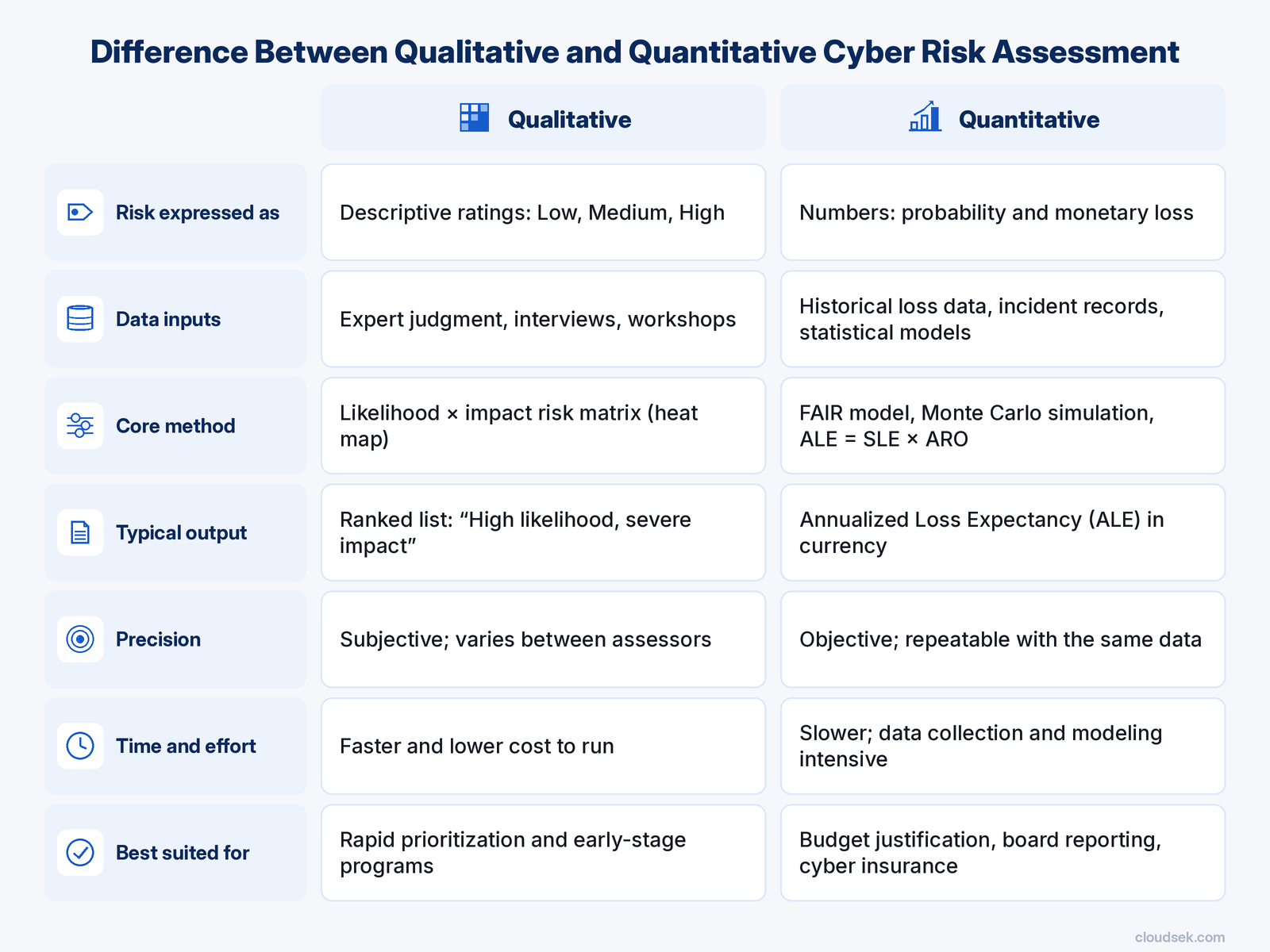
Qualitative assessment fits the stage where risks are still being identified and nobody knows yet which entries deserve scrutiny. A newly disclosed vulnerability class with no exploitation history and no internal incident record offers nothing to measure, though a security team can still judge whether the affected technology is widely deployed and business-critical. A risk workshop that has to finish with an agreed order of concerns needs a shared ranking inside the hour, not a model. Headcount has nothing to do with it: a bank working through a long inherited register faces the same problem as a firm assessing its first ten risks.
Quantitative assessment earns its cost when the number itself decides the outcome. Choosing between two control investments, setting a retention level on a cyber policy, and deciding whether to accept a risk instead of treating it all turn on how much, and a category cannot settle any of them. The effort is wasted when the decision would come out the same at either end of the plausible range.
Semi-quantitative assessment suits the wide middle where categories are too coarse and measurement is out of reach. When most entries share the same top rating, they need separation the three broad categories cannot supply. Criteria that spell out what each band means make that separation repeatable across analysts and across quarters, which matters when a different team runs the review each cycle. Loss and frequency data adequate for modeling is frequently unavailable, and banded scoring lets the work continue without anyone inventing data. Scores produced this way still should not be presented as measurements they were never designed to be.
One organization will run all three in the same quarter, on different decisions. The harder question is whether they can be applied to the same set of risks without contradicting each other.
Yes, and most mature risk programs do exactly that. A register holding hundreds of scenarios cannot receive the same analytical depth throughout, so depth has to be rationed. Most programs ration it in four stages.
A risk register assembled this way holds mixed depth on purpose: a handful of entries with loss ranges attached, the large majority with ratings alone. When a risk owner escalates an entry into full modeling, that is a call about where to spend analyst time, not a verdict that the earlier judgment was wrong. The three methods are not rungs on a ladder that every risk eventually climbs, and nothing is gained by quantifying a scenario whose treatment would be identical either way. What the sequence cannot fix is the age of its own inputs, because a well-chosen method still returns a stale answer when the conditions behind an entry have moved on.
Assessment methods run on information that someone gathered at a particular moment, and that information has a shelf life.
Every method described so far operates on inputs it does not generate: the likelihood judgments, exposure assumptions and impact estimates supplied when a scenario was first written. Those were accurate on the day they were made. A scenario rated medium likelihood on the reasoning that no public exploit existed becomes wrong the moment one is published, and the rating will keep reading medium until somebody revisits it.
Several categories of external evidence move likelihood or impact assumptions directly:
The supply of this evidence refreshes continuously: CERT-EU analyzed 385 open-source reports for its August 2026 Cyber Brief, published on 3 September 2026. A single finding can force one scenario open, as when Australia's ASD/ACSC warned on 19 August 2026 that it had observed targeting of two authentication-bypass vulnerabilities, CVE-2026-18556 and CVE-2026-18577, affecting N-able N-central in Australia. Platforms such as CloudSEK supply external evidence of this kind, covering threat-actor and exploited-CVE intelligence, external attack-surface visibility, leaked-credential exposure and third-party risk signals. Current evidence makes the inputs to an assessment more accurate; it does not by itself turn a qualitative model into a quantitative one.
No method is universally superior, so the choice belongs to the decision rather than to a house standard applied across the whole register. The question to ask is what the decision needs out of the assessment: an order, a repeatable score, or a figure to act on. A sophisticated model is worth nothing when its inputs cannot support the precision it appears to offer.
The objective is not to make every cyber risk quantitative. The objective is to produce enough reliable information to support the decision in front of you.
CloudSEK tracks the external evidence behind these decisions and refreshes it as exposure and adversary activity change. Request a demo to see how that evidence reaches your risk register.
No. Monetary loss is the most common expression because budget and investment decisions are denominated that way, which is why the output lands with the executives approving spend. Quantitative measures can equally represent event frequency, probability, hours of downtime, the number of affected devices, or the services taken out of operation, and NCSC's quantification guidance counts all of these as valid quantitative expressions of cyber risk.
The inputs fall into two groups: how often something happens, and what it costs when it does. The first draws on event frequency records, probability estimates and historical incident data, internal where it exists and external where it does not. The second draws on business impact information, asset and service details, and evidence about how well existing controls actually perform. Complete historical data is rarely available for cyber scenarios, so credible estimates fill the gaps, and documenting the reasoning behind each estimate is what makes the result auditable later.
The terms are used interchangeably in much of the literature, and NIST terminology takes them as synonyms or near-synonyms depending on the framework in question. Where a distinction is drawn, analysis usually refers to the examination of individual risks and assessment to the broader process that contains it.
Yes, where the available data supports measurable estimates. Vendor-dependent scenarios take the same form as internal ones, using frequency and business consequence. The binding constraint is usually visibility into the vendor's environment, not any property of the method.
There is no universal interval that suits every organization. Formal review cycles serve a governance purpose and give the process a floor, but a calendar alone will not catch a change that happens between reviews. Reassessment should also be triggered by material change in systems, business operations, controls, threat conditions, vulnerabilities, suppliers or external exposure. NCSC's risk-management method describes assessment as continually iterated rather than a one-time exercise.
