🚀 CloudSEK featured in the 2026 Frost Radar™!
Read more
.avif)

Supply chain attacks are cyber threats where attackers gain access through compromised third-party vendors, software providers, or external dependencies. These attacks exploit trusted distribution channels to bypass traditional security controls and infiltrate target systems.
Instead of targeting internal infrastructure directly, attackers focus on vendor relationships and software ecosystems. One compromised component, such as a software update or external service, can impact multiple organizations simultaneously.
Reliance on cloud platforms, APIs, and open-source dependencies has significantly expanded the attack surface. Continuous validation of vendors, software integrity, and trust relationships play a critical role in reducing exposure across interconnected systems.
Supply chain attacks work through a staged process where attackers exploit trusted relationships to gain indirect access to target systems.
Real-world supply chain attacks show how trust in vendors, software updates, and external tools can be exploited to reach thousands of organizations at once.
Late 2020 saw attackers compromise the Orion software build system and inject malicious code into signed updates. More than 18,000 organizations installed the update, turning a single breach into a global espionage campaign.
Mass exploitation began in May 2023 after a zero-day vulnerability was discovered in MOVEit file transfer software. Hundreds of organizations across finance, healthcare, and government sectors experienced large-scale data theft.
In 2023, attackers embedded malicious code into digitally signed updates of the 3CX VoIP desktop application. Thousands of businesses installed the compromised version, allowing long-term unauthorized access.
July 2021 ransomware deployment exploited vulnerabilities in Kaseya’s remote management software. Impact spread rapidly through managed service providers, affecting over 1,500 downstream businesses in hours.
Attackers modified Codecov’s Bash uploader script in 2021 to capture sensitive environment variables from CI/CD pipelines. Delayed detection exposed secrets across hundreds of organizations relying on the tool.
Access to Target’s internal network came through stolen credentials from a third-party HVAC vendor in 2013. Payment data from over 40 million customers was exposed during a peak shopping period.
In 2024 a hidden backdoor was discovered inside the widely used XZ Utils compression library. Maintainer-level compromise allowed malicious code to be introduced into Linux distributions before detection prevented widespread damage.
Preventing supply chain attacks requires strong visibility, controlled access, and well-defined security processes across every external dependency.
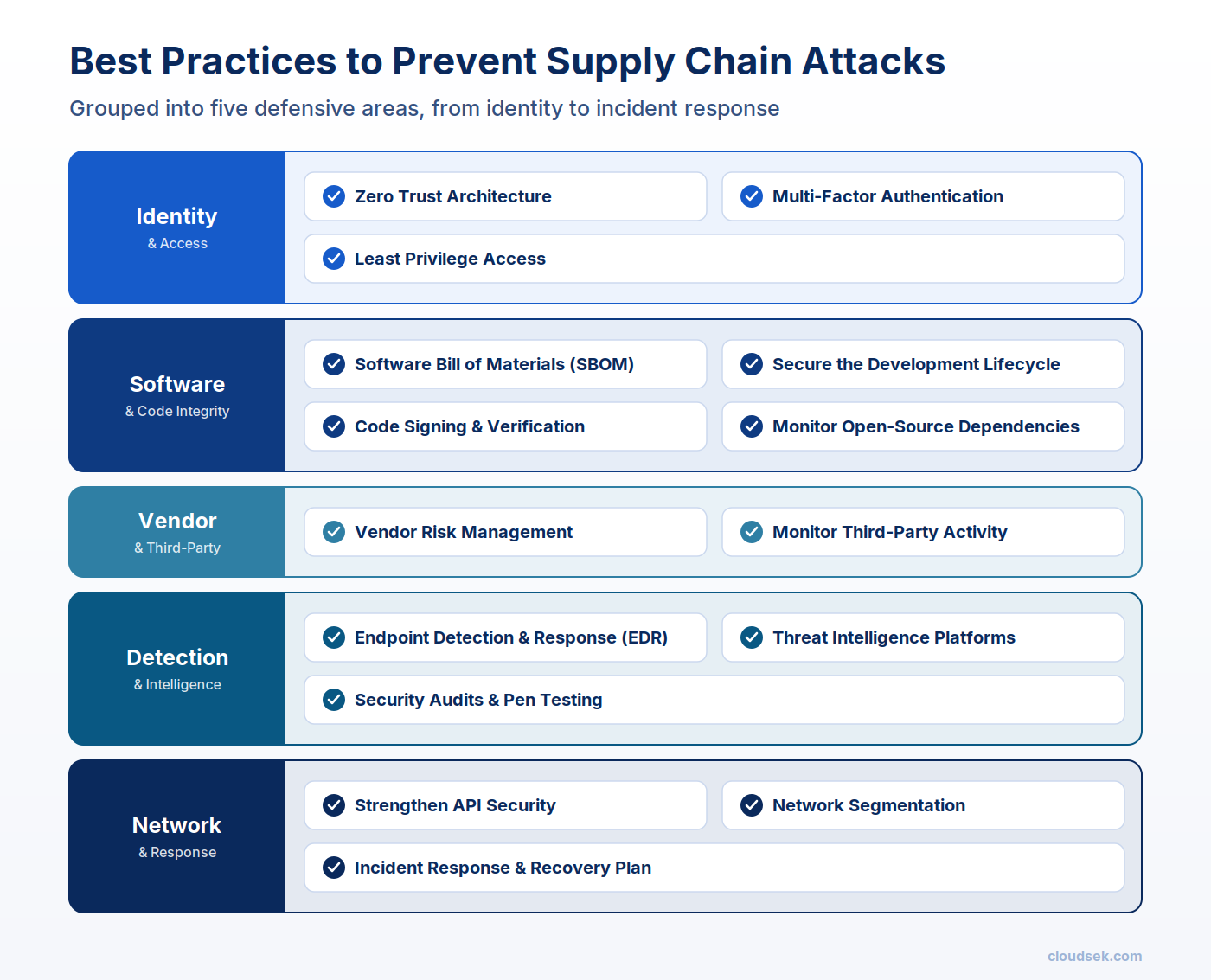
Zero Trust architecture removes the idea of implicit trust within networks and requires identity verification for every interaction between users, devices, and systems. Authentication decisions rely on identity signals, device posture, and behavioral context rather than network location.
Modern environments include cloud platforms, remote workforces, and third-party integrations that extend beyond traditional boundaries. Strict identity validation limits the ability of attackers to move across systems after gaining an initial foothold.
A Software Bill of Materials acts as a detailed inventory of all components, libraries, and dependencies within an application. Security teams gain visibility into software composition, which helps identify vulnerable or compromised elements quickly.
Incidents like the SolarWinds Attack demonstrated how hidden dependencies can be exploited at scale. Clear tracking of software components allows faster remediation when vulnerabilities are disclosed.
Vendor relationships introduce varying levels of security maturity into an organization’s ecosystem. Formal assessment processes evaluate security posture before integration with internal systems.
Frameworks from NIST and CISA provide structured guidance for evaluating third-party risks. Regular reassessment and ongoing automated third-party risk monitoring using products like SVigil provides visibility into vendor security posture and ensures they maintain strong security practices over time.
Multi-factor authentication requires verification through multiple independent factors, such as passwords, biometric data, or one-time codes. Additional verification layers reduce the likelihood of unauthorized entry through stolen credentials.
Credential-based attacks remain a common method in breaches involving external vendors and service providers. Strong authentication mechanisms significantly reduce the success rate of such attacks.
Least privilege limits permissions granted to users and systems based on specific roles and responsibilities. Restricting permissions reduces the potential impact of compromised credentials or insider threats.
Environments with excessive privileges allow attackers to escalate control rapidly after initial entry. Careful permission management ensures that critical systems remain protected even if one account is compromised.
Visibility into vendor interactions helps identify unusual behavior across integrated systems. Behavioral analysis reveals anomalies that may indicate malicious activity within external connections.
Incidents such as the Target Data Breach highlight how third-party entry points can be exploited. Early detection of irregular activity reduces the chance of large-scale compromise.
Security practices integrated into development processes help prevent vulnerabilities from entering production environments. Code reviews, dependency checks, and testing improve overall software reliability.
Attackers often target build pipelines and development environments to inject malicious code. Strong controls within development workflows reduce the risk of compromised software releases.
Code signing ensures that software originates from a verified source and remains unchanged during distribution. Digital signatures provide assurance that applications and updates have not been tampered with.
Verification mechanisms play an important role in preventing malicious code execution. Systems that validate software integrity reduce exposure to unauthorized modifications.
APIs serve as communication channels between services, applications, and external platforms. Strong authentication, encryption, and validation controls protect data exchanges from unauthorized use.
Weak API configurations often create entry points for attackers targeting interconnected systems. Proper security measures reduce the risk of exploitation through exposed interfaces.
Endpoint detection tools analyze system behavior to identify unusual patterns that indicate potential threats. Behavioral monitoring helps detect attacks that bypass traditional signature-based defenses.
Incidents involving ransomware and malware often begin at endpoint devices before spreading further. Strong endpoint visibility enables faster containment and reduces the overall impact of an attack.
Security audits provide structured evaluations of systems, policies, and integrations. Penetration testing simulates real-world attack scenarios to identify weaknesses before adversaries exploit them.
Unidentified vulnerabilities often remain hidden until exploited during an attack. Regular testing ensures that defenses remain effective against evolving threat techniques.
Open-source libraries play a critical role in modern software development but may introduce security risks if not properly managed. Visibility into dependency usage helps identify outdated or compromised components.
The XZ Utils Backdoor Incident demonstrated how trusted open-source projects can be manipulated. Careful monitoring reduces exposure to hidden threats within widely used libraries.
Network segmentation divides infrastructure into isolated sections based on function and sensitivity. Separation limits communication between systems and reduces the spread of attacks.
Containment becomes more effective when systems operate within defined boundaries. Segmented environments prevent a single compromise from affecting the entire network.
Threat intelligence platforms provide insights into emerging vulnerabilities, attack methods, and adversary behavior. Information gathered from global threat data helps organizations prepare for potential risks.
Awareness of current threat trends improves decision-making during security incidents. Proactive defense strategies become more effective with timely and relevant intelligence.
An incident response plan outlines clear steps for detecting, containing, and recovering from security breaches. Defined roles and procedures ensure coordinated action during critical situations.
Recovery planning focuses on restoring systems and minimizing disruption to operations. Organizations with structured response strategies recover faster and reduce long-term damage.
CloudSEK's SVigil enables organizations to continuously assess and monitor the cybersecurity posture of third parties, suppliers, partners, and vendors that form part of their extended digital ecosystem. Rather than relying on periodic questionnaires or point-in-time assessments, SVigil delivers continuous, external risk visibility to identify emerging exposures before they can be exploited.
The platform evaluates vendors for internet-facing vulnerabilities, exposed assets, credential leaks, security misconfigurations, compromised infrastructure, and other indicators of elevated cyber risk. AI-powered analytics prioritize findings based on their potential business impact, while actionable risk scoring helps security teams focus remediation efforts on the third parties that present the greatest risk.
By providing ongoing monitoring, automated risk assessments, and timely alerts on changes in vendor security posture, SVigil enables organizations to proactively manage third-party cyber risk, strengthen supply chain resilience, and reduce the likelihood of vendor-driven breaches.
