Third-Party Risk Management (TPRM): Lifecycle, Frameworks, and Best Practices

Third-party risk management (TPRM) controls vendor risk across the full lifecycle. Learn the TPRM lifecycle, key components, frameworks, and best practices.
Published on
Sunday, August 16, 2026
Updated on
August 16, 2026

Third-party risk management (TPRM) is the ongoing process of identifying, assessing, mitigating, and monitoring the risks that vendors, suppliers, and service providers introduce across the entire relationship.

The exposure is expensive and slow to contain: IBM's 2025 Cost of a Data Breach Report found that supply-chain compromise accounts for 15% of breaches at an average cost of $4.91 million and takes the longest of any vector to contain, at 267 days.

Third-party risk management gives organizations a structured program to govern that exposure from the moment a vendor is onboarded to the day the relationship ends. This guide covers what TPRM is, how it differs from a third-party risk assessment, the TPRM lifecycle, the frameworks and regulations that shape it, the challenges teams face, and the practices that keep a program effective.

What is Third-Party Risk Management (TPRM)?

Third-party risk management is the continuous discipline of governing the risks that external parties create for an organization. It runs as a standing program rather than a one-time check, and it spans the full vendor lifecycle from discovery through offboarding. The practice overlaps with vendor risk management (VRM) and supply chain risk management (SCRM), and it treats third-party cyber risk as a measurable exposure that changes over time. Every vendor with access to data, systems, or operations falls inside its scope.
TPRM vs Third-Party Risk Assessment

tprm vs third party risk assessment

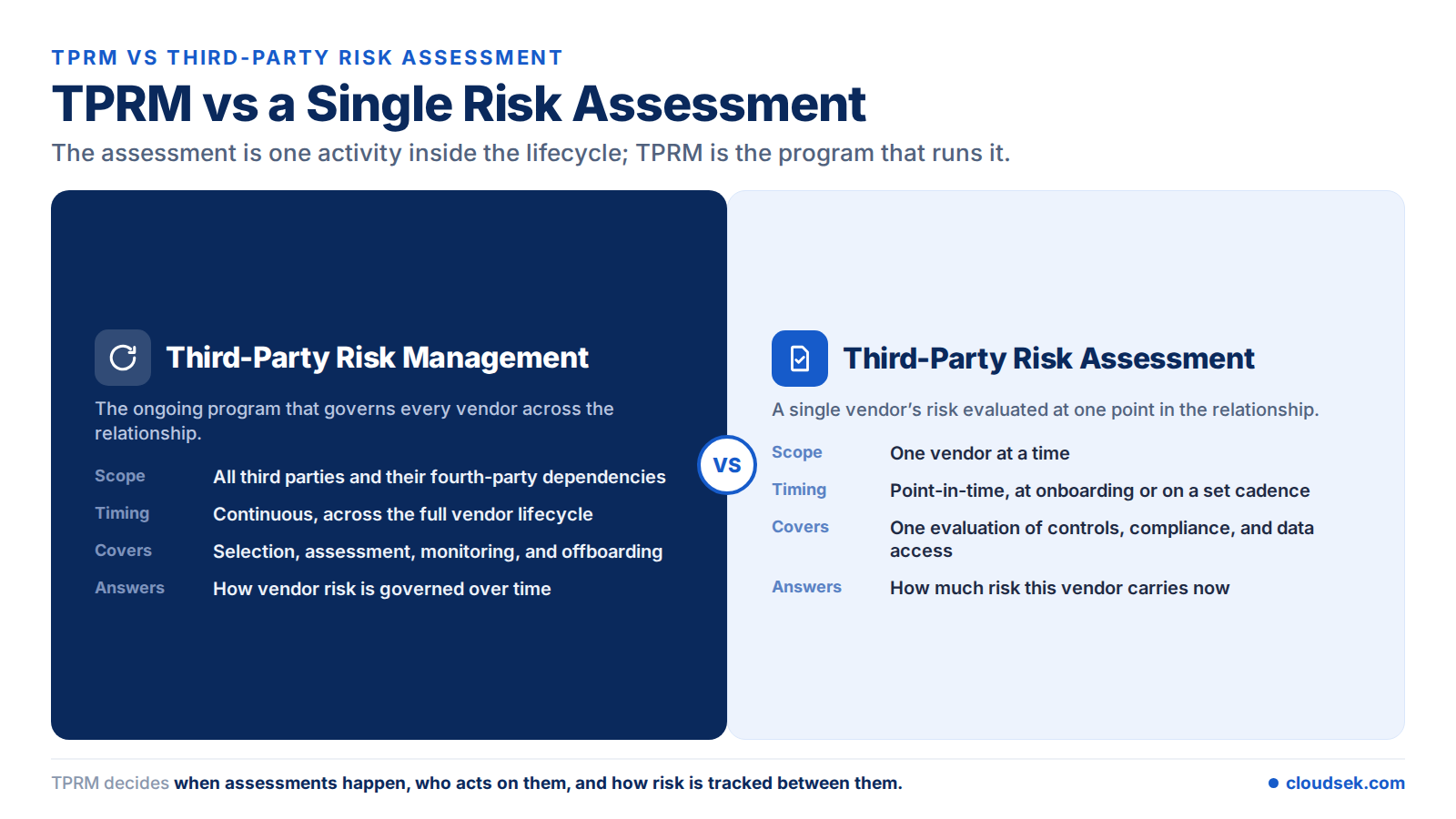
A third-party risk assessment evaluates a single vendor's risk at one point in the relationship. While Third-party risk management is the wider program that runs those assessments and governs every vendor across discovery, onboarding, monitoring, and offboarding. The assessment is one activity inside the lifecycle; TPRM is the system that decides when assessments happen, who acts on them, and how risk is tracked between them.

Why is Third-Party Risk Management Important?

Third-party risk management matters because attackers follow the path of least resistance, and a vendor with weaker security becomes the way into a stronger target. SecurityScorecard research found that 29% of breaches originate with a third party. Five outcomes make the program essential:

  • Breach prevention: Every vendor with network access or sensitive data widens the attack surface.
  • Regulatory compliance: Frameworks such as DORA, HIPAA, and GDPR hold the organization accountable for vendor security.
  • Operational resilience: A vendor outage disrupts the organization's own service and supply chain.
  • Reputation: Customers blame the organization, not the vendor, when their data is exposed.
  • Attack-surface reduction: Each managed vendor relationship removes a blind spot that attackers exploit.

Third-Party Breach Examples

Three recent incidents show how one vendor failure cascades across every organization connected to it:

  • CDK Global (2024): a BlackSuit ransomware attack disabled the dealer-management software that serves close to 15,000 car dealerships across North America. Operations froze for weeks, and the collective cost to dealerships passed $1 billion by an Anderson Economic Group estimate, exposing the concentration risk of a single industry-wide vendor.
  • MOVEit (2023): the Cl0p ransomware group exploited a zero-day in the MOVEit file-transfer tool, breaching more than 2,700 organizations and exposing data on roughly 93 million individuals through one piece of vendor software. A single flaw in widely used software reached its entire customer base at once.
  • Change Healthcare (2024): a ransomware attack on the UnitedHealth subsidiary affected 190 million individuals, the largest healthcare data breach on record, and disrupted claims and prescriptions across the US for weeks. A critical service provider became a single point of failure for an entire sector.

Types of Third-Party Risks

A TPRM program governs several categories of third-party risk:

  • Cybersecurity risk: breaches, ransomware, and credential exposure originating in a vendor's environment.
  • Operational risk: outages and supply disruptions that interrupt the organization's service.
  • Financial risk: penalties, recovery costs, and a vendor's own financial instability.
  • Compliance risk: a vendor's failure to meet regulations that exposes the organization to fines.
  • Reputational risk: brand damage when a vendor incident reaches customers.
  • Strategic risk: misaligned goals, mergers, or vendor decline that undermine long-term plans.
  • Concentration and fourth-party risk: overreliance on one vendor, or exposure through the vendor's own suppliers.

The Third-Party Risk Management Lifecycle

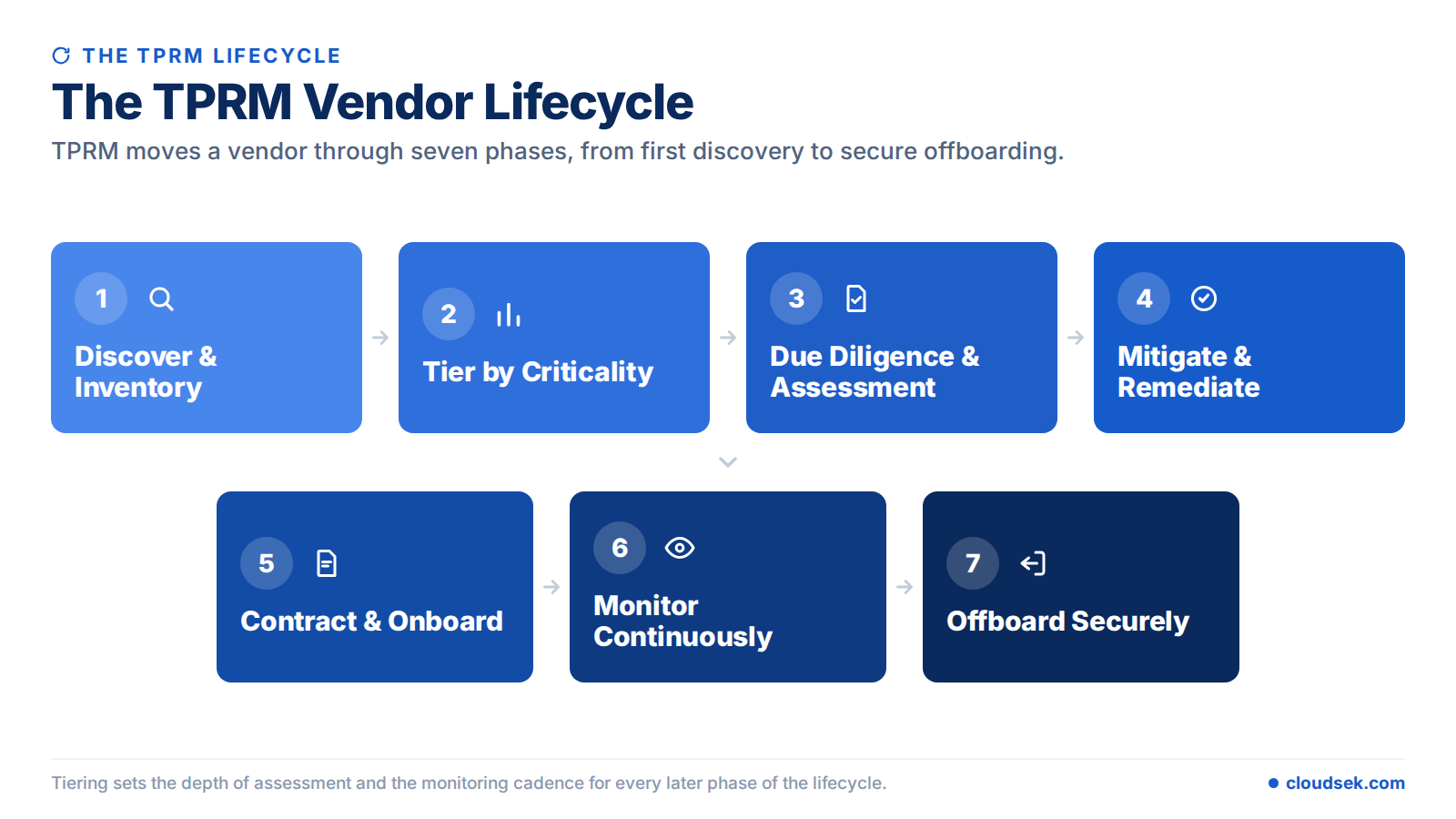
The TPRM lifecycle moves a vendor through seven phases, from first discovery to secure offboarding:
tprm lifecycle
  1. Discover and inventory every third party, then classify each by the inherent risk it carries.
  2. Tier vendors by criticality so the highest-impact relationships receive the deepest review.
  3. Conduct due diligence and risk assessment before granting access to data or systems.
  4. Mitigate and remediate gaps, measuring residual risk against the organization's risk appetite.
  5. Contract and onboard the vendor, embedding security obligations, SLAs, and data-protection terms.
  6. Monitor continuously, because a vendor's risk profile shifts long after onboarding.
  7. Offboard securely, revoking access and confirming that data is returned or destroyed.

Tiering turns the lifecycle into a focused effort. A payroll provider with access to employee PII and bank details sits in the critical tier and warrants continuous monitoring, while a design contractor with no access to internal systems sits in a low tier reviewed once a year. The tier sets the depth of assessment and the monitoring cadence for every later phase.

TPRM Frameworks and Standards

Established frameworks give a TPRM program a consistent structure and a common language with vendors:

  • NIST Cybersecurity Framework and NIST SP 800-161: guidance for managing cybersecurity and supply chain risk.
  • ISO/IEC 27036 and ISO 27001: standards for supplier security and information security management.
  • Shared Assessments SIG: a standardized questionnaire library for vendor due diligence.
  • CAIQ: The Cloud Security Alliance questionnaire focused on cloud service providers.

Regulatory Requirements for TPRM

Regulators now treat vendor risk as the organization's responsibility. The rules that mandate third-party risk management include:

  • DORA and NYDFS: operational-resilience and cybersecurity rules for financial services.
  • NIS2: an EU directive covering a broad set of sectors and their supply chains.
  • HIPAA: third-party safeguards for protected health information.
  • GDPR and CCPA: accountability for how processors handle personal data.
  • PCI DSS: security requirements for vendors that handle payment-card data.
  • SEC disclosure rules: reporting obligations that extend to material third-party incidents.

TPRM Tools and Automation

Tools reduce the manual load of third-party risk management and keep findings current. The capability categories that matter:

  • Vendor inventory and tiering: a central, classified record of every third party.
  • Questionnaire automation: AI-assisted completion and validation against vendor evidence.
  • Security ratings: external scores that benchmark a vendor's posture.
  • Attack-surface and credential-exposure monitoring: visibility into a vendor's internet-facing assets and leaked credentials.
  • Fourth-party mapping: discovery of the dependencies behind each vendor.
  • Reporting and dashboards: a board-level view of vendor risk across the portfolio.

Choosing a TPRM tool comes down to a few criteria:

  • Integration: fit with existing procurement, SIEM, and ticketing systems.
  • Scalability: the capacity to handle a growing vendor count without added manual work.
  • Continuous monitoring: real-time updates in place of periodic snapshots.
  • Fourth-party coverage: visibility into the dependencies behind each vendor.
  • Reporting depth: dashboards that translate vendor risk for boards and stakeholders.

Continuous Third-Party Risk Management with CloudSEK SVigil

Most TPRM programs still run on questionnaires and annual reviews. The trouble is that a questionnaire captures a vendor on the day it arrives, while the vendor's real exposure keeps moving: new infrastructure appears, an employee's credentials leak, a dependency picks up a vulnerability. By the next review cycle, the picture is already out of date. Closing that gap is where CloudSEK's SVigil works.

SVigil fingerprints a vendor ecosystem and watches it over time, surfacing exposed assets, leaked credentials, and the fourth-party dependencies that sit behind each vendor. When a vendor's exposure changes, the security team sees it between assessments rather than after an incident.

SVigil covers the continuous-monitoring phase of the lifecycle. Governance, due diligence, contracts, and offboarding remain the program's own work. The program decides which vendors to trust; continuous monitoring confirms whether that trust still holds.

Frequently Asked Questions (FAQ)

What is the difference between TPRM and vendor risk management (VRM)?

Vendor risk management focuses on risks from contracted vendors. Third-party risk management is broader, covering every external party, including suppliers, partners, and service providers, along with their fourth-party dependencies. The terms are often used interchangeably.

What is the NIST framework for third-party risk management?

The NIST Cybersecurity Framework addresses third-party risk under its supply chain risk management category, and NIST SP 800-161 provides detailed supply-chain guidance. Both direct organizations to assess, monitor, and document vendor security.

How do you build a TPRM program?

Start by assigning ownership and defining risk appetite, then build a vendor inventory, tier vendors by criticality, set an assessment framework, and add continuous monitoring. Governance and automation hold the program together as it scales.

What software is used for third-party risk management?

TPRM software combines vendor inventory, questionnaire automation, security ratings, attack-surface and credential-exposure monitoring, fourth-party mapping, and reporting. Most programs pair an assessment platform with continuous external monitoring.

Is third-party risk management part of GRC?

Yes. Third-party risk management sits within governance, risk, and compliance (GRC), and it feeds vendor risk data into the wider enterprise risk and compliance program.

How does continuous monitoring improve TPRM?

Continuous monitoring replaces point-in-time snapshots with a live view of vendor risk, flagging exposed assets and leaked credentials as they appear, so teams act before an incident rather than after one.

Related Posts
Spear Phishing vs. Phishing: What is the Difference?
The main difference is that spear phishing targets specific individuals using personalized attacks, while phishing uses generic mass emails to steal credentials and sensitive information.
What is an Insider Threat? Types, Risks, and Prevention
An insider threat is a security risk posed by employees, contractors, or partners who misuse authorized access to harm an organization’s data, systems, or operations.
FBI FLASH-20260702-01 Explained: The AI Supply Chain Advisory and Who It Applies To
Package presence isn't compromise. See how CloudSEK separates confirmed TeamPCP exposure from reconstructed risk in FBI FLASH-20260702-01.

Start your demo now!

Schedule a Demo
Free 7-day trial
No Commitments
100% value guaranteed

Related Knowledge Base Articles

No items found.