🚀 A CloudSEK se torna a primeira empresa de segurança cibernética de origem indiana a receber investimentos da
Leia mais
.avif)

A DNS scanner inspects a domain’s records, subdomains, and configuration for weaknesses that expose an organization to hijacking, spoofing, and takeover. It turns one domain name into a map of connected assets, then tests that map for records pointing at services that no longer exist, missing email authentication, and nameservers configured to give away more than they need to.
Attackers work the same layer, and sometimes in places defenders never look. CloudSEK researchers documented phishing infrastructure staged across IPv6 reverse-DNS space through ip6.arpa wildcard abuse, a technique that sidesteps blocklists and conventional controls because almost nobody enumerates that address space. DNS is not a supporting service in these attacks. It is the target.
Scanning starts with a single seed domain and expands outward using public data rather than credentials or internal access, which makes it an outside-in exercise.
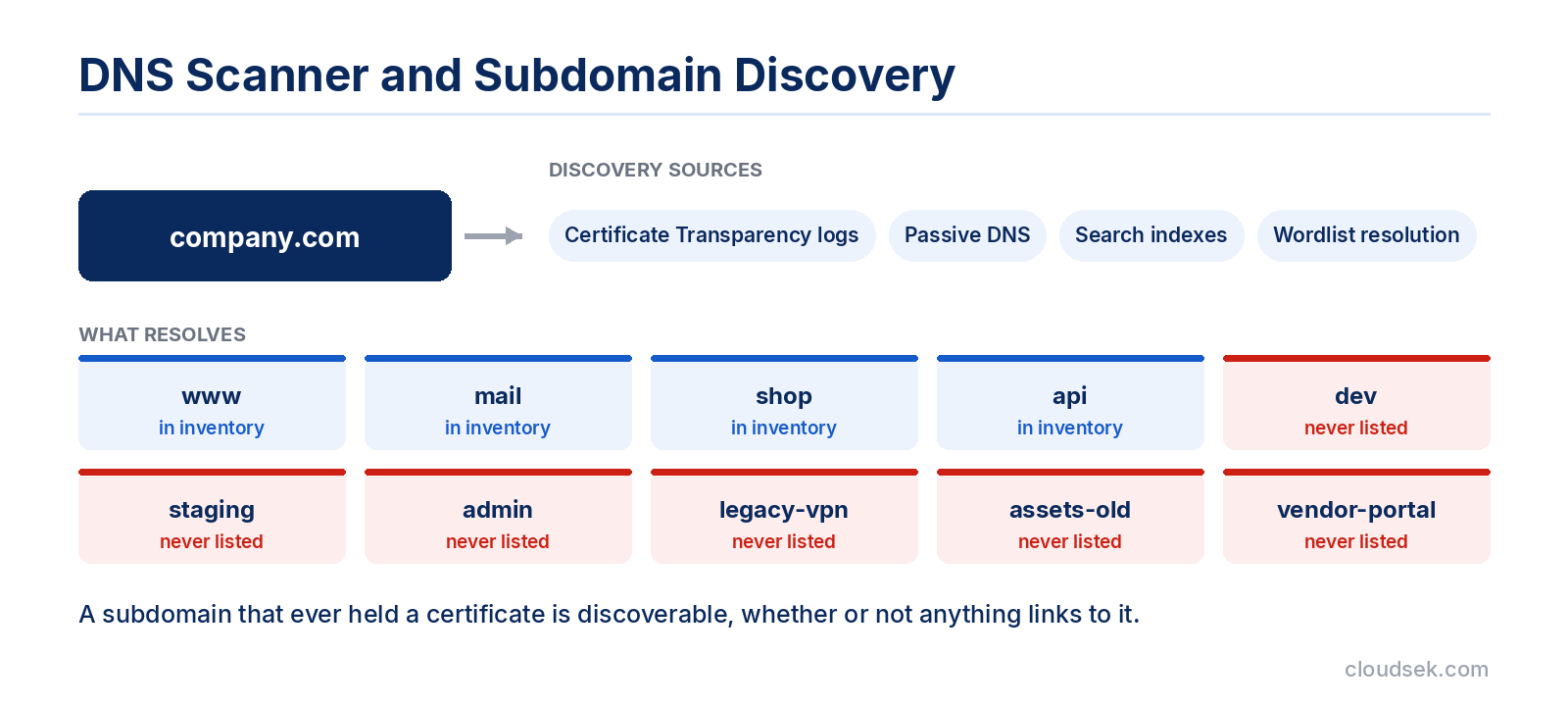
Certificate Transparency logs deserve particular attention as a discovery source. Every certificate issued by a publicly trusted authority is published to them, so any subdomain that has ever been given a certificate appears in a public record regardless of whether it is still linked from anywhere. That is how scanners surface dev, staging, and admin hosts that no internal inventory lists, and it is why external attack surface management treats DNS as a primary discovery layer.
A DNS scanner turns a single domain into a map of connected assets and then tests that map for weaknesses. The findings matter because DNS is a target in itself:
Records are the raw material a scan works from. Read together, they describe an organization’s infrastructure, vendors, and integrations, which is exactly why attackers enumerate them first.
What a domain omits matters as much as what it publishes. A missing CAA record places no restriction on which certificate authority can issue for a domain, and a missing DMARC policy leaves SPF and DKIM without enforcement. Manipulating these gaps defines a DNS attack, where traffic is blocked, redirected, or intercepted without ever touching the servers behind the names
Whether anyone can send mail pretending to be a domain comes down to three records. A scanner checks that all three exist and that each one says something enforceable.
Sender Policy Framework lists the servers authorized to send mail for a domain. A missing record lets anyone deliver in the domain’s name, and an overly permissive one achieves much the same. Scanners flag records ending in a soft fail, which asks receivers to accept unauthorized mail and mark it, rather than reject it.
DomainKeys Identified Mail attaches a cryptographic signature to outgoing messages, verified by receivers against a public key published in DNS. Scanners check that the selector record exists and that the key length meets current standards, since 1024-bit keys remain common and are no longer considered adequate.
Domain-based message authentication, reporting and conformance tells receivers what to do with mail failing SPF and DKIM, and returns reports naming everyone sending under the domain. Policy strength is what a scanner reports on: a policy of p=none monitors without protecting, and only quarantine or reject stops a forged message. Domains left unprotected here become the raw material for email spoofing and wider domain spoofing campaigns.
Every subdomain is an asset, and the forgotten ones cause the damage. Discovery lists them; takeover testing establishes which can be stolen outright.
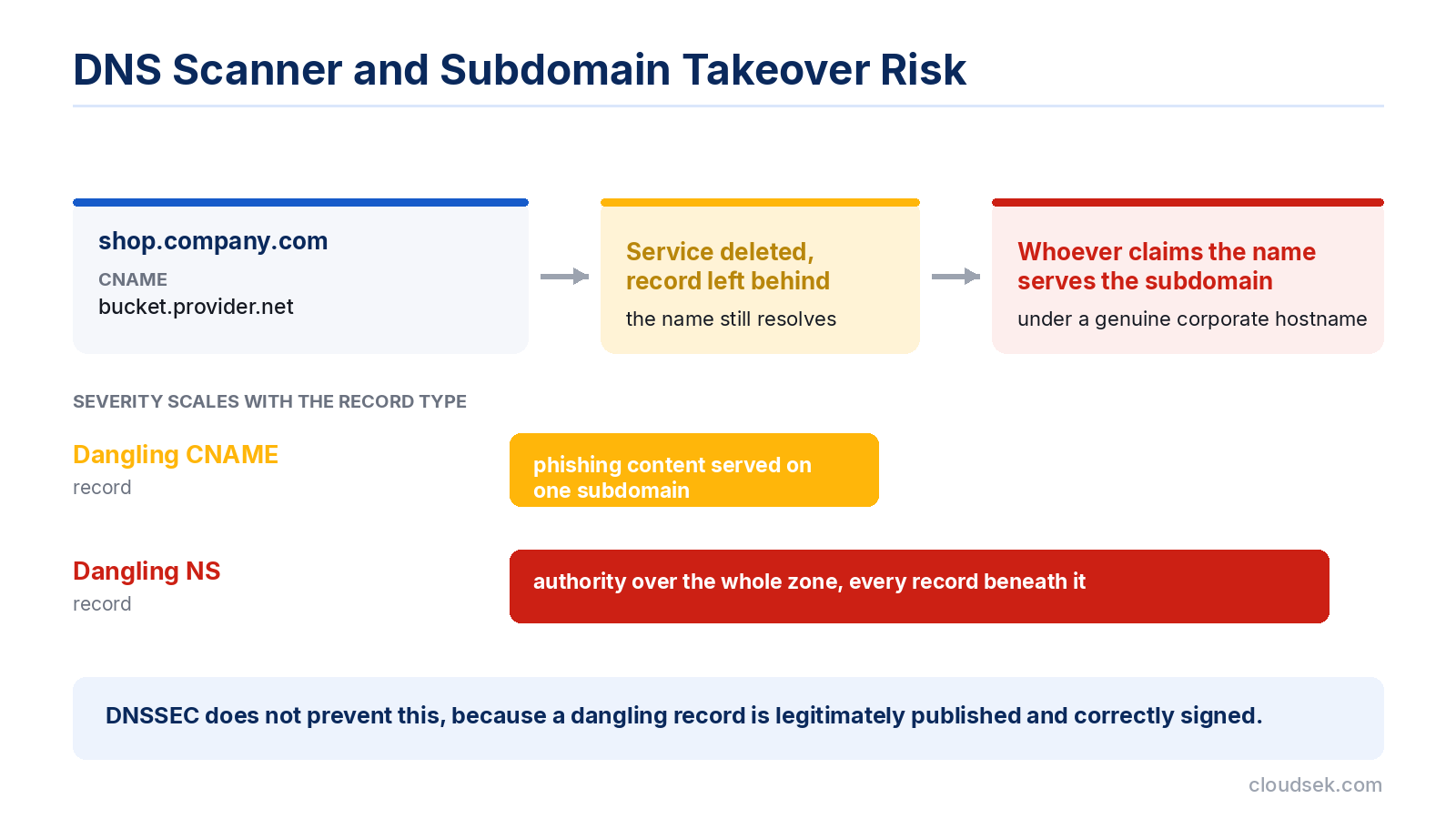
A takeover happens when a DNS record points to an external service that no longer exists. A CNAME aimed at a deleted cloud storage bucket or an abandoned hosting page still resolves, and anyone who registers that resource name controls the subdomain and everything a browser will trust on it. The OWASP subdomain takeover testing guide documents the conditions in detail, and dozens of SaaS providers allow the claim by design because reclaiming a released name is a normal product function.
Severity of a takeover scales with the record type involved. A dangling CNAME on a marketing subdomain lets an attacker serve phishing content under a genuine corporate name, which is a brand impersonation problem before it is a technical one. A dangling NS record hands over authority for the entire zone, letting an attacker rewrite every record beneath it. Where a takeover has already occurred, removal runs through a domain takedown process with the hosting provider or registrar.
Configuration of DNS itself forms the last stage of a scan, covering the protections a domain either has or lacks.
Registrar-level compromise sits outside what a record scan detects and produces the most severe outcome. Attackers who reach the registrar account alter nameserver delegation directly, which is the mechanism behind DNS hijacking and redirects an entire domain regardless of how well its zone is configured.
Certain findings recur across almost every estate, and each maps to a specific attack rather than to a theoretical weakness.
Reachability rather than finding type is what decides severity. A dangling record on a customer-facing subdomain warrants immediate action, while the same finding on a decommissioned internal name warrants a ticket. Scanners that rank purely by finding type rather than by reachability produce backlogs nobody works through.
A scan reads configuration rather than intent, and several conditions need human judgment before anyone acts.
Takeover detection produces false positives, because a dangling record and a temporarily unresponsive service look identical from outside. Validation before action prevents a team from deleting records for a service that was simply down. Third-party infrastructure complicates attribution too: records pointing at a CDN or SaaS platform describe configuration the organization does not control, so the finding belongs with the provider.
Configuration drift is the limitation no cadence fully removes. Records change with every infrastructure update, services get retired without their records being removed, and new subdomains appear whenever a team provisions something. A point-in-time scan begins going stale the day it completes.
Turning scan output into reduced exposure depends on a handful of operating habits.
Findings gain the right priority alongside other exposure data rather than in isolation. Feeding DNS results into external vulnerability scanning output and a broader security threat assessment places a dangling record next to the systems it could be used against.
Nobody has to deploy anything for DNS posture to decay. Records outlive the services they point to, and the risk grows in the quiet weeks when nothing changed. CloudSEK BeVigil runs DNS scanning as one of eight monitored surfaces, discovering subdomains through Certificate Transparency logs and enumeration, flagging dangling records and takeover conditions, checking SPF and DMARC posture, and surfacing private IP disclosures.
What the scanner looks for is shaped by the research behind it. The ip6.arpa investigation described earlier came from hunting phishing infrastructure in address space that conventional monitoring ignores, and findings like that inform detection rather than sitting in a report. Certificate-side exposure is covered alongside it, since the two layers fail together more than they fail separately, a relationship explored further under SSL misconfiguration.
Fixing what a scan surfaces stays with the teams owning each record. External scanning contributes the inventory and the finding, and the DNS change itself remains a registrar or hosting operation.
DNS carries no visible warning when it goes wrong. A dangling record resolves normally, a missing DMARC policy produces no error, and an open zone transfer answers politely to anyone who asks. Nothing breaks, which is why these findings persist for years in estates that are otherwise well managed.
Discovery is the half most organizations underinvest in. Testing configuration on the domains a team already knows about is straightforward, and the exposure sits in the subdomains nobody listed, the acquisition domains nobody migrated, and the records nobody deleted when a service was retired.
A lookup tool returns records for a name supplied to it. A scanner discovers names nobody knew existed, then tests their configuration for exploitable weaknesses.
Yes. Certificate Transparency logs record every certificate issued, so any subdomain that has ever held one is discoverable regardless of whether anything links to it.
O registro aponta para um serviço externo que retorna um erro de reivindicação, como um bucket de nuvem removido. A confirmação exige verificar se o recurso de destino pode ser registrado.
Não. O DNSSEC autentica que os registros vieram da zona legítima. Um registro pendente é publicado legitimamente e assinado corretamente, portanto, ele passa na validação do DNSSEC.
Sim, embora a técnica seja diferente. Zonas internas exigem consultas de dentro da rede, já que a verificação externa alcança apenas o que os servidores de nomes autoritativos publicam publicamente.
Continuamente. Os registros mudam a cada atualização de infraestrutura, e as janelas de sequestro abrem no momento em que um serviço é desativado enquanto seu registro permanece ativo.
