🚀 CloudSEK featured in the 2026 Frost Radar™!
Read more
.avif)

Domain spoofing is a cyberattack technique in which threat actors impersonate a trusted domain name to trick users, steal credentials, spread malware, or commit advertising fraud.
The forgery appears in two places: in the sender address of an email, where a message claims to come from a company that never sent it, and in web addresses, where a lookalike domain hosts a page built to pass for the real one.
What these two techniques have in common is that neither involves breaking into the impersonated organization. Email forgery exploits a protocol that was never designed to verify sender identity, while lookalike domains can be legally and cheaply registered by anyone willing to pay. The result is convincing deception without direct intrusion.
Domain spoofing works by forging the sender address while a message is in transit. Simple Mail Transfer Protocol lets a sending server declare any domain it chooses, and whether that forgery survives depends entirely on what the receiving server checks when the message arrives.
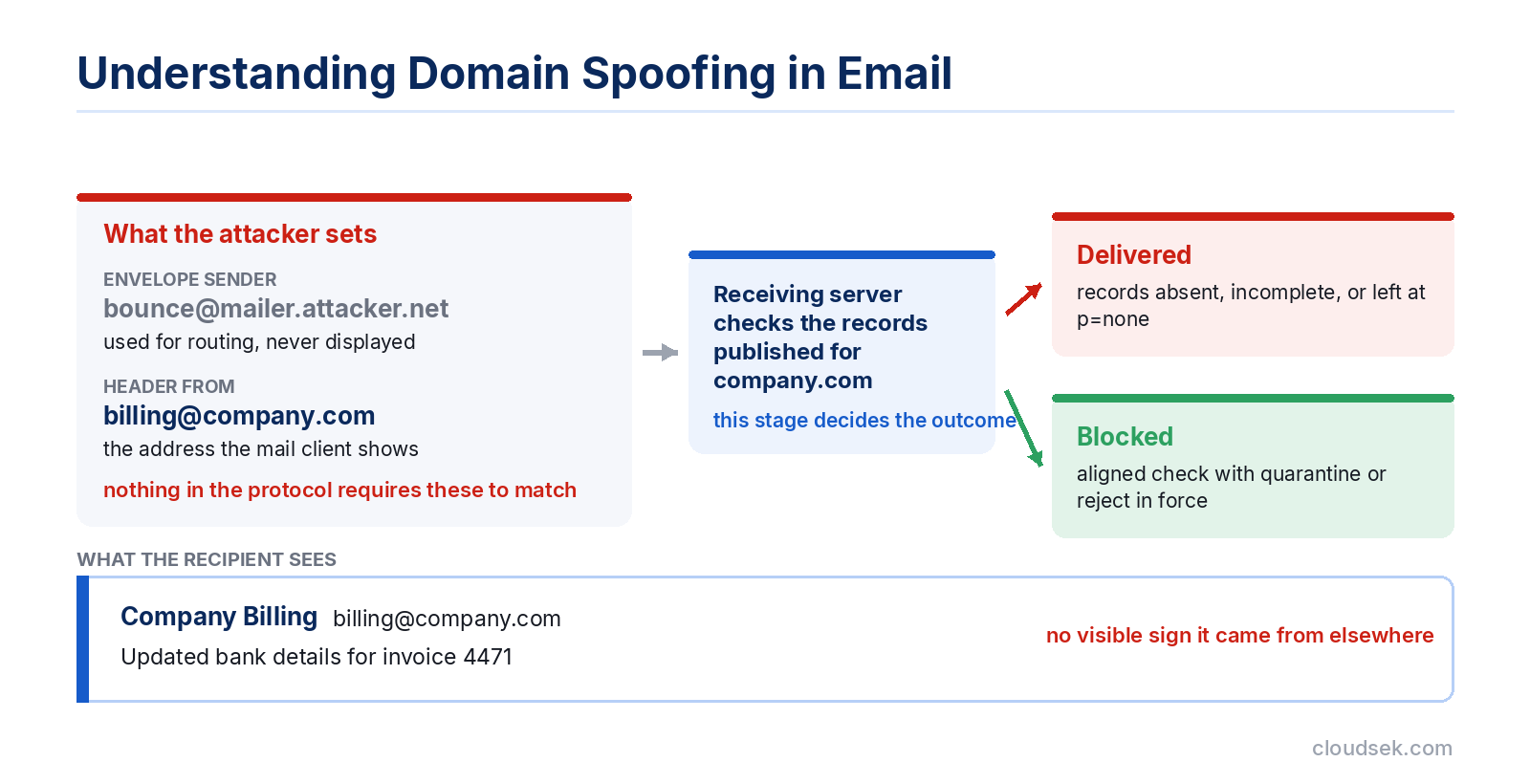
Every email carries two sender addresses rather than one, and the gap between them is what the attack turns on. A forged message reaches an inbox through five stages.
Stage four decides the outcome. A message can pass a check on the envelope domain while displaying a completely different company in the inbox, and closing that gap is exactly what alignment in email spoofing defenses is designed to do.
Attackers choose a technique based on what the message needs to survive: an authentication check, a glance at the inbox, or a recipient who reads the address carefully.
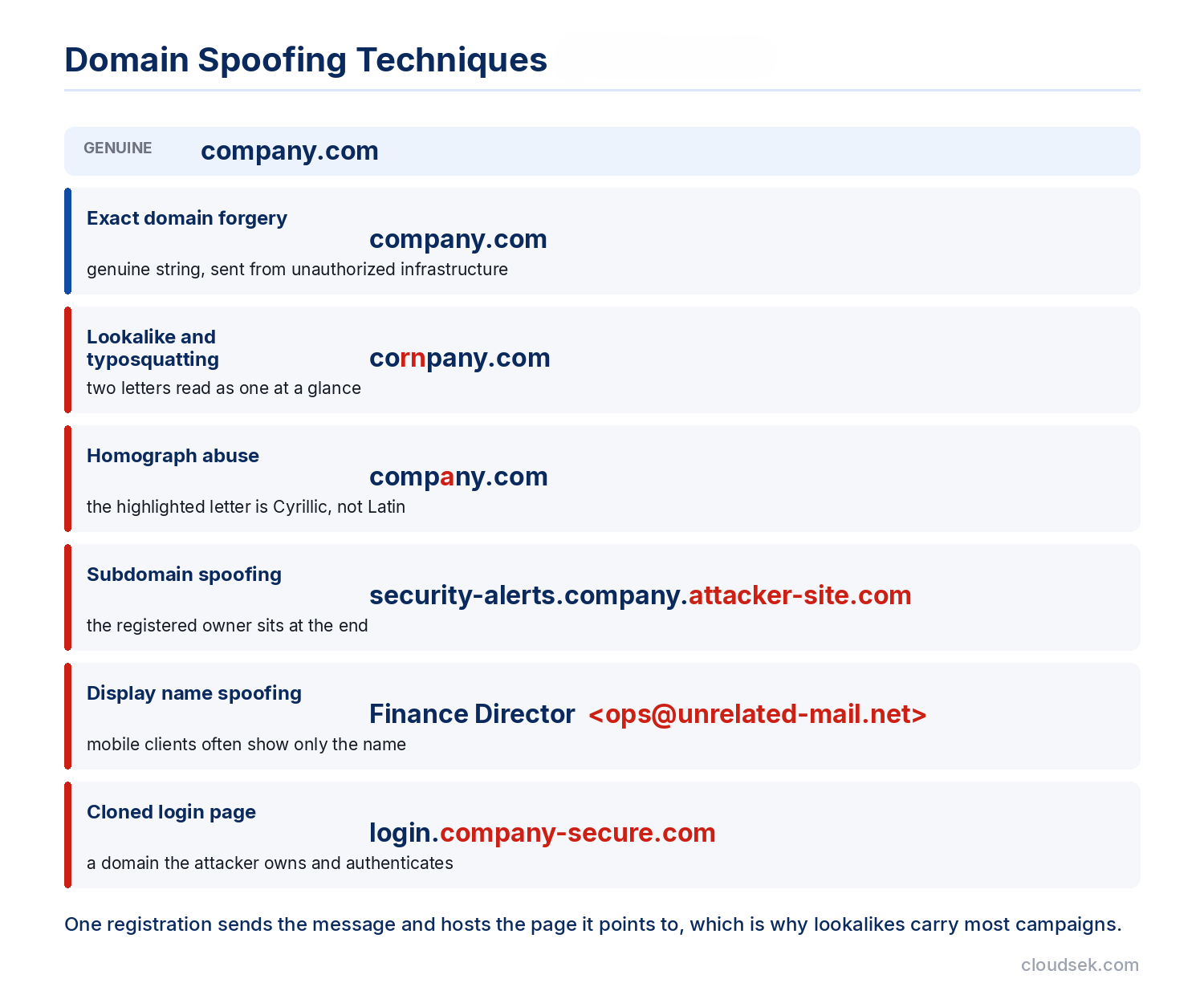
Lookalike domains sit at the center of most campaigns because they support both halves of the attack. A single registration sends a convincing email and hosts the credential-harvesting page the email points to, which is why these registrations feature so heavily in brand impersonation activity.
A spoofed domain does not have to send anything. Web-based domain spoofing places a fraudulent site at an address close enough to the genuine one that visitors arriving through paid search results, SMS links, or simple mistyping never question where they landed.
Assembling one of those pages stopped requiring any real effort some time ago. CloudSEK research into generic phishing frameworks documented a kit that impersonates any brand from a single template, hosted free on Cloudflare’s workers.dev subdomain. The page reads the targeted email domain out of the URL, then pulls the organization’s favicon and a screenshot of its real website to generate a convincing background automatically, with the harvested credentials exfiltrated to a remote server through obfuscated JavaScript.
Completing the illusion costs nothing, because certificate authorities issue free TLS certificates to any domain that requests one. A padlock in the address bar confirms that traffic to the site is encrypted and says nothing whatsoever about who operates it, so a phishing page on a lookalike domain displays exactly the same security indicator the genuine site does.
Email authentication works by publishing in DNS, where any receiving server can read it, a record of who is permitted to send on a domain’s behalf and what to do about messages that fail the check.
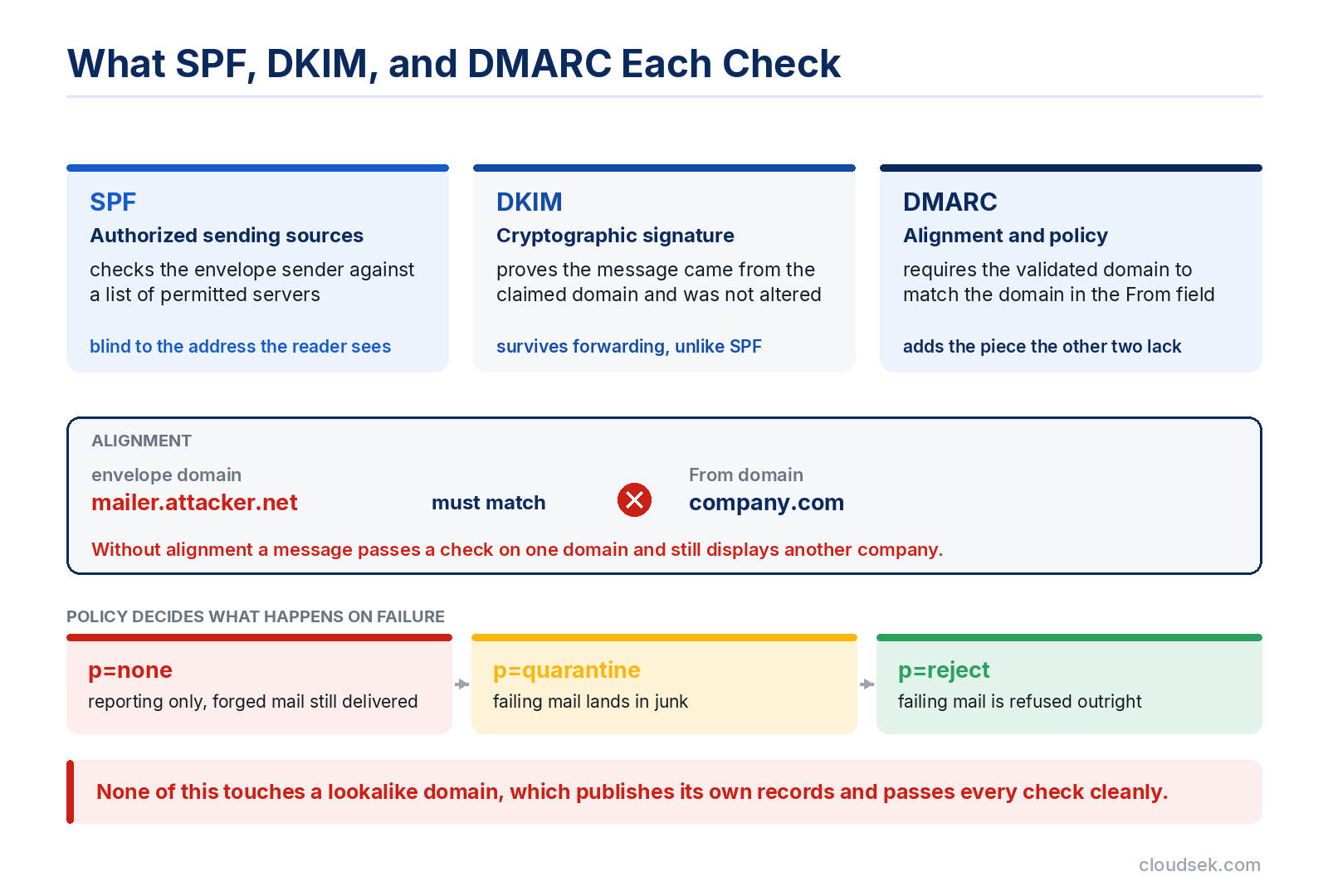
Sender Policy Framework lists the IP addresses and hostnames allowed to send email for a domain. A receiving server compares the connecting server against that list and records a pass or fail. SPF validates the envelope sender rather than the visible From address, which is why it cannot stop display-level forgery on its own, and it breaks on forwarded mail because the forwarding server is not on the original list.
DomainKeys Identified Mail attaches a cryptographic signature to outgoing messages, generated with a private key held by the sender and verified against a public key published in DNS. A valid signature proves the message came from the claimed domain and that its content was not altered in transit. Signatures survive forwarding in a way SPF checks do not.
Domain-based Message Authentication, Reporting and Conformance ties the other two together and adds the piece both lack: alignment. DMARC requires that the domain validated by SPF or DKIM actually matches the domain shown in the From field, closing the gap where a message passes SPF for one domain while displaying another.
Policy determines what happens on failure, and enforcement level is where most programs fall short. A policy of p=none monitors and reports while delivering forged mail exactly as before, so a domain publishing DMARC without enforcement gains visibility and no protection. Only p=quarantine or p=reject stops the message. Aggregate reports, meanwhile, name every server sending under the domain, legitimate and unauthorized alike, which turns an invisible problem into a list a security team can work through.
Correctly configured authentication still leaves two openings, and attackers use both routinely.
SPF, DKIM, and DMARC verify that a message genuinely came from the domain it claims. An attacker sending from company-secure.com holds that domain, publishes its own authentication records, and passes every check cleanly. Authentication answers whether the sender is who it claims to be, not whether the domain deserves trust, and no amount of enforcement on the real domain affects a different one.
Complex mail routing recreates the gap authentication was meant to close. Microsoft Threat Intelligence reported a vector, rising since May 2025, in which tenants route mail through an on-premises Exchange server or a third-party service before it reaches Microsoft 365, and spoof protections applied at the wrong point in that chain fail to catch messages forged to look internal. In October 2025 alone, Defender for Office 365 blocked more than 13 million malicious emails linked to the Tycoon2FA phishing-as-a-service platform, many of them spoofing the domains of the organizations they targeted.
Reporting had attributed the technique to a flaw in Direct Send, and the actual cause is routing complexity combined with spoof protections that are not strictly enforced. Tenants whose MX records point straight to Microsoft 365 are unaffected.
Business email compromise, which depends heavily on forged and lookalike domains, produced $3.05 billion in reported losses during 2025 according to the FBI Internet Crime Complaint Center, from fewer than 25,000 complaints. That ratio is the point: roughly $123,000 per reported incident, against an attack that costs an adversary a domain registration.
Of the damage that follows, financial loss arrives first and moves fastest. A spoofed message from a known vendor requesting a bank detail change moves money to an attacker-controlled account, and wire transfers become effectively unrecoverable within days.
Consequences reach well past the balance sheet from there. Credential theft from spoofed login pages opens internal systems to further intrusion. Customers who receive fraudulent mail bearing a company domain lose confidence in every legitimate message that follows, and the organization carries the reputational cost of an attack it neither suffered nor could see. Where personal data is exposed, regulatory reporting obligations follow, and investigators examine whether authentication controls were adequate in the first place.
Most organizations learn they are being spoofed when a customer forwards them the email. Four sources shorten that discovery considerably.
Finding a spoofed domain accomplishes nothing on its own unless a removal process follows. A confirmed lookalike domain warrants a domain takedown request to the registrar or hosting provider, and most succeed on terms-of-service grounds without legal escalation.
Configuration alone is not protection. The controls below run from the ones that stop attacks outright to the ones that limit damage once a spoofed message lands.
Authentication records govern the domain an organization owns, and the domains impersonating it sit entirely outside that control. CloudSEK XVigil monitors that external space, tracking newly registered lookalike and homoglyph domains, fake login pages, fraudulent mobile apps, and executive impersonation across the surface, deep, and dark web.
Where this differs from monitoring alone is that detection connects to removal rather than stopping at a report. CloudSEK XVigil provides end-to-end takedown support for fake domains, phishing infrastructure, and fraudulent social accounts, which matters because a lookalike domain identified but left running keeps collecting credentials from customers for as long as it stays online.
Inbound filtering, DNS record configuration, and mail gateway policy remain separate work. External monitoring covers what those controls cannot reach: domains registered by someone else, hosted elsewhere, and impersonating a brand that has no administrative authority over any of it.
Yes, where it supports fraud or impersonation. Most jurisdictions prosecute it under wire fraud, computer misuse, or trademark law rather than under a dedicated spoofing statute.
Spoofing imitates a domain the attacker does not control. Hijacking seizes the real domain by compromising its registrar account or DNS records, as covered in phishing vs spoofing.
No. Enforcement stops forgery of the owned domain, and nothing prevents an attacker from registering a lookalike. Monitoring and takedown handle what authentication cannot.
No. Free certificates are issued to any domain, including lookalikes. The padlock confirms the connection is encrypted, not that the operator is legitimate.
Indirectly. BIMI displays a verified brand logo beside authenticated mail and requires DMARC at enforcement first, so its benefit comes from the enforcement it mandates.
Publishing records takes minutes. Reaching reject spans two to six months in most rollouts, since every legitimate sending service has to be identified and authorized first.
Domain spoofing persists because it is cheap, fast, and aimed at people rather than systems. A registration costs a few dollars, a phishing kit assembles the page automatically, and the only thing an attacker needs is a recipient who trusts a familiar name.
Authentication and monitoring answer different halves of the problem, and running one without the other leaves a predictable gap. DMARC at enforcement stops forgery of the owned domain and does nothing about the lookalike registered yesterday, while monitoring finds that lookalike and cannot stop a forged message on a domain left at p=none. Organizations that close both halves treat the domain as an asset with an attack surface of its own rather than as a setting configured once and left alone.
