🚀 A CloudSEK se torna a primeira empresa de segurança cibernética de origem indiana a receber investimentos da
Leia mais
.avif)

A computação forense é o ramo da ciência forense que identifica, preserva, analisa e documenta evidências digitais para que sejam válidas em investigações ou processos judiciais. Ela aplica métodos investigativos comprovados a dados extraídos de qualquer dispositivo que armazene ou transmita informações.
O termo é frequentemente usado como sinônimo de forense computacional, embora os dois difiram em escopo. A forense computacional abrange evidências de dispositivos como desktops e servidores, enquanto a computação forense estende-se a celulares, redes, contas na nuvem e qualquer outra fonte digital.
A computação forense está inserida na disciplina mais ampla de DFIR, sigla para computação forense e resposta a incidentes. Seu objetivo não é impedir um ataque, mas reconstruir o que aconteceu de uma forma que permaneça defensável sob escrutínio.
A computação forense surgiu na década de 1980 com os computadores pessoais e tornou-se uma disciplina formal ao longo das décadas de 1990 e 2000, à medida que o crime digital crescia. Procedimentos padrão foram desenvolvidos para que as evidências digitais pudessem ser confiáveis em processos judiciais.
O crime digital tem aumentado desde então. O Internet Crime Complaint Center do FBI registrou mais de US$ 16,6 bilhões em perdas relatadas em 2024, um aumento de 33 por cento em relação ao ano anterior, e cada um desses casos pode depender de evidências digitais.
As evidências agora residem em quase todos os dispositivos que uma pessoa utiliza: celulares, laptops, contas na nuvem e sensores conectados. Essa disseminação coloca a computação forense no centro das investigações modernas, já que quase todo caso deixa um rastro digital.
A área atende a várias necessidades distintas. Ela apoia processos criminais, investigações corporativas e internas, resposta a violações de dados, litígios civis, eDiscovery e a atribuição de ataques a agentes específicos.
A computação forense divide-se em ramos definidos pela fonte da evidência. Cada ramo possui suas próprias ferramentas e técnicas, embora todos compartilhem o mesmo processo central.
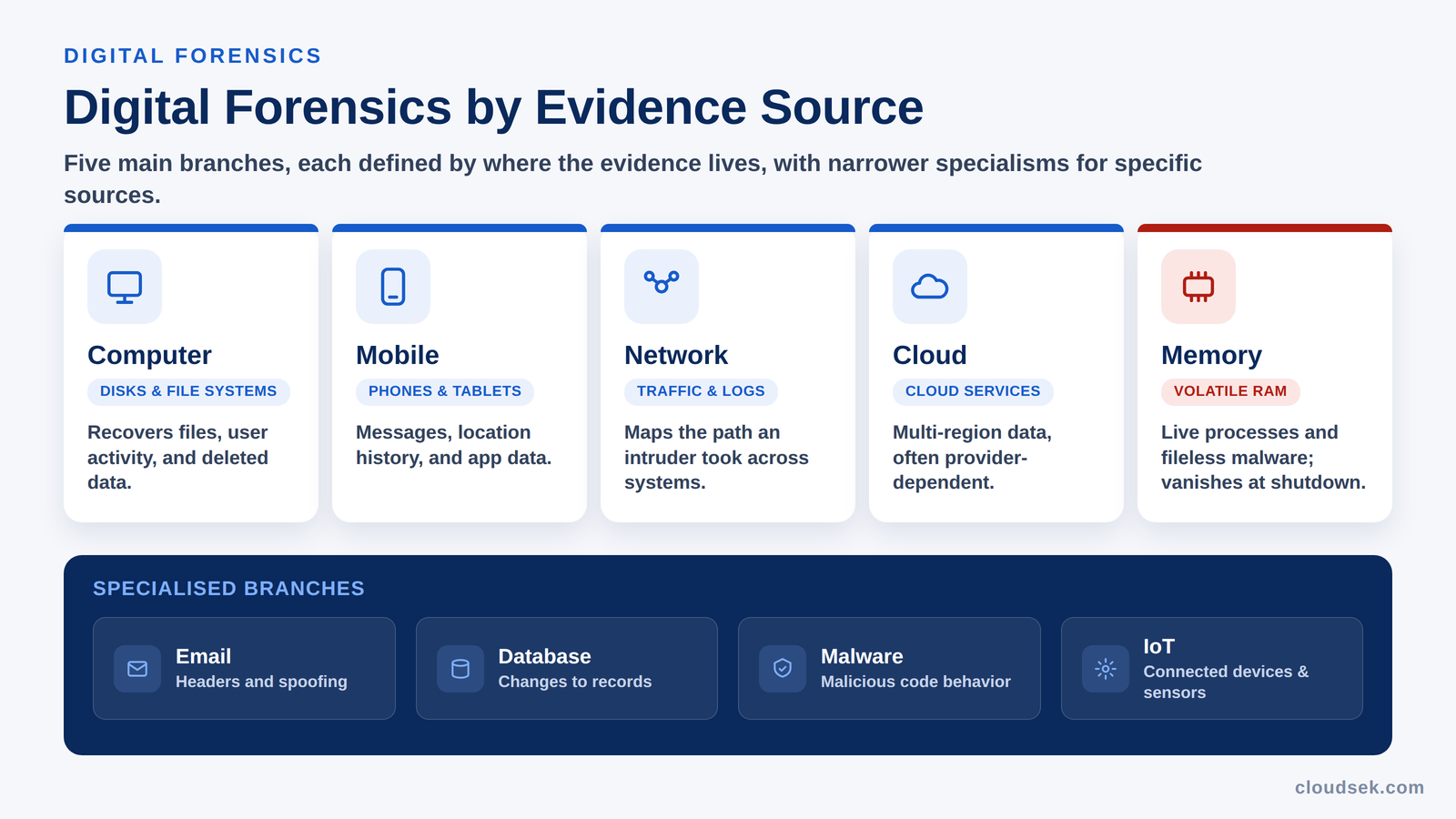
A forense computacional examina desktops, laptops e servidores. Os investigadores recuperam arquivos, reconstroem a atividade do usuário e resgatam dados excluídos de discos rígidos e sistemas de arquivos. É o ramo mais antigo e a base para os demais.
A forense de dispositivos móveis foca em smartphones e tablets. Esses dispositivos contêm mensagens, histórico de localização, dados de aplicativos e registros sincronizados na nuvem, muitas vezes protegidos por criptografia forte. Os métodos de extração variam de acordo com o modelo do dispositivo e o sistema operacional.
A forense de rede captura e analisa o tráfego para reconstruir uma intrusão. Ela examina capturas de pacotes, registros de fluxo e logs para mapear o caminho de ataque que um invasor percorreu pelos sistemas. Como os dados de rede são efêmeros, a captura geralmente precisa ocorrer em tempo real.
A forense em nuvem investiga evidências armazenadas em serviços de computação em nuvem. Ela enfrenta desafios que outros ramos evitam: dados espalhados por diferentes regiões, controle compartilhado com o provedor e questões sobre a jurisdição em que a evidência se encontra. A aquisição frequentemente depende da cooperação do provedor.
A forense de memória analisa o conteúdo da memória RAM de um dispositivo, a memória volátil que retém dados apenas enquanto o sistema está em execução. Ela revela processos ativos, código injetado, chaves de criptografia e malwares sem arquivo que nunca chegam a ser gravados no disco. Como os dados desaparecem ao desligar o sistema, o tempo é um fator crítico.
Diversos ramos mais específicos abordam fontes particulares. A forense de e-mail rastreia cabeçalhos de mensagens e falsificações, a forense de banco de dados reconstrói alterações em registros armazenados, a forense de malware disseca códigos maliciosos para entender seu comportamento e a forense de IoT recupera dados de dispositivos e sensores conectados.
O processo forense é uma sequência defensável que protege a integridade da evidência do início ao fim. Diferentes modelos o dividem de formas distintas. NIST SP 800-86 condensa o trabalho em quatro fases: coleta, exame, análise e relatório, enquanto uma visão de seis fases torna a identificação e a preservação os primeiros passos explícitos. As seis fases abaixo mantêm cada responsabilidade distinta visível.

A identificação localiza e delimita o escopo da evidência. Os investigadores encontram os dispositivos, contas e fontes de dados que podem conter informações relevantes e, em seguida, decidem o que faz parte da investigação. Definir o escopo corretamente evita tanto a perda de evidências quanto o desperdício de esforço.
A preservação protege a evidência contra qualquer alteração antes que a análise comece. Dois princípios regem esta fase.
A cadeia de custódia é o registro documentado de quem manuseou a evidência, quando, onde e por que, desde a coleta até o tribunal. Cada transferência é registrada. Uma única lacuna nesse registro pode tornar a evidência inadmissível, o que torna a documentação tão importante quanto os próprios dados. A norma internacional ISO/IEC 27037 estabelece como manusear evidências digitais para preservar essa integridade.
A ordem de volatilidade define a sequência da coleta. Os dados mais perecíveis vêm primeiro: memória, processos em execução e conexões de rede, todos os quais desaparecem quando um sistema é desligado. O conteúdo do disco e os dados arquivados, que persistem, vêm depois.
A coleta captura a evidência em si, trabalhando em cópias para que o original permaneça intacto.
Uma imagem forense é uma cópia bit a bit de um dispositivo de armazenamento, idêntica até nos dados excluídos e ocultos. Os investigadores a criam por meio de um bloqueador de escrita, um hardware ou software que permite que os dados sejam lidos, mas nunca gravados, garantindo que a fonte não seja alterada durante a cópia.
Um hash é uma impressão digital única calculada a partir dos dados, usando algoritmos como MD5 ou SHA-256. Os investigadores geram o hash do original e da cópia e, em seguida, comparam os dois. Hashes correspondentes provam que a imagem é exata e que nada a alterou posteriormente.
O exame extrai os dados relevantes das cópias coletadas. Os investigadores recuperam arquivos excluídos, extraem dados de espaços não alocados, filtram materiais irrelevantes e trazem à tona os artefatos pertinentes ao caso. Esta fase transforma um disco completo em um conjunto focado de evidências.
A análise interpreta esses artefatos. Os investigadores reconstroem uma linha do tempo, correlacionam eventos entre diferentes fontes e concluem o que aconteceu, quando e quem foi o responsável. A atividade é frequentemente mapeada com base no comportamento documentado de atacantes por meio de estruturas como MITRE ATT&CK, que transforma descobertas dispersas em um relato coerente de um ataque.
O relatório registra a investigação de forma clara e reproduzível. Um laudo forense descreve a metodologia, as ferramentas utilizadas, a cadeia de custódia e as conclusões, redigido de modo que outro examinador possa segui-lo. Em casos judiciais, o investigador frequentemente apresenta essas descobertas como testemunho especializado.
Os investigadores dependem de ferramentas especializadas, cada uma adequada a uma fonte ou tarefa. As ferramentas servem ao processo; elas não substituem o julgamento por trás dele.
A maioria das investigações combina várias dessas ferramentas, adequando a escolha à evidência em mãos.
A forense digital e a resposta a incidentes andam juntas como DFIR, mas respondem a perguntas diferentes. A resposta a incidentes trabalha para conter e recuperar de uma ameaça ativa o mais rápido possível. A perícia digital trabalha para estabelecer a verdade probatória do que aconteceu, o que geralmente leva mais tempo.
Sem coordenação, as duas áreas interferem uma na outra. Um responsável pela resposta que corre para remover um malware pode sobrescrever a memória de que um perito forense precisa, enquanto um perito que preserva evidências pode atrasar uma limpeza urgente. O DFIR combina ambas em um único fluxo de trabalho para que as evidências sobrevivam à resposta.
Em termos simples, a resposta a incidentes estanca a hemorragia, e a perícia digital prova o que a causou. Equipes de segurança que executam ambas em conjunto recuperam-se mais rápido e mantêm evidências utilizáveis.
Várias forças tornam o trabalho forense mais difícil a cada ano. A criptografia forte pode tornar os dados inacessíveis sem uma chave, e técnicas antiforense, como a exclusão segura e a adulteração de registros de data e hora, são criadas para destruir ou falsificar evidências.
A escala é um segundo problema. O volume absoluto de dispositivos e dados cria filas de espera, com casos aguardando meses por um exame. As evidências em nuvem adicionam outra camada, já que dados espalhados por regiões e provedores criam barreiras legais e jurisdicionais para a coleta.
A área em si continua mudando. Novos dispositivos, aplicativos e formatos de arquivo surgem mais rápido do que as ferramentas conseguem suportá-los, por isso os investigadores enfrentam uma corrida constante para manter seus métodos atualizados.
As descobertas forenses ganham significado com o contexto. Quando uma investigação revela um endereço IP, uma amostra de malware ou um padrão de comportamento do atacante, a inteligência de ameaças conecta esses artefatos ao que já se sabe sobre os agentes por trás deles.
Esse suporte aparece principalmente na fase de análise. Indicadores de comprometimento, os rastros técnicos que um ataque deixa para trás, podem ser comparados com bancos de dados de inteligência para identificar as ferramentas e grupos envolvidos. Mapear o comportamento observado para táticas, técnicas e procedimentos (TTPs) documentados ajuda os investigadores a atribuir a atividade e entender o que um atacante fez em seguida.
A Inteligência de Ameaças da CloudSEK é uma fonte desse contexto, rastreando agentes de ameaças, suas técnicas e os indicadores vinculados a campanhas ativas. Esse tipo de inteligência complementa uma investigação forense em vez de substituí-la. O processo forense estabelece o que aconteceu nas evidências, a inteligência de ameaças explica quem e por quê, e a atribuição ainda depende das evidências em si.
A perícia digital é a prática de recuperar e examinar dados de dispositivos digitais para descobrir o que aconteceu de uma forma que sirva como prova. Ela trata um disco rígido ou um telefone da mesma forma que a perícia tradicional trata uma cena de crime.
O processo compreende a identificação, preservação, coleta, exame, análise e relatório. O NIST condensa essas etapas em quatro fases: coleta, exame, análise e relatório. Cada passo protege a integridade da evidência.
A cadeia de custódia é o registro documentado de todos que manusearam uma evidência, incluindo o horário e o motivo de cada transferência. Ela comprova que a evidência não foi alterada, e qualquer falha nesse registro pode tornar a evidência inadmissível em tribunal.
A resposta a incidentes visa conter e recuperar sistemas de um ataque ativo rapidamente, enquanto a computação forense investiga o que aconteceu para fins probatórios. A resposta a incidentes prioriza a velocidade, e a forense prioriza a prova. O DFIR combina ambos em um único fluxo de trabalho.
Ferramentas comuns incluem Autopsy e FTK para análise de disco, Volatility para memória, Wireshark para tráfego de rede e Cellebrite para dispositivos móveis. Os investigadores selecionam a ferramenta adequada de acordo com a fonte da evidência.
A computação forense exige uma combinação de habilidades técnicas e analíticas: conhecimento de sistemas operacionais e sistemas de arquivos, familiaridade com ferramentas forenses, compreensão de procedimentos legais e cadeia de custódia, além de clareza na redação de relatórios. A atenção aos detalhes é fundamental em todas essas etapas.
