🚀 A CloudSEK se torna a primeira empresa de segurança cibernética de origem indiana a receber investimentos da
Leia mais
.avif)

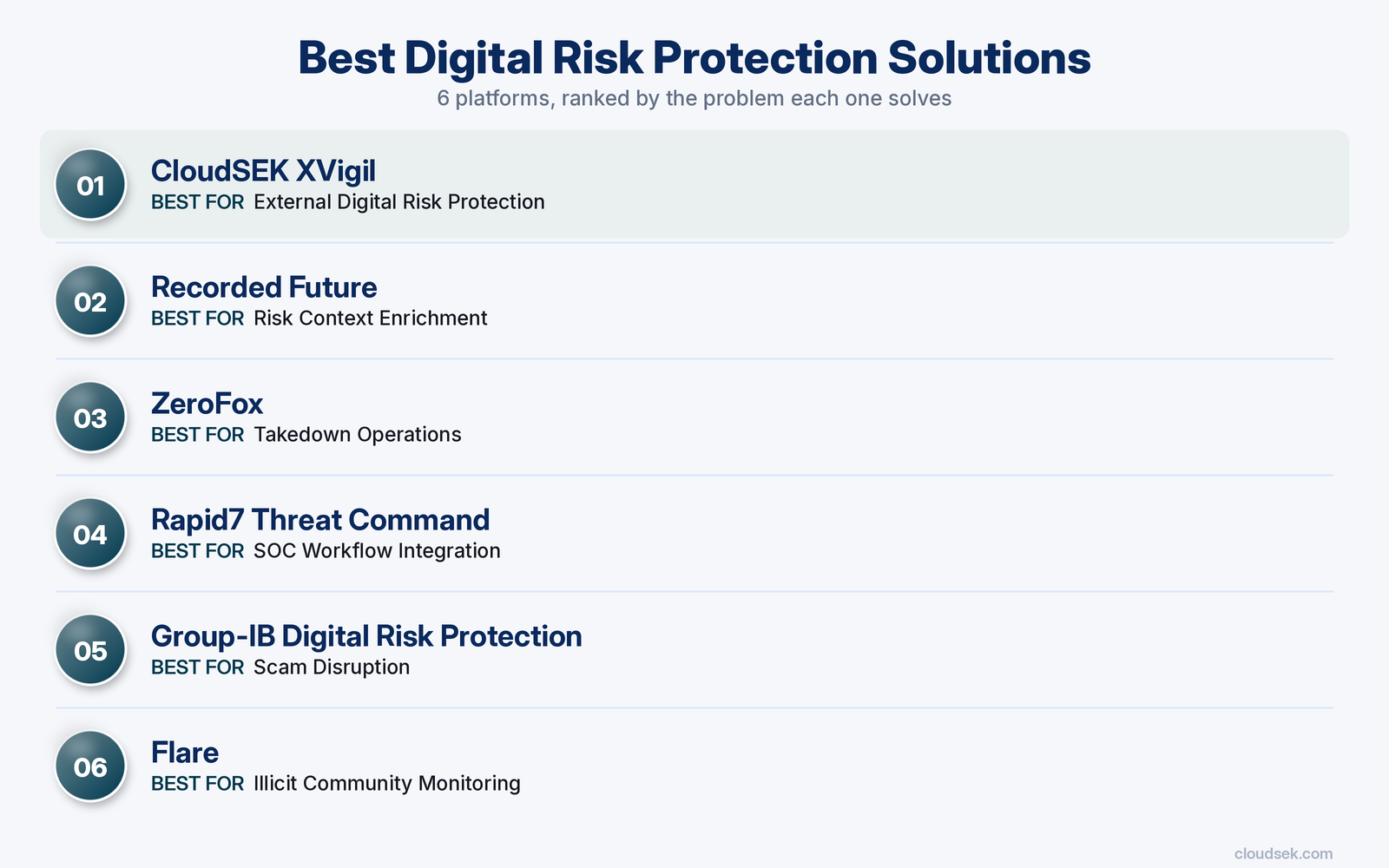
CloudSEK XVigil is best for external digital risk protection because it monitors organization-specific exposure and prioritizes the risks that need action. Recorded Future Digital Risk Protection attaches evidence and intelligence context to external-risk alerts, making Risk Context Enrichment its main use case. ZeroFox handles Takedown Operations, moving confirmed impersonation, phishing, and brand abuse into enforcement and removal.
External digital risk can surface across identities, brands, data, and digital properties that an enterprise does not directly control. Credential exposure, impersonation, fraud, and underground activity call for different DRP strengths, so the dominant risk should determine which product receives deeper evaluation.
Source: Gartner Peer Insights. Ratings may change as new reviews are added.
The six DRP providers were assessed across four areas: relevance of coverage, quality of evidence, available response options, and fit with existing operations. Source volume and alert count were not used as stand-ins for quality. An alert needed enough evidence and response context to support a decision.
External-risk priorities vary across the six products reviewed below.
CloudSEK XVigil monitors digital risk tied directly to an organization’s people, data, brand, and online properties. Leaked credentials and data leaks show where employee access or company information has surfaced beyond controlled systems. Fake domains, fraudulent apps, phishing infrastructure, brand abuse, and executive impersonation reveal where the organization’s digital identity is being misused. These signals may point to an initial-access vector, while exposure itself remains distinct from confirmed compromise.
XVigil ranks those risks by exploitability and attacker intent so higher-priority activity does not get buried among lower-value alerts. Confirmed phishing or impersonation assets can move into takedown support, taking the DRP work beyond monitoring and into response. On Gartner Peer Insights, 96% of enterprise reviewers recommend the product.
A digital-risk signal can matter beyond the immediate DRP case when it forms part of a larger attack path. XVigil signals feed Nexus AI, which correlates them with data from other CloudSEK products for cross-product attack-path analysis. XVigil remains the DRP layer while Nexus AI performs that correlation. XVigil was selected for the NVIDIA Inception Program to help scale CloudSEK’s AI-driven threat intelligence infrastructure.
Recorded Future Digital Risk Protection attaches evidence and risk reasoning directly to external-risk alerts. Brand and identity signals from malicious sites, code repositories, and dark-web sources are linked with additional intelligence through the Intelligence Graph, helping analysts understand why the alert deserves attention.
That reasoning stays with the alert during triage. AI-assisted analysis brings higher-priority items forward and presents recommended action beside the evidence already collected. The enriched alert can continue into investigation or, where removal is required, a takedown workflow.
In ZeroFox, analyst validation comes before enforcement. Impersonation, phishing domains, fake profiles, and executive threats are reviewed before removal activity begins. Validation separates verified abuse from activity that does not warrant takedown.
Verified assets then enter enforcement, with the takedown process tracking them through removal. Removal verification records whether the abusive property remains active after action has been taken. For organizations dealing with recurring brand or executive abuse, verified removal shows whether enforcement actually removed the asset.
Rapid7 Threat Command routes external intelligence into the SOC tools analysts already use. Tailored intelligence from clear, deep, and dark web sources can enter SIEM or InsightIDR, placing external-risk data beside the security activity already under investigation.
The workflow can continue through:
Rapid7 documents Digital Risk Protection / Threat Command separately from Intelligence Hub. Packaging and deployment should be reviewed at the module level.
A phishing page may be only the visible edge of a larger scam operation. Group-IB Digital Risk Protection uses scam intelligence, ML-based detection, and analyst research to connect that artifact with the fraudulent infrastructure behind it. Domains and other resources can then be examined as parts of the same fraud ecosystem instead of separate incidents.
Tracing those infrastructure links lets investigators see how separate resources support the scam. Brand abuse and VIP protection add target-specific evidence, while connections between fraudulent assets guide enforcement.
Group-IB’s three-stage takedown process gives those infrastructure relationships an enforcement path. Confirmed abuse can be acted on across the resources sustaining the scam, not only the page that first revealed it.
Flare begins in the environments where stolen access and company data circulate. Dark-web communities, illicit Telegram channels, and stealer-log sources provide the evidence base for that investigation. A credential or identity record found there can be tied back to the affected company and examined as potential access risk.
From the initial record, investigators can follow identity and access data across the same communities. Those links show where company-related information continues to appear across the criminal ecosystem instead of treating one leak as an isolated event. Digital risk protection is part of Flare’s broader Threat Exposure Management offering, not a standalone DRP point product.
The external-risk problem creating the most work or business impact should set the evaluation priority.
Leaked employee logins call for a different DRP response than copycat domains, executive impersonation, phishing, or organized scam activity. Underground mentions may matter more in one environment, while brand abuse dominates another. The provider should match the risk that appears often enough to demand a dedicated response.
A SOC may need DRP cases to enter existing queues and escalation paths. Fraud, brand protection, threat intelligence, and identity functions may use different queues, escalation paths, and case owners. The receiving team determines where the case goes next and who is responsible for acting on it.
Provider involvement may end with detection or continue into investigation support, escalation, takedown, or disruption. Available analyst capacity determines how much of that work can stay in-house. Limited resources can increase the need for provider-led response after confirmation.
Existing tools and analyst capacity affect how DRP operates in practice. Geographic coverage, governance rules, and module packaging introduce separate deployment considerations. A product may cover the right risk but still require processes or staffing the business does not have.
A proof of concept should recreate incidents the company has already faced. Test real domains, past impersonation cases, known leaked logins, relevant executives, and previous phishing infrastructure. Then follow the same path an analyst would use in production, from the first alert through the expected response.
A DRP platform has to do more than collect external signals. The work starts with finding activity tied to the company, then checking whether it creates identity or brand risk and whether the evidence is credible. From there, the case can move into disruption or the systems already used for response.
These categories overlap at certain points, but they answer different security questions. DRP deals with organization-specific risk outside company control. CTI explains adversaries, EASM examines owned internet-facing assets, dark web monitoring looks specifically at underground sources, and brand protection addresses impersonation and misuse.
An enterprise dealing with recurring impersonation, credential leakage, fraud, or underground activity needs a provider that can surface the relevant risk with enough evidence to support action. Breadth matters only when the monitored sources reflect problems the business actually faces. A long feature list offers little value if analysts still have to sort through weak or poorly contextualized alerts.
After confirmation, the response still needs a clear owner. Investigation, escalation, takedown, or remediation should stay with the people best equipped to handle them, while the provider covers the areas that require outside support.
Discovery, validation, and response should continue through the tools and teams already in place. Unclear handoffs or manual workarounds push unnecessary effort back onto analysts. The provider should solve the organization’s dominant external-risk problem without creating a second process around it.
No. SIEM analyzes security telemetry, EDR monitors endpoint activity, and DRP covers digital risk outside controlled environments.
Early visibility can reduce attack opportunities. Leaked credentials, phishing infrastructure, impersonation, or exposed data may surface before an attacker uses them. Remediation or removal can reduce that risk, although detection alone does not prove an attack was prevented.
Cloud-based delivery is common across DRP products. Setup usually includes defining monitoring scope, configuring access, and connecting the service to systems that receive alerts or cases.
Domains, brand names, executives, subsidiaries, applications, and employee identities can define what the service watches for. Monitoring scope should reflect the parts of the business exposed publicly. New assets or identities need to be added as the company changes.
Validated cases, response time, takedown outcomes, recurring abuse, analyst effort, and completed remediation provide better signals than raw alert volume. The metrics should show whether relevant risk is being identified and resolved.
Review the scope whenever domains, subsidiaries, executives, applications, branding, or other public-facing identifiers change.
