🚀 CloudSEK featured in the 2026 Frost Radar™!
Read more
.avif)

Cyber incidents introduce immediate operational risk while facts are incomplete and systems remain in flux. Effective response depends on maintaining control without sacrificing the evidence required for accurate investigation.
Containment actions can unintentionally disrupt logs, memory, and endpoint artifacts that explain how an intrusion occurred. DFIR aligns response execution with forensic discipline so investigation, remediation, and recovery progress in parallel rather than in conflict.
This approach is now treated as a foundational security capability beyond individual organizations. The ITU’s current registry shows 143 countries operate national Computer Incident Response Teams (CIRTs), underscoring how structured incident response and investigation have become globally institutionalized.
DFIR (Digital Forensics and Incident Response) is a cybersecurity discipline that manages cyber incidents while preserving investigative accuracy. The practice aligns incident containment and system recovery with evidence handling required to understand attack scope and impact.
Incident response within DFIR addresses active threats through containment, eradication, and operational restoration. Digital forensics supports that response by collecting and analyzing logs, endpoint data, memory artifacts, and network traces to reconstruct attacker behavior.
Integration of response actions and forensic analysis prevents evidence loss during remediation. Coordinated execution enables organizations to recover systems while producing verified findings for root-cause analysis, compliance obligations, and security improvement.
DFIR works by coordinating incident response actions with forensic investigation from the moment an incident is identified. Detection triggers containment measures while parallel evidence collection begins across affected systems.
Containment limits attacker movement and reduces impact, while forensic workflows preserve logs, memory, endpoint data, and network traces. Parallel execution ensures response actions do not overwrite artifacts required for timeline reconstruction and scope validation.
Analysis correlates collected evidence to identify entry points, lateral movement, and persistence mechanisms. Findings guide remediation and recovery decisions, allowing systems to be restored based on verified understanding rather than assumption.
DFIR follows a structured sequence that allows incidents to be controlled, investigated, and resolved without losing evidentiary integrity.
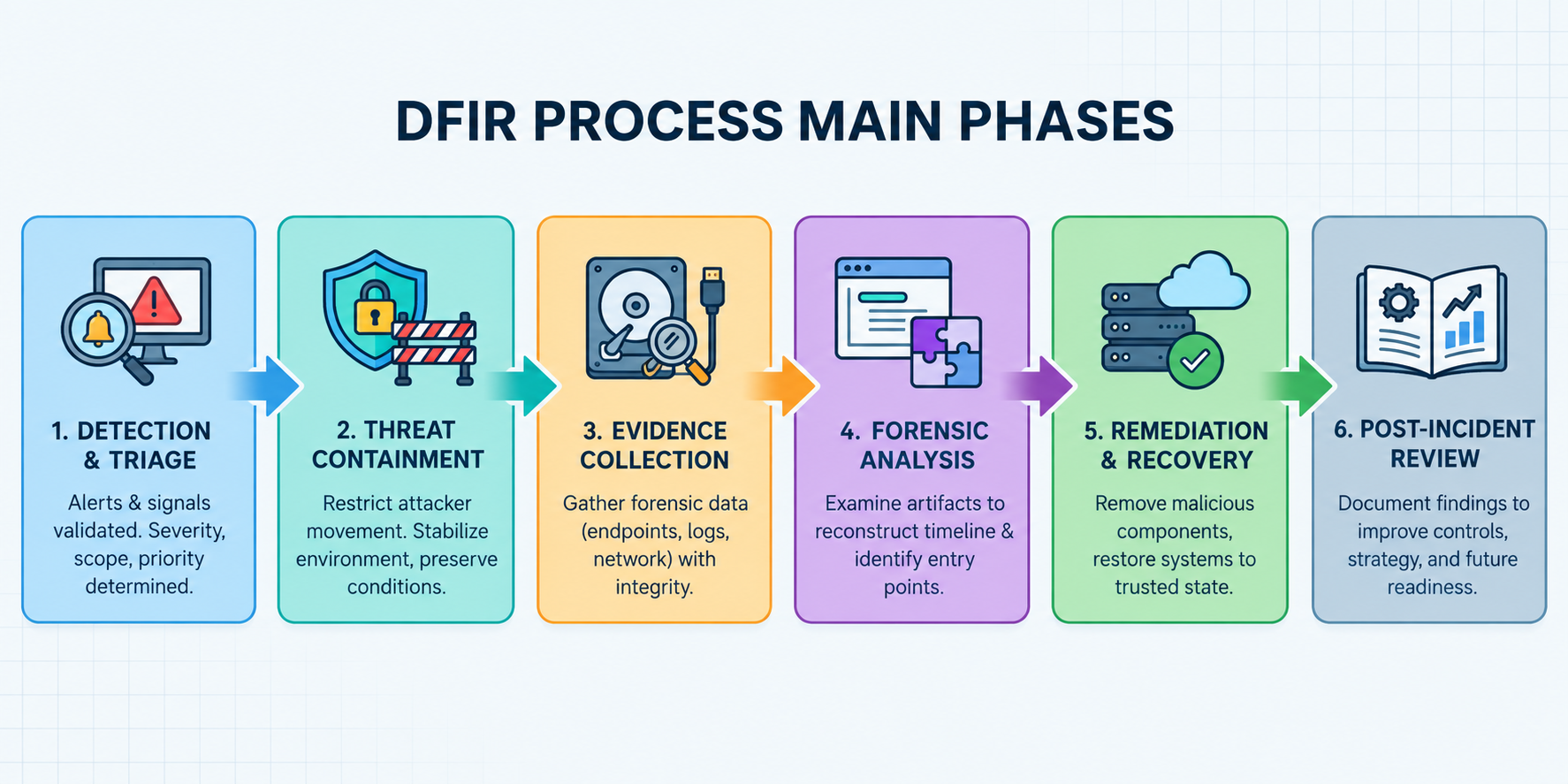
Security alerts, monitoring systems, or abnormal behavior signal potential incidents that require validation. Triage determines severity, scope, and response priority before broader action begins.
Containment actions restrict attacker movement and limit further damage across systems and networks. Short-term controls stabilize the environment while preserving conditions needed for investigation.
Forensic data is gathered from endpoints, servers, memory, logs, and network traffic. Collection methods focus on accuracy and integrity to support reliable analysis.
Collected artifacts are examined to reconstruct timelines, identify entry points, and trace attacker activity. Analysis clarifies how the incident occurred and which assets were affected.
Malicious components are removed, vulnerabilities are addressed, and systems are restored to a trusted state. Recovery proceeds only after confidence is established that active threats no longer remain.
Findings are documented to improve controls, response procedures, and detection coverage. Lessons learned feed directly into security strategy and future incident readiness.
Digital forensics focuses on understanding what happened during a cyber incident, while incident response focuses on stopping the incident and restoring normal operations.
DFIR combines both disciplines to ensure response actions do not compromise investigative accuracy. Integrated execution allows organizations to recover systems while maintaining reliable findings for accountability, compliance, and long-term security improvement.
DFIR matters because modern cyber incidents create overlapping technical, operational, and accountability demands that cannot be handled in isolation.
Threat actor uses persistence, lateral movement, and privilege escalation across multiple systems and environments. DFIR helps teams to determine full incident scope instead of reacting to isolated alerts.
Business services often need to remain available while an incident is being investigated. DFIR supports containment and recovery without introducing additional risk from uninformed system changes.
Regulatory scrutiny and internal accountability depend on accurate incident records. DFIR preserves logs, timelines, and forensic artifacts required for defensible findings.
Unidentified root causes increase the likelihood of reinfection or follow-on attacks. DFIR links investigation outcomes directly to remediation decisions that eliminate underlying weaknesses.
Security incidents require alignment between security teams, IT operations, legal, and leadership. DFIR provides a shared factual basis that supports consistent decision-making across stakeholders.
Hybrid and cloud environments introduce visibility gaps during incidents. DFIR maintains investigative continuity across endpoints, networks, and cloud workloads without fragmenting analysis.
DFIR is required whenever an incident involves potential system compromise, data exposure, or uncertainty about attacker activity and impact.
Ransomware incidents require DFIR to contain encryption activity while determining initial access, lateral movement, and data exfiltration. Forensic analysis helps confirm whether backups, credentials, or sensitive data were also compromised.
Unauthorized access to sensitive or regulated data triggers investigative and reporting obligations. DFIR establishes breach scope, affected systems, and data exposure timelines needed for disclosure and remediation.
Malware incidents often involve persistence mechanisms and secondary payloads. DFIR identifies how malicious code entered the environment and whether additional systems were affected.
Misuse of authorized access requires careful evidence handling to distinguish malicious intent from policy violations. DFIR supports attribution, activity reconstruction, and defensible findings.
Unauthorized access to internal networks introduces risk of lateral movement and hidden persistence. DFIR traces attacker pathways across hosts, accounts, and network segments.
Cloud incidents involve shared responsibility and distributed logging sources. DFIR preserves cloud-native artifacts and correlates activity across identities, workloads, and services.
DFIR responsibility is distributed across technical, operational, and governance roles rather than owned by a single team.
Internal security teams or a security operations center handle detection, triage, and initial response actions. These teams coordinate forensic collection and maintain incident timelines during active investigations.
IT teams support containment, system isolation, and recovery activities. Coordination with DFIR ensures operational changes do not destroy forensic evidence.
Legal and compliance teams guide evidence handling, regulatory obligations, and disclosure requirements. DFIR findings provide the factual basis needed for defensible reporting and decision-making.
Leadership teams make risk-based decisions related to business impact, communication, and resource allocation. DFIR enables those decisions by supplying verified incident scope and impact assessments.
External DFIR providers may be engaged for advanced investigations or capacity support. These specialists bring independent expertise and tooling while aligning with internal response workflows.
DFIR relies on specialized tools that support detection, evidence preservation, investigation, and coordinated response across complex environments.
Security monitoring tools surface suspicious activity through alerts, behavioral signals, and anomaly detection. These platforms provide the initial visibility required to trigger DFIR workflows.
Endpoint detection and response solutions collect process activity, file changes, memory behavior, and user actions. Telemetry enables investigators to trace attacker behavior at the system level.
Centralized log platforms aggregate data from servers, applications, identity systems, and network devices. Correlated logs support timeline reconstruction and scope validation.
Forensic tools support disk imaging, memory acquisition, and artifact analysis. These tools preserve data integrity while enabling detailed investigation of compromised systems.
Network monitoring technologies capture traffic patterns, connections, and data flows. Visibility at the network layer helps identify lateral movement and command-and-control activity.
Incident case management systems track actions, evidence, findings, and decisions. Centralized documentation supports coordination, accountability, and post-incident review.
DFIR services should be engaged whenever an organization lacks certainty about incident scope, attacker activity, or data impact.
Ongoing attacks involving malware, ransomware, or unauthorized access require immediate DFIR support. Early engagement helps contain activity while preserving evidence needed for investigation.
Unexplained system behavior, alerts, or data access may indicate compromise even without confirmation. DFIR validates whether an incident occurred and determines its extent.
Incidents that appear resolved may still leave unanswered questions about root cause or persistence. DFIR verifies cleanup effectiveness and confirms no residual attacker access remains.
Incidents involving sensitive or regulated data often trigger reporting and documentation requirements. DFIR provides verified findings that support accurate disclosure and compliance decisions.
Organizations without in-house forensic capability may engage DFIR proactively. External expertise strengthens preparedness before incidents occur.
DFIR provides the structure organizations need to manage cyber incidents without sacrificing accuracy, accountability, or recovery confidence. Its value lies in unifying response speed with investigative discipline so decisions are based on verified evidence rather than assumption.
As environments grow more distributed and incidents more complex, DFIR remains essential for understanding impact, meeting obligations, and reducing future risk. Mature incident handling is no longer defined by how quickly systems are restored, but by how clearly incidents are understood and resolved.
DFIR does not automatically require systems to be taken offline. Response actions are selected based on risk level, evidence preservation needs, and operational impact.
DFIR adapts investigation methods to encryption and cloud-native architectures. Analysis relies on identity activity, access logs, workload telemetry, and provider-generated artifacts rather than traditional disk access alone.
DFIR evaluates indicators of data access and transfer using logs, network telemetry, and endpoint behavior. Absolute confirmation is not always possible, but findings reflect the highest defensible level of certainty.
DFIR documents evidence gaps and assesses remaining artifacts to reconstruct incident activity. Conclusions include confidence levels and clearly stated limitations.
DFIR scales based on environment size and complexity rather than organization size. Investigative and response requirements remain the same when incidents involve data exposure or unauthorized access.
