🚀 CloudSEK featured in the 2026 Frost Radar™!
Read more
.avif)

Indicators of Compromise (IoCs) are forensic data points such as IP addresses, file hashes, domain names, and log entries that indicate a potential cyberattack or system breach. These indicators help cybersecurity teams identify whether malicious activity has occurred.
IoCs originate from traces left during unauthorized access, revealing how attackers interact with systems and networks. Patterns found in network traffic, endpoint behavior, or login activity often expose these signals.
Security teams rely on IoCs to confirm threats and move into deeper investigation stages. Verified indicators support containment efforts and reduce the risk of further compromise across environments.
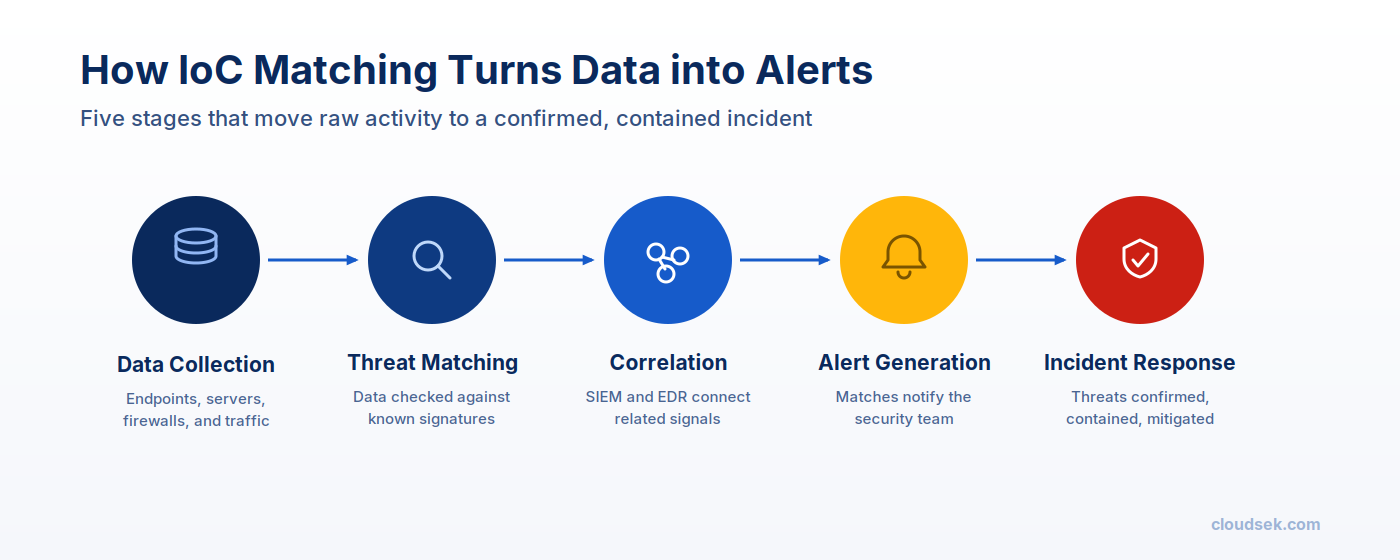
Indicators of Compromise work by analyzing system and network data to detect patterns associated with known cyber threats.
Cybersecurity analysis groups IoCs based on where malicious activity appears and how it can be observed across systems, networks, and user interactions.

Suspicious IP addresses, malicious domains, and irregular outbound traffic often point to communication with external threat actors. Network monitoring tools surface these patterns during abnormal data flows.
Unexpected file changes, registry modifications, and irregular system logs indicate compromise within a device. Endpoint-level visibility helps uncover unauthorized access or execution.
Repeated login failures, privilege escalation attempts, and lateral movement expose attacker behavior inside an environment. Pattern recognition plays a key role in identifying these activities.
Hash values like MD5 or SHA-256 help identify malicious files and detect unauthorized modifications. Malware analysis frequently relies on these signatures for verification.
Phishing campaigns leave traces through suspicious sender domains, malicious attachments, and deceptive links. Email security systems flag these elements during threat filtering.
IoCs play a critical role in identifying signs of compromise before attackers can cause widespread damage. Security teams rely on these indicators to quickly recognize malicious activity across systems and networks.
Visibility into suspicious behavior enables analysts to investigate threats with greater accuracy and speed. Faster detection based on IoCs also improves response time, helping organizations contain incidents before they escalate.
Rising threat activity further highlights the need for effective detection signals in modern environments. Australia’s ACSC reported over 1,700 notifications of malicious cyber activity in FY2024–25, an 83% increase from the previous year, showing why monitoring IoCs is essential for early threat identification and response.
Detection and analysis rely on continuous monitoring, pattern recognition, and correlation across multiple security layers.
System logs from servers, applications, and authentication systems reveal unusual activities such as failed logins or unauthorized access attempts. Security teams review these records to identify anomalies linked to potential threats.
Irregular data movement, unfamiliar external connections, and communication patterns outside normal behavior often reveal potential threats. Traffic inspection systems analyze these patterns continuously to surface anomalies.
Activity on devices such as file execution, process behavior, and configuration changes exposes signs of compromise. Endpoint Detection and Response (EDR) tools track these actions continuously.
External intelligence feeds provide updated information on known malicious indicators like domains and file hashes. Security systems match internal data against these sources to detect known threats.
Security Information and Event Management (SIEM) systems aggregate data from multiple sources and connect related events. Correlation rules help uncover attack patterns that may not be visible in isolated logs.
User and system behavior patterns are analyzed to detect deviations from normal activity. Machine learning and analytics highlight subtle indicators of advanced or unknown threats.
Detected indicators trigger alerts that require validation and deeper investigation. Security teams analyze these alerts to confirm incidents and initiate response actions.
Raw security data is transformed into structured, shareable indicators, where IoCs can be used across detection and response systems.
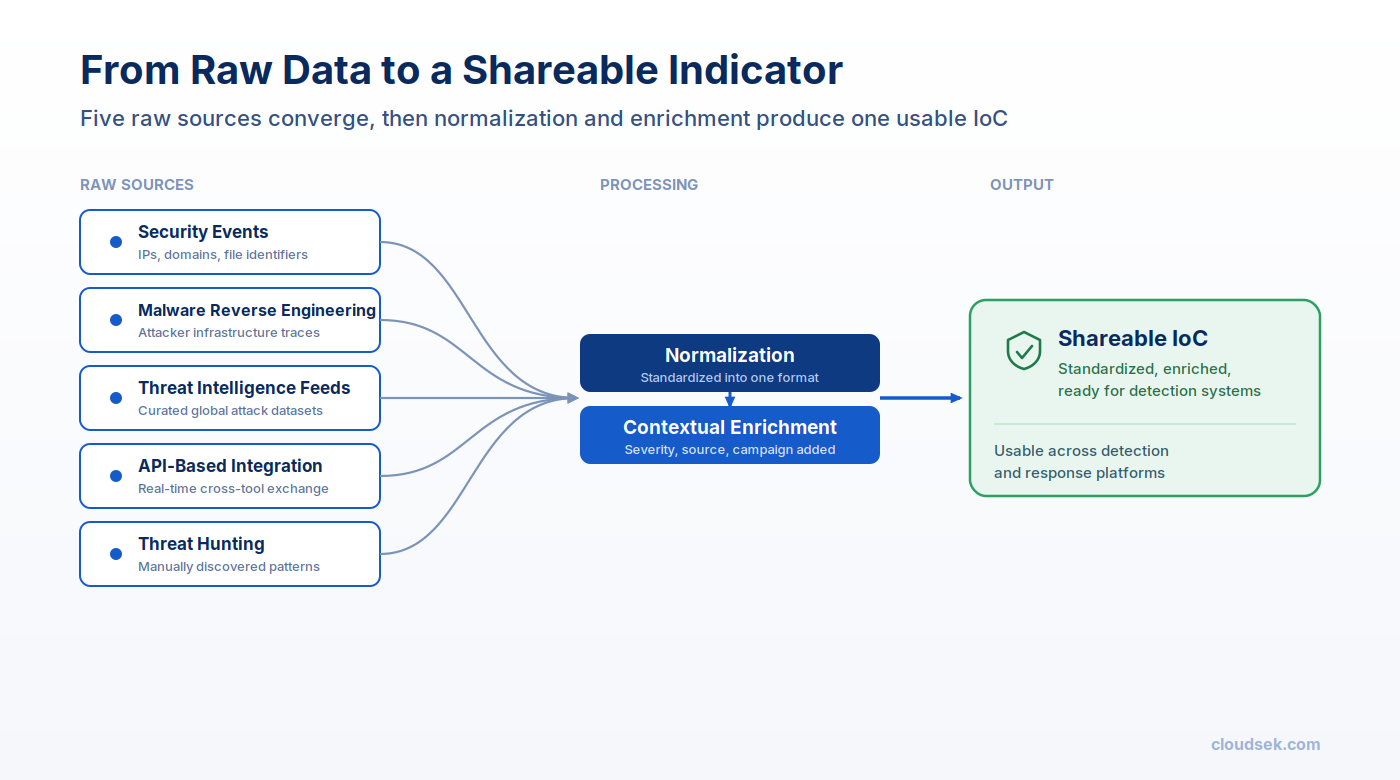
Raw activity across systems and applications is filtered to isolate meaningful signals. Key attributes such as IPs, domains, and file identifiers are captured during this step.
Analysis of malicious code reveals identifiers linked to attacker infrastructure and execution patterns. Extracted elements are formatted into usable indicators.
External intelligence sources provide curated datasets collected from global attack activity. These inputs expand visibility beyond internal environments.
Security platforms exchange indicators through APIs, enabling seamless ingestion across tools. Real-time synchronization ensures updated indicators are available across systems.
Manual exploration of systems uncovers hidden attack patterns missed by automated processes. Discovered traces are documented and converted into indicators.
Extracted data is standardized into consistent formats for compatibility across platforms. Structured formatting improves accuracy and correlation efficiency.
Additional context such as severity, source, and related threat campaigns is attached to indicators. Enriched data improves prioritization and decision-making during investigations.
Indicators of Compromise (IoCs) identify evidence of a past or ongoing attack, while Indicators of Attack (IoAs) focus on detecting attacker behavior before damage occurs. Know more about IoCs vs IoAs.
During security investigations, analysts rely on IoCs as observable clues to understand how a system may have been exposed to malicious activity.
Connections reaching unfamiliar external servers or irregular data transfer flows often reveal hidden interaction with attacker-controlled infrastructure. Such patterns may point to data being quietly transmitted outside the environment.
Files that do not match trusted hash records raise concerns about hidden malware. Cross-checking these values with threat databases helps determine their origin.
Repeated authentication failures or sign-ins from unusual geographic regions can signal compromised credentials. These patterns frequently appear during account takeover attempts.
Unplanned modifications to system configurations or critical files suggest internal tampering. Persistence mechanisms often rely on such silent alterations.
Communication with newly registered or deceptive domains can indicate phishing campaigns or callback activity. Domain reputation analysis helps uncover links to attacker infrastructure.
Processes running without clear initiation or deviating from normal behavior often expose hidden threats. Observing execution patterns helps bring these activities to light.
Reliance on IoCs alone creates detection gaps since known patterns cannot fully represent evolving attack techniques.
Identification happens after traces appear within systems, limiting the ability to stop threats at an early stage. Response often begins only after some level of impact.
New attack methods and zero-day exploits do not match existing indicators. Detection systems struggle when no prior reference exists.
Small modifications in attacker infrastructure, such as altering domains or file signatures, reduce indicator effectiveness. Frequent changes allow threats to bypass static detection methods.
Large numbers of indicators can generate excessive alerts, many of which lack real impact. Security teams spend additional time filtering and validating these signals.
Standalone indicators do not explain the full scope or progression of an attack. Deeper visibility requires behavioral analysis and broader correlation.
Security operations rely on specialized platforms to collect, analyze, and act on indicators across networks, endpoints, and cloud environments.
Centralized systems aggregate logs and security data from multiple sources for correlation and analysis. Platforms like Splunk or IBM QRadar help identify patterns across large datasets.
Endpoint Detection and Response tools monitor device-level activity such as processes, file changes, and system behavior. These tools provide deep visibility into endpoint-level threats.
Dedicated platforms collect and distribute global threat data, including known indicators and attacker techniques. They help organizations stay updated on emerging threats.
Network-based systems analyze traffic to identify known attack signatures and anomalies. Alerts generated from these systems help detect suspicious activity early.
Advanced systems not only detect but also block malicious activity in real time. Preventive actions reduce the risk of attacks spreading within the network.
Extended Detection and Response solutions integrate data across endpoints, networks, and cloud environments. Unified visibility improves detection accuracy and response coordination.
Choosing the right system depends on how effectively it can process, correlate, and act on security indicators across environments.
Fast ingestion and analysis ensure indicators are evaluated without delay. Immediate visibility helps reduce response time during active threats.
Seamless connection with SIEM, EDR, and other security tools improves data flow across systems. Unified visibility strengthens overall detection accuracy.
Well-designed APIs enable automated data exchange between platforms and external intelligence sources. Automation reduces manual effort and keeps indicators consistently updated.
Large environments generate high volumes of security data that must be handled efficiently. Scalable systems maintain performance without slowing down analysis.
Flexible alert configuration helps teams focus on relevant threats instead of noise. Prioritization ensures critical incidents receive immediate attention.
CloudSEK’s XVigil platform uses AI-driven intelligence to monitor, analyze, and act on IoCs across surface, deep, and dark web environments. Continuous scanning helps identify threats such as malicious domains, leaked credentials, and compromised infrastructure in real time.
Collected indicators are enriched with contextual insights, linking threat actors, attack methods, and potential business impact. Integration with SIEM systems enables seamless data flow, allowing security teams to correlate IoCs with internal events and improve detection accuracy.
AI-powered filtering prioritizes high-risk indicators while reducing noise from irrelevant data. Actionable intelligence and external attack surface mapping help organizations identify exposure points and respond quickly to emerging threats.
IoCs often have a short lifespan as attackers frequently change infrastructure like domains and IPs. Continuous updates are required to keep detection effective.
Yes, IoCs are commonly shared through threat intelligence platforms and security communities. Shared indicators improve collective defense against similar attack patterns.
IoC enrichment involves adding context such as threat actor details, severity, and attack techniques to raw indicators. This additional information improves analysis and decision-making.
APIs allow automated exchange of indicators between security tools and external intelligence sources. This ensures consistent updates and faster integration across systems.
Managing large volumes of indicators can create noise and increase analysis workload. Prioritization and filtering are required to focus on high-risk threats.
Yes, IoCs are applied in cloud environments to monitor suspicious activity across cloud workloads and services. Cloud-native tools analyze these indicators to detect threats in distributed systems.
IoCs provide measurable signals that reveal how attackers interact with systems and networks. This visibility allows teams to track attack patterns more effectively.
