🚀 A CloudSEK se torna a primeira empresa de segurança cibernética de origem indiana a receber investimentos da
Leia mais
.avif)

A predictive attack graph platform models how an attacker could chain weaknesses into paths to critical assets, then predicts those paths before an attacker uses them. A predictive attack graph platform turns scattered exposures into prioritized routes that a security team disrupts first.
The need is concrete. Research found that only 2% of security exposures sit on choke points, the junctions where many attack paths converge to reach critical assets. A predictive attack graph platform exists to find that 2% before an attacker does.
This guide defines the term, explains what makes a platform predictive, walks through how it works, lists its capabilities, separates it from related tools, and shows how to evaluate one.
The term combines three ideas. An attack graph maps how weaknesses connect into routes to critical assets. Predictive means the platform forecasts the paths an attacker would take before the attack happens, rather than reporting on one after the fact. A platform unifies the discovery, correlation, modeling, and prioritization in one continuous system.
Put together, a predictive attack graph platform ingests signals about assets and exposures, models them as a graph, and predicts the validated, prioritized paths an attacker would use to reach high-value targets.
The idea has academic roots. Attack graph research by Sushil Jajodia, Steven Noel, and Paul Ammann defined a predictive attack graph as one where redundant paths are removed so the remaining structure predicts how an attacker could compromise hosts. Commercial platforms extend that concept across the modern attack surface.
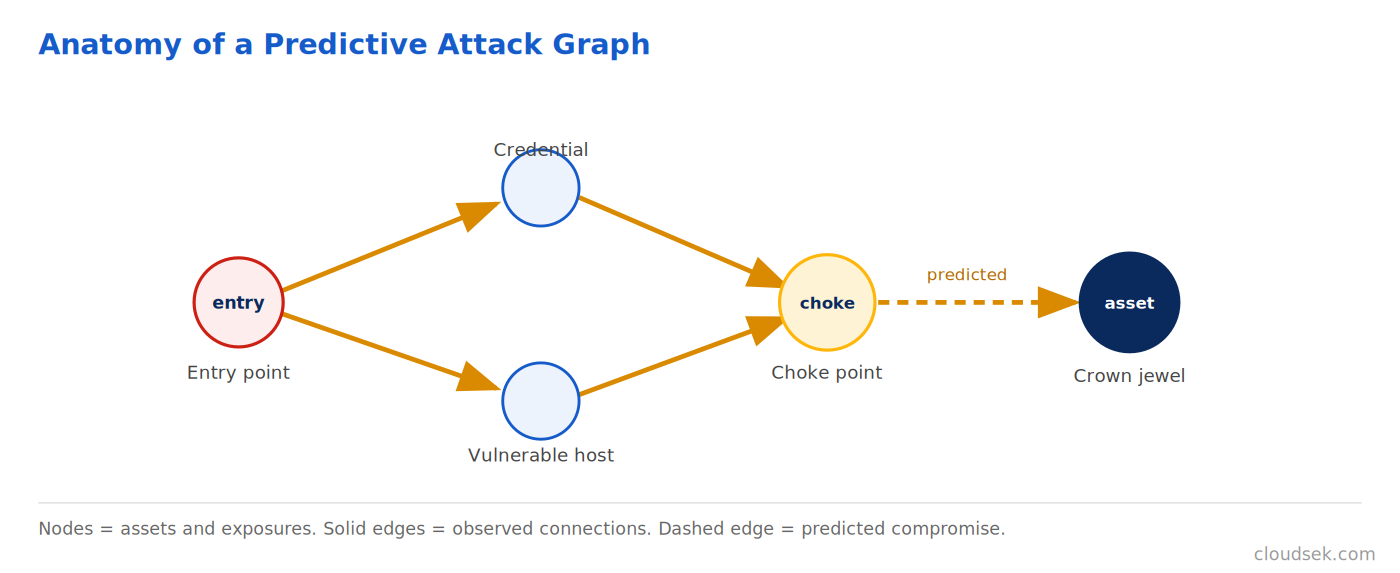
An attack graph is a model of how an attacker moves through an environment. Nodes represent assets and exposures, such as a vulnerable host or a stolen credential. Edges represent the connections an attacker uses to move from one node to the next.
Read end-to-end, the graph shows attack paths, the routes from an entry point to a critical asset. The points where many paths converge are choke points, where a single fix breaks multiple routes at once.
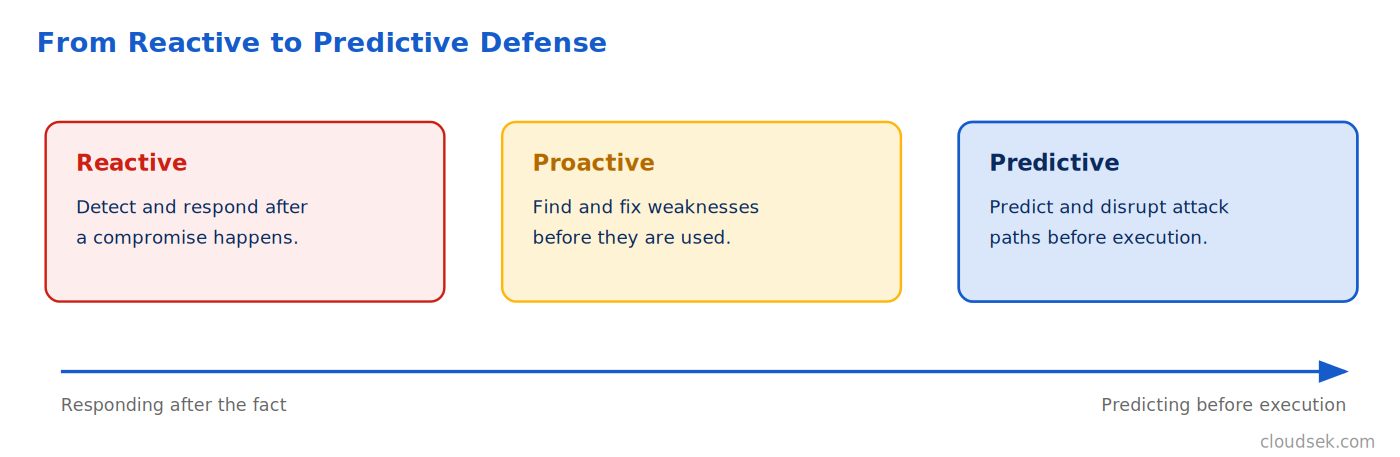
Security has moved through three stages. Reactive security detects and responds after a compromise. Proactive security finds and fixes weaknesses before they are used. Predictive security forecasts the specific paths an attacker would take and disrupts them before execution.
A predictive attack graph platform sits in that third stage. It does not wait for an alert. It models the routes that exist right now and predicts which ones an attacker reaches a critical asset through, so teams break the path first.
Prediction means the model stays continuous. As assets, exposures, and identities change, the platform remodels the graph and updates which paths are reachable, rather than producing a snapshot that ages.
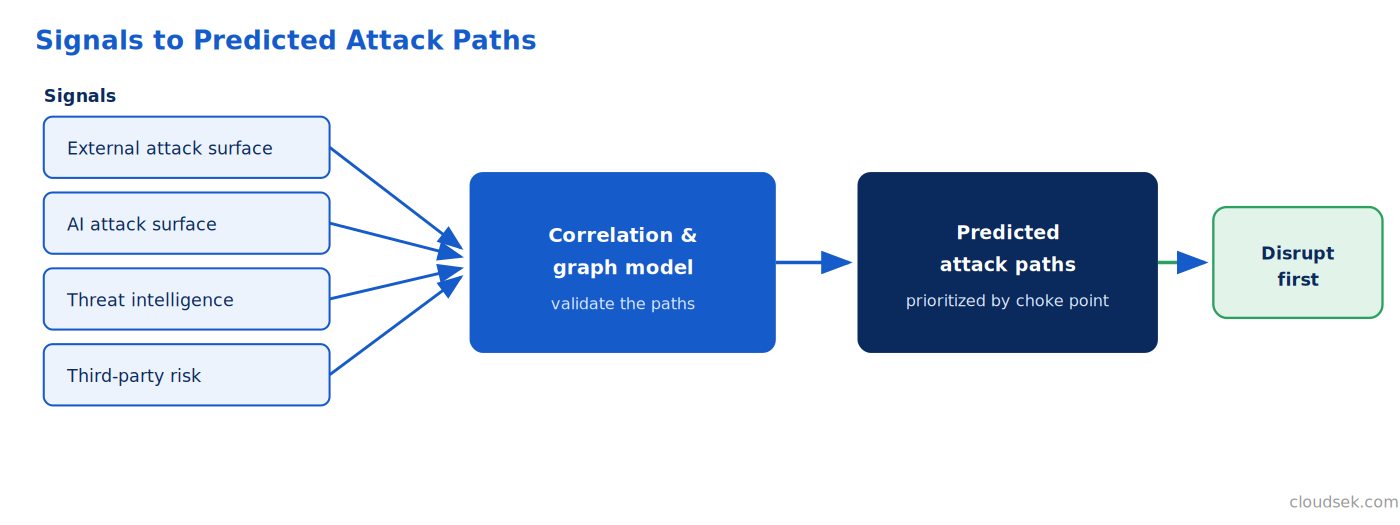
A predictive attack graph platform turns scattered signals into prioritized routes. It follows five steps:
The platform often maps each step to MITRE ATT&CK techniques, connecting exposures to known attacker behavior.
A worked example shows the output. The platform links a leaked credential, an exposed admin panel, and an over-privileged service account into one predicted path that ends at a customer database. None of the three rates as critical alone, yet together they form the route the platform flags first.
A platform earns the label through a set of capabilities working together:
The category gets confused with several others. The difference is what each one acts on and when:
A predictive attack graph platform works before a compromise and adds prediction on top of the modeling that attack graph tooling provides. It does not detect or respond to live activity, which is the job of detection and response tooling.
Predictive attack graph platforms work in two places. Internal platforms model lateral movement inside the network, predicting how an attacker moves from host to host once inside. A compromised laptop, a shared local-admin password, and an unsegmented network become one predicted internal path. Several established vendors focus here.
External platforms start outside the perimeter. They model the initial access vector, how an attacker reaches the network through an exposed asset, a leaked credential, or a vulnerable vendor, before any internal movement begins.
Both qualify as predictive attack graph platforms. They predict attacker paths and prioritize the routes that reach critical assets. They differ in where on the attack chain they focus.
Organizations adopt a predictive attack graph platform for clear gains:
Predictive attack graph platforms support several recurring jobs:
CloudSEK Nexus AI is an external predictive attack graph platform. It correlates signals from across CloudSEK's platform, the external attack surface from BeVigil, threat actor and CVE intelligence, AI attack surface risks, and third-party exposure into predictive attack graphs.
Nexus AI focuses on the initial access vector, how an attacker gets in, and scores each path by exploitability and attacker behavior. It complements internal platforms and the security operations center rather than replacing them.
CloudSEK's research shows the pattern. In one published finding, AIVigil discovered an unauthenticated MCP server on a customer's AI attack surface. An attacker could chain it into server-side request forgery, local file inclusion, and the theft of live AWS credentials. Nexus AI maps that chain as a single predicted attack path rather than three unrelated alerts.
When comparing platforms, check each one against the capabilities that define the category:
How is it different from a vulnerability scanner?
A scanner lists individual weaknesses ranked by severity. A predictive attack graph platform connects those weaknesses into routes and predicts which ones reach critical assets.
Is it the same as attack path management?
They overlap. Attack path management models and remediates paths, and a predictive attack graph platform adds the prediction and prioritization of those paths across the attack surface.
What makes a platform predictive?
It forecasts the paths an attacker would take before an attack happens and updates continuously as the environment changes, rather than reporting after the fact.
Does it replace a SIEM?
No. A SIEM detects and responds to activity after it occurs. A predictive attack graph platform works before a compromise and predicts the paths to prevent. The two address different stages.
Is it only for internal networks?
No. Internal platforms predict lateral movement inside the network, and external platforms predict how an attacker reaches the network through an initial access vector. Both qualify.
