🚀 A CloudSEK se torna a primeira empresa de segurança cibernética de origem indiana a receber investimentos da
Leia mais
.avif)

AI jailbreaking is a technique that bypasses an AI model's safety guardrails, causing it to produce restricted or harmful content it would normally refuse. AI jailbreaking maps to the top risk on the OWASP Top 10 for LLM Applications.
The research shows why AI jailbreaking matters. Microsoft's Crescendo attack, presented at USENIX Security 2025, beat earlier jailbreaks by 29 to 61 percent on GPT-4 and 49 to 71 percent on Gemini-Pro. Anthropic showed that many-shot jailbreaking compromises leading models by flooding the context window with fake examples. OWASP keeps prompt injection and jailbreaking at the top of its LLM risk list across three editions.
This guide explains what AI jailbreaking is, how it works, and how it differs from prompt injection. It covers the attack types, the common techniques attackers use, the risks to enterprises, and the defenses that reduce them.
AI jailbreaking is the practice of crafting inputs that bypass an AI model's built-in safety rules, so the model produces content it was trained to refuse. The attack exploits a gap that alignment creates: a model can generate harmful output, yet its guardrails make it unwilling to. Jailbreaking narrows that gap between capability and willingness.
Models stay vulnerable because they are trained to be helpful and to follow instructions written in natural language. A crafted persona, a fictional frame, or a gradual conversation turns that helpfulness against the safety rules.
AI jailbreaking spreads as fast as AI adoption. Every chatbot, copilot, and autonomous agent that accepts open-ended prompts inherits the weakness, and attackers share working jailbreaks in public forums within hours of a model's release.
Four traits define AI jailbreaking:
AI jailbreaking is not always malicious. Safety researchers jailbreak models to find weaknesses before attackers do. The technique ranks among the core concerns of AI security because a single bypass can defeat months of safety training.
AI jailbreaking and prompt injection are related but distinct. Jailbreaking targets a model's safety rules to make it produce restricted content. Prompt injection overrides a model's instructions through crafted input, often to hijack its task or steal data. These two overlap because a prompt injection can deliver a jailbreak, yet their goals differ.
AI jailbreaking works by exploiting the gap between what a model can produce and what its alignment allows. Attackers use three levers: a false frame that makes a harmful request seem acceptable, a persona that the model adopts, or a gradual conversation that erodes the guardrails turn by turn. Each lever pushes the model toward an output that it would refuse in a direct request.
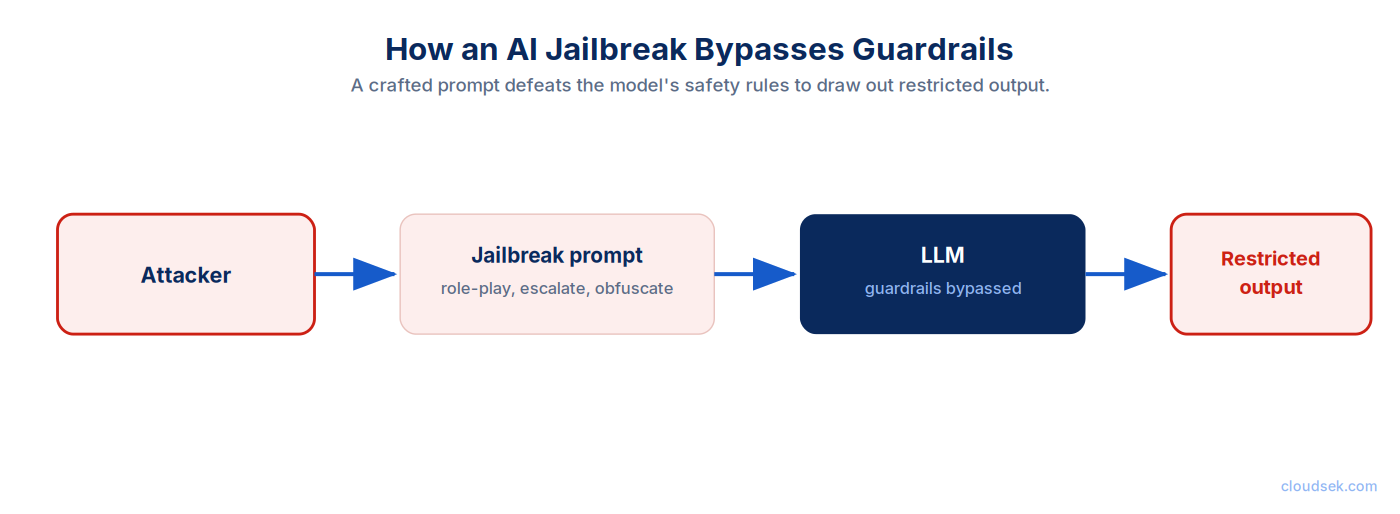
Some jailbreaks use plain language that a person writes. Others optimize the raw tokens fed to the model with automated tools. Both aim at the same result: a response that breaks the rules.
A simple example shows the pattern. A direct request for restricted instructions draws a refusal. The same request wrapped in a fictional role, such as a prompt that casts the model as an unrestricted assistant writing a novel, often slips through. A multi-turn version asks innocent questions first, then escalates once the conversation looks routine.
AI jailbreak attacks fall into four key types, grouped by method and structure:
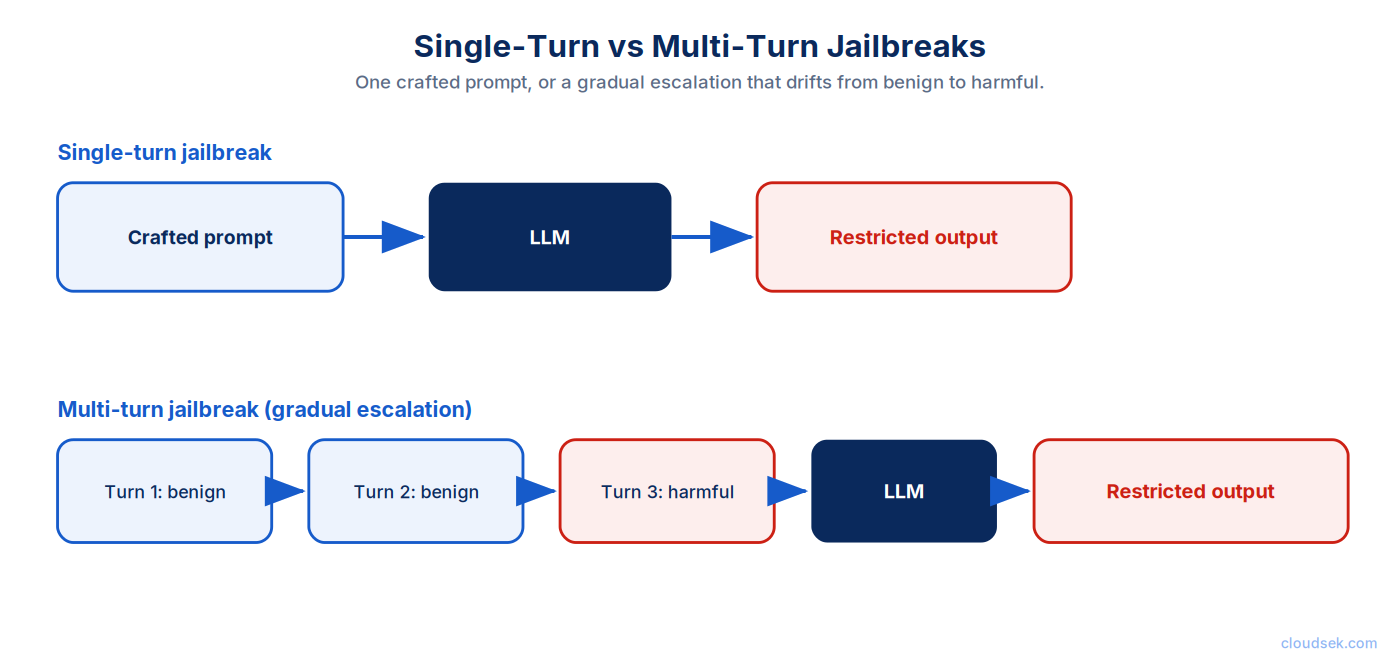
Single-turn jailbreaks bypass guardrails in one prompt; multi-turn jailbreaks escalate from benign turns until the model complies.
Multi-turn jailbreaks now pose the larger threat, because they evade filters that judge each prompt in isolation.
Attackers rely on several named AI jailbreak techniques:
These techniques work against production systems. The DAN prompt cycled through dozens of versions on ChatGPT as each was patched. Microsoft reported that Skeleton Key bypassed safeguards across models from OpenAI, Google, Anthropic, and Meta in 2024. Crescendo went further the next year, jailbreaking both text and multimodal models through gradual escalation.
Automation raises the stakes. Tools such as PAIR and GCG generate and refine attack prompts with no human effort, while Best-of-N samples many variations until one slips through. Automation lets a single attacker scale what once took manual trial and error, and it produces fresh prompts that signature-based filters have never seen.
The impact of AI jailbreaking scales with the model's reach and access. AI jailbreaking creates five risks for enterprises:
Each risk grows in agentic systems, where a jailbreak reaches the wider AI attack surface of connected tools, data, and APIs.
AI jailbreaking resists a permanent fix for three reasons:
A model that refused every borderline prompt would be too restricted to use, so vendors balance safety against usefulness. That balance leaves room for an attacker's probe, which is why prevention relies on layered defense rather than a single cure.
No defense eliminates AI jailbreaking, so protection means layered controls. These seven measures effectively reduce the risk:
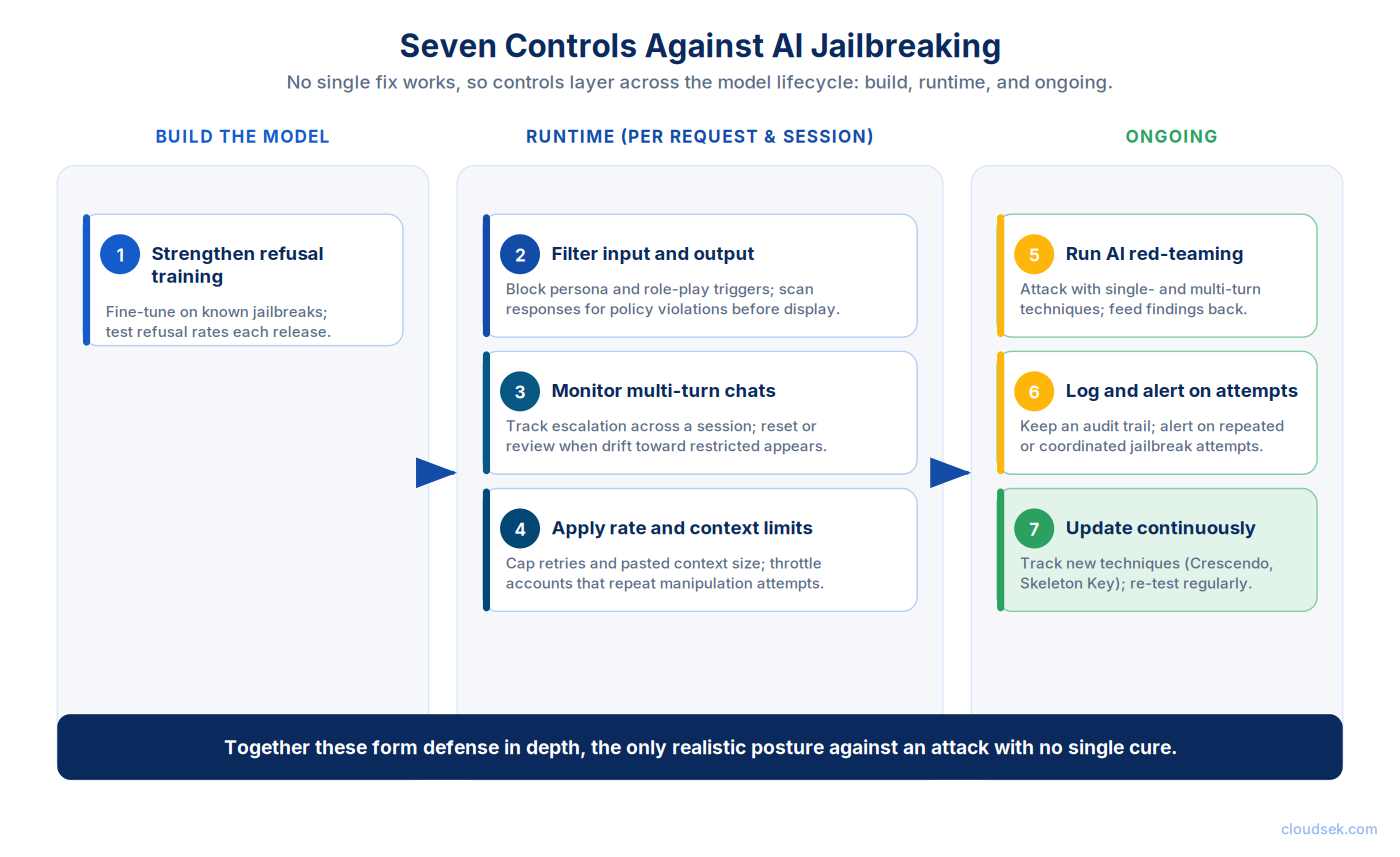
Together, these measures form defense in depth, the only realistic posture against an attack with no single cure.
No tool eliminates AI jailbreaking, and the problem is unrelated to device jailbreaking. CloudSEK AIVigil monitors LLM endpoints, AI APIs, and agentic workflows, and runs active AI red-teaming that tests how a model responds to jailbreak attempts. AIVigil treats a successful jailbreak as an AI-layer initial access vector and surfaces the exposure before attackers reach it.
AIVigil scores each exposure by three factors: the agent's agency, its authentication state, and its blast radius. A model that refuses a direct request can still fail under a graded multi-turn attack, so the scoring weighs how far a successful jailbreak would reach rather than whether one prompt was blocked.
One published AIVigil finding shows why blast radius matters. During routine scanning of a customer's AI attack surface, AIVigil flagged an unauthenticated MCP server that exposed an agent's internal tools. An external actor could enumerate those tools and chain them into server-side request forgery, local file inclusion, and theft of live AWS credentials and database secrets. The same reach applies when a jailbreak, rather than a missing password, hands an attacker control of an agent's tools.
AIVigil makes AI attack surface monitoring a continuous workflow, discovering the AI assets where jailbreaks land and scoring each by blast radius. It answers a question every enterprise running AI now carries: how can attackers bypass our AI safeguards?
AI jailbreaking bypasses a model's safety rules, while prompt injection overrides the model's instructions through crafted input.
No. AI jailbreaking is illegal only when used to cause harm or unauthorized access, and researchers use it legitimately to test model safety.
A DAN, short for Do Anything Now, is a role-play jailbreak that tells a model to act as an unrestricted persona that ignores its rules.
No. AI jailbreaking can be reduced through layered defenses and testing, but no method eliminates it entirely.
AI jailbreaking bypasses an AI model's safety rules, while device jailbreaking removes manufacturer restrictions on phones and other hardware.
