🚀 CloudSEK featured in the 2026 Frost Radar™!
Read more
.avif)

AI security is the practice of protecting AI systems from attacks on their data, models, and decision logic, and of applying AI to detect threats across enterprise environments.
Exposure at the infrastructure layer is already documented in published scanning work. CloudSEK research catalogued more than 100 exposed credential sets and over 80 publicly accessible MLOps deployments within 48 hours of scanning, and most of those environments needed no exploitation to enter.
Attack techniques against these systems include prompt injection, data poisoning, and model extraction. Each one targets how a model learns or responds, and code scanners inspect execution paths that none of these techniques touch.
AI security carries two meanings, and mature programs fund both. Securing AI protects models, training data, and agent workflows from manipulation. Applying AI to security embeds machine learning inside detection, triage, and threat intelligence work.
Securing AI carries a newer control set, because prompt injection and data poisoning have no equivalent in traditional application security. Tooling built to find code defects detects neither one.
Enterprise deployment expands the AI attack surface across six categories: data, models, applications, agents, infrastructure, and shadow AI. Each category introduces initial access vectors that conventional discovery tools were never built to find.
AI security works by placing controls at every lifecycle stage, from data collection through production inference. Five control areas carry most of the weight: data integrity, model protection, agent constraint, behavioral monitoring, and supply chain verification.
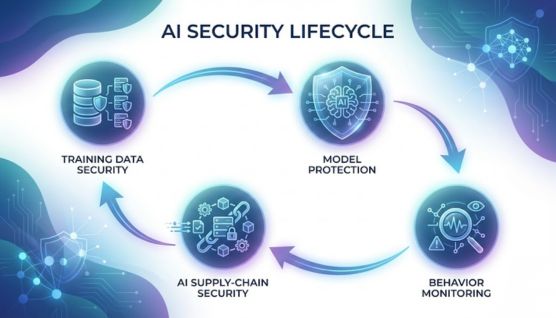
Datasets earn trust through provenance checks, integrity hashing, and review of every third-party corpus before ingestion. Validation at this stage cuts poisoning risk, because a poisoned record that reaches training becomes part of what the model treats as fact.
Model weights, checkpoints, and inference endpoints sit behind authentication, encryption, and rate limits. Query throttling raises the cost of extraction attacks, which require high-volume probing to reconstruct a decision boundary.
Agents receive the narrowest permission set their task allows, with tool access scoped per workflow and human approval required for irreversible actions. An agent that can act is an agent an attacker can direct.
Production monitoring tracks input patterns, output distributions, and tool-call sequences against an established baseline. Deviation in any of the three points to a poisoned retrieval source, a manipulated model, or a hijacked agent session.
Every model file, package, and container in the stack carries provenance risk. AI supply chain security verifies model hashes, pins dependency versions, and blocks pickle-format model loading, since deserialization executes embedded instructions at load time.
AI systems face attack techniques that target statistical behavior instead of code defects. NIST groups these techniques into evasion, poisoning, privacy, and misuse categories across predictive and generative systems.
Prompt injection hides instructions inside content a model reads, and the model follows them because it processes instructions and data through one channel. OWASP ranks prompt injection first in its Top 10 for LLM Applications 2025.
Indirect injection now appears in the wild at scale. Google reported a 32 percent relative increase in malicious injection content across repeated scans of the public web archive between November 2025 and February 2026, documented alongside Forcepoint telemetry. EchoLeak, tracked as CVE-2025-32711, produced zero-click data exfiltration from Microsoft 365 Copilot.
Poisoning inserts crafted samples into a training set so the model learns an attacker-chosen behavior. Backdoor variants stay dormant until a trigger phrase or pattern arrives in production input, which keeps the defect invisible during pre-release evaluation.
Extraction rebuilds a model's decision boundaries through repeated querying and hands an attacker a working copy without access to the weights. Inversion runs the opposite way and reconstructs training records from outputs, exposing personal data absorbed during training.
Evasion perturbs an input just enough to flip a classification while looking unchanged to a human reviewer. Fraud scoring, malware classification, and biometric matching all inherit this weakness, since each converts a continuous score into a binary decision.
Agents become exploitable when three properties combine: access to private data, exposure to untrusted content, and the ability to send data outward. Removing any one property breaks the attack path.
CloudSEK AIVigil found that combination inside a customer environment. An unauthenticated MCP server exposed internal tools, which chained into SSRF, local file inclusion, and theft of live AWS IAM credentials.
Compromise of one shared AI dependency reaches every downstream build at once. CloudSEK's investigation into the March 2026 LiteLLM attack identified more than 2,500 organizations and 434,000 CI/CD pipelines potentially exposed after attackers poisoned an upstream scanner and published malicious LiteLLM releases to PyPI.
Attackers apply AI to four ends: deception quality, malware production, fraud volume, and intrusion automation. Guidance on preventing AI-powered cyberattacks covers the operational controls that answer each one.
AI strengthens defense by correlating signal volumes no analyst team reads in full. Detection engineering, behavioral analytics, fraud screening, and attack path correlation each gain accuracy from models trained on historical outcomes.
Enterprise AI security work draws on six reference documents, each covering a different layer of the problem. Governance belongs to NIST and ISO, technical risk to OWASP and MITRE, and legal obligation to the EU AI Act.
Legal obligation under the EU AI Act follows a clock of its own. Regulation (EU) 2026/1744, the Digital Omnibus on AI, entered into force on July 27, 2026, and deferred high-risk obligations for standalone Annex III systems to December 2, 2027, with embedded Annex I systems moving to August 2, 2028. Article 50 transparency duties took effect on August 2, 2026, as originally written.
Implementation works as a sequence, because each step supplies the input the next one requires. Inventory precedes assessment, and assessment precedes control design.
Evaluation of an AI security platform turns on two properties: coverage and context. A platform earns its place when it finds AI assets nobody registered and explains which exposure creates a reachable attack path.
CloudSEK treats AI security as an attack surface problem. CloudSEK AIVigil, an AI attack surface monitoring platform, discovers exposed AI infrastructure, MCP servers, vector databases, agentic workflows, leaked AI credentials, and shadow AI from outside the perimeter, then records the result as an AI Bill of Materials.
Discovery on its own leaves the triage question unresolved. AIVigil scores each exposure using agent agency, authentication state, and blast radius, which separates a public demonstration chatbot from an agent holding production database credentials. Those findings feed Nexus AI, correlating AI-layer exposures with dark web signals from XVigil and external attack surface findings from BeVigil into validated attack paths.
AI estates change faster than quarterly review cycles allow anyone to track. Continuous AI attack surface monitoring keeps the inventory current as models ship, integrations appear, and agent permissions widen.
No. AI security addresses model, data, and agent-layer attacks. Cybersecurity covers networks, endpoints, identity, and applications.
No. Standard penetration tests examine infrastructure and application logic. Prompt injection, poisoning, and model extraction operate at the model and inference layer.
No. Models read instructions and data through one channel, so defenses reduce success rates without eliminating the attack class.
Yes. Data leaves the organization at the API boundary, and the vendor's model, logging, and retention become part of the risk surface.
Output that shifts on specific inputs while overall accuracy holds steady, alongside tool calls the workflow never authorized.
After every model, prompt, or integration change, plus a scheduled quarterly review for systems holding production permissions.
Yes. Public inference endpoints, unauthenticated MCP servers, and open MLOps dashboards accept requests from anyone who finds them.
