🚀 A CloudSEK se torna a primeira empresa de segurança cibernética de origem indiana a receber investimentos da
Leia mais
.avif)

Threat intelligence delivers the context security teams need to detect, analyze, and respond to cyber threats with precision. Incident response and threat hunting both become faster and more effective when intelligence explains attacker behavior, infrastructure, and intent, rather than leaving analysts to react to isolated alerts.
The shift is from alert-based detection to proactive defense. Analysts use indicators of compromise (IOCs) and tactics, techniques, and procedures (TTPs) to investigate incidents and surface hidden threats before they escalate into a breach.
This is where a dedicated cyber threat intelligence platform matters. CloudSEK Threat Intelligence tracks threat actors, exploited CVEs, malware, and ransomware campaigns, then correlates those signals with an organization's external exposure, so teams can connect an alert to the campaign and the initial access vector behind it rather than triaging every indicator in isolation.
Incident response depends on timely insights, structured processes, and the ability to act without delay during security events.
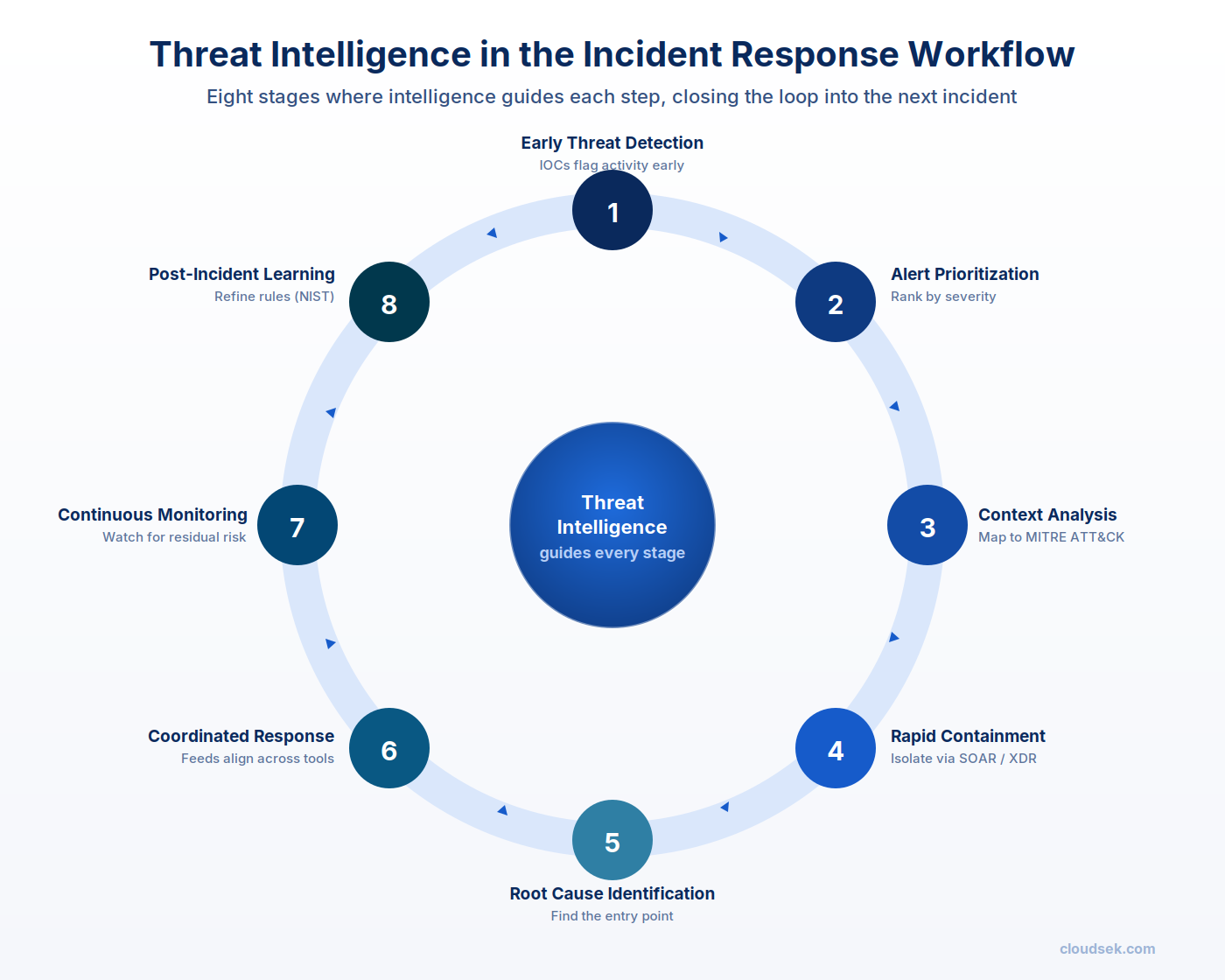
Security teams identify malicious activity using indicators of compromise such as IP addresses, domains, file hashes, and exposed credentials. Integration with Security Information and Event Management and Endpoint Detection and Response enables correlation across logs, endpoints, and network traffic.
CloudSEK XVigil expands this visibility by monitoring cybercrime forums, Telegram channels, paste sites, and other external sources for leaked credentials and sensitive data. Earlier discovery allows analysts to validate the exposure, secure affected accounts, and investigate whether related activity has appeared inside the organization.
High alert volumes often slow down response efforts and create unnecessary noise. Threat intelligence adds context that helps rank alerts based on severity, risk level, and potential impact.
Focused prioritization directs attention toward incidents that require immediate action. Analysts spend less time filtering noise and more time handling real threats.
Investigations rely on understanding how an attack progresses across systems and stages. Mapping activity to frameworks like MITRE ATT&CK reveals attacker techniques and behavioral patterns.
Context-rich analysis supports accurate conclusions during investigations. Analysts can connect events, trace attack paths, and understand intent without relying on fragmented data.
CloudSEK Threat Intelligence supports this by mapping activity to known threat actors and their TTPs, and by adding exploited-CVE and malware context, so analysts can attribute an incident to a campaign rather than interpreting events in isolation.
Once a threat is confirmed, immediate action is required to prevent further spread. Automated workflows within Security Orchestration Automation and Response and Extended Detection and Response isolate affected systems and block malicious activity.
Reduced response time limits operational disruption and system damage. Coordinated containment ensures threats are restricted before moving laterally.
Long-term security depends on identifying how an incident originated. Analysis focuses on entry points, exploited vulnerabilities, and attacker methods.
Addressing the root cause prevents repeated incidents and strengthens defensive controls. Security strategies become more aligned with real attack scenarios.
Effective incident handling requires alignment between tools, teams, and workflows. Shared intelligence ensures actions taken across systems follow a consistent approach.
Threat data moves from external feeds into SIEM platforms, triggers workflows in SOAR systems, and supports analyst decisions. This structured flow reduces delays and keeps response efforts organized.
Threat activity may continue even after initial containment, making ongoing observation essential. Systems track behavior across endpoints and networks to detect any remaining risks.
Persistent monitoring helps identify new variations of attacks and suspicious patterns. Visibility remains active, reducing the chances of threats going unnoticed.
Every incident provides insights that shape future response strategies. Detection rules and workflows are refined based on observed attack patterns and outcomes.
Alignment with frameworks like NIST Incident Response Lifecycle ensures a structured approach across preparation, response, and recovery phases. Security teams become better equipped to handle future threats.
Threat hunting focuses on uncovering hidden threats by combining intelligence insights with exploratory analysis across systems and user behavior.
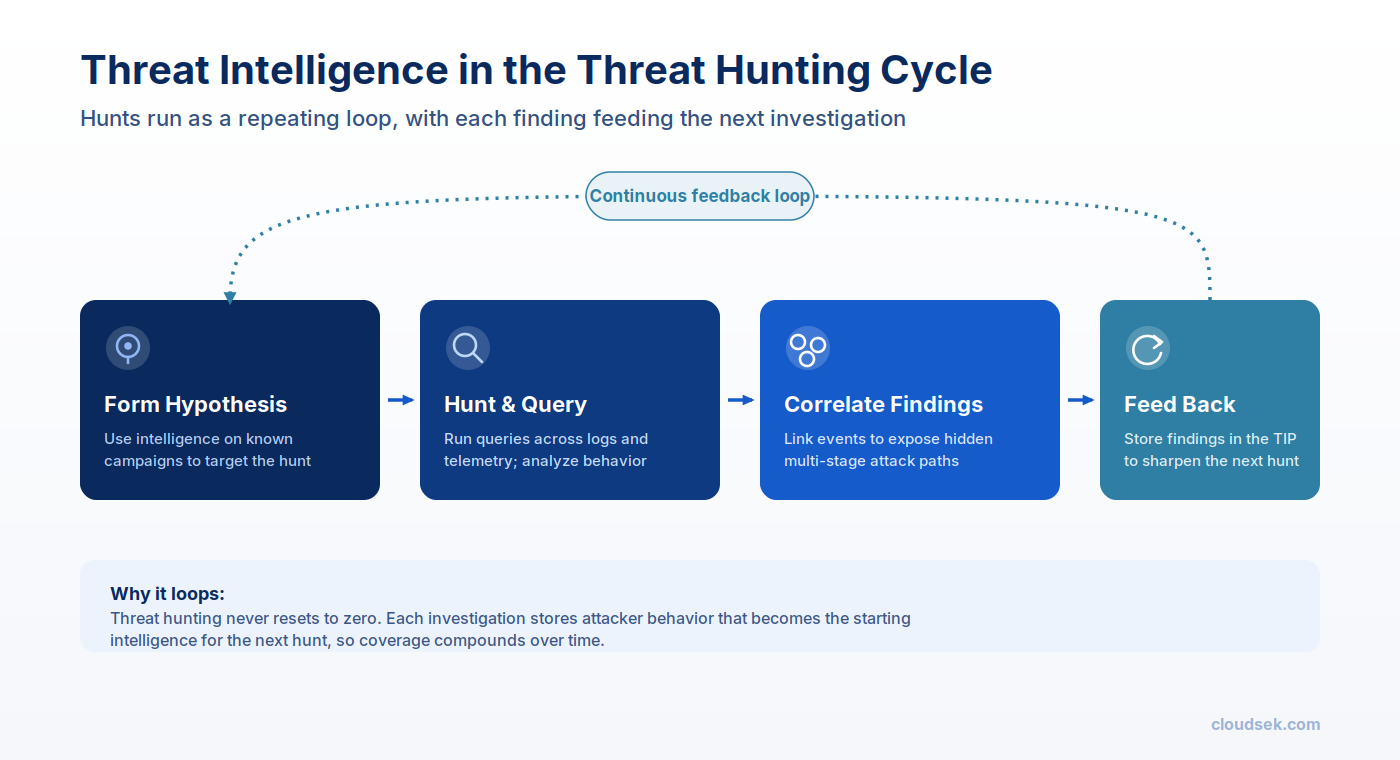
Analysts form assumptions using intelligence gathered from internal logs and external sources. Patterns linked to known attack campaigns guide the search toward suspicious activity.
A defined hypothesis keeps the investigation focused on specific risks. Effort shifts from random searching to targeted exploration based on known threat behavior.
Attack techniques often blend into normal activity, making behavior analysis critical. Platforms using User and Entity Behavior Analytics identify deviations in login patterns, access levels, and system interactions.
Unusual sequences of actions reveal potential compromise. Comparison against baseline activity exposes threats that do not rely on known signatures.
Ongoing investigations rely on updated threat data from multiple intelligence sources. Information about attacker infrastructure, malware activity, and campaign trends shapes search direction.
Alignment with current threat activity ensures investigations remain relevant. Focus stays on active risks instead of outdated indicators.
CloudSEK Threat Intelligence feeds this stage with current data on attacker infrastructure, malware campaigns, and exploited CVEs relevant to the organization's industry and region, keeping hunts aligned to active threats rather than stale indicators.
Large-scale environments generate complex datasets across endpoints and networks. Analysts correlate logs, access records, and system events to identify relationships between activities.
Linked events often reveal multi-stage attacks that appear harmless in isolation. Correlation exposes hidden connections across different parts of the environment.
Search queries are created using attacker behavior patterns and observed anomalies. Queries run across logs and telemetry to isolate suspicious activity. Refined queries reduce noise and surface meaningful signals faster. Investigation becomes more efficient as irrelevant data is filtered out.
Exposure across digital assets increases the risk of unnoticed entry points. Attack surface management identifies publicly exposed systems, misconfigurations, and weak points.
Wider visibility reveals how attackers may approach the environment. External exposure often provides the first indication of targeted activity.
Search efforts continue as new intelligence becomes available. Investigative paths evolve based on findings and updated threat data. Ongoing analysis increases the chance of detecting persistent or dormant threats. An activity that appears benign at one point may later reveal malicious intent.
Findings from investigations are stored and reused for future analysis. A Threat Intelligence Platform collects and organizes this information to support ongoing operations.
Accumulated insights strengthen future investigations and detection strategies. Knowledge of attacker behavior grows with each completed analysis.
Detection and investigation rely on combining known threat signals with behavioral patterns to uncover both familiar and unknown risks across systems.
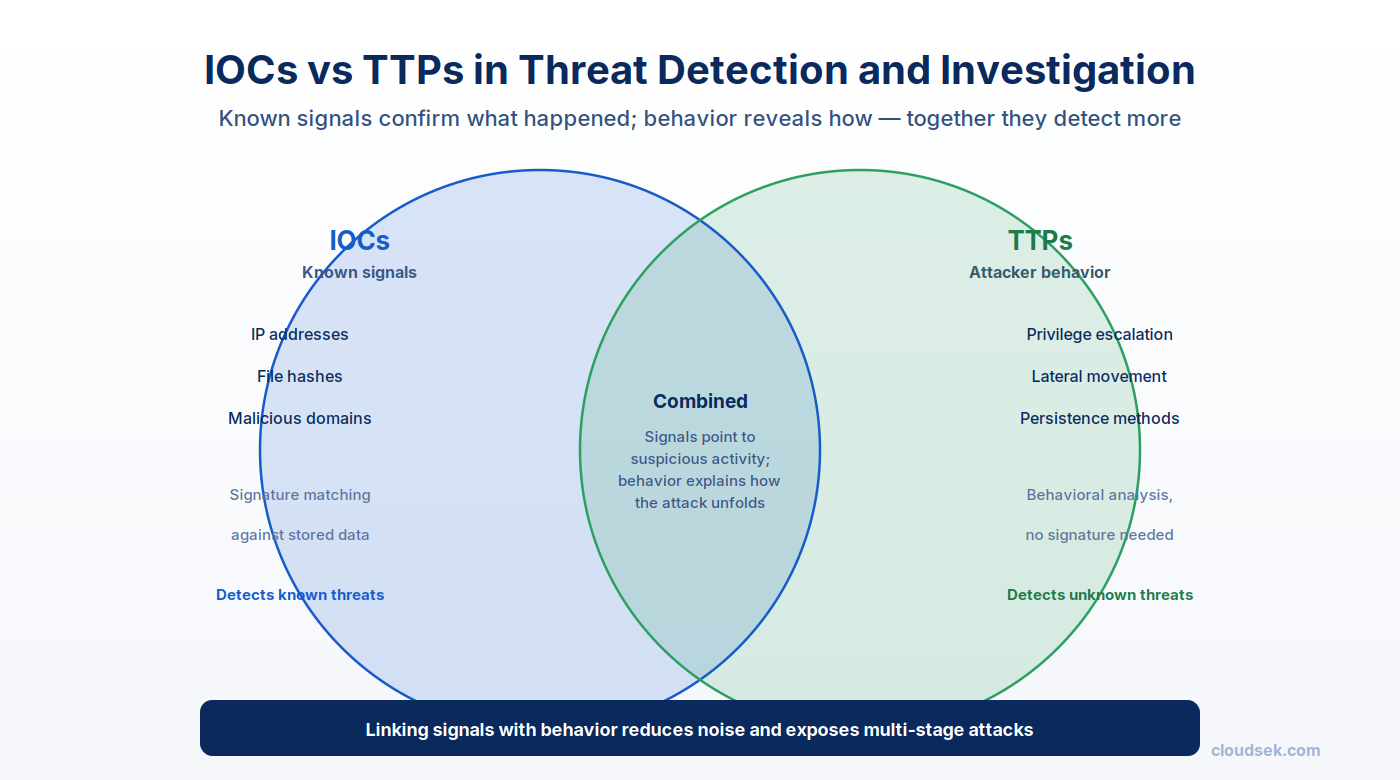
Indicators of Compromise include artifacts such as IP addresses, file hashes, and malicious domains that signal suspicious activity. Security systems compare these values against incoming and stored data to identify known threats quickly.
Tactics, Techniques, and Procedures describe how attackers operate within an environment, including movement and persistence methods. Analysis focuses on actions like privilege escalation and lateral movement to uncover threats that do not rely on static signatures.
Individual indicators often lack enough context on their own. Connecting them with observed behavior helps build a complete view of how an attack unfolds.
Known signals only reveal threats that have already been identified. Behavioral analysis highlights anomalies, making it possible to uncover new or evolving attack methods.
Investigations require both immediate clues and deeper behavioral understanding. Signals point to suspicious activity, while behavior explains how the attack progresses across systems.
Alert systems may generate noise when signals are analyzed without context. Behavioral validation helps confirm real threats and filters out irrelevant activity.
Threat intelligence connects data, context, and action across security operations, enabling faster and more informed decisions. Incident response and threat hunting become more precise when intelligence guides detection, investigation, containment, and recovery.
CloudSEK's Nexus AI correlates threat intelligence with identities, assets, external exposures, and attacker behavior to construct and validate predictive attack paths. Security teams can then prioritize credible initial access routes instead of reviewing every indicator or exposure as an isolated finding.
Continuous learning from incidents and investigations strengthens detection rules, hunting queries, and response workflows over time. Connecting external risk signals with internal security operations prepares organizations to address likely entry points before they develop into larger incidents.
