🚀 A CloudSEK se torna a primeira empresa de segurança cibernética de origem indiana a receber investimentos da
Leia mais
.avif)

A third-party cyber risk assessment evaluates the cybersecurity risk a vendor, supplier, or service provider introduces to an organization. It examines how well an external party protects the data and systems it can reach, so a security team understands the exposure before granting access and tracks it afterward. Every connected vendor widens the attack surface, and attackers routinely target the weakest supplier to reach a better-defended primary target.
The risk is concrete. In one case, CloudSEK's SVigil platform found exposed credentials belonging to a third-party communication provider serving major banks, surfacing access to critical cloud infrastructure before an attacker could weaponize it.
A third-party cyber risk assessment is the security-focused part of a broader third-party risk program: where general vendor risk weighs financial, operational, and reputational factors, the cyber assessment concentrates on security posture, vulnerabilities, and breach exposure. This guide covers what it evaluates, the process, methods, frameworks, challenges, and a practical checklist.
A third-party cyber risk assessment is a structured review of an external party's security controls, weaknesses, and history, scoped to the data and systems that party can access.
It answers a single question: if this vendor were compromised, how far could an attacker reach into the organization, and how likely is that compromise? The output ranks vendors by cyber risk and drives decisions on onboarding, contractual controls, and monitoring.
The cyber assessment is narrower than a general third-party risk assessment and deeper in security. It looks past a vendor's finances and service quality to its patching discipline, access controls, cloud configuration, and supply chain attack exposure. NIST treats this as a cybersecurity supply chain risk assessment, the security-specific review of any supplier, integrator, or service provider on which an organization depends.
Outsourcing, cloud adoption, and software dependencies have pushed much of an organization's risk outside its own perimeter. A vendor with network access, an integrated API, or a copy of customer data becomes an extension of the attack surface that the organization does not directly control. Attackers understand this and exploit the trust between organizations and their suppliers. A supplier with weaker defenses is an easier path than attacking a hardened enterprise directly, which is why supply chain intrusions have climbed.
Supply chain incidents such as the SolarWinds and MOVEit campaigns showed how a single compromised supplier can cascade across thousands of downstream victims. Regulators have responded: the EU's DORA and NIS2 directives and the SEC's disclosure rules now hold organizations accountable for the cyber risk their third parties carry. A disciplined assessment turns that accountability into a repeatable process rather than a reaction to the next breach.
A disciplined assessment delivers measurable advantages beyond satisfying a compliance requirement.
A cyber risk assessment examines the security domains where a vendor compromise would harm the organization. The domains below define the scope of a thorough review.
A repeatable assessment follows six steps from discovery to ongoing oversight.
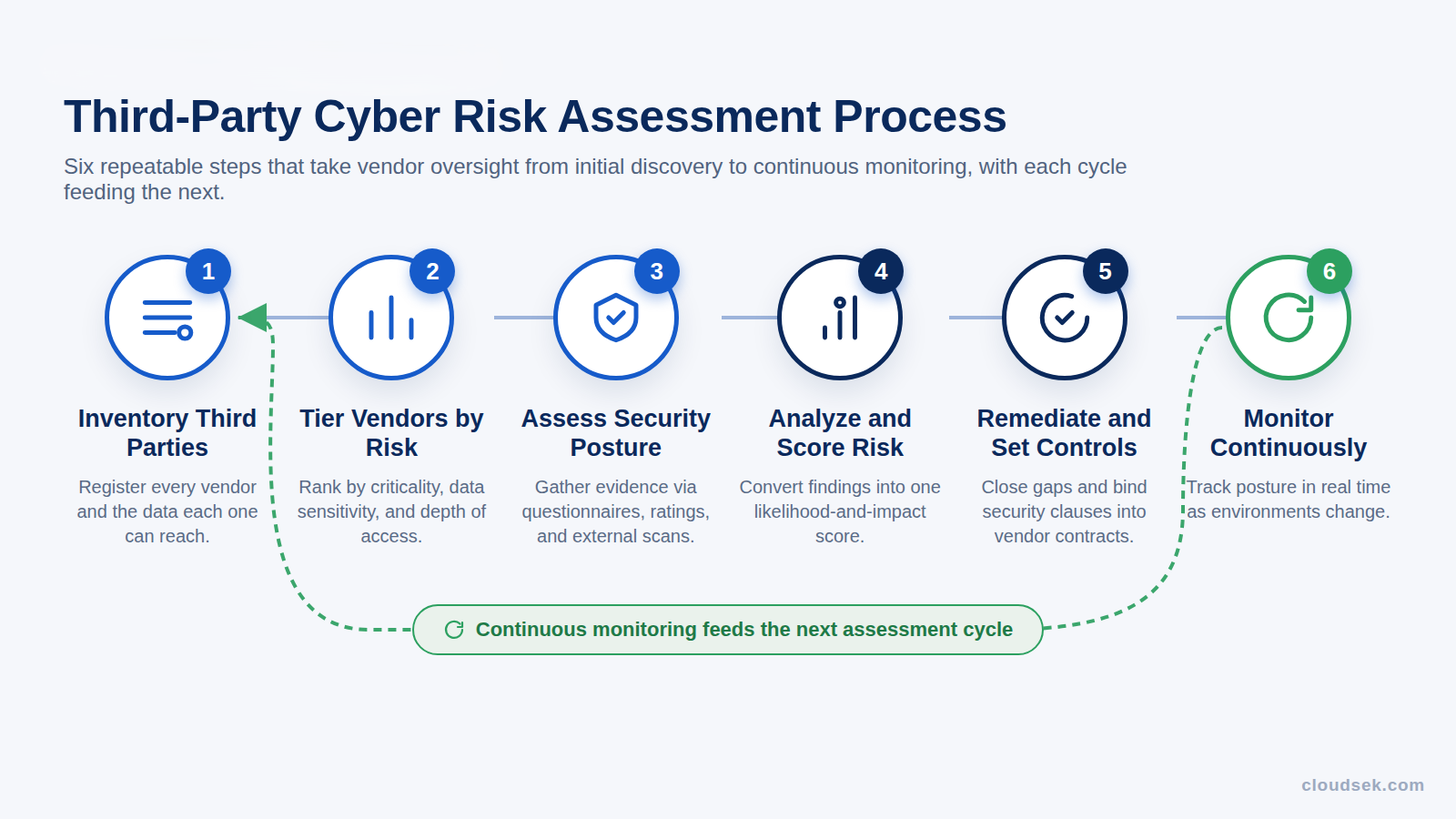
Build a complete register of vendors, suppliers, and partners, and record what data and systems each one can access. An assessment is only as good as the inventory behind it, since an unknown vendor is an unassessed risk. Shadow vendors onboarded outside procurement are a common blind spot, so the inventory draws on finance, procurement, and network data rather than a single list.
Rank vendors by criticality, data sensitivity, and depth of access so effort matches exposure. A payroll processor with access to employee records warrants deeper scrutiny than a supplier of office goods. Tiering focuses limited resources on the relationships that could cause real harm.
Gather evidence on each vendor's controls through questionnaires, security ratings, external scans, and audit reports. High-tier vendors justify several methods at once, while low-tier vendors can be cleared with a lighter touch. Pairing a self-reported questionnaire with an outside-in scan reveals gaps between what a vendor claims and what it exposes.
Combine the findings into a risk score that reflects both the likelihood of a vendor compromise and its impact on the organization. Scoring converts scattered evidence into a single, comparable measure that ranks vendors against one another. A common scale lets leadership compare this year's vendor risk against last year's and track whether it has improved.
Work with high-risk vendors to close gaps, and bind security expectations into contracts through clauses on encryption, breach notification timelines, and audit rights. Remediation turns an assessment from a report into measurable risk reduction. Where a vendor cannot meet a control, the organization documents the accepted risk or a compensating control rather than leaving the gap unrecorded.
Track each vendor's posture after onboarding, since a clean assessment expires as the vendor's environment changes. Continuous monitoring of exposed assets and leaked credentials catches new risks between formal review cycles, when most vendor exposures actually surface.
Consider a SaaS analytics vendor that processes customer data. The organization tiers it as high risk because of that data access, then assesses it with a security questionnaire, an external security rating, and a request for its current SOC 2 Type II report.
The questionnaire and report confirm encryption and access controls, but the external scan flags a subdomain without multi-factor authentication and a vendor credential exposed in an earlier breach.
The organization scores the vendor as medium-high, requires the gaps to be closed and MFA to be enforced before go-live, adds a breach-notification clause to the contract, and enrolls the vendor in continuous monitoring. That risk would have stayed hidden behind a clean questionnaire alone.
Organizations gather vendor security evidence through four main methods. Each reveals something different, and strong programs combine them rather than relying on one.
Questionnaires and audits show what a vendor reports about itself, while ratings and continuous monitoring show what its exposure looks like from the outside. Pairing an inside-out method with an outside-in one closes the gap between what a vendor claims and what attackers can actually see. The cost of each method scales with depth, so programs reserve audits and continuous monitoring for high-tier vendors and lean on questionnaires and ratings for the long tail.
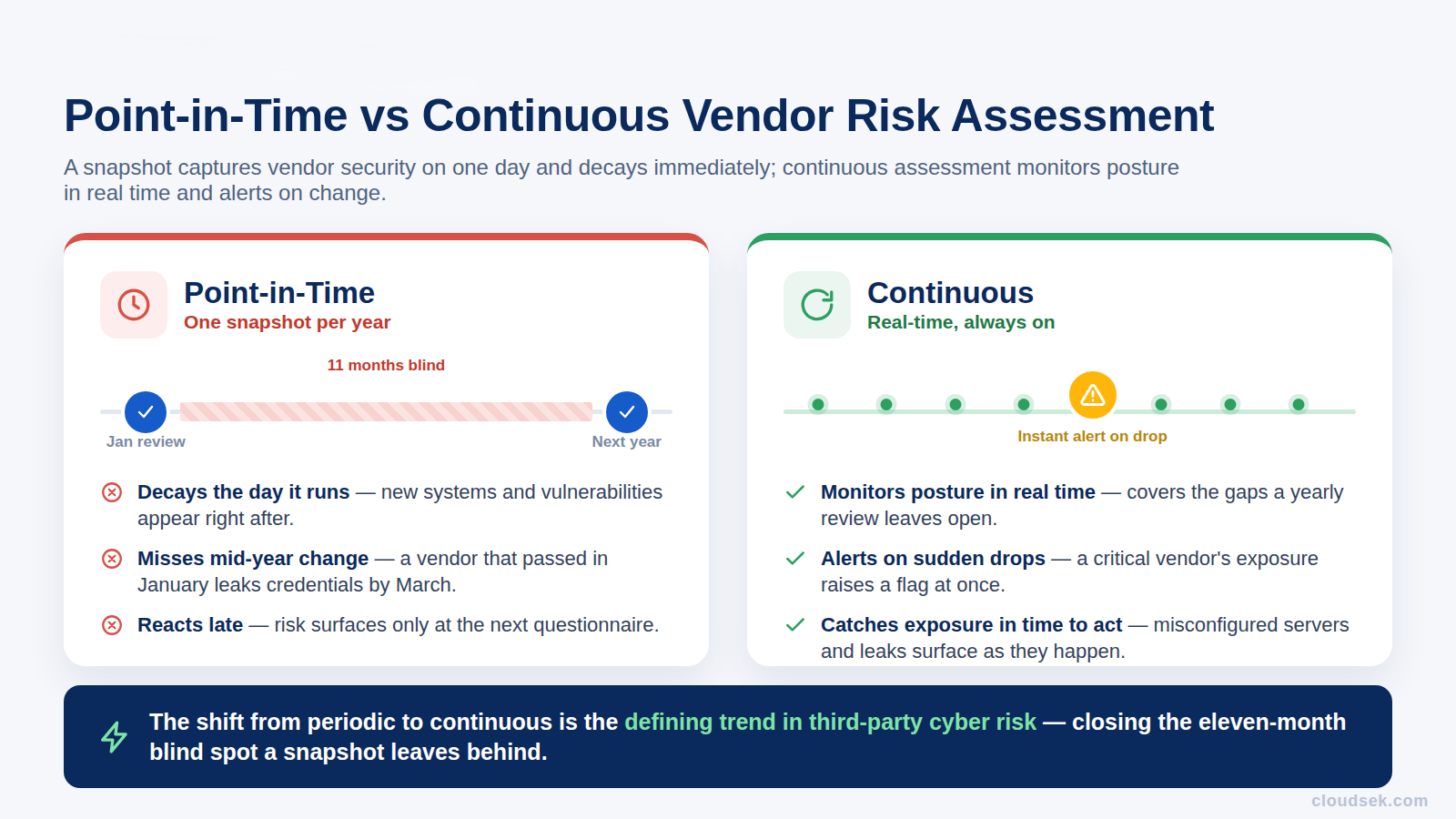
A point-in-time assessment captures a vendor's security on the day it runs, and that picture decays immediately. New systems, expired certificates, fresh vulnerabilities, and leaked credentials appear between annual reviews, leaving an organization blind to risk for most of the year.
Continuous assessment closes that gap by monitoring vendor posture in real time, so a sudden drop in a critical vendor's security raises an alert rather than waiting for the next questionnaire. A vendor that passed a January review can expose a misconfigured server or leak credentials by March, and only continuous monitoring surfaces those changes in time to act. The shift from periodic to continuous is the defining trend in third-party cyber risk.
Recognized frameworks give an assessment structure and a common language with vendors. NIST SP 800-161 is the authoritative US framework for cybersecurity supply chain risk management, and the standards below support specific parts of the process.
Several obstacles make third-party cyber risk hard to manage at scale.
The following practices keep a third-party cyber risk program effective and proportionate.
A visibilidade contínua é a parte do risco cibernético de terceiros que questionários e auditorias periódicas não alcançam, e é o problema que CloudSEK SVigil foi criado para resolver. O SVigil identifica os ativos de um fornecedor expostos à internet, verifica vulnerabilidades e configurações incorretas e monitora a dark web em busca de credenciais expostas de fornecedores, transformando o risco de terceiros de um questionário trimestral em um sinal operacional. No caso bancário mencionado acima, o monitoramento contínuo detectou credenciais expostas de um fornecedor antes que o acesso pudesse ser explorado.
Utilizado em conjunto com o CloudSEK BeVigil para cobertura da superfície de ataque externa, o SVigil mapeia a exposição de terceiros e quartas partes em toda a cadeia de suprimentos de uma organização. A plataforma complementa, em vez de substituir, os questionários, contratos e controles internos que compõem o restante de um programa de risco cibernético de terceiros, adicionando a visão em tempo real de fora para dentro que os métodos pontuais não possuem.
Uma avaliação de risco de terceiros pondera todos os riscos do fornecedor, incluindo financeiros, operacionais e reputacionais. Uma avaliação de risco cibernético de terceiros é o subconjunto específico de segurança, focado na postura de cibersegurança, vulnerabilidades e exposição a violações de um fornecedor.
No momento da integração e, posteriormente, conforme um cronograma definido pelo nível do fornecedor, com fornecedores críticos sendo reavaliados pelo menos anualmente e monitorados continuamente nesse intervalo. Uma mudança significativa, como uma violação de dados do fornecedor ou uma nova integração, aciona uma reavaliação imediata.
Um conjunto padronizado de perguntas que um fornecedor responde sobre seus controles, políticas e certificações de segurança. Formatos comuns incluem o SIG da Shared Assessments e o CAIQ da Cloud Security Alliance.
Os questionários são uma visão de dentro para fora, capturando o que o fornecedor relata sobre si mesmo. As classificações de segurança são uma visão de fora para dentro, medindo a postura exposta de um fornecedor a partir da internet, sem a necessidade de intervenção do mesmo. Programas eficazes utilizam ambos.
O risco de quarta parte é o risco cibernético proveniente de subcontratados, softwares e serviços dos quais os próprios fornecedores de uma organização dependem. Ele estende a exposição para além dos fornecedores diretos e, muitas vezes, é invisível sem um mapeamento dedicado.
NIST SP 800-161 para gestão de risco na cadeia de suprimentos de cibersegurança, ISO/IEC 27036 para segurança de fornecedores e padrões de evidência como SOC 2 e ISO 27001. O SIG da Shared Assessments e o CAIQ da CSA fornecem questionários padronizados.
