🚀 CloudSEK featured in the 2026 Frost Radar™!
Read more
.avif)

Leaked credentials are exposed authentication data such as email-password pairs, usernames, or hashed passwords that become accessible after a data breach. Attackers extract this information from compromised systems and distribute it across various online channels.
Breaches occur when unauthorized access allows attackers to download user databases containing sensitive login details. Exposed data often includes both plaintext credentials and hashed values depending on the system’s security implementation.
Stolen credentials quickly spread across cybercriminal ecosystems where they are reused, sold, or combined with other datasets. Such exposure increases the risk of unauthorized access, making continuous monitoring essential for security.
Leaked credentials are distributed across multiple online environments where attackers store and reuse stolen data.
Dark web marketplaces are primary hubs where credential dumps are sold in bulk. These platforms enable large-scale distribution, allowing attackers to reuse stolen data across multiple targets.
Hacker forums are used to share and exchange leaked credential databases within restricted communities. Limited access increases the value of these sources for tracking newly surfaced leaks.
Infostealer malware captures credentials from infected systems and stores them in structured logs. Logs contain fresh and valid data, making them highly effective for immediate exploitation.
Paste sites host credentials that are publicly shared in plain text. Open access allows automated systems to detect and index exposed data quickly.
Public repositories expose credentials due to misconfigurations or accidental uploads. A case reported by CloudSEK showed exposed credentials in a GitHub repository that could have compromised sensitive systems for over 500 employees.
Cybersecurity platforms detect leaked credentials using automated systems that continuously scan, collect, and surface exposed data from multiple sources.
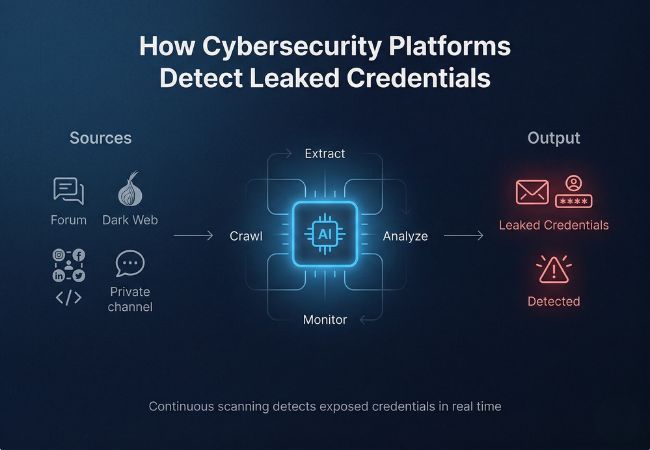
Source discovery systems identify where leaked data is likely to appear across the web. Platforms map high-risk environments such as forums, marketplaces, and repositories for continuous monitoring.
Web crawlers scan indexed and non-indexed pages to collect exposed credentials at scale. These systems operate continuously to capture newly published data as soon as it appears.
Automated scraping engines extract raw credential data from unstructured sources like posts and dumps. Extracted data is then forwarded for filtering and processing.
Threat intelligence feeds provide pre-aggregated data about breaches and leaked credentials. Integration with these feeds expands coverage beyond internally discovered sources.
Open Source Intelligence collection gathers publicly available data from repositories, websites, and forums. This approach helps detect leaks that are openly accessible but widely distributed.
Closed source monitoring focuses on tracking credential leaks within restricted communities and private platforms. Limited visibility makes these environments critical for early-stage leak detection.
Infiltration techniques enable access to private groups, invite-only forums, and encrypted channels. This approach helps uncover credential leaks before they become widely distributed.
Platforms process and verify exposed credentials by converting collected data into structured, validated, and usable intelligence.
Data parsing extracts email-password pairs, usernames, and related fields from raw dumps. Structured output enables consistent downstream analysis.
Data normalization standardizes formats across datasets from different sources. Consistent structure improves matching accuracy and reduces inconsistencies.
Deduplication systems eliminate repeated credentials gathered from multiple sources. Unique datasets improve clarity and reduce processing overhead.
Hashing matching compares leaked password hashes with known databases. Matching techniques identify reused credentials without exposing plaintext values.
Credential validation checks whether exposed credentials remain active or usable. Validation results determine risk levels and prioritization.
Data correlation connects credentials across multiple breaches and datasets. Linked records reveal repeated exposure patterns and larger compromise clusters.
Read More: How Does Threat Intelligence Work?
Exposed credentials are linked to real users or organizations by analyzing identifiers, metadata, and contextual signals across datasets.
Email domain mapping connects leaked credentials to specific organizations using domain names. Corporate domains help identify affected companies and employee accounts. Learn more about email security.
Username and alias matching links identities used across different platforms. Pattern analysis reveals connections between accounts belonging to the same user.
Metadata analysis uses information such as timestamps, IP data, and source context. Additional signals improve accuracy in identifying ownership.
Identity resolution systems combine multiple data points to build unified user profiles. Linked datasets provide a complete view of exposure across breaches.
Risk scoring models assign severity based on exposure frequency and credential validity. Higher scores indicate greater likelihood of exploitation.
Monitoring leaked credentials enables faster detection of exposed data and reduces the risk of unauthorized access.
Credential stuffing attacks rely on reused passwords across multiple platforms. Detection of exposed credentials allows systems to block unauthorized login attempts before they scale.
Account takeover occurs when attackers gain access using leaked credentials. Continuous monitoring enables rapid identification of compromised accounts and prevents unauthorized control.
Leaked credentials are widely used in financial fraud and identity theft. Detection of compromised data helps reduce unauthorized transactions and account misuse.
Continuous tracking identifies newly leaked credentials within short timeframes across multiple sources. Reduced detection time limits opportunities for attackers to exploit exposed data.
Credential exposure alerts enable immediate actions such as password resets and access restrictions. Faster response reduces the overall impact of security incidents.
Ongoing monitoring reveals patterns in credential exposure across systems and users. Insights from these patterns strengthen authentication mechanisms and access policies.
Credential monitoring supports regulatory compliance by identifying exposure of sensitive data. Improved visibility into risks enhances audit readiness and security governance.
CloudSEK tracks leaked credentials through its AI-driven platform XVigil, which monitors exposed data across surface, deep, and dark web environments. Digital fingerprinting maps organizational assets such as domains and subdomains to detect relevant credential leaks.
XVigil scans cybercrime forums, paste sites, repositories, and encrypted channels like Telegram to identify exposed usernames, passwords, API keys, and cloud credentials. A proprietary data lake containing years of historical breach data enables detection of both new and previously compromised credentials.
Continuous scanning across combolists and underground sources helps identify credential matches in real time. Verification processes confirm authenticity of leaked data and generate actionable alerts that allow security teams to rotate credentials and prevent further compromise.
