🚀 A CloudSEK se torna a primeira empresa de segurança cibernética de origem indiana a receber investimentos da
Leia mais
.avif)

Cryptojacking is a cyberattack where attackers secretly use a device’s CPU or GPU to mine cryptocurrency without the owner’s knowledge or permission.
Attackers run hidden mining code on infected systems. This code enters through malicious downloads, phishing links, or compromised websites. Once active, it uses system resources in the background without showing clear signs.
Cryptojacking targets computers, servers, mobile devices, and even cloud systems. The attack does not aim to steal data directly. Instead, it focuses on using processing power to generate cryptocurrency for the attacker.
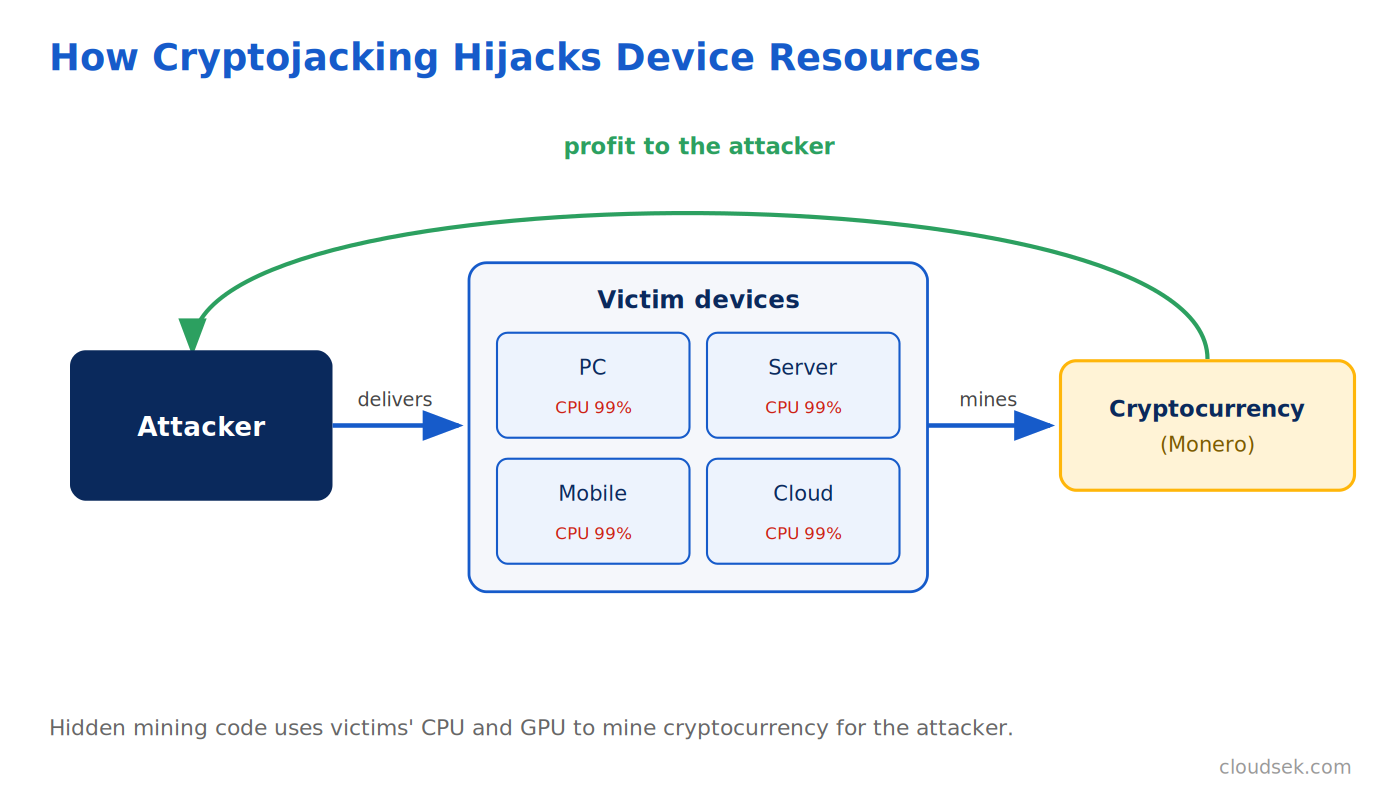
Preventing cryptojacking is important because it drains system resources, increases operational costs, and exposes devices to further security risks. According to the 2024 SonicWall Cyber Threat Report, cryptojacking hits reached 1.06 billion in 2023, a 659% increase over 2022, making it the highest volume SonicWall has recorded since it began tracking the threat in 2018.
Cryptojacking forces systems to use high CPU or GPU power continuously: high usage slows down applications, reduces system performance, and causes overheating. Over time, constant strain damages hardware and shortens its lifespan.
Energy consumption increases significantly during cryptojacking activity: devices consume more electricity to support continuous mining operations. Higher power usage raises operational costs, especially in large environments such as enterprises and cloud systems.
Hidden nature makes cryptojacking difficult to detect. Attackers run mining scripts silently without obvious alerts. Compromised systems may remain infected for long periods, which increases the risk of additional malware or deeper system compromise.
Cryptojacking attacks follow a 4-stage process that enables infection, execution, persistence, and continuous resource exploitation.
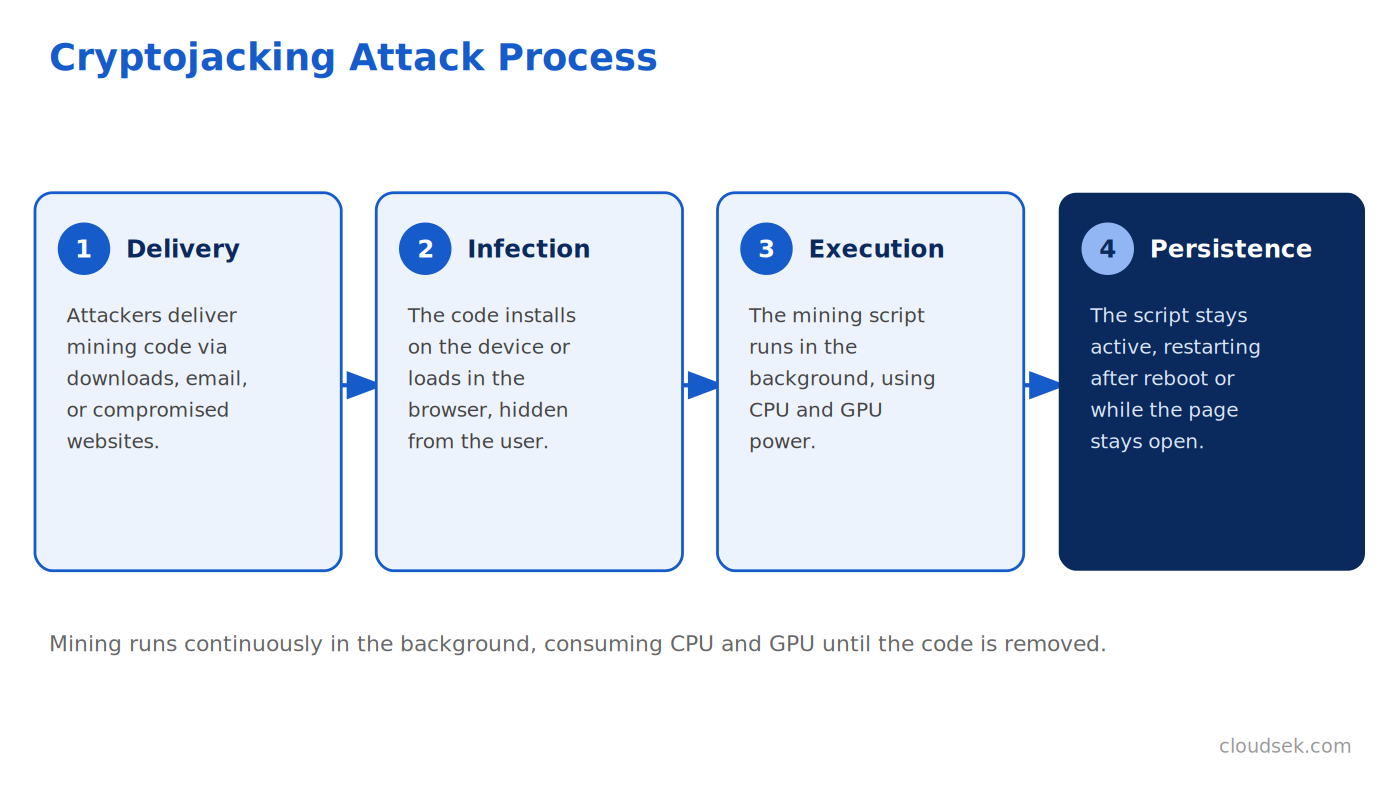
Attackers deliver cryptojacking code, often known as crypto malware, through two main paths: file-based malware and browser-based scripts. Malware enters through downloads, email attachments, or infected software. Browser-based attacks run scripts when users visit compromised websites.
After delivery, the malicious code installs itself on the system or loads into the browser. This step allows attackers to access system resources without user awareness. The infection often remains hidden from standard user activity.
The mining script starts running in the background. It uses CPU or GPU power to perform cryptocurrency mining tasks. This process runs continuously and consumes system resources.
Attackers maintain long-term access by keeping the script active. Malware may restart after a system reboot, while browser scripts run as long as the page remains open. Persistent execution ensures continuous mining without interruption.
Here are the common signs that will appear in your system if it is under attack from cryptojacking:
High CPU or GPU usage appears even when no heavy applications are running. Systems show constant high utilization in task managers. This indicates mining activity using system resources.
Slow performance occurs as mining consumes processing power. Applications take longer to load and respond. Continuous high usage causes systems to overheat and reduces efficiency.
Power consumption increases significantly during cryptojacking. Devices use more electricity due to constant processing. Higher energy usage leads to increased operational costs.
Unknown processes run without user knowledge. These processes appear in system monitors and use significant resources. Hidden background activity indicates a possible cryptojacking infection.
A browser slowdown occurs when visiting certain websites that run mining scripts. Pages become unresponsive, and CPU usage spikes instantly. Closing the tab often restores normal performance, which signals browser-based cryptojacking.
Preventing cryptojacking requires practical steps that block malicious code, secure browsers, and protect system resources.
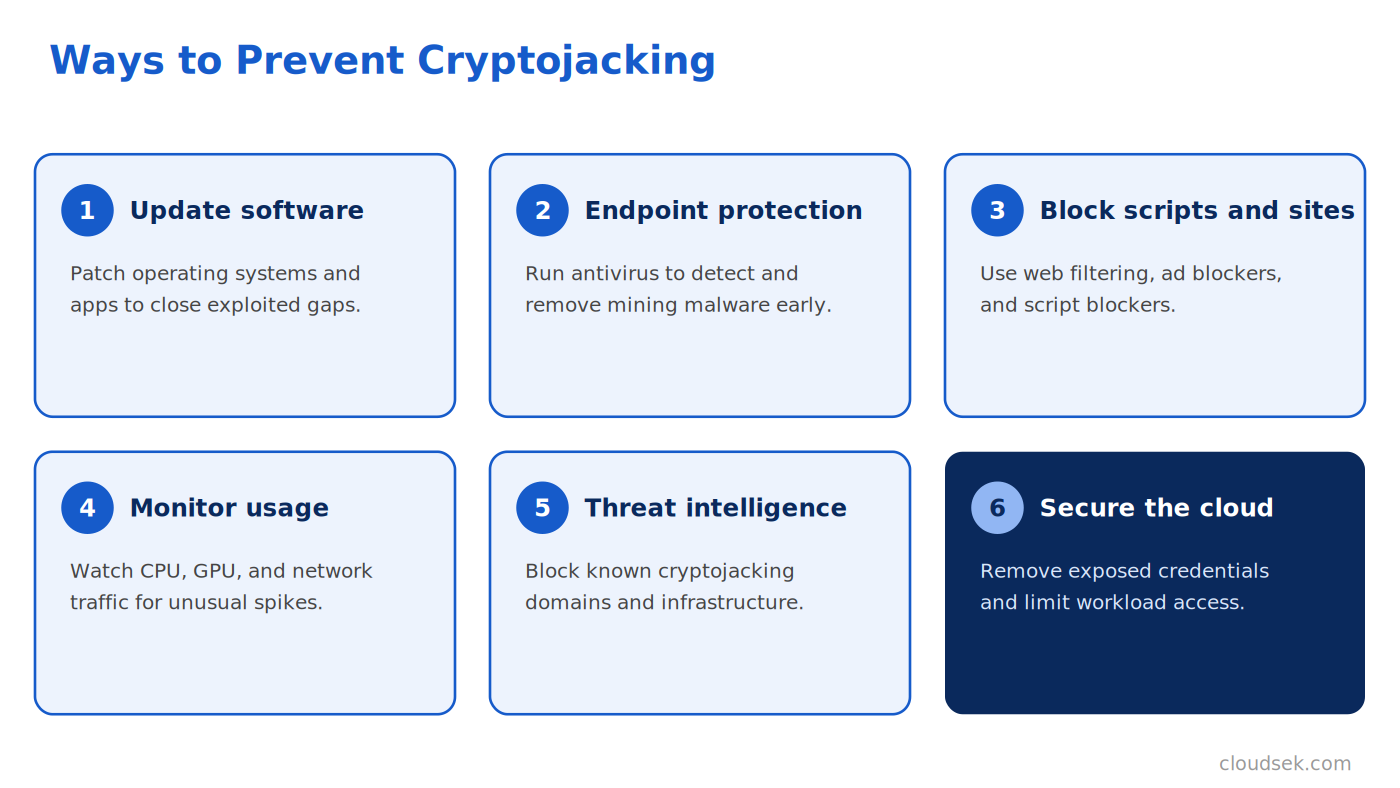
Updates fix known vulnerabilities in operating systems and applications. Attackers exploit outdated software to run mining code. Regular updates close these gaps and reduce risk.
Security tools scan files, processes, and system activity for threats. These tools detect and remove cryptojacking malware early. Continuous protection reduces the chance of infection.
Web filtering blocks access to known malicious domains. Script blocking prevents unauthorized code from running in the browser. This stops browser-based mining before it starts.
Ad blockers remove malicious ads that deliver mining scripts. Script blockers control which scripts run on websites. These tools reduce exposure to hidden mining code.
Unused extensions increase the risk of hidden malware. Removing unnecessary add-ons reduces the attack surface. Fewer extensions mean fewer entry points for malicious scripts.
Monitoring CPU, GPU, and memory usage helps detect unusual activity early. Sudden spikes without heavy tasks indicate possible mining. Regular checks allow quick action before damage increases.
Advanced security measures detect hidden mining activity, control resource usage, and block malicious connections across systems and environments very effectively.
Network monitoring tracks traffic between devices and external servers. Unusual outbound connections or repeated requests to unknown domains indicate mining activity. Continuous monitoring helps detect hidden communication early.
Web filtering blocks access to malicious or high-risk websites. These filters prevent users from loading pages that run mining scripts. Blocking unsafe sites reduces the chance of browser-based cryptojacking.
Threat intelligence provides updated data on known cryptojacking domains, scripts, and attack patterns. Security systems use this data to block threats automatically. Updated intelligence improves detection accuracy and response speed.
Browser security settings restrict unauthorized scripts and extensions. Disabling unnecessary permissions reduces risk. In cloud environments, monitoring workloads and limiting resource access prevent attackers from abusing computing power for mining.
Between 2017 and 2019, attackers widely used Coinhive to run browser-based cryptojacking attacks. The script was injected into compromised websites and ads, allowing attackers to mine Monero using visitors’ devices. Millions of users were affected globally as popular websites unknowingly hosted the script. Systems slowed down significantly, and users experienced high CPU usage. The campaign highlighted how easily web-based cryptojacking could scale without direct malware installation.
In 2018, attackers targeted Tesla by gaining access to its unsecured cloud infrastructure. They used exposed credentials to deploy mining software within the company’s cloud environment. The attack exploited cloud computing power to mine cryptocurrency without authorization. While the exact number of affected systems was not publicly disclosed, the incident increased operational costs and exposed security gaps. Tesla responded by securing access controls and strengthening cloud security measures.
From 2017 to 2019, the Smominru botnet infected over 500,000 systems worldwide. Attackers used the EternalBlue vulnerability to spread malware and take control of systems. Infected devices were used to mine Monero continuously in the background. The attack caused severe performance issues, increased energy consumption, and hardware strain across affected systems. It demonstrated how large-scale botnets could be used for sustained cryptojacking operations.
Cryptojacking campaigns frequently rely on malicious domains, compromised websites, exposed cloud resources, leaked credentials, and attacker infrastructure operating outside internal environments.
CloudSEK’s AI-driven Threat Intelligence and XVigil capabilities help organizations identify external threat signals linked to cryptojacking activity by monitoring malicious infrastructure, suspicious domains, compromised assets, credential exposure, and underground threat activity.
These insights help security teams detect potential mining-related threats earlier, investigate exposure paths, and reduce the risk of unauthorized cryptocurrency mining across endpoints, browsers, cloud workloads, and internet-facing environments.
Continuous monitoring ensures that new threats are identified as they emerge. This approach strengthens prevention by combining visibility, analysis, and timely action without disrupting normal operations.
Cryptojacking primarily consumes resources but can also expose systems to additional threats.
Monero is the most commonly mined cryptocurrency in cryptojacking attacks. It is preferred because it supports anonymous transactions and works efficiently on regular CPUs.
Yes, Cryptojacking affects mobile devices such as smartphones and tablets. Infected apps or malicious websites use device resources, which leads to overheating and battery drain.
Cryptojacking uses system resources silently, while ransomware locks data for payment. Cryptojacking runs in the background, while ransomware shows an immediate visible impact.
Antivirus software reduces risk but does not guarantee complete protection. Advanced attacks may bypass detection, which makes layered security necessary.
Cryptojacking can remain undetected for long periods if no monitoring exists. Low-level resource usage and hidden scripts allow attackers to operate silently.
