🚀 A CloudSEK se torna a primeira empresa de segurança cibernética de origem indiana a receber investimentos da
Leia mais
.avif)

Machine learning em cibersegurança é o uso de algoritmos que aprendem padrões a partir de dados para detectar ameaças, sinalizar anomalias e automatizar a defesa sem a necessidade de uma regra escrita manualmente para cada ataque. O machine learning é um subconjunto da inteligência artificial e impulsiona a maioria das detecções de ameaças modernas, desde a classificação de malware até a análise comportamental.
As equipes de segurança recorrem ao machine learning porque o volume de ataques supera a capacidade de análise manual. Organizações que utilizaram IA e automação de forma extensiva em suas operações de segurança economizaram, em média, US$ 1,9 milhão por violação e contiveram incidentes 80 dias mais rápido, de acordo com o Relatório de Custo de uma Violação de Dados de 2025 da IBM.
O machine learning funciona na cibersegurança treinando modelos com dados de segurança e, em seguida, usando esses modelos para prever se uma nova atividade é maliciosa. O processo é definido por quatro etapas.
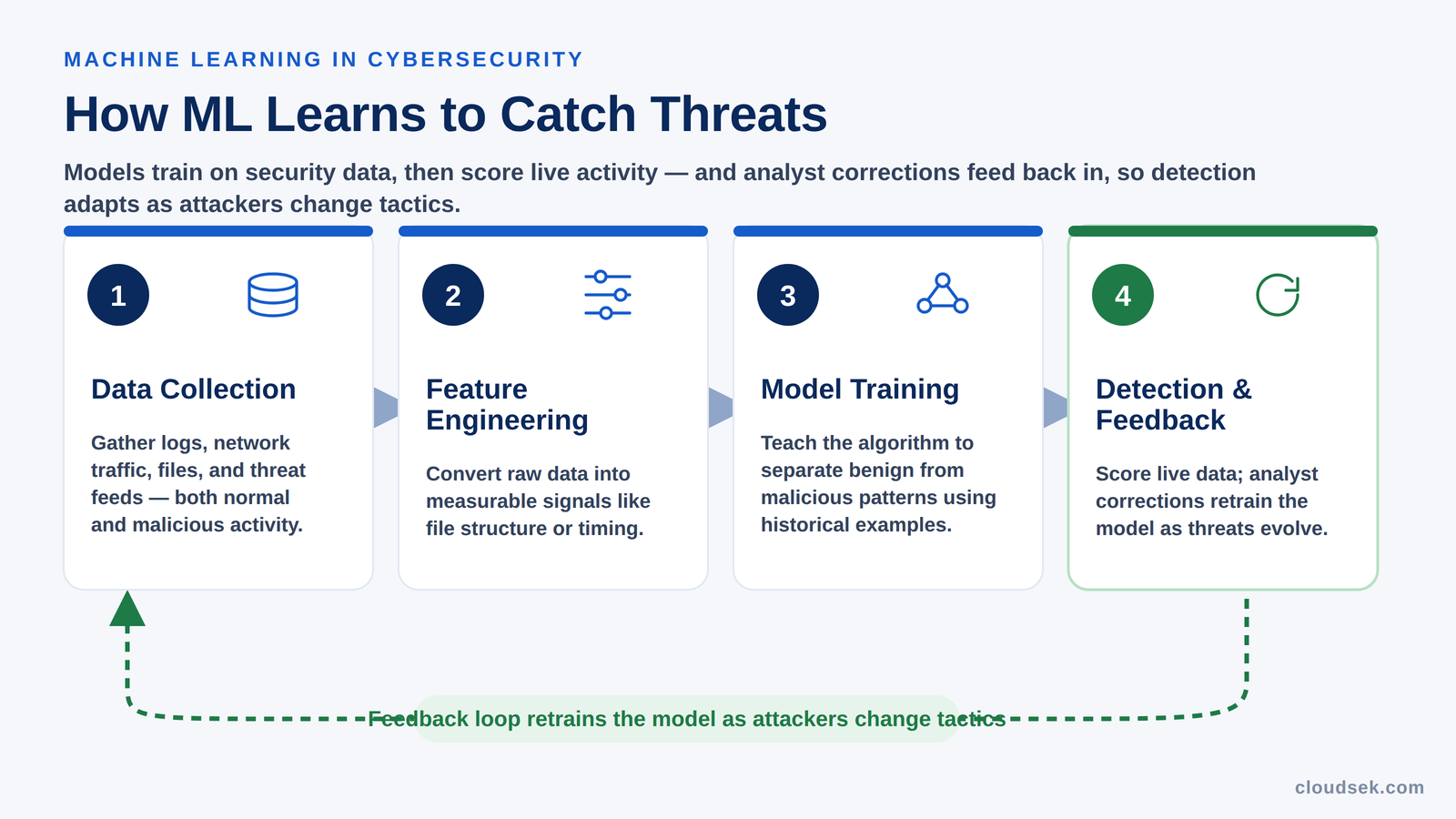
Esse ciclo de feedback permite que os modelos se adaptem conforme os atacantes mudam suas táticas, algo que ferramentas baseadas apenas em assinaturas não conseguem acompanhar.
A cibersegurança utiliza três abordagens principais de aprendizado, além do deep learning — cada uma adequada a diferentes tarefas de detecção.
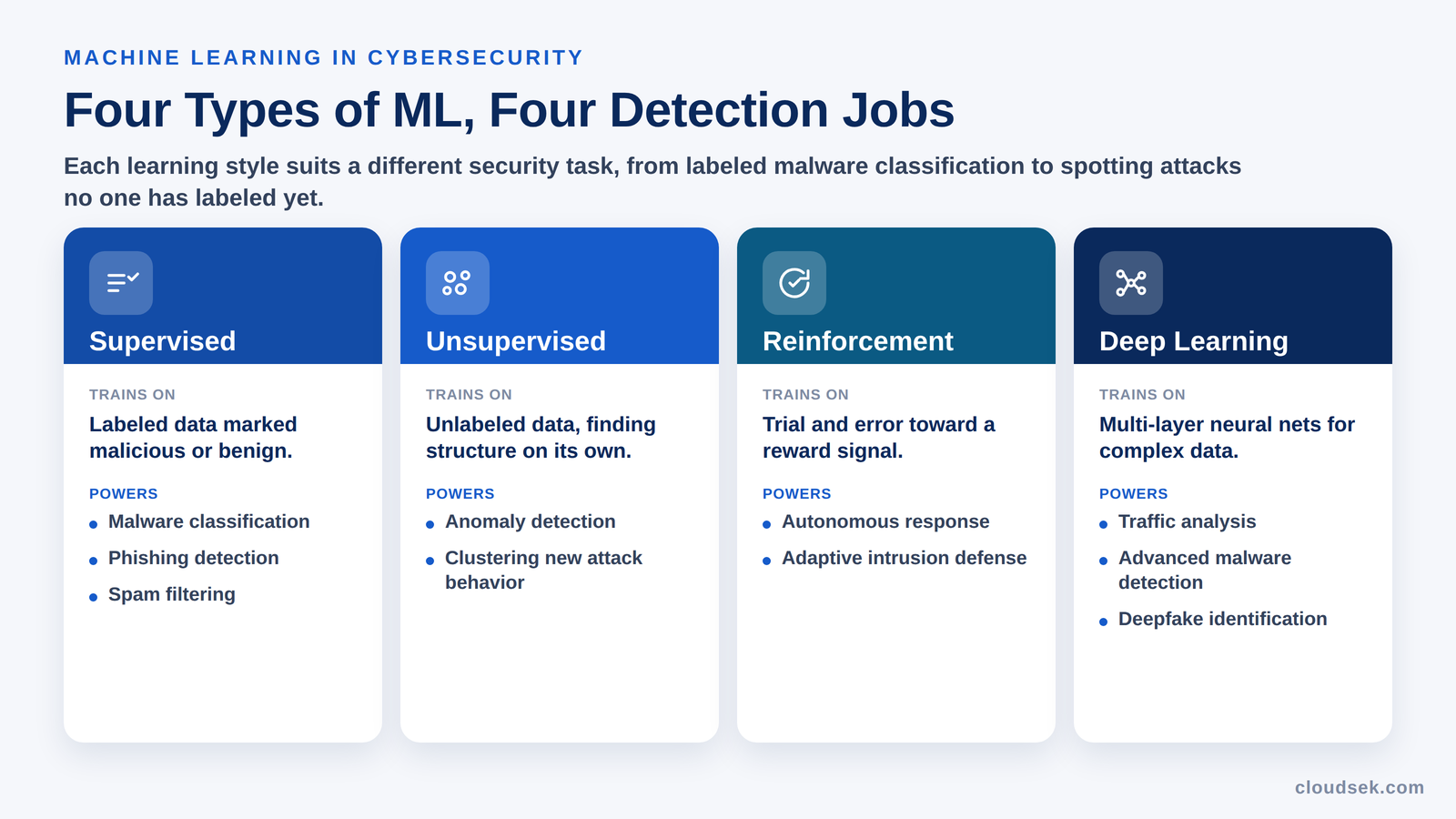
O aprendizado supervisionado treina modelos com dados rotulados, onde cada amostra é marcada como maliciosa ou benigna. Na cibersegurança, ele impulsiona a classificação de malware, detecção de phishinge filtragem de spam, pois o modelo aprende padrões conhecidos como maliciosos e os aplica a novas amostras.
O aprendizado não supervisionado encontra estruturas em dados não rotulados sem categorias predefinidas. As equipes de segurança o aplicam na detecção de anomalias e no agrupamento de novos comportamentos de ataque, pois o modelo revela desvios da atividade normal que ninguém rotulou previamente.
O aprendizado por reforço treina modelos por meio de tentativa e erro em direção a um sinal de recompensa. Na cibersegurança, ele apoia a resposta autônoma e a defesa adaptativa contra intrusões, onde um agente aprende quais ações contêm uma ameaça ao longo de tentativas repetidas.
O deep learning utiliza redes neurais multicamadas para modelar dados complexos e de alta dimensão. Ele lida com análise de tráfego, detecção avançada de malware e identificação de deepfakes, tarefas onde os padrões são sutis demais para serem capturados por modelos mais simples.
O machine learning apoia a detecção e a resposta em sete funções principais de segurança.
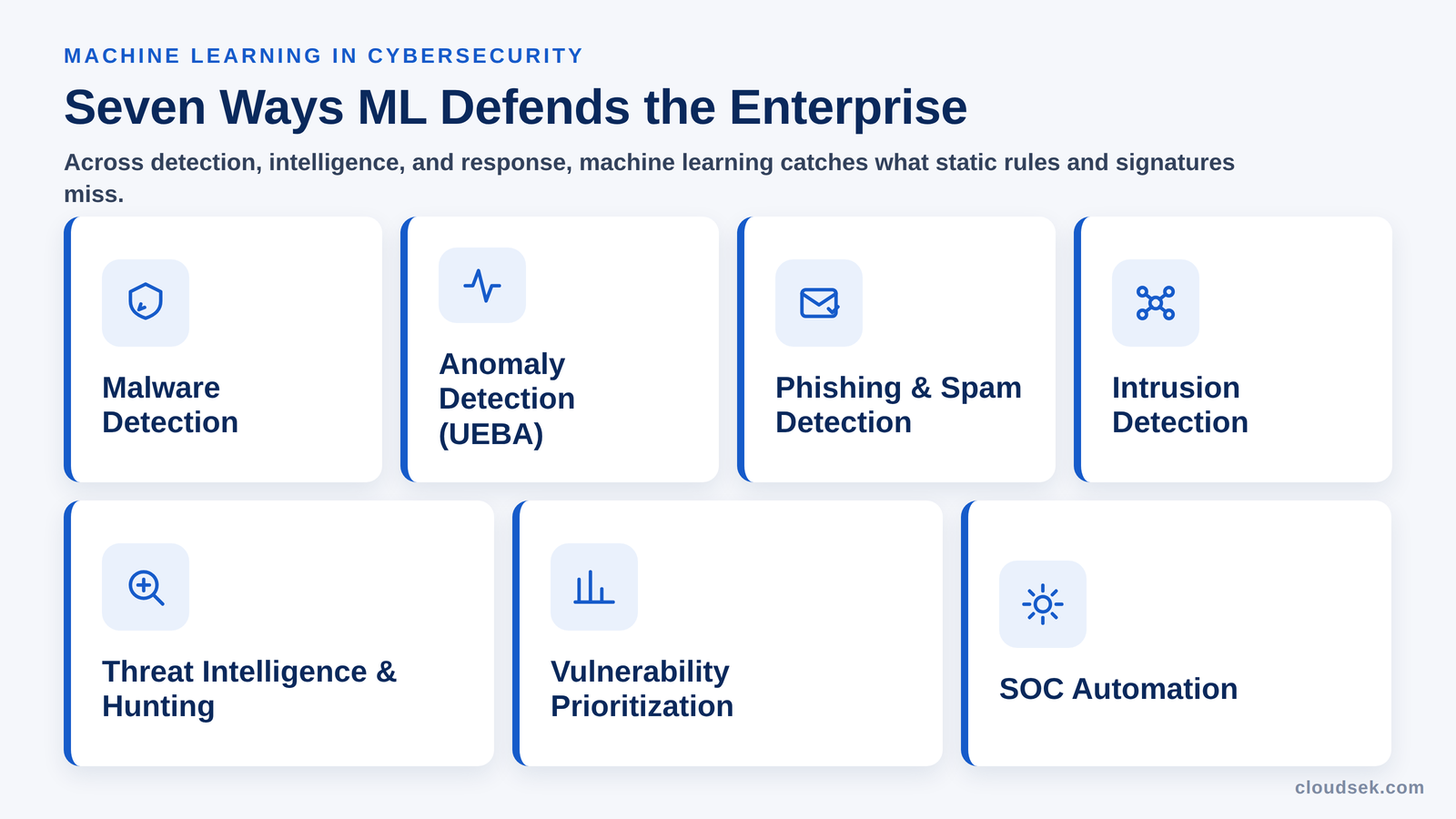
O machine learning classifica arquivos como maliciosos ou benignos aprendendo características de milhões de famílias de malware. Os modelos sinalizam amostras novas e modificadas que as bases de dados de assinaturas não detectam, incluindo variantes polimórficas que alteram seu código para evitar a detecção.
Modelos não supervisionados aprendem uma linha de base do comportamento normal de usuários e redes, sinalizando então desvios que indicam comprometimento. Essa abordagem, conhecida como análise de comportamento de usuários e entidades (UEBA), detecta ameaças internas e invasões de contas que regras fixas deixam passar.
O machine learning pontua e-mails e URLs com base no idioma, reputação do remetente e estrutura para filtrar phishing e spam. Os modelos se adaptam a novas iscas mais rapidamente do que listas de bloqueio estáticas, reduzindo o sucesso da engenharia social.
Os modelos analisam padrões de tráfego para detectar intrusões, movimentação lateral e atividades de comando e controle. O machine learning aumenta as taxas de detecção para tráfego evasivo e criptografado que sensores baseados em regras não identificam.
O machine learning correlaciona sinais de feeds de ameaças, fontes da dark web e telemetria para revelar campanhas emergentes. Ele classifica indicadores por relevância, permitindo que analistas busquem as ameaças com maior probabilidade de atingir seu setor.
Os modelos preveem quais vulnerabilidades os invasores provavelmente explorarão, utilizando a atividade de exploração, a exposição de ativos e o contexto da ameaça. Essa priorização foca na correção de falhas que representam riscos reais, em vez de apenas pontuações de gravidade bruta.
O aprendizado de máquina faz a triagem de alertas, agrupa eventos relacionados e aciona a contenção automatizada para detecções de alta confiança. Os centros de operações de segurança o aplicam para reduzir a fadiga de alertas e diminuir os tempos de resposta.
O aprendizado de máquina oferece seis vantagens que a defesa manual não consegue escalar.
O aprendizado de máquina na cibersegurança apresenta principalmente seis limitações que moldam a forma como as equipes o implementam.
Os atacantes usam o aprendizado de máquina para escalar e aprimorar suas operações, transformando a tecnologia da qual os defensores dependem em uma ferramenta ofensiva. A IBM constatou que 1 em cada 6 violações em 2025 envolveu atacantes usando IA, mais frequentemente para phishing e falsificação de identidade por deepfake.
O aprendizado de máquina ofensivo assume três formas principais.
O aprendizado de máquina é um subconjunto da inteligência artificial, não uma tecnologia separada. A inteligência artificial é o objetivo amplo de máquinas que realizam tarefas que exigem inteligência semelhante à humana, enquanto o aprendizado de máquina é o método específico de aprender essas tarefas a partir de dados.
Em cibersegurança, a maioria das ferramentas comercializadas como IA opera com modelos de aprendizado de máquina treinados para detectar ameaças. A distinção é importante ao avaliar fornecedores: uma alegação de IA geralmente significa modelos supervisionados ou não supervisionados por trás das cortinas.
A CloudSEK aplica IA em toda a sua plataforma de segurança para ajudar as equipes de segurança a passar de descobertas isoladas para uma visão de como os invasores podem encadear exposições em um caminho de ataque. Em vez de posicionar o aprendizado de máquina como um mecanismo de detecção independente, a CloudSEK combina correlação orientada por IA, inteligência contra ameaças e monitoramento externo contínuo para identificar e priorizar caminhos de ataque.
Nexus AI é a camada de inteligência de caminho de ataque da CloudSEK. Ela correlaciona sinais de risco digital, inteligência contra ameaças, superfície de ataque externa, superfície de ataque de IA e ecossistemas de terceiros em um grafo de ataque unificado. Ela utiliza agentes de IA e raciocínio agentico para determinar como um invasor poderia encadear exposições, como credenciais vazadas, ativos vulneráveis, configurações incorretas de IA e fraquezas de fornecedores, em um caminho de ataque executável.
Essa abordagem complementa as operações de segurança tradicionais em vez de substituí-las. Embora um SOC possa investigar alertas individuais de ferramentas de endpoint, rede ou outras ferramentas de segurança internas, o Nexus AI foca em sinais externos e relacionados à IA para mostrar qual combinação de exposições poderia dar a um invasor um caminho para dentro da organização e o que deve ser interrompido primeiro.
A CloudSEK AIVigil estende essa abordagem para a superfície de ataque de IA. Ela descobre continuamente ativos de IA — incluindo infraestrutura de IA exposta, endpoints de IA, servidores MCP, bancos de dados vetoriais, fluxos de trabalho de agentes e IA sombra — e os avalia quanto a exposições específicas de IA. Essas descobertas podem então ser integradas ao Nexus AI, onde os riscos da camada de IA podem ser correlacionados com ameaças externas e exposições de terceiros para revelar caminhos de ataque mais amplos.
A Inteligência de Ameaças da CloudSEK fornece contexto adicional sobre agentes de ameaças, vulnerabilidades, malware, ransomware e outras ameaças externas. Juntas, essas capacidades ajudam as equipes de segurança a entender não apenas o que está exposto, mas como um invasor poderia combinar essas exposições— mudando o foco de alertas e vulnerabilidades individuais para os caminhos de ataque que realmente importam.
O aprendizado de máquina em cibersegurança exige habilidades em ciência de dados, programação e fundamentos de segurança. Os profissionais combinam estatística e construção de modelos com conhecimento sobre ataques, redes e análise de ameaças.
Python é a linguagem principal para ML em cibersegurança, com suporte de R e Java. Bibliotecas Python como scikit-learn e TensorFlow lidam com a maior parte da construção de modelos e do trabalho com dados.
Não, deep learning é um subconjunto especializado do aprendizado de máquina. O deep learning utiliza redes neurais de múltiplas camadas para dados grandes e complexos, enquanto o aprendizado de máquina também abrange modelos mais simples.
O aprendizado de máquina em cibersegurança está caminhando para sistemas autônomos e agentes que investigam e respondem com menos intervenção humana. A adoção continua a crescer à medida que os atacantes ampliam seu próprio uso de IA.
Sim, pequenas empresas podem usar aprendizado de máquina por meio de ferramentas de segurança em nuvem que já trazem essa tecnologia integrada. Serviços de detecção gerenciada e plataformas SaaS oferecem defesa baseada em ML sem a necessidade de cientistas de dados internos.
Sim, antivírus modernos e ferramentas de endpoint usam aprendizado de máquina para detectar malwares desconhecidos. Classificadores de ML identificam arquivos maliciosos pelo comportamento e estrutura, indo além da simples correspondência de assinaturas.
