🚀 A CloudSEK se torna a primeira empresa de segurança cibernética de origem indiana a receber investimentos da
Leia mais


Businesses protect customer data by locating retained copies, limiting unnecessary collection, and restricting retrieval to authorized people and services. Those responsibilities extend to downstream copies, not just records held in the original database. An unrestricted export or poorly authorized API can disclose sensitive details even when the primary repository is secured.
Classification and retention requirements determine how identified records must be handled and when they should be removed. Permission restrictions govern who retrieves the remaining data, while encryption and application testing address distinct technical weaknesses. Supplier assessments and external monitoring investigate concerns beyond systems reviewed internally. Written policies assign accountability, while remediation measurements and incident exercises examine whether corrective actions were completed and personnel are prepared to respond.
Customer data protection refers to the organizational responsibilities and technical safeguards used to prevent unauthorized disclosure, alteration, misuse, and loss of records associated with customers. It covers details collected directly from individuals alongside material generated through purchases, service interactions, and account administration. Confidentiality, integrity, and availability remain central objectives whether the records reside within the business or with an authorized provider. Handling rules also govern permitted use, sharing arrangements, retention periods, and disposal.
The security significance of a customer record depends on what it reveals, whether it authorizes an account action, and how it relates to details held elsewhere.
A government-issued identification number directly identifies an individual, whereas location histories or device identifiers become more revealing when linked to an account. Removing names from a dataset therefore does not necessarily prevent someone from recognizing the people represented in it. Businesses combining records for analytics or sharing de-identified material need to examine whether the remaining details permit identification.
Payment credentials present a different concern from invoices or billing histories because certain authentication details facilitate transactions. The PCI Security Standards Council prohibits storing sensitive authentication data after authorization, including card verification codes, even when the material has been encrypted.
A valid session token represents an authenticated session and may permit requests without another password entry. Recovery codes and reset links serve a different purpose, allowing account entry to be restored under specified conditions. The consequences of disclosure depend on the secret's remaining validity and the privileges associated with the affected identity. Revoking an exposed session and resetting a password are not necessarily interchangeable remedies.
Support conversations rarely follow the structured fields found in an account profile. A service ticket might combine an ordinary delivery question with a photograph of an identification document, making its actual contents more sensitive than the platform's general classification suggests.
Recurring purchases, payment dates, and delivery destinations reveal patterns in spending and commercial relationships. Account changes add another dimension by showing how a person interacts with a business over time. These histories primarily document transactions rather than authorize payments, yet disclosure still carries privacy implications.
An isolated website visit reveals relatively little, but a sequence of browsing events can describe interests or personal circumstances. Profiling may produce inferences about health-related concerns or preferences never explicitly provided by the individual. Medical details, biometric identifiers used for identification, and certain records concerning children warrant separate consideration because their contents or applicable laws impose additional obligations. Unlike information that is sensitive when collected, behavioral inferences acquire their significance through subsequent analysis.
Unauthorized disclosure, alteration, theft, and service disruption arise through different attack methods and failures in how systems handle protected records.
The threats described above reach customer records through different systems, accounts, and supplier relationships. Before selecting safeguards, a business needs to establish the locations and transfers that those threats could affect.
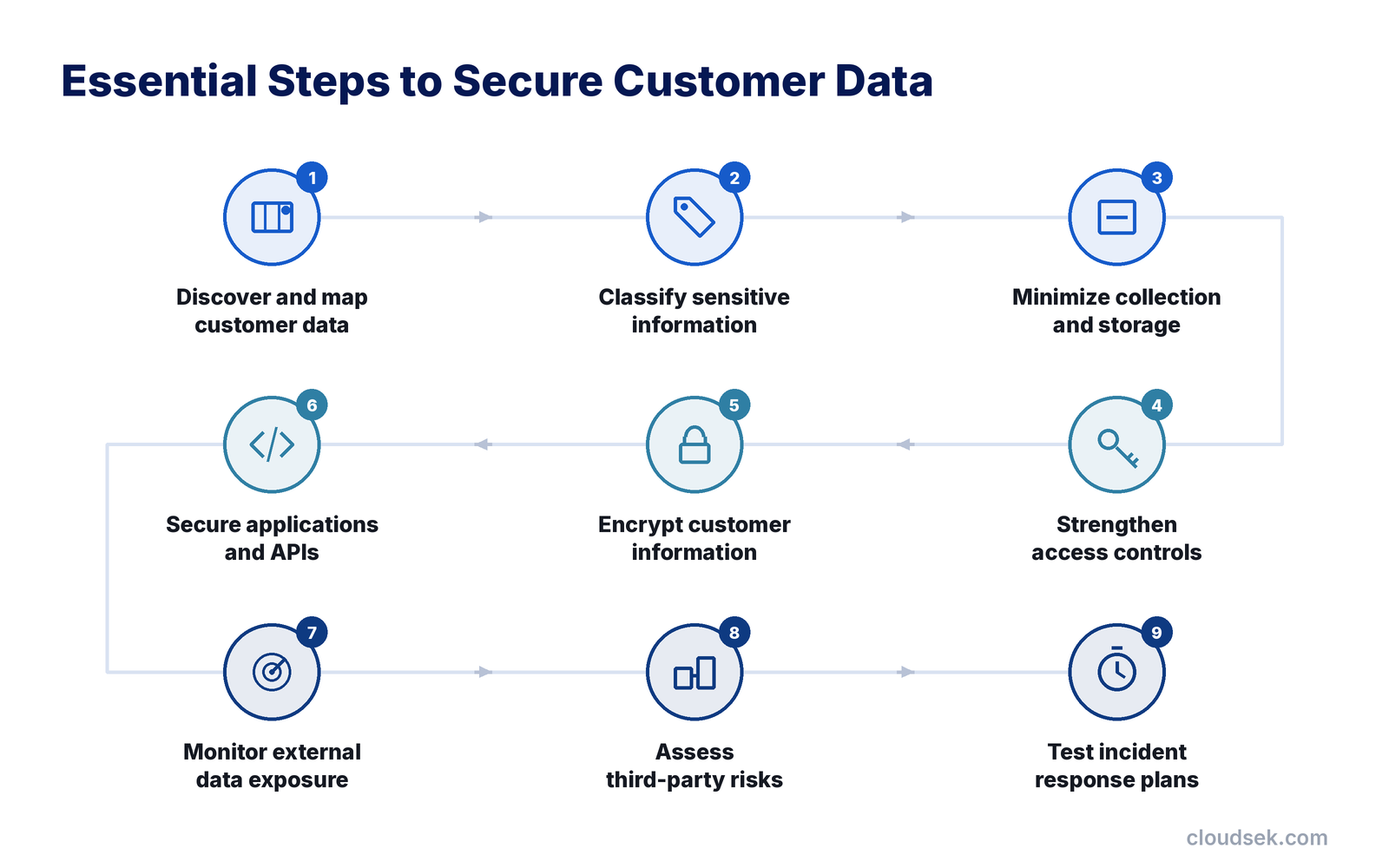
Consider an order that moves from a storefront into warehouse software before reaching a delivery partner. Although the customer submits the details once, several systems subsequently hold portions of the transaction. Tracing those transfers reveals both the locations involved and the organizations responsible for handling the records.
A usable inventory connects every relevant source and destination with its business purpose, data category, and accountable owner. The European Commission's data-processing register illustrates how purposes, recipients, international transfers, and anticipated erasure periods are recorded together rather than maintained as unrelated asset lists.
Knowing where a file resides does not determine the restrictions its contents require. Classification connects the sensitivity of those contents with handling decisions based on potential harm, business purpose, and legal obligations. NIST's February 2026 public draft of its Data Classification Practices guide demonstrates discovery and labeling of sensitive unstructured data using a synthetic dataset, although the publication remains a draft rather than a finalized standard.
Retaining customer details beyond their legitimate purpose leaves a larger volume of sensitive material at risk if a repository is compromised. Retention decisions need to reflect ongoing business needs and legal preservation duties instead of allowing outdated copies to accumulate.
France's CNIL found that Free Mobile had kept millions of former subscribers' records for excessive periods, as explained in its January 2026 enforcement announcement involving Free Mobile and Free. The decision followed an investigation associated with an October 2024 breach and addressed unjustified retention alongside other security deficiencies. Avoiding the same retention problem requires checking collection fields, temporary exports, and duplicate datasets against their documented purposes and retention schedules. Once an authorized retention period ends, deletion or secure disposal must be completed and verified, subject to any continuing preservation obligation.
An employee checking an order's delivery status does not need unrestricted permission to export the entire customer database. Least privilege limits account capabilities to the tasks associated with the person's actual responsibilities.
A February 2026 decision published by Singapore's Personal Data Protection Commission described ransomware affecting a B2B e-commerce service provider and rendering personal details relating to approximately 39,000 individuals inaccessible. The regulator identified weak permission restrictions, unpatched systems, and failure to enforce multifactor authentication among the deficiencies. Its announcement did not establish that the affected data had been stolen.
Authentication confirms the identity making a request, whereas authorization determines what that identity is permitted to retrieve or change. Entitlement reviews need to follow role changes and account retirement, with checks against the affected systems to confirm that revoked privileges no longer function.
A stolen storage device presents a different threat from an intercepted connection between applications. Encryption at rest protects stored content under relevant compromise conditions, whereas encryption in transit protects communications when suitable protocols are correctly configured. Neither prevents a compromised account from requesting plaintext that its assigned permissions allow it to retrieve.
The Australian Signals Directorate's September 2026 cryptography guidelines address protection for stored and transmitted data alongside cryptographic key management. Technical assessments must examine how keys are generated, stored, restricted, rotated, and retired. If an attacker hijacks an authorized session, investigating the identity and application permissions becomes necessary even when the underlying encryption remains correctly configured.
A successful login proves that an identity passed the application's authentication checks, not that every subsequent request is authorized. OWASP's API1:2023 Broken Object Level Authorization guidance illustrates how manipulating shop identifiers in an e-commerce API could reveal sales information belonging to different stores. That scenario demonstrates a resource-level authorization failure rather than documenting a specific historical breach.
A publicly shared file, leaked authentication secret, or reachable repository first needs to be associated with the organization before investigators assess its significance. The initial questions concern what is visible, whether the material is genuine, and which system or account is affected.
The Canadian Centre for Cyber Security's April 2026 guidance on assessing publicly accessible content describes examinations for protected material published outside approved boundaries and checks confirming its removal. Those assessment requirements apply to specified information under Canadian government arrangements rather than customer records generally, but they provide a concrete example of reviewing public disclosures. Finding an authentication secret in a leaked collection does not demonstrate that an intruder successfully used it, so investigators must establish its relationship to the affected service and examine available evidence before determining whether unauthorized entry occurred.
Once the exposure is validated, the responsible account or system owner needs to carry out the appropriate corrective action. Depending on the finding, that might involve revoking a secret, changing repository permissions, or restricting a reachable service. A follow-up assessment must check the affected resource and preserve any unresolved questions about prior misuse.
Service providers sometimes retain sensitive records within environments the original business cannot administer directly. Supplier assessment therefore needs to examine the entrusted datasets, employee permissions, and arrangements governing the relationship.
The Australian privacy regulator’s July 2026 report on its preliminary inquiries into Qantas examined a June 28, 2025 incident involving an overseas contact center. An attacker impersonated Qantas IT personnel and deceived an agent into connecting a customer relationship management system to an attacker-controlled extraction tool, compromising approximately 5.67 million customer records worldwide. The regulator's preliminary inquiries did not find grounds to conclude that Qantas had failed to take reasonable privacy-security precautions, and no formal Commissioner-initiated investigation followed that review.
An incident involving a supplier calls for investigation of the actual customer impact rather than an automatic conclusion of regulatory noncompliance. Assessment findings should remain unresolved until corrective work is verified or a risk exception receives formal approval.
A suspected breach can require containment decisions before investigators establish which accounts and datasets are affected. That uncertainty complicates decisions when a supplier operates the relevant infrastructure. ENISA's February 2026 Cybersecurity Exercise Methodology describes an approach to planning exercises around explicit objectives, participating roles, and evaluation of decisions made during simulated incidents.
Technical investigation, legal assessment, containment, and communications require designated owners before an event occurs. Escalation instructions must specify who authorizes restrictions on affected accounts or services. Relevant logs and investigative materials need preservation according to the circumstances. Notification and recovery decisions must then reflect established facts and the governing legal or contractual obligations.
A tabletop scenario involving suspected disclosure through a supplier tests how those responsibilities interact. Missed escalations and unresolved decisions become corrective tasks that can be examined again during subsequent exercises.
A formal policy assigns responsibility for handling customer records and sets mandatory rules for employees and external providers. The US Federal Trade Commission's Safeguards Rule guidance illustrates written program requirements, designated accountability, and service-provider oversight for covered financial institutions rather than businesses generally.
A June 2026 audit of eight federal cloud systems by the US Government Accountability Office found full implementation of continuous monitoring for three of the selected systems. The limited government sample illustrates why written security expectations must be assessed separately from evidence that they are functioning, rather than serving as an industry-wide benchmark.
Inventory coverage compares validated register entries with the independently discovered population of in-scope repositories. Dividing represented repositories by that population and multiplying by 100 produces the coverage percentage. Unknown systems remain outside the denominator, so a high result does not prove that discovery was exhaustive.
Completed entitlement reviews and actual removal of excessive privileges are separate outcomes. A reviewer's approval does not change an account's capabilities until the restriction takes effect. Identity-management logs and resource-level settings establish which changes were enforced. Unresolved exceptions must remain visible beside completed corrections.
Stored-data assets and transmission paths require assessment against the cryptographic settings and key-management obligations relevant to their environment. The proportion passing those checks indicates configuration compliance, not whether application permissions are correctly enforced.
The remediation interval begins when an externally observed weakness is confirmed and ends after its correction has been independently checked. Investigation timestamps, tickets, and retest results establish the duration for completed cases. Open findings need separate reporting because they lack a validated closure date. The measure describes response to discovered weaknesses rather than the completeness of external monitoring.
The resolution rate is the percentage of supplier findings due for remediation during a reporting period that were confirmed as corrected. Follow-up assessments and issue-tracking evidence determine which cases qualify. Accepted exceptions and overdue actions must remain separate from completed remediation.
The preceding measurements evaluate known repositories, completed security changes, and supplier findings already under review. CloudSEK's AI-native predictive cyber intelligence adds externally observed evidence involving leaked secrets, internet-facing assets, supplier dependencies, and potential attack paths. Those findings direct attention to conditions that security teams need to investigate against their own environments.
Corrective action remains with the teams responsible for affected accounts, infrastructure, and supplier relationships. CloudSEK's intelligence informs those decisions but does not replace encryption, internal authorization enforcement, or direct remediation.
Data Protection as a Service (DPaaS) refers to protection functions delivered through managed or cloud-based services. Offerings differ, with certain providers concentrating on backup and recovery and others including encryption or related capabilities. The term describes how particular services are delivered, not the full organizational responsibility of safeguarding customer records.
Customer data consists of records a business holds or generates through its customer relationships. Personal data concerns an identified or identifiable individual under the governing legal definition. A commercial account might include company transaction histories alongside personal details belonging to an employee or representative. The categories overlap, but personal details also concern people who have no customer relationship with the business.
Responsibility depends on the organization's role and the applicable legal framework. Business leadership assigns accountability, technical teams implement safeguards, and employees follow the permitted handling arrangements. Service providers and processors also have duties arising from legislation, contracts, and the work they perform.
Cross-border storage is not universally prohibited, although permitted arrangements depend on the countries involved, the category of data, and the parties handling it. Particular jurisdictions require recognized transfer mechanisms or additional safeguards before personal records are transferred abroad. Contractual restrictions and sector-specific rules sometimes impose further conditions. A hosting decision therefore needs to account for the actual destination and processing relationship.
Before submitting confidential customer details to an AI service, a business needs an authorized purpose and an understanding of the provider's handling arrangements. Retention periods, onward disclosure, and additional uses of submitted material influence whether a particular service is appropriate. On October 8, 2026, the UK’s data protection regulator, the ICO, reported changes made or committed to by ten major foundation-model developers, alongside increased scrutiny of agentic AI. Those commitments do not establish that every AI service is suitable for confidential records, making the assessment specific to the provider and intended use.
Yes, backup copies require safeguards appropriate to the records they contain, including copies held outside production environments. Permission restrictions, encryption, retention, and disposal arrangements must account for recovery needs and preservation obligations. Restoration exercises test whether the necessary material remains recoverable without unnecessarily disclosing its contents during recovery.
