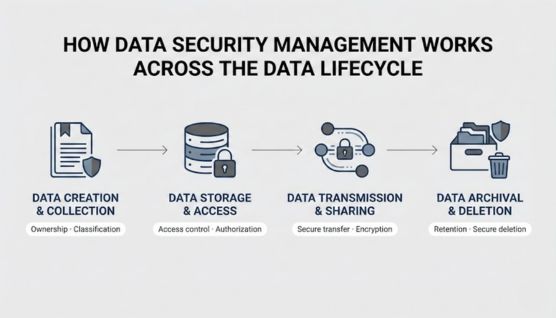
Data security management is the practice of protecting an organization's data across its entire lifecycle, from creation through deletion, using policies, access controls, encryption, and monitoring. It exists to keep data confidential, accurate, and available.
Technology alone does not deliver it. Governance decides what the controls protect, data owners decide who needs access, and employees handle the data every day. A program that treats this as a tooling problem protects whatever the tools happen to see and nothing else.
Data Security Management Across the Data Lifecycle
Controls change as data moves. What protects a record in storage does nothing for the same record in transit, so lifecycle stages make the useful organizing unit.
Creation: Data is classified and assigned an owner at the point it is created or collected. Getting this wrong means every later control lands on the wrong things.
Storage: Encryption at rest and access restrictions govern who can read, change, or delete stored data.
Use: Access policies limit interaction by role and business need, so a user reaches only what their job requires.
Sharing: Data loss prevention and secure transfer protect data in motion between people, systems, and third parties.
Archiving: Retention policies define how long data is kept and under what controls, balancing legal obligation against unnecessary exposure.
Deletion: Secure destruction removes data irrecoverably at end of life. Data kept past its purpose carries risk with no remaining business value.
Data Creation and Collection
Security starts when data is created or collected by assigning ownership and determining its sensitivity level. This ensures appropriate controls are applied before the data is widely accessed or stored.
Data Storage and Access
Stored data is protected through access controls that restrict who can view, modify, or delete it. Authentication and authorization mechanisms help prevent unauthorized or excessive access.
Data Transmission and Sharing
When data is transmitted or shared, security measures protect it from interception and misuse. Secure transfer methods and encryption help maintain confidentiality during movement.
Data Archival and Deletion
Archived data must remain protected even when it is no longer actively used. Secure deletion processes ensure outdated or unnecessary data is permanently removed and cannot be recovered.
What Are the Main Threats to Data Security?
Controls exist to answer specific threats. Naming those threats makes the control set legible instead of arbitrary.
Credential theft and account takeover: bypass traditional alerts, since valid logins access data without triggering failed‑access warnings. Monitoring for leaked credentials must sit alongside access controls, not downstream of them.
Ransomware and extortion: encryption of production data, increasingly paired with exfiltration so payment is demanded twice. Tested backups decide the outcome.
Misconfiguration: open storage buckets, permissive database rules, and default settings expose sensitive data without requiring attacker skill or exploitation.
Insider misuse and error: authorized people moving data to unauthorized places. Malicious intent is the rarer half; misdirected email and personal cloud storage accounts account for more incidents.
Third-party and vendor exposure: processors, contractors, and SaaS platforms hold data under controls the owning organization never inspects, which vendor risk monitoring exists to surface.
Social engineering: manipulation of people with legitimate access, delivered through phishing and pretext calls that bypass every technical control in place.
AI and shadow data flows: production data pasted into prompts, embedded in vector stores, or used for fine-tuning, commonly with no classification and no retention rule applied.
CIA Triad in Data Security Management
Every control in DSM traces back to one of three properties. The model is old, and it remains the cleanest way to explain why a given control exists.
Confidentiality: only approved users and systems can view or use the data. Access control, authentication, and encryption all serve this.
Integrity: data stays accurate and unaltered from creation through use. Checksums, version history, and change monitoring support it.
Availability: authorized users reach data when they need it. Backups, redundancy, and recovery planning protect it, including during an attack.
Why Is Data Security Management Important?
Data keeps moving into systems the security program never scoped, and governance arrives years behind adoption every time. IBM's Cost of a Data Breach 2025 measured that gap directly: 97 percent of organizations breached through an AI system had no access controls governing it, and 63 percent held no AI governance policy at all.
Those numbers describe a pattern older than AI. Cloud storage, collaboration platforms, and analytics tools each arrived the same way, adopted by business teams and scoped by security afterwards.
Consequences land in four places. Operations halt when data becomes unavailable. Regulators impose penalties where controls existed and went unused. Customers leave once an exposure becomes public, and the fallout commonly arrives as brand impersonation campaigns built on the leaked records. Ransomware operators price their demand against what the data is worth to the business, not what it cost to store.
What Are the Core Controls in Data Security Management?
Controls group into functions, and each one answers a different question. A program missing any of them carries a gap the others cannot cover.
Knowing What Data Exists
Discovery locates sensitive data across cloud, on-premises, and third-party systems. Classification tags it by sensitivity and regulatory relevance so controls apply automatically without a manual decision each time. Nothing downstream works without this, because controls cannot protect data nobody has found.
Controlling Who Reaches It
Identity and access management decides who authenticates and what they can access afterwards. Authentication verifies identity, authorization scopes it by role, and zero trust conditions re-check both on every request instead of once at login. Least privilege keeps the blast radius of any compromised account small.
Protecting the Data Itself
Encryption renders data unreadable without the correct key, at rest and in transit. Key management governs how those keys are generated, stored, rotated, and revoked, and weak key handling undoes strong encryption entirely. Masking and tokenization substitute realistic non-sensitive values, which removes real data from test and analytics environments.
Watching and Recovering
Continuous visibility into access and usage comes from monitoring. Logging records events for investigation and audit. Data loss prevention blocks unauthorized movement across email, endpoints, and cloud applications. Backup and tested recovery restore data after loss or encryption-based extortion, and an untested backup remains an assumption, not a control.
DSPM and Its Role in Data Security Management
Data security posture management is a cloud-focused capability within the wider discipline. It continuously discovers, classifies, and monitors sensitive data, then flags the risks around it: excessive access, misconfiguration, and unmonitored copies scattered across cloud services.
Knowing where the data actually lives is the contribution that matters here. Applying the right encryption or access policy requires knowing where the sensitive data actually lives, and cloud environments generate copies faster than manual inventory can track them.
Two words name the specific problem it addresses: shadow data. Snapshots, backups, test datasets, and exports accumulate outside the managed estate, and AI adoption accelerated this sharply. Prompts, fine-tuning datasets, and vector stores now hold production data inside the AI attack surface, with no classification applied to any of it.
What Is the Difference Between Data Security and Data Privacy?
Data security controls who can reach data. Data privacy governs whether the organization should hold that data at all, and what it may lawfully do with it.
A company can encrypt a dataset perfectly, restrict access to three named people, log every read, and still breach privacy law. The controls are sound, and the collection was never permitted.
The reverse fails too. A lawful basis for processing, a published privacy notice, and signed consent offer no protection when the database sits behind a default password.
Security answers to threat actors. Privacy answers to data subjects and regulators. Most programs need both, and the two belong to different teams under different reporting lines, so a single owner rarely covers the whole obligation.
Data Security Management vs Data Governance, Information Security, and Cybersecurity
These adjacent disciplines get used interchangeably in everyday practice. Scope separates them, and that separation decides which team owns any given control.
Aspect
Data Security Management
Data Governance
Information Security
Cybersecurity
Core Question
Who can reach this data?
Who owns it and how is it used?
How is information protected overall?
How is the environment defended?
What It Covers
Data itself, wherever it resides
Ownership, quality, definitions, permitted use
All information, including physical records
Systems, networks, infrastructure
Typical Controls
Classification, encryption, IAM, DLP, retention
Stewardship, catalogs, data quality rules
Policy, risk assessment, audit programs
Firewalls, EDR, segmentation, monitoring
Usual Owner
Security engineering with data owners
Chief data officer or data management
Governance, risk, and compliance
Security operations
Failure Looks Like
Sensitive data readable by the wrong people
Nobody can say who owns a dataset
Controls exist, but nothing verifies them
An attacker inside the environment
Governance and security get conflated more than any other pair here. Governance decides that customer records belong to the retail business unit and may be used for service delivery. Security enforces that only the retail service team can read them. Information security management frames both, and cybersecurity protects the environment all three depend on.
Frameworks That Guide Data Security Management
Most programs build on an existing framework instead of inventing one. Four references cover almost every enterprise deployment.
NIST Cybersecurity Framework: organizes a program around six functions, with Govern added in the 2.0 revision alongside Identify, Protect, Detect, Respond, and Recover.
ISO/IEC 27001: a certifiable international standard for an information security management system, recognized by customers and regulators as external evidence.
CIS Controls: a prioritized, implementation-ordered list of safeguards, several mapping directly to data inventory, access control, and data recovery.
Regulatory requirements: GDPR, HIPAA, and regional data protection laws set binding obligations for specific data categories and usually define the program's minimum scope.
Nearly every organization references several of them at once. Mature programs treat the frameworks as a checklist to work against, not a rigid methodology to follow line by line.
How Do You Implement Data Security Management?
Implementation works as a repeating cycle, not a project with an end date. Each step supplies what the next one needs.
Discover and inventory data. First, establish what data exists and where it lives across cloud, on-premises, and third-party systems, including copies nobody registered.
Classify by sensitivity. Second, tag data by sensitivity and regulatory relevance so controls apply consistently without a human decision each time.
Identify exposure and risk. Third, assess where sensitive data is publicly reachable, over-permissioned, or unmonitored.
Define access policy. Fourth, set rules for who reaches which data, based on role and demonstrated need, never on convenience.
Apply technical controls. Fifth, deploy encryption, access restrictions, and data loss prevention to enforce the policy in practice.
Monitor data activity. Sixth, track access and usage continuously so anomalies surface while they are still small.
Test and audit. Seventh, verify controls work as intended and close the gaps each review finds. Untested backups account for most of what this step uncovers.
Rehearse incident response. Eighth, practice containment and remediation for data exposure before an actual event forces it.
Revisit as the estate changes. Ninth, update policy and controls as data, tools, and obligations shift. A classification scheme set two years ago describes an environment that no longer exists.
Who Is Responsible for Data Security Management?
Ownership spreads across several teams, and the program fails quietly when nobody names the owner of a specific dataset.
CISO and security team: set strategy, define policy, and oversee the technical controls that enforce it.
Data owners: business-side stakeholders who determine sensitivity for their datasets and approve access requests.
IT and cloud teams: build and maintain the encryption, access systems, and backup infrastructure the policy relies on.
Compliance and legal: map handling practice to regulatory obligation and manage the legal exposure of a breach.
Employees: follow handling policy day to day. Human error remains among the leading causes of exposure, putting awareness in everyone's remit.
Common Data Security Management Mistakes
Strong tools and written policy coexist with weak outcomes at organizations of every size. These failures recur regardless of budget or headcount.
Classification that nobody maintains: sensitive data goes untagged or mis-tagged, so the correct controls never reach it.
Permissions that only accumulate: users and service accounts gain access over time and lose none, widening the blast radius of every compromise.
No view of where data lives: security teams cannot name every location holding sensitive data, particularly across cloud services and vendor platforms.
Inconsistent access enforcement: authentication and authorization are applied rigorously in some systems and loosely in others.
Monitoring with coverage gaps: unusual access goes unnoticed because logging never reached the systems that mattered.
Unreviewed third-party access: vendors and partners retain access long after the relationship changes, and a third-party breach inherits everything they could still reach.
Backups that were never restored: copies exist, and nobody has tested a recovery, which turns an assumption into a discovery during an incident.
Retention beyond purpose: data is kept long past its business use, adding exposure with no offsetting value.
Measuring a Data Security Management Program
Programs without measurement drift toward whatever the tooling reports. These measures describe whether the controls are working, and each one has an owner who can move it.
Classification coverage: the share of known data stores with a current sensitivity label. Anything unlabeled is unprotected by policy, whatever the encryption settings say.
Discovery completeness: how much of the estate the inventory actually reaches, measured against external attack surface findings that identify assets the inventory missed.
Excessive access rate: the proportion of accounts holding permissions beyond their role, reviewed on a fixed cycle instead of at audit time.
Restore success rate: the percentage of backup tests that complete within the recovery objective. Backup coverage without this number means nothing.
Time to revoke third-party access: the interval between a vendor relationship ending and their access being removed, tracked as a standing metric and not an audit finding.
Detection coverage for data events: the share of sensitive data stores generating usable access logs into the security operations workflow.
Data Security Management FAQs
What are the three principles of data security?
Confidentiality, integrity, and availability. Together they are known as the CIA triad, and every data control maps to at least one of them.
Is data security management the same as data governance?
No. Governance defines ownership, quality, and permitted use. Data security management enforces protection of that data against unauthorized access and loss.
What is DSPM?
Data security posture management continuously discovers, classifies, and monitors sensitive data across cloud environments, flagging excessive access and misconfiguration.
How often should data classification be reviewed?
At least annually, and after any migration, acquisition, or major system change. Classification schemes drift quickly as estates grow.
Does encryption alone satisfy compliance requirements?
No. Most regulations require access control, logging, retention limits, and breach response alongside encryption, and encryption on its own leaves those unmet.
Who should own a data security management program?
Security defines policy and controls, while named data owners carry accountability for their own datasets. Programs with no named owner stall at the inventory stage.
How does data security management apply to cloud environments?
The same controls apply, and discovery becomes harder. Cloud services create copies, snapshots, and exports faster than manual inventory tracks them.
Data Security Management Beyond the Perimeter
Every control described above operates on data the organization holds. A growing share of exposure now lives somewhere else entirely: credentials in a public code repository, customer records on a criminal forum, internal documents posted to a paste site. None of it appears in a classification inventory, and no access policy applies to it. CloudSEK XVigil monitors surface, deep, and dark web sources for organization-specific exposure of exactly this kind, which is the half of the picture an internal program has no way to see.
Malware is malicious software; viruses replicate inside a host file, and worms spread as standalone programs. Their replication methods determine how infections continue.
SaaS security threats include stolen credentials, session hijacking, and data loss. Mitigation requires secure sign-ins, limited permissions, and controlled integrations.
The Capital One breach shows how a misconfigured WAF, AWS credentials, IAM permissions, and S3 access formed an attack path, plus where cloud defenses can stop it today.
.avif)