🚀 CloudSEK featured in the 2026 Frost Radar™!
Read more
.avif)

Attack surface monitoring is the continuous discovery and observation of every asset and entry point an attacker could use to reach an organization. It maps the systems, services, domains, and exposures that face the outside world and the internal environment, then watches them for change so that new weaknesses surface before an attacker finds them.
The need is acute because organizations keep losing track of what they expose. According to Enterprise Strategy Group research, 76% of organizations experienced a cyberattack that began with an unknown, unmanaged, or poorly managed internet-facing asset. Attack surface monitoring exists to close that visibility gap.
This article explains what attack surface monitoring is, how it differs from attack surface management, the types of surfaces it covers, its core components, how it works step by step, its benefits, common challenges, and the practices that keep it effective, and how it fits into a broader exposure management program.
An attack surface is the sum of all points where an attacker could attempt to enter a system or extract data. It grows with every device, application, account, and connection an organization adds. Security teams group it into three broad categories:
Attack surface monitoring focuses on the digital attack surface, which changes fastest and carries most of the exposure that attackers exploit remotely, though a complete program accounts for all three.
Attack surface monitoring is the practice of seeing an organization the way an attacker does, on a continuous basis. The attack surface is the full set of points where an attacker could attempt entry: internet-facing servers, web applications, APIs, cloud instances, employee endpoints, third-party connections, and more. Monitoring keeps a live inventory of those points and tracks how they change. Because attackers scan the internet constantly for new openings, the value lies in spotting an exposure on the same timescale they do.
The defining word is continuous. A traditional audit captures the attack surface on a single day, but cloud resources, code deployments, and new vendor connections change the surface constantly. Monitoring replaces the one-time snapshot with ongoing visibility, so a newly exposed database or an expired certificate is caught when it appears rather than at the next review. The result is a defender's map that stays in step with an attacker's view instead of lagging behind it. Visibility on that timescale is what separates monitoring from a periodic audit.
Attack surface monitoring and attack surface management are related but distinct. Monitoring provides continuous visibility; management acts on what that visibility reveals.
Monitoring is a component of attack surface management. Management depends on monitoring for accurate, current data, and monitoring without management produces visibility that no one acts on.
The attack surface keeps expanding, and most of the growth happens where security teams have the least visibility.
Point-in-time assessments cannot keep pace with this rate of change. An asset that did not exist at the last audit can be live, exposed, and exploited weeks later. Continuous monitoring turns a static, outdated picture into a current one, and current visibility is the foundation of every other control, since a defense can only protect assets the team knows exist.
Attack surface monitoring spans several distinct surfaces. A complete program covers all of them, since attackers probe whichever is weakest.
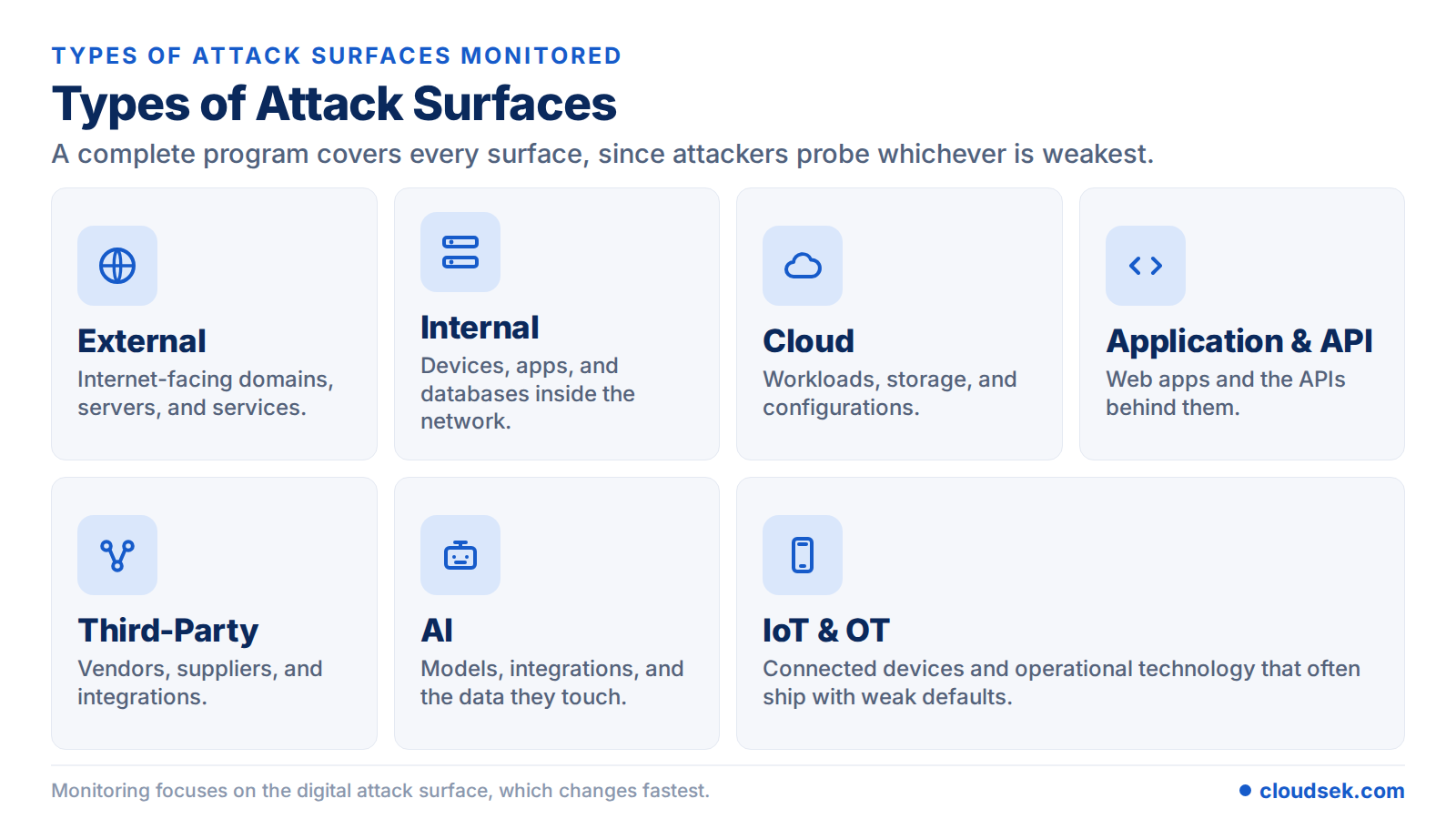
The internet-facing assets visible to anyone online: domains, subdomains, public servers, and exposed services. This is where opportunistic attackers look first, which is why external attack surface management is a priority for most programs. Forgotten subdomains and abandoned staging servers are common findings here.
The assets inside the corporate network include devices, applications, and databases. Cyber asset attack surface management gives visibility into this internal inventory and the risks an attacker reaches after the perimeter, where flat networks and over-privileged accounts widen the blast radius.
Cloud workloads, storage, and configurations. Misconfigured storage and over-permissive access are frequent exposures in this layer, with public buckets and exposed management consoles among the typical examples.
Web applications and the APIs behind them, where insecure code and unauthenticated endpoints create entry points. Shadow APIs that never went through review are a growing concern.
The vendors, suppliers, and integrations connected to the organization, any of which can introduce exposure that the organization does not directly control. A single breached vendor can expose every organization that depends on it.
Models, AI integrations, and the data they touch. AI attack surface monitoring tracks the exposures that come with rapid AI adoption, including shadow AI deployed without review.
Connected devices and operational technology often ship with weak defaults and limited security capabilities. Cameras, sensors, and industrial controllers are frequent weak points.
Effective attack surface monitoring combines several components into one continuous loop.
Attack surface monitoring follows a continuous cycle rather than a one-time sequence.
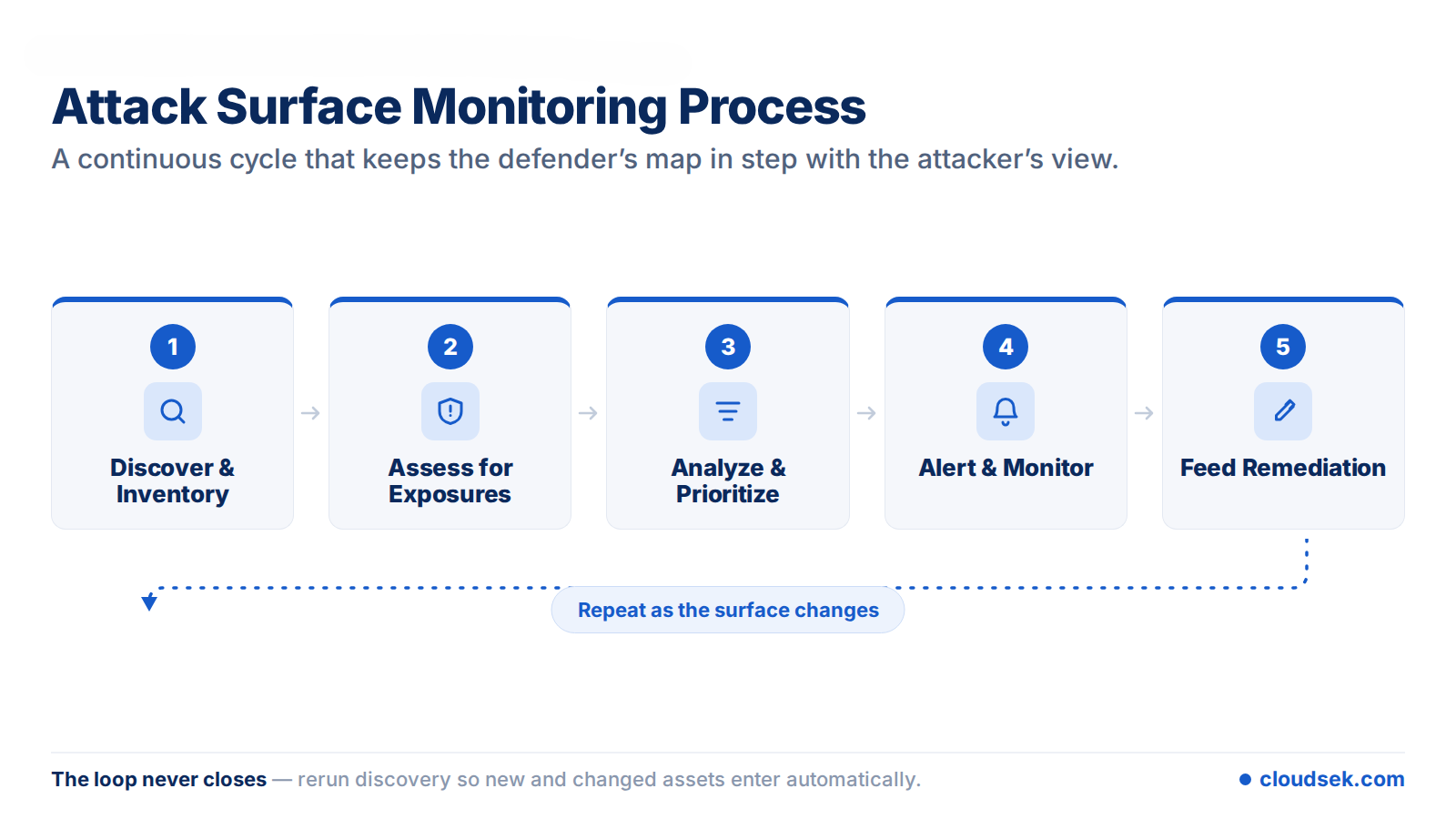
attack-surface-monitoring-process
Attack surface monitoring rarely operates alone. It forms the discovery and visibility layer of a broader exposure management program, the model Gartner describes as Continuous Threat Exposure Management (CTEM).
In that model, monitoring handles the scoping and discovery stages, building and maintaining the inventory of exposed assets. Other functions then prioritize the exposures by risk, validate which are genuinely exploitable, and mobilize teams to remediate them. Monitoring supplies the current, accurate picture the rest of the program depends on, and without it prioritization and validation work from stale data. That makes monitoring the starting point of the whole exposure management cycle.
Continuous monitoring of the attack surface delivers concrete security gains.
Attack surface monitoring supports several practical scenarios across a security program.
Several obstacles can limit the effectiveness of attack surface monitoring.
A focused set of practices keeps attack surface monitoring accurate and actionable.
As the surface grows, manual tracking becomes impractical, and organizations turn to dedicated tools. The right tool maps what the organization exposes and keeps that map current without constant manual effort. When evaluating attack surface monitoring tools, organizations look for a common set of capabilities:
The external attack surface, the internet-facing assets attackers see first, is where many programs concentrate. CloudSEK BeVigil continuously discovers and monitors an organization's external attack surface, surfacing exposed assets, misconfigurations, and shadow IT as they appear rather than at the next review. For the AI attack surface, AIVigil maps the exposures that come with AI adoption, and SVigil covers the third-party and supply chain surface. BeVigil focuses on the external attack surface and complements internal and endpoint monitoring rather than replacing it.
Attack surface monitoring discovers and watches every asset an attacker could target, including unknown ones. Vulnerability scanning tests assets the organization already knows about for specific flaws. Monitoring finds the assets, and scanning examines them.
No. Penetration testing is a point-in-time, manual attempt to exploit specific weaknesses, while attack surface monitoring runs continuously and automatically to track exposures across the whole surface. Pen testing validates findings, and monitoring keeps the picture current.
Continuously. The attack surface changes daily as assets are added, modified, and retired, so an effective program monitors in near real time rather than on a fixed schedule. Point-in-time checks leave gaps between reviews.
The security operations or security team typically owns attack surface monitoring, often within a broader exposure management or vulnerability management function. In smaller organizations it sits with IT. Accountability rests with the organization, not any external tool.
Not directly. No tool guarantees prevention of an unknown exploit, but attack surface monitoring reduces the risk by shrinking exposure and catching the vulnerable internet-facing assets that zero-day attacks target, which speeds detection and response.
Attack surface reduction is the practice of shrinking the number of exposed assets and entry points an attacker can reach, by removing unused services, closing unnecessary ports, and decommissioning forgotten assets. Monitoring identifies what to reduce.
