🚀 A CloudSEK se torna a primeira empresa de segurança cibernética de origem indiana a receber investimentos da
Leia mais
.avif)

Continuous security monitoring (CSM) is the automated, always-on practice of collecting and analyzing security data across an organization's systems, controls, and external exposure to detect threats and weaknesses as they emerge. Instead of checking security at fixed intervals, continuous security monitoring maintains real-time visibility, so teams act on risks within hours rather than months.
The stakes are measurable. The gap between an attacker's entry and its detection, known as dwell time, has narrowed sharply over the past decade as monitoring has moved from periodic checks toward real-time visibility, though attackers who go undetected for even a few days can still move laterally, escalate privileges, and reach sensitive data well before a scheduled review would ever catch them. Continuous detection is what closes that gap.
Continuous security monitoring is a security practice that automates the observation of information security controls, vulnerabilities, configurations, and threats to support ongoing risk decisions.
The National Institute of Standards and Technology formalizes the concept as Information Security Continuous Monitoring (ISCM): maintaining awareness of threats, vulnerabilities, and control effectiveness on an ongoing basis to support organizational risk management.
A point-in-time check, such as an annual audit or a quarterly penetration test, captures security at a single moment. Continuous security monitoring runs without pause, so new vulnerabilities, misconfigurations, exposed assets, and leaked data surface as they appear. The scope reaches across two layers: the internal environment of networks, endpoints, and applications, and the external attack surface of internet-facing assets, vendors, and exposed credentials that attackers reach first.
Threat environments change continuously, which makes fixed assessment cycles insufficient for catching risks as they emerge. The same Mandiant M-Trends data shows attackers move within days, far faster than scheduled reviews can detect. Four forces push organizations toward continuous monitoring:
The shared thread is time: the longer a weakness or intrusion goes unseen, the more damage it enables.
Point-in-time assessments, such as annual penetration tests, quarterly vulnerability scans, and vendor questionnaires, evaluate security at a fixed moment. They produce a useful baseline, yet the result ages immediately. A new asset deployed the next day, a vulnerability disclosed the following week, or a credential leaked the next month all fall into the blind spots between cycles.
Continuous security monitoring removes those gaps by observing the environment without pause. The defining difference is detection timing: a periodic model finds an exposure at the next scheduled review, while a continuous model finds it as it appears. For fast-moving risks, including leaked credentials, newly exposed services, and active exploitation, that timing difference often decides whether a weakness becomes a breach. Mature programs keep periodic assessments for depth and layer continuous monitoring on top for currency.
Continuous security monitoring works by turning a defined monitoring strategy into a repeating cycle of data collection, analysis, and response. NIST's SP 800-137 describes this ISCM process across five recurring stages:
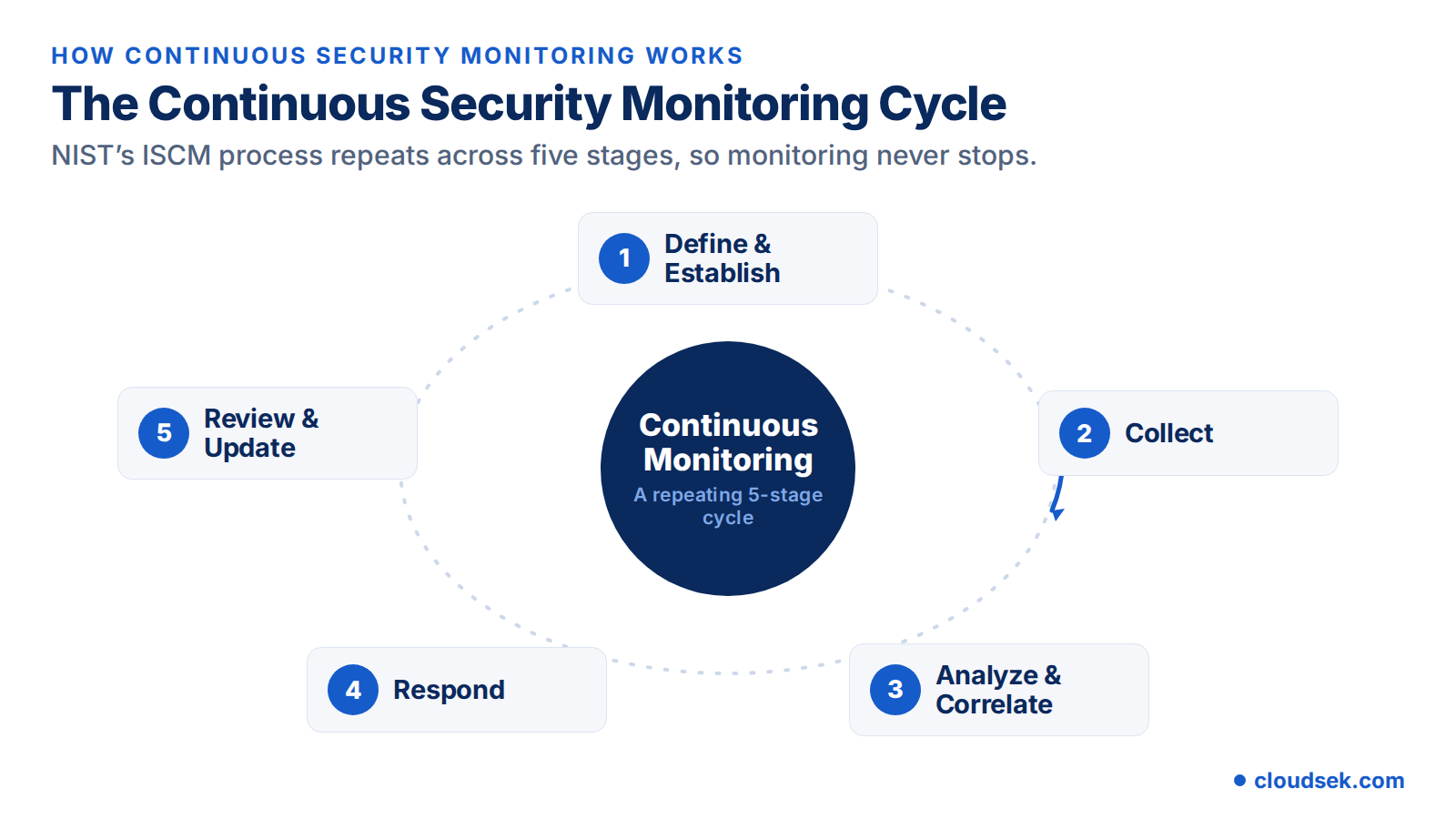
Most programs route the collected and correlated data to a security operations center, where automated analysis handles volume and analysts apply judgment to the signals that matter.
A complete continuous security monitoring program spans both the internal estate and the external exposure that attackers see first. The domains below define what a mature program keeps under constant observation.
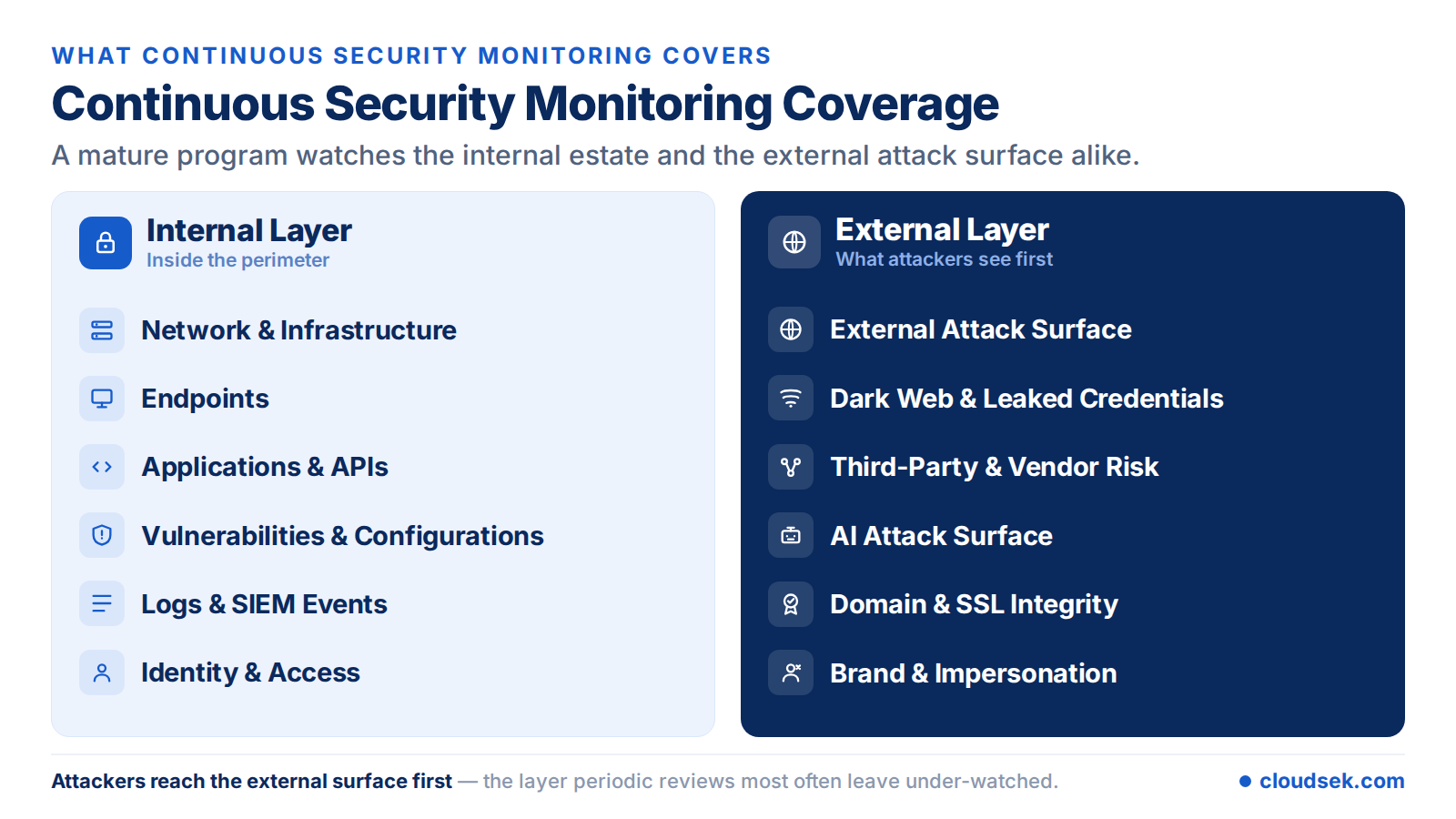
Monitoring traffic, open ports, and infrastructure changes reveals misconfigurations and suspicious activity across servers and network devices in real time.
Endpoint detection and response (EDR and XDR) tools watch laptops, servers, and workloads for malicious behavior, persistence, and lateral movement.
Continuous checks on web applications, mobile apps, and APIs catch injection flaws, broken access controls, and exposed endpoints as code and services change.
Ongoing vulnerability scanning and configuration assessment flag unpatched software and drift from secure baselines before attackers exploit them.
Centralized log collection and SIEM correlation connect events across systems into a single timeline, surfacing patterns that isolated logs miss.
Watching authentication events, privilege changes, and anomalous access detects account compromise and misuse early in the attack chain.
Continuous discovery of internet-facing assets, including unknown and forgotten ones, keeps the cyber asset inventory current as new infrastructure appears.
Monitoring deep and dark web sources surfaces leaked credentials, exposed data, and brand abuse before they fuel an attack.
Ongoing visibility into vendor posture closes the gap that periodic assessments leave open, where a supply chain compromise reaches an organization through a trusted partner.
As organizations deploy AI systems, AI attack surface monitoring tracks exposed models, APIs, and infrastructure for prompt injection, model abuse, and training data exposure.
Building a continuous security monitoring program follows a structured sequence. Each step builds on the previous one to move from scattered visibility to a measured, repeatable operation.
Continuous security monitoring delivers measurable advantages by giving teams current, prioritized, and actionable information.
Continuous security monitoring is woven into modern compliance. Major frameworks expect organizations to demonstrate that controls work on an ongoing basis, not only at audit time. SOC 2, ISO 27001, PCI DSS, HIPAA, NIST, and GDPR each call for continuous oversight of security controls and data protection.
This expectation gave rise to continuous compliance monitoring, where control testing, evidence collection, and alerting run automatically against framework requirements. The approach keeps an organization audit-ready throughout the year and converts compliance from a periodic scramble into a steady operational state. Mapping monitoring controls to specific framework requirements turns the same data used for security into proof of compliance.
No single product delivers continuous security monitoring on its own. A working program combines several tool categories, each covering part of the internal or external picture:
Integration is the deciding factor when selecting tools. Coverage that feeds one correlated view, rather than separate dashboards, is what turns raw data into action.
The internal side of continuous monitoring, network, endpoints, applications, logs, is well served by SIEM, EDR, and XDR platforms. The external side, everything an organization doesn't fully control but still gets attacked through, needs a different kind of continuous coverage.
BeVigil covers external attack surface discovery, continuously fingerprinting internet-facing assets, including the unknown and forgotten ones that periodic inventories miss. XVigil covers the dark web and leaked credentials domain, monitoring surface, deep, and dark web sources for exposed data and brand abuse. SVigil covers third-party and vendor risk, providing continuous visibility into vendor posture rather than a point-in-time assessment. And as organizations extend into AI infrastructure, AIVigil covers the AI attack surface domain, monitoring exposed models, APIs, and infrastructure.
Correlating findings across these domains, along with CloudSEK Threat Intelligence, is handled by Nexus AI, so external monitoring output feeds into one prioritized view instead of four separate ones.
Metrics turn continuous security monitoring from activity into accountability. A program proves its value by tracking how quickly it detects and resolves risk, and how completely it covers the environment.
Continuous monitoring is a broad term for ongoing observation of any system or process, including performance and operations. Continuous security monitoring applies that approach specifically to security controls, vulnerabilities, threats, and exposures, to detect and reduce cyber risk.
Yes, in practice. Frameworks such as SOC 2 and ISO 27001 expect organizations to monitor the effectiveness of security controls on an ongoing basis, and continuous security monitoring is how teams meet and evidence that expectation throughout the year.
Continuous security monitoring focuses on detecting threats, vulnerabilities, and exposures to reduce risk. Continuous compliance monitoring focuses on confirming that controls meet specific framework requirements.
Continuous security monitoring runs in real time or near real time for high-risk assets, with automated collection and alerting. Lower-risk areas follow scheduled intervals defined in the monitoring strategy, so coverage matches the criticality of each asset.
A SIEM is a tool that aggregates and correlates logs and events, and it is a common component of continuous security monitoring. Continuous security monitoring is the broader practice, combining the SIEM with vulnerability scanning, attack surface management, external monitoring, and response workflows.
