🚀 A CloudSEK se torna a primeira empresa de segurança cibernética de origem indiana a receber investimentos da
Leia mais
.avif)

Cybersecurity risk management is the continuous process of identifying, assessing, prioritizing, and treating the cyber risks that threaten an organization's data, systems, and operations. Rather than trying to eliminate every threat, it directs limited resources toward the risks that matter most, measured against how much risk the organization is willing to accept.
Cyber risk itself is the probability that a threat exploits a vulnerability to compromise the confidentiality, integrity, or availability of information, and the financial, operational, or reputational damage that follows. Risk rises with the likelihood of an event and the severity of its impact, which is why the discipline weighs both rather than reacting to threats in isolation.
Ownership has shifted over the past decade, as cybersecurity risk management moved from a technical task owned by IT into a business decision owned by leadership, because a breach now carries balance-sheet consequences, regulatory penalties, and board-level accountability. Modern programs translate technical exposure into business terms, so executives decide what to fix, insure, or accept.
A working program produces five benefits that justify the investment behind it.
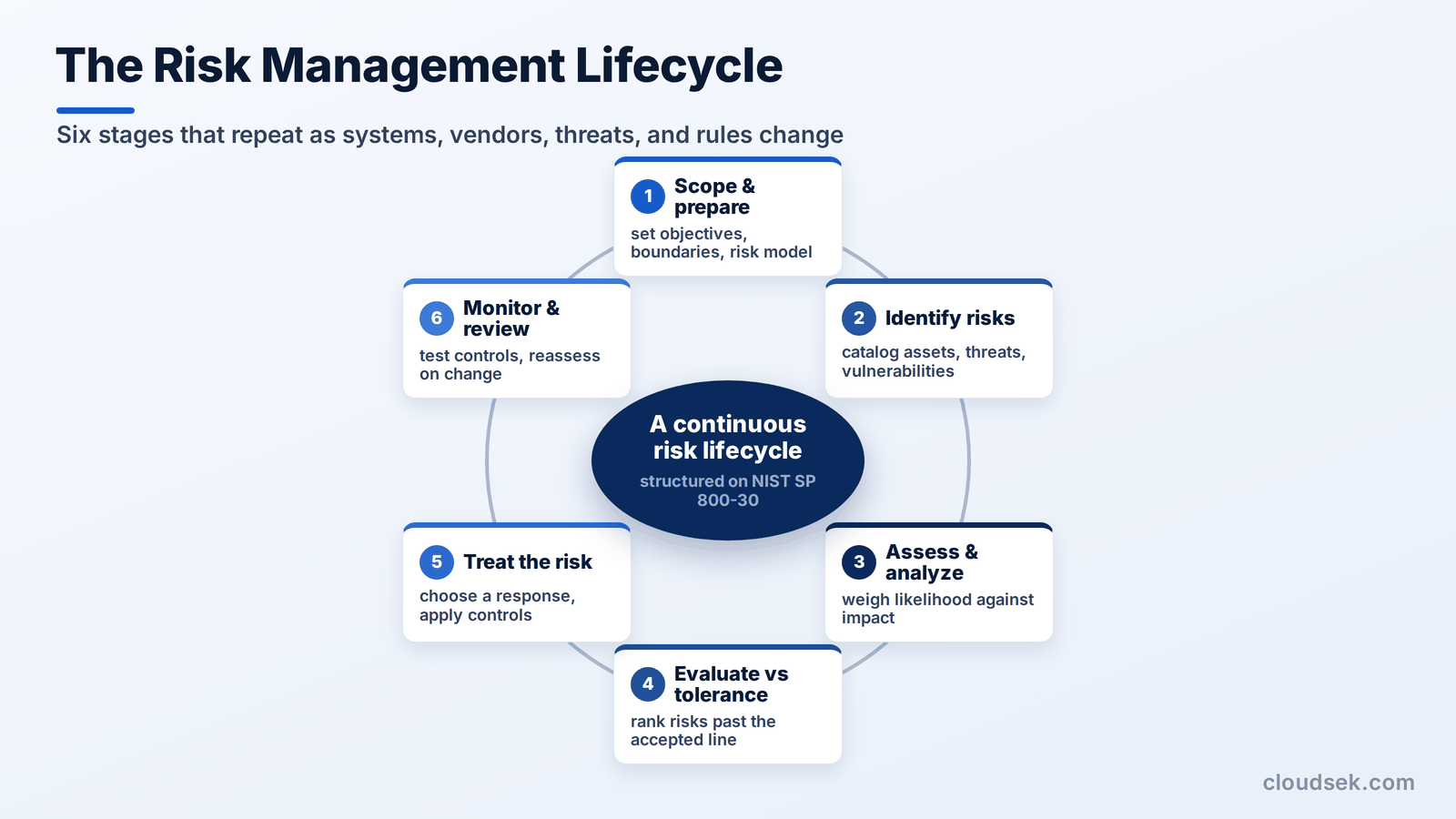
The process runs as a repeating lifecycle rather than a one-time project, and most programs structure it on NIST SP 800-39, which frames the overall risk management process, with SP 800-30 guiding the assessment stage.
Every assessed risk leads to one of four treatment decisions. The right choice depends on where the risk sits against tolerance and what mitigation would cost.

Mitigation reduces a risk's likelihood or impact by applying controls, and it is the default response for risks above tolerance that controls address. Examples include multi-factor authentication against credential theft, patching against known exploits, and network segmentation to limit how far a compromise spreads.
Transfer shifts the financial consequence of a risk to a third party, through cyber insurance or contractual terms that assign liability to a vendor. It suits high-impact events an organization cannot fully prevent, absorbing the cost when a risk materializes rather than lowering its odds.
Acceptance means taking no further action, appropriate when a risk sits below tolerance or when mitigation would cost more than the exposure warrants. Acceptance is a deliberate decision recorded in the risk register, not an oversight or an ignored risk.
Avoidance eliminates a risk by stopping the activity that creates it, reserved for intolerable exposure that no control brings within tolerance. Retiring a vulnerable legacy system or declining to enter a market with unacceptable risk are examples of avoidance.
Residual risk is the exposure that remains after controls are applied, since no treatment removes risk entirely. Organizations accept residual risk once it falls within tolerance or transfer it to an insurer, and documenting that decision closes the loop on each treated risk.
Frameworks give a program a common structure for assessment, controls, and reporting, and most organizations adopt at least one. Five recur across the field, each suited to a different need.
The NIST Cybersecurity Framework 2.0 anchors many programs. It organizes work around six functions, Govern, Identify, Protect, Detect, Respond, and Recover, and its Govern function, added in 2024, places accountability and risk strategy at the center while naming supply-chain risk management as a first-class obligation.
Risk analysis takes two forms, and mature programs combine them.
Qualitative analysis rates risks as high, medium, or low and plots them on a heat map of likelihood against impact. It is fast and intuitive, which makes it a common starting point, though its subjective ratings are hard to defend in budget conversations.
Quantitative analysis, or cyber risk quantification, expresses risk in money. Models such as FAIR estimate annualized loss exposure by combining loss event frequency with loss magnitude, expressed as ranges rather than single figures, letting leadership compare a security investment against the loss it prevents. Quantification moved from a niche practice toward the mainstream of board reporting as boards demanded financial clarity.
Building a program turns the process into a standing capability. Seven steps establish it and keep it running.
Cybersecurity risk management is a shared responsibility, and NIST CSF 2.0 made governance explicit through its Govern function. Five roles carry distinct parts of the program.
The risk landscape keeps shifting, and a current program weights its attention toward the threats defining the moment. Cyber threat trends heading into 2026 concentrate in six areas.
Running a program is harder than describing one, and mainly five obstacles recur across organizations.
Six best practices separate a program that reduces risk from one that only documents it.
CloudSEK’s monitoring modules each feed a different part of the risk register. BeVigil continuously discovers internet-facing assets and their vulnerabilities across eight attack surfaces. SVigil replaces point-in-time vendor questionnaires with continuous third- and fourth-party monitoring. XVigil watches the deep and dark web for leaked credentials, exposed data, and brand impersonation. AIVigil inventories exposed AI infrastructure and leaked AI credentials, the risk category most registers don’t yet track. CloudSEK Threat Intelligence adds which threat actors and actively exploited CVEs matter for the organization’s sector.
Nexus AI correlates those findings into potential attack paths and prioritizes them by exploitability, impact, and attacker behaviour rather than severity score alone. It also quantifies the resulting cyber risk in financial terms. That gives the Assess and Evaluate stages a continuously updated input, and gives the board an answer in the language it asks for: which exposures could lead to a breach, what that would cost, and what to fix first.
CloudSEK supplies the external risk intelligence behind identification, prioritization, and quantification. It doesn’t run an organization’s internal governance, control implementation, or audit program, and it complements those functions rather than replacing them
Risk assessment is one stage within cybersecurity risk management. The assessment identifies and analyzes risks, while risk management is the full ongoing cycle of assessing, treating, monitoring, and governing those risks.
The steps of the cybersecurity risk management process are scope and prepare, identify risks, assess and analyze, evaluate against tolerance, treat the risk, and monitor and review continuously.
The difference between a threat and a risk is: A threat is a potential source of harm, such as an attacker or malware, while a risk combines the likelihood that a threat exploits a vulnerability with the impact if it does.
Residual risk in cybersecurity is the risk that remains after controls are applied, since no treatment removes risk entirely. Organizations accept it once it falls within tolerance or transfer it to an insurer.
It depends: no single framework is best for cybersecurity risk management. NIST CSF 2.0 suits broad governance, ISO 27001 suits certification, CIS Controls suit a prioritized start, and FAIR suits financial quantification.
Cyber risk quantification expresses cyber risk in financial terms, using models like FAIR to estimate the annualized loss exposure a risk is likely to cause, so leadership can compare security investment against prevented loss.
