🚀 A CloudSEK se torna a primeira empresa de segurança cibernética de origem indiana a receber investimentos da
Leia mais


Monitor the security posture of your suppliers and their hidden dependencies, correlated with your assets.


Empresas globais e empresas da Fortune 500 confiam na CloudSEK para fortalecer sua postura de segurança cibernética.
Vendor risk monitoring is the continuous tracking of the security posture of your suppliers, partners, and the dependencies behind them. SVigil is CloudSEK's continuous third-party and supply chain attack surface intelligence platform: it monitors vendors continuously, not just at onboarding, maps the hidden dependencies behind them, and turns vendor risk assessment from a periodic snapshot into a continuous operational intelligence program.
Continuous monitoring across the supplier base includes:

Know about all the features

Vendor posture evaluated as it changes, not once a year

A supplier-led approach towards monitoring third-party risk

The dependencies behind each vendor, made visible

Third-party risks ranked by potential impact and severity

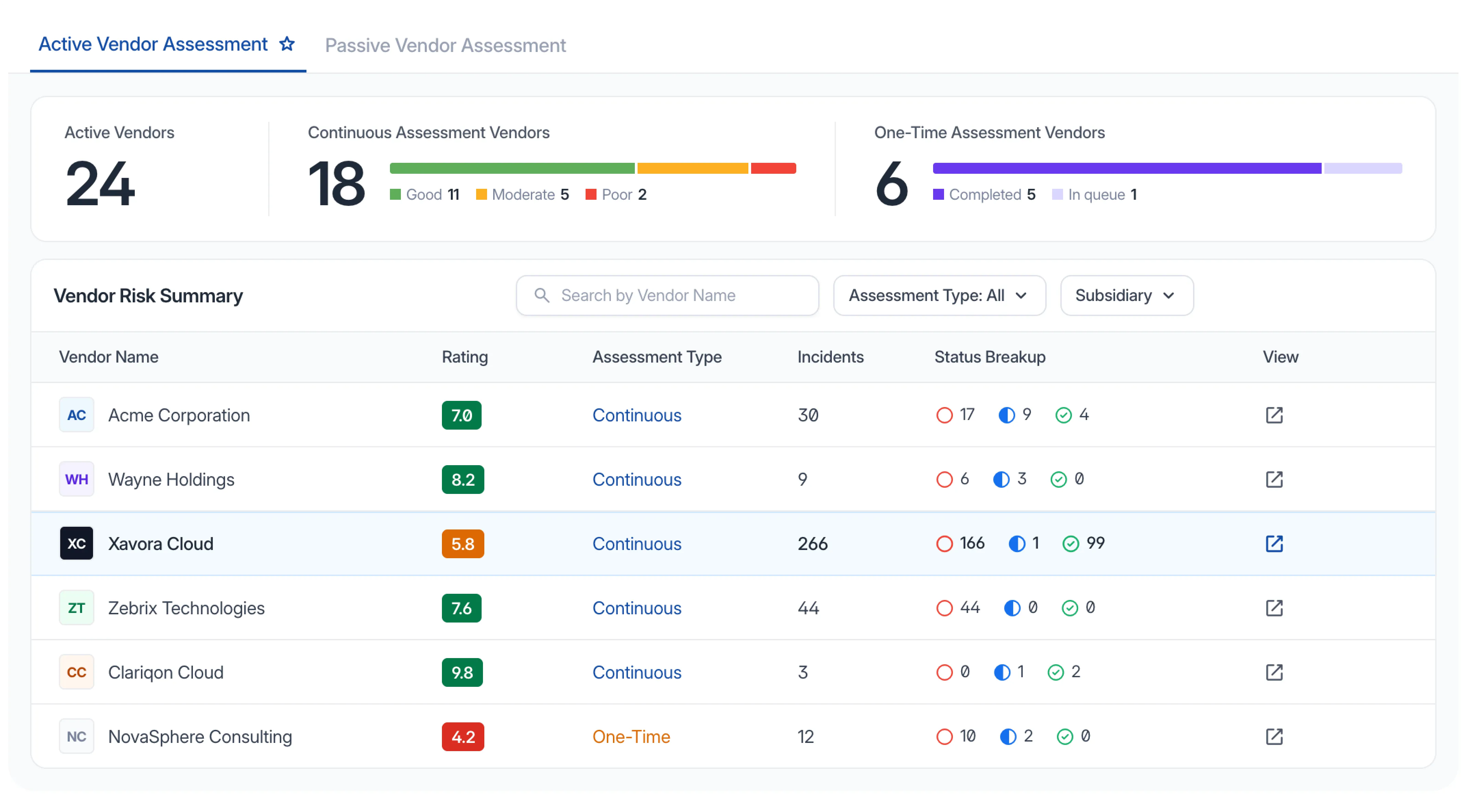
Vendor risk by supplier, severity, and business unit

Findings land in SIEM, SOAR, TIP, and ticketing tools
SVigil monitors the elements of your supply chain that carry risk, from each vendor's observable posture to the software components and providers behind them, correlated with your assets.
How each supplier's observable security state changes over time, so a vendor rated safe at onboarding does not stay trusted on old evidence.
(i) Continuous posture assessment
(ii) Changes visible when they happen
(iii) Ratings that stay current between reviews
Read a related article on: What is Third-Party Risk Management?

Exposure introduced through a supplier's breach or mishandling of your data.
- Organisation credentials exposed in third-party data leaks
- Proprietary internal documents exposed through a vendor
The software your vendors ship into your environment, and the weaknesses it carries.
- Vendor software and plugins
- Dependencies and third-party libraries
- Components with known vulnerabilities
Read a related article on: What is a Supply Chain Attack? Detection and Prevention
The providers behind your providers, mapped so a compromise two steps away is still visible to you.
- Hidden dependencies behind each vendor
- Software, libraries, and services your vendors rely on
The entry points that exist because of a supplier relationship, identified before an attacker chains them.
- Misconfigured cloud services and storage buckets
- Secrets and vulnerabilities affecting vendor applications
- Misconfigured DNS servers and records
- Improper SSL implementations and misconfigurations
Read a related article on: How Does Vendor Risk Monitoring Work?
Most third-party programs assess direct suppliers and stop there. Attackers do not. A compromise in a provider two steps removed can still reach you through the chain.
SVigil helps enterprises manage fourth-party risk by mapping hidden dependencies across the supply chain, so the question stops being who your vendors are and becomes what they depend on. Vendor findings feed Nexus AI, which correlates them into potential attack paths across the CloudSEK platform.
Threat Severity
MEDIUM
Threat Severity
HIGH
Threat Severity
LOW
Supply chain attack detection is a cadence problem. Most third-party risk management programs still run on review cycles, and the difference shows up everywhere it matters.

SVigil prioritizes third-party findings by potential impact and severity, and Nexus AI correlates vendor-driven initial access vectors into potential attack paths, so the alerts that reach your team are specific, actionable, and timely.
Respond to intelligence about your vendors that names the exposure and the first fix.
A change in a vendor's posture is shown as soon as it is discovered, not at the next review.
Vendor monitoring, not onboarding-only
Vendors monitored across customers
Rating
5.5 One-Time
Rating
8.7 Continuous
Vendor risk monitoring is the continuous tracking of the security posture of an organization's suppliers, partners, and their dependencies. Instead of assessing a vendor once at onboarding, it watches for the exposures, breaches, and weaknesses that appear across the vendor base over time, so risk introduced through a supplier is caught when it emerges.
A vendor risk monitoring program inventories the vendors and dependencies in use, observes each vendor's security posture and exposure, watches continuously for changes such as leaked data, vulnerable software components, or misconfigurations, and prioritizes findings by potential impact so security and procurement teams can act on the suppliers that matter.
A periodic assessment describes a vendor on the day it was reviewed. A vendor rated safe at onboarding can be breached the following week, and the gap between review cycles is where that risk lives unnoticed. Continuous monitoring closes the gap: a change in a vendor's posture is visible when it happens, not at the next annual review.
Coverage should include each vendor's security posture, exposure introduced through third-party data leaks, the software components and libraries vendors bring with them, and the fourth-party dependencies behind each supplier. It should also connect findings to business context: which systems a vendor can reach and what an attacker could do with that access.
Fourth-party risk monitoring extends visibility to your vendors' own vendors and dependencies. Most programs stop at direct suppliers, but a compromise in a provider two steps removed can still reach you through the chain. Mapping those hidden dependencies shows where a distant failure becomes your exposure.
No. A completed questionnaire records what a vendor said about its controls at a point in time. Monitoring observes what is actually true about a vendor's posture, continuously. Questionnaires still have a role in procurement, but they are an input to a program, not a substitute for observed, current evidence.
In most organizations it is shared. Security teams own the technical monitoring and response, procurement owns onboarding decisions and contracts, and risk and compliance teams own reporting and oversight. The program works best when all three act on the same continuously updated view of vendor posture instead of separate spreadsheets.
SVigil. It is CloudSEK's continuous third-party and supply chain attack surface intelligence platform. SVigil monitors vendors continuously rather than only at onboarding, maps the fourth-party dependencies behind each supplier, and helps security and procurement teams act on third-party risk without manual evidence collection.
Every supplier relationship can create a vendor-driven initial access vector: an entry point into your organization that exists because of the vendor. SVigil identifies these vectors, and Nexus AI correlates them with findings from across the CloudSEK platform into potential attack paths, so teams see how a supplier weakness could actually be chained into an attack.
Yes. Third-party findings should land in the workflows teams already run. SVigil integrates with existing SIEM, SOAR, TIP, and ticketing tools, and supports custom dashboards and reports that show vendor risk by supplier, severity, and business unit.
