🚀 A CloudSEK se torna a primeira empresa de segurança cibernética de origem indiana a receber investimentos da
Leia mais
.avif)

A third-party risk assessment is the process of evaluating the security, compliance, operational, and financial risks a vendor, supplier, or partner introduces, both before a contract begins and throughout the relationship. The exposure is no longer marginal: Verizon's 2025 Data Breach Investigations Report found that third-party involvement in breaches doubled to 30% in a single year.
A third-party risk assessment gives organizations a structured way to measure how much risk each vendor carries and to decide what to do about it. This guide covers what the assessment is, the risk types it measures, a step-by-step process, a practical checklist, the questionnaire behind it, regulatory requirements, and the practices that keep it effective.
A third-party risk assessment is the evaluation and categorization of the risks tied to working with an external party. Third parties include vendors, suppliers, SaaS providers, contractors, and partners that connect to an organization's data, systems, or operations.
The assessment applies to new relationships during onboarding and to existing relationships on a recurring basis, and it forms one component of a broader third-party risk management (TPRM) program that governs the full vendor lifecycle. Treating third-party cyber risk as a measurable, ongoing exposure rather than a contract formality is the foundation of the practice.
A third-party risk assessment matters because vendors hold the access and data that attackers reach through the weakest link in the chain. Four reasons make the assessment essential:
The 2024 CrowdStrike software update that disrupted airlines, hospitals, and financial systems worldwide showed how a single vendor failure cascades across every organization that depends on it.
Third-party risk takes several forms, and a complete assessment measures each one:
A third-party risk assessment evaluates the factors that determine how much risk a vendor carries:
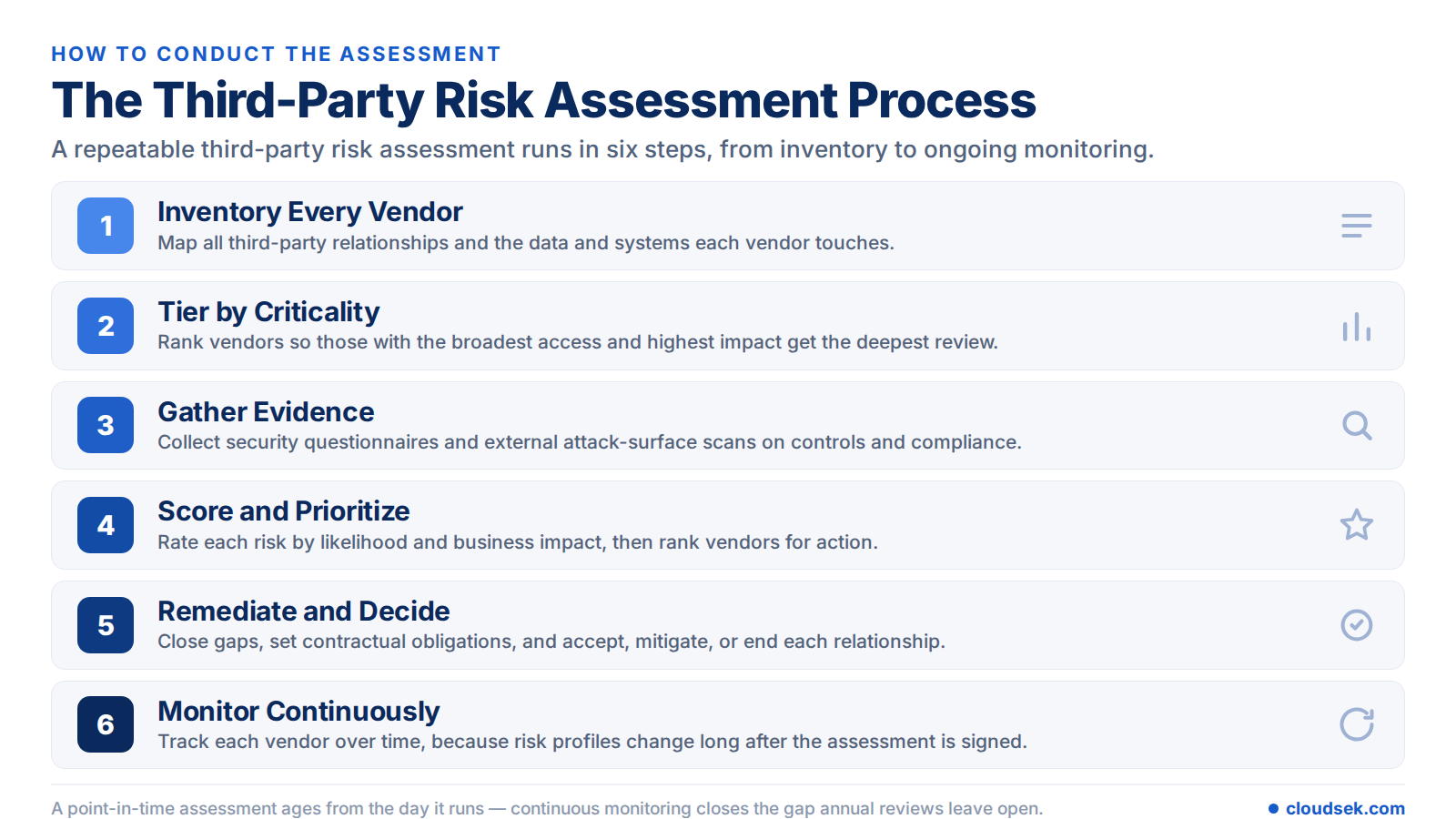
A repeatable third-party risk assessment runs in six steps:
This checklist covers the items that a thorough third-party risk assessment verifies:
A third-party risk assessment questionnaire collects the evidence that scoring depends on. A strong questionnaire covers data handling and storage, access controls, business continuity and disaster recovery, subprocessors, and compliance posture. Standardized frameworks speed the process and keep results comparable across vendors:
A reusable template standardizes scoring, documents each decision, and turns the assessment into a repeatable process rather than a one-off exercise.
Regulators now treat third-party risk as the organization's responsibility, not the vendor's alone. The frameworks that mandate third-party risk assessment include:
These practices keep a third-party risk assessment accurate and consistent:
A point-in-time assessment captures a vendor on the day it runs. A vendor's exposure shifts daily as new assets, leaked credentials, and vulnerabilities appear, so continuous monitoring closes the gap that annual reviews leave open.
Tools reduce the manual load of third-party risk assessment and keep findings current. The capability categories that matter:
A questionnaire captures a vendor at a single moment, and the answers start aging the day they arrive. The vendor adds infrastructure, an employee's credentials leak, a dependency picks up a vulnerability, and none of it surfaces until the next review cycle. Closing that gap is where continuous monitoring fits, and where CloudSEK's SVigil works.
SVigil fingerprints a vendor ecosystem and watches it over time, surfacing exposed assets, leaked credentials, and the fourth-party dependencies that sit behind each vendor. When a vendor's exposure changes, the security team sees it between assessments rather than after an incident.
SVigil covers the monitoring half of the program. Questionnaires, contracts, due diligence, and internal review still own the rest. The assessment decides whether to trust a vendor; continuous monitoring confirms whether that trust still holds.
A third-party risk assessment evaluates a single vendor's risk at a point in the relationship. Third-party risk management is the wider program that governs vendor selection, assessment, monitoring, and offboarding across the whole lifecycle.
A dedicated TPRM team owns third-party risk assessments in large organizations, working with procurement, legal, compliance, and security. In smaller companies, IT, procurement, or finance carries the responsibility.
Run a third-party risk assessment at onboarding, then reassess on a cadence set by vendor criticality. High-risk vendors warrant continuous monitoring, while lower-risk vendors fit an annual cycle.
Inherent risk is the risk a vendor carries before any controls apply. Residual risk is what remains after the vendor's controls and the organization's mitigations are in place.
Fourth-party risk is the exposure that comes from a vendor's own suppliers and dependencies. An organization inherits this risk indirectly, even without a direct relationship with the fourth party.
Yes. Automation handles evidence collection, questionnaire validation, risk scoring, and continuous monitoring. Human review still sets criticality tiers and final risk decisions.
