🚀 A CloudSEK se torna a primeira empresa de segurança cibernética de origem indiana a receber investimentos da
Leia mais
.avif)

O sistema de supervisão e aquisição de dados (SCADA) é um sistema de controle industrial que monitora e gerencia processos físicos em fábricas, serviços públicos e infraestruturas. O SCADA coleta dados em tempo real de sensores de campo, apresenta-os aos operadores em uma interface central e envia comandos de volta para equipamentos como bombas, válvulas e motores.
Esses sistemas operam infraestruturas críticas, tornando-os alvos de alto valor. As vulnerabilidades em sistemas de controle industrial atingiram um recorde histórico em 2025, com 508 avisos de segurança de ICS sinalizando 2.155 vulnerabilidades em todo o setor.
Um sistema SCADA desempenha cinco funções principais em uma operação industrial.
O SCADA funciona movendo dados de dispositivos de campo para um servidor central e enviando comandos de controle de volta aos equipamentos, fechando um ciclo de monitoramento contínuo. Cinco etapas definem esse fluxo.
A arquitetura SCADA combina hardware de campo, links de comunicação e software supervisório em um sistema em camadas. Cinco componentes realizam o trabalho.
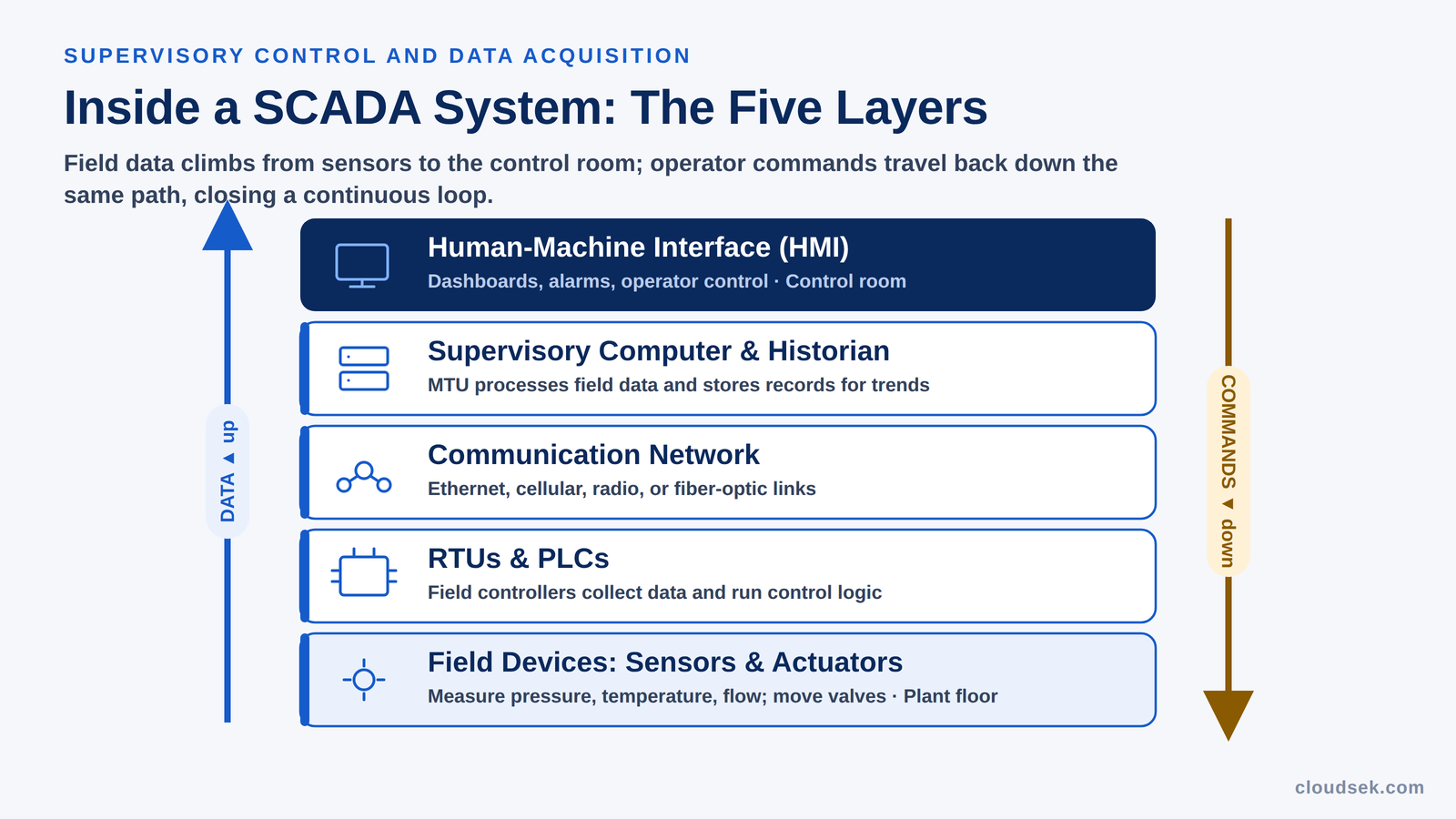
Os dispositivos de campo ficam no nível do equipamento e formam a camada sensorial do SCADA. Sensores medem condições como fluxo, tensão e temperatura, enquanto atuadores executam comandos abrindo válvulas ou ligando motores.
RTUs e PLCs atuam como controladores de campo que conectam o equipamento à rede SCADA. Unidades terminais remotas (RTUs) coletam dados de sensores em locais distantes, e controladores lógicos programáveis (PLCs) executam lógica de controle automatizada para máquinas locais.
Uma rede de comunicação conecta os controladores de campo ao sistema central e transporta dados em ambas as direções. As redes SCADA usam canais com e sem fio, incluindo conexões Ethernet, celular, rádio e fibra óptica.
Um computador supervisório, às vezes chamado de unidade terminal mestre (MTU), forma o núcleo do SCADA. Ele processa dados de campo, aplica lógica de controle e grava registros em um banco de dados historiador para análise de tendências e relatórios.
Uma IHM apresenta dados de SCADA aos operadores por meio de painéis, gráficos e alarmes. Os operadores utilizam a IHM para monitorar o desempenho do processo, reconhecer alarmes e enviar comandos para equipamentos de campo.
Os sistemas SCADA dividem-se em quatro gerações, cada uma definida pela sua arquitetura e conectividade.
Cada geração adicionou conectividade, e essa conectividade expandiu a superfície de ataque que a segurança SCADA moderna aborda.
O SCADA é frequentemente confundido com termos relacionados a sistemas de controle. Três distinções são as mais importantes.
O SCADA é um tipo de sistema de controle industrial (ICS), não uma categoria separada. ICS é o termo abrangente que cobre SCADA, sistemas de controle distribuído e controladores autônomos, enquanto SCADA refere-se a sistemas de supervisão que coletam dados em locais dispersos.
Um CLP é um componente dentro de um sistema SCADA, não uma alternativa a ele. Controladores lógicos programáveis executam o controle em tempo real em máquinas individuais, enquanto o SCADA supervisiona e coordena vários CLPs em toda uma operação.
O SCADA supervisiona ativos geograficamente dispersos, enquanto um SDCD controla processos dentro de uma única instalação. Sistemas de controle distribuído (SDCD) priorizam o controle contínuo de processos dentro de uma planta, e o SCADA prioriza a coleta de dados e a supervisão em longas distâncias.
Os sistemas SCADA trocam dados por meio de protocolos industriais especializados. Cinco aparecem com mais frequência.
O SCADA gerencia os processos físicos por trás de seis setores fundamentais.
O SCADA oferece cinco benefícios operacionais para as indústrias que o implementam.
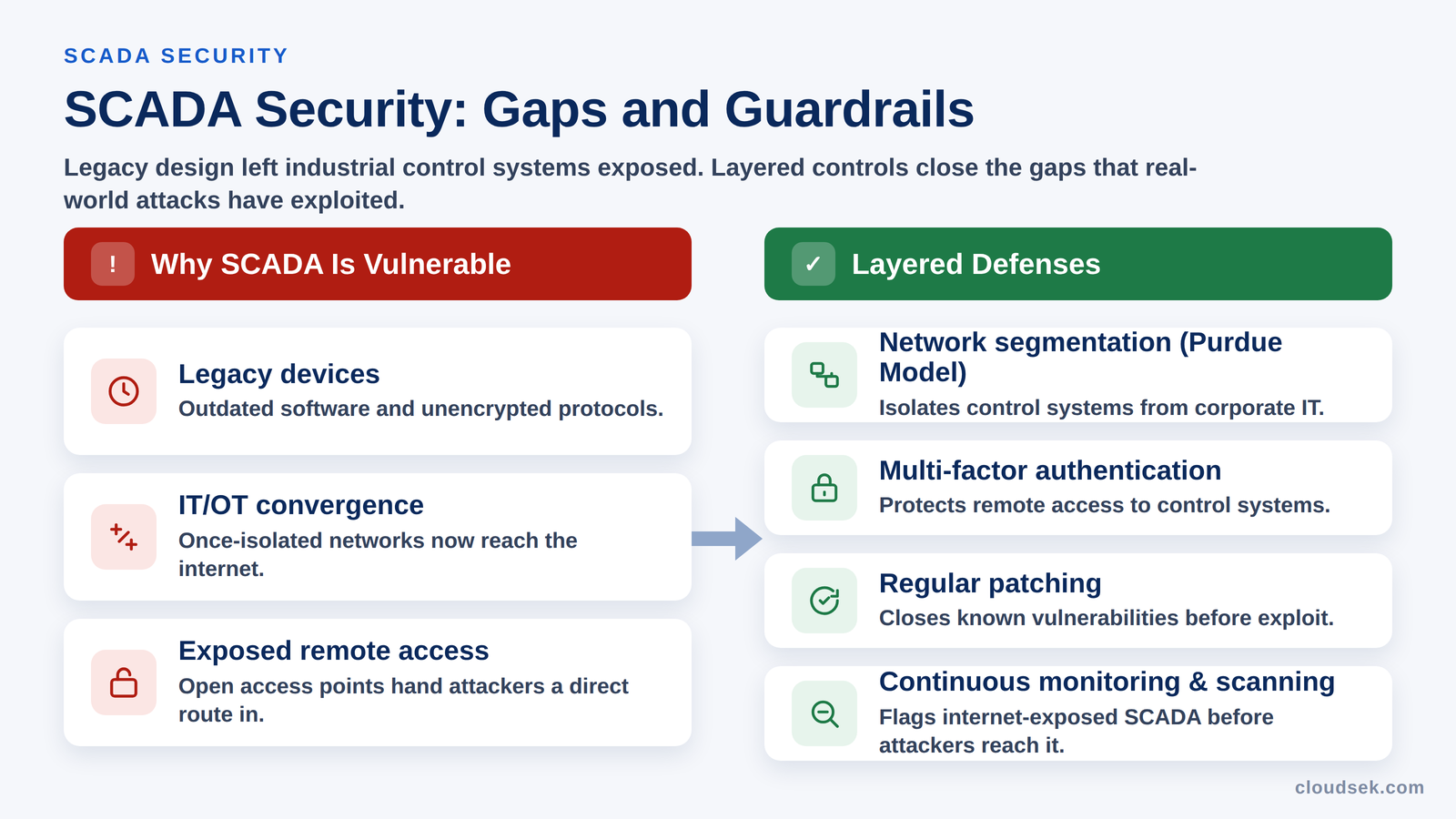
A segurança SCADA protege sistemas de controle industrial contra ataques cibernéticos que interrompem operações físicas. Redes SCADA mais antigas foram projetadas para confiabilidade, não para segurança, o que deixa lacunas que os invasores exploram.
Três condições enfraquecem o SCADA. Dispositivos legados executam softwares desatualizados e protocolos não criptografados, a convergência entre TI e TO conecta redes antes isoladas à internet, e pontos de acesso remoto expostos oferecem aos invasores uma rota de entrada direta. NIST SP 800-82 documenta essas fraquezas de TO e as salvaguardas que as abordam.
Os ataques ao SCADA visam tanto dados quanto equipamentos físicos. Casos documentados incluem o Stuxnet, que danificou centrífugas iranianas em 2010, o ataque à rede elétrica da Ucrânia em 2015, que cortou a energia de 230.000 pessoas, e a invasão da estação de tratamento de água de Oldsmar em 2021, que alterou a dosagem de produtos químicos. Relatórios da CISA indicam que os invasores alcançam muitos desses sistemas por meio de ativos expostos à internet e credenciais padrão.
A segurança eficaz de sistemas SCADA baseia-se em controles em camadas. A segmentação de rede, estruturada em torno do Modelo Purdue, isola os sistemas de controle da TI corporativa; a autenticação multifator protege o acesso remoto; a aplicação regular de patches corrige vulnerabilidades conhecidas; e o monitoramento contínuo detecta invasões precocemente. O escaneamento externo de vulnerabilidades de ativos expostos à internet identifica interfaces SCADA vulneráveis antes que os invasores as alcancem.
A CloudSEK não é uma plataforma de segurança de Tecnologia Operacional (OT) e não monitora protocolos industriais nem substitui ferramentas dedicadas de ICS. Ela aborda um risco específico de SCADA: ativos expostos à internet que são encontrados primeiro pelos invasores.
CloudSEK BeVigil mapeia a superfície de ataque externa de uma organização e sinaliza interfaces SCADA, portas abertas e pontos de acesso remoto acessíveis pela internet pública. Essa visão externa reflete a perspectiva utilizada pelos invasores, permitindo que as equipes eliminem a exposição antes que ela se torne uma via de entrada.
A Inteligência contra Ameaças da CloudSEK rastreia grupos de ransomware e agentes ligados a estados que visam infraestruturas críticas, fornecendo às equipes de SOC contexto antecipado sobre campanhas contra o seu setor. Ambos complementam, em vez de substituir, o monitoramento de OT que protege a rede de controle interna.
SCADA significa supervisão, controle e aquisição de dados. O termo descreve sistemas industriais que monitoram e controlam processos físicos a partir de uma localização central.
SCADA é composto por hardware e software. O hardware inclui RTUs, PLCs e sensores, enquanto o software processa os dados e gerencia a interface do operador.
Uma IHM é a interface do operador dentro de um sistema SCADA, não um substituto para ele. O SCADA executa todo o pipeline de controle e dados, e a IHM exibe esses dados aos operadores.
Sim, o SCADA continua sendo utilizado em infraestruturas críticas em todo o mundo. Operadores de energia, água e manufatura utilizam sistemas SCADA modernos, baseados na web e conectados à nuvem, diariamente.
Um engenheiro SCADA projeta, configura e mantém sistemas SCADA para operações industriais. A função abrange o desenvolvimento de IHM, integração de PLC e solução de problemas em sistemas de controle.
Sim, sistemas SCADA podem ser hackeados, geralmente por meio de ativos expostos à internet e credenciais fracas. Os invasores acessam interfaces expostas e, em seguida, manipulam a lógica de controle ou interrompem operações físicas.
