🚀 A CloudSEK se torna a primeira empresa de segurança cibernética de origem indiana a receber investimentos da
Leia mais
.avif)

Detection engineering is the process of creating, testing, tuning, and improving security detections that identify malicious activity, attacker behavior, and suspicious actions across enterprise systems before they become security incidents.
Security teams use detection engineering to build detections across endpoints, cloud systems, applications, identities, APIs, and networks. These detections help organizations identify threats such as credential abuse, ransomware activity, privilege escalation, fileless malware, and cloud misconfigurations earlier in the attack lifecycle. The focus is not on generating more alerts. The focus is on producing accurate detections that surface real threats with minimal noise.
Detection engineering converts large volumes of security data into meaningful detection logic using attacker behavior patterns, threat intelligence, and security telemetry. This process helps organizations improve visibility into advanced threats while reducing false positives that overwhelm many security operations centers.
Detection engineering improves enterprise threat detection by helping security teams identify real attacker activity faster, reduce investigation noise, and strengthen proactive cyber defense across modern environments.
The stakes are real: the 2025 SANS Detection and Response Survey found that 73 percent of organizations now name false positives their number one challenge in threat detection, and Microsoft and Omdia's State of the SOC 2026 report found that 46 percent of all alerts turn out to be false positives, meaning nearly half of a typical analyst's workload generates no security value at all.
Filtering noisy alerts and prioritizing high-confidence detections is where detection engineering earns its keep against numbers like the ones above. Security teams investigate fewer false positives and focus on real threats that require immediate action.
Modern attackers use advanced techniques such as credential theft, ransomware execution, privilege escalation, fileless malware, and cloud account compromise to bypass static security controls. Detection engineering improves visibility into these attack methods by identifying behavioral patterns and malicious activity across enterprise systems before attackers achieve their objectives.
The time attackers remain active inside an environment drops when detection speed improves, and the trend line is moving the wrong way without it. Continuous monitoring and accurate detection logic identify malicious behavior earlier in the attack lifecycle, which reduces mean time to detect (MTTD) and limits security impact.
Better detection accuracy and investigation efficiency are what strengthen the operation as a whole. Security analysts spend less time reviewing low-value alerts and more time responding to confirmed threats.
Malicious behavior gets identified before attackers can expand access across systems, which is the core of proactive defense. Early threat visibility helps organizations contain attacks before major disruption occurs.
Detection engineering follows a continuous process that transforms security telemetry, attacker intelligence, and behavioral analysis into accurate threat detections.
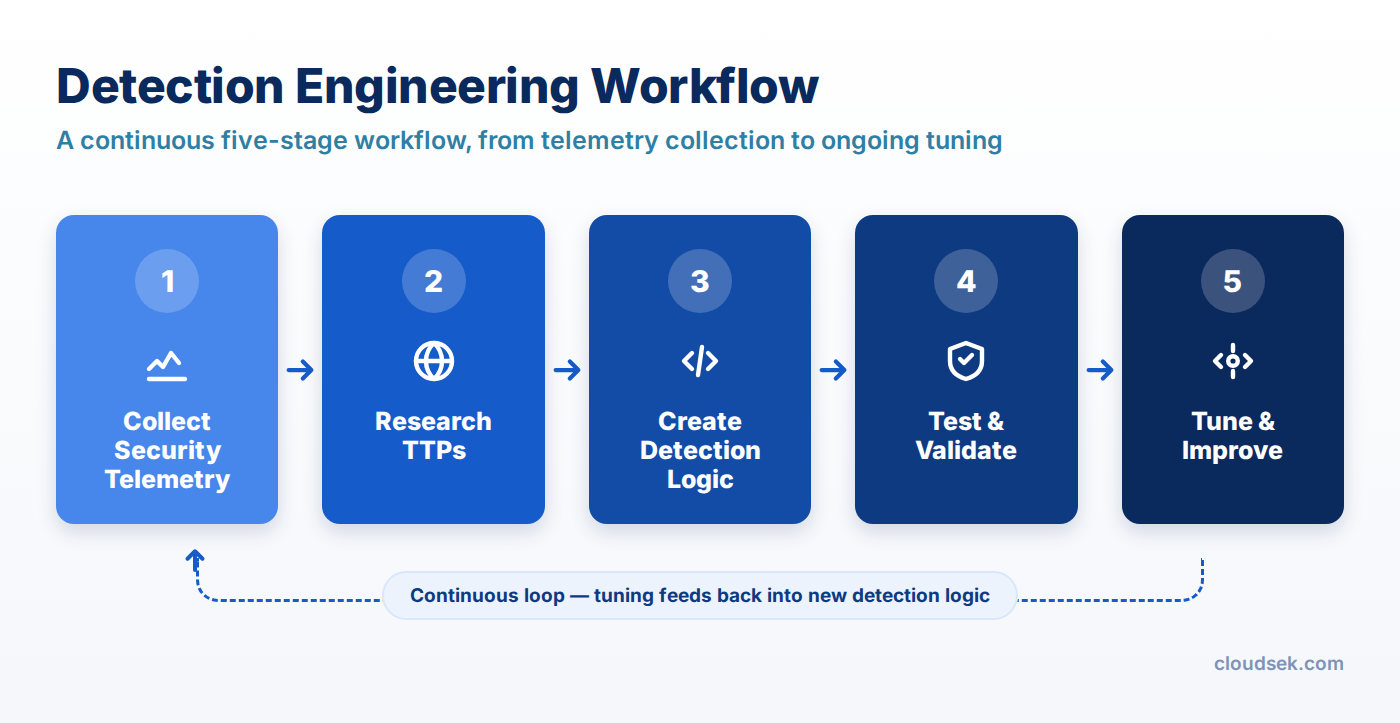
Detection engineering starts with collecting security telemetry from enterprise systems and infrastructure. Security teams gather logs and activity data from endpoints, cloud platforms, identity systems, applications, APIs, firewalls, and networks to monitor user behavior and system activity continuously, since detection accuracy depends on complete, reliable data reaching the pipeline in the first place.
Detection engineers analyze threat intelligence and attacker tactics, techniques, and procedures (TTPs) to understand how modern attacks operate, studying ransomware behavior, credential abuse techniques, privilege escalation activity, and exploited vulnerabilities to build detections around real attack methods rather than guesswork.
Many organizations map this research to frameworks like MITRE ATT&CK, which organizes attacker behavior into standardized techniques. That structure lets detection engineers build rules aligned with known adversary activity instead of relying only on static indicators that go stale the moment an attacker changes tooling.
Detection engineers turn that research into logic that identifies suspicious activity inside enterprise environments, using behavioral patterns, event correlations, thresholds, and threat indicators to flag malicious actions across systems and networks.
Rules commonly monitor abnormal logins, suspicious PowerShell execution, unauthorized privilege changes, lateral movement attempts, unusual API requests, and ransomware-related behavior. The goal throughout is accuracy: catching real attacker behavior while generating as few unnecessary alerts as possible.
That last part is where most detection programs actually fail, not from missing coverage, but from rules tuned too loosely to be trusted.
Detections don't get trusted just because they were written correctly on paper. Security teams validate them using attack simulations, red team exercises, adversary emulation, and controlled testing environments, then measure the results against real-world attack scenarios to reveal detection gaps, inaccurate logic, missing telemetry, and false positives before anything reaches production.
Detection engineering never really finishes. Engineers refine thresholds, improve event correlation logic, and strip out noisy alerts that create unnecessary investigation workload, and that continuous tuning is what keeps detection quality high as attacker behavior, infrastructure, and the broader environment keep changing underneath it.
Detection engineering relies on multiple technical components that help security teams collect telemetry, analyze attacker behavior, create accurate detections, and improve threat visibility across enterprise environments.
Detection rules and queries identify suspicious activity by analyzing security events and behavioral patterns across enterprise systems, with security teams using SIEM queries to search large volumes of logs and telemetry for indicators of malicious activity.
Correlation conditions are what improve accuracy here, connecting multiple events together, such as a failed login followed by privilege escalation, rather than judging any single event in isolation.
Reliable data sources are the foundation everything else depends on.
Endpoint telemetry captures process execution, file activity, and user actions; identity systems provide authentication logs, login behavior, and privilege usage; DNS logs surface suspicious domains and command-and-control communication; firewall logs monitor unauthorized network connections; and cloud platforms generate telemetry from workloads, SaaS applications, and infrastructure services.
Threat intelligence integration improves detection quality by providing context about known threats, attacker behavior, and exploited vulnerabilities. IOC feeds supply indicators such as malicious IPs, domains, file hashes, and URLs, while threat actor intelligence explains tactics and targeting behavior.
Exploited CVE intelligence adds another layer, showing which vulnerabilities are actively being used in attacks so teams can prioritize detections around the highest-risk exposures rather than every disclosed flaw equally.
Behavioral analytics identifies suspicious patterns that differ from normal user and system activity. User behavior analysis monitors login activity, access patterns, and device usage to catch credential abuse or insider threats, while entity behavior monitoring tracks systems, applications, and cloud resources for the same kind of deviation, impossible travel logins, unauthorized privilege changes, unusual data transfers.
Detection automation reduces manual investigation workload and speeds up threat response. SOAR workflows automate repetitive tasks such as alert triage and investigation steps.
Automated enrichment adds threat intelligence, asset context, and historical activity to detections without a human pulling that data manually, and automated response triggers can isolate devices, disable accounts, block malicious IPs, or escalate high-risk incidents the moment a detection fires.
Detection engineering uses multiple detection techniques to identify malicious activity, suspicious behavior, and attacker techniques across enterprise environments more accurately.
Signature-based detection identifies known threats using predefined patterns, file hashes, malicious commands, or indicators of compromise (IOCs). Security teams use this technique to detect known malware, ransomware variants, and previously identified attack activity quickly.
Behavioral detection identifies suspicious actions by analyzing how users, applications, and systems behave inside the environment. This technique detects activities such as privilege escalation, credential abuse, lateral movement, and suspicious process execution that differ from normal behavior patterns.
Anomaly-based detection identifies unusual activity that deviates from established baselines. Security teams use this approach to detect abnormal login activity, unusual network traffic, unexpected data transfers, and suspicious system behavior that may indicate an active attack.
Security teams convert threat hunting findings into repeatable security detections. They analyze attacker behavior discovered during investigations and create detections that automatically identify similar malicious activity in the future.
MITRE ATT&CK-based detection mapping aligns detections with known attacker tactics and techniques documented in the MITRE ATT&CK framework. This approach helps organizations measure detection coverage, identify visibility gaps, and improve detection accuracy against real-world attack methods.
Effective detection engineering improves threat visibility, reduces false positives, and helps security teams detect malicious activity more accurately across enterprise environments.
1. Prioritize High-Risk Attack Techniques. Detection engineering programs should focus first on high-risk attack techniques such as credential theft, ransomware activity, privilege escalation, lateral movement, and unauthorized remote access. Prioritizing these attack methods improves visibility into threats that create the highest operational and security impact.
2. Align Detections With MITRE ATT&CK. Mapping detections to the MITRE ATT&CK framework helps organizations measure detection coverage against known attacker techniques. This approach improves detection consistency and helps security teams identify visibility gaps across different attack stages.
3. Continuously Reduce False Positives. False positives increase investigation workload and reduce analyst efficiency inside security operations centers. Detection engineers should tune detection logic regularly, refine thresholds, and add contextual analysis to improve detection accuracy and reduce unnecessary alerts.
4. Test Detections Regularly. Regular testing validates whether detections identify real attack activity successfully. Security teams should use red team exercises, attack simulations, adversary emulation, and purple team assessments to evaluate detection effectiveness and identify detection gaps.
5. Use Detection-as-Code Methodologies. Detection-as-code improves scalability, consistency, and version control for security detections. Security teams can manage detection logic through automated workflows, CI/CD pipelines, and centralized repositories to simplify detection updates and deployment.
6. Monitor Cloud and Identity Threats. Modern attackers increasingly target cloud environments, SaaS applications, and identity systems to gain unauthorized access. Detection engineering should include continuous monitoring for suspicious cloud activity, identity abuse, unauthorized privilege changes, and abnormal authentication behavior.
Detection engineering, threat hunting, and SIEM platforms support different parts of enterprise security operations. Detection engineering focuses on building and improving detections that automatically identify malicious activity.
Threat hunting focuses on proactively searching for hidden threats and suspicious behavior that existing detections may miss. SIEM platforms collect, store, normalize, and analyze security logs from multiple systems to provide centralized visibility. These functions work together inside modern SOC environments, but each one serves a different operational purpose.
Detection engineering is continuously evolving as enterprises adopt cloud infrastructure, AI systems, identity-based security models, and automated security operations to detect advanced threats more quickly and accurately.
AI-assisted detection engineering improves detection creation, alert analysis, and threat prioritization by analyzing large volumes of security telemetry automatically. Adoption is accelerating fast: Prophet Security's State of AI in the SOC 2026 report found that AI in the SOC is now 40 percent deployed and 56 percent in evaluation or pilot, with 71 percent of teams adopting it specifically to improve detection coverage.
Separately, SOC Automation Statistics for 2026 found that the rate of effective automation between threat intelligence and SecOps tools doubled from 13 percent in 2025 to 26 percent in 2026, though only 38 percent of organizations use threat intelligence within a fully automated, continuous validation process today, leaving significant room to close that gap.
Cloud-native detection engineering focuses on securing multi-cloud infrastructure, containers, Kubernetes environments, and cloud workloads. Organizations increasingly build detections around cloud-specific threats such as unauthorized API access, misconfigured storage, privilege abuse, and workload compromise.
Identity systems have become primary attack targets because attackers frequently abuse compromised accounts and authentication workflows to gain access. Detection engineering now prioritizes identity-focused detections such as suspicious login activity, MFA abuse, session hijacking, impossible travel activity, and unauthorized privilege escalation.
Detection-as-code adoption improves scalability, consistency, and automation across enterprise security operations. Security teams manage detections through version-controlled repositories, automated deployment pipelines, and standardized workflows that simplify detection updates and testing.
Predictive attack path detection improves threat visibility by correlating suspicious activity across endpoints, identities, cloud systems, applications, and networks. Modern detection engineering increasingly focuses on identifying how attackers move through environments so organizations can disrupt attack progression before a major compromise occurs.
Detection logic is only as good as the intelligence behind it. A detection built purely on internal telemetry can catch behavior that already looks abnormal, but it has no way to prioritize which abnormal behavior actually matters until it's tied to what real attackers are doing outside the organization right now.
That external context is what CloudSEK Threat Intelligence feeds into a detection engineering program. It tracks threat actor tactics, techniques, and procedures, exploited CVEs, and malware and ransomware activity relevant to a specific organization's industry and region, and maps that activity to the MITRE ATT&CK framework, the same framework detection engineers already use to structure their rules. Instead of building detections around generic attack patterns, teams can prioritize the techniques a threat actor already known to target their sector is actively using.
Correlation is where this compounds. CloudSEK Nexus AI connects that external threat activity with exposure signals from across CloudSEK's platform, so a detection engineer isn't just tuning thresholds against internal telemetry. They're tuning against a live picture of which techniques are actually being used against organizations like theirs.
A detection engineer creates, tests, tunes, and improves security detections that identify malicious activity across enterprise environments. Detection engineers analyze attacker behavior, threat intelligence, and security telemetry to build accurate detections that help security teams identify real threats faster and reduce false positives.
Detection engineering typically runs on SIEM, EDR, and XDR platforms for telemetry and correlation, SOAR tools for automated response, and threat intelligence platforms that supply the attacker context detections are built around.
Detection-as-code is the practice of managing detection logic through code-based workflows and version-controlled repositories. Security teams use detection-as-code to automate detection deployment, maintain detection consistency, simplify updates, and improve collaboration across security operations.
Detection engineering improves SOC operations by reducing alert noise, improving detection accuracy, and helping analysts focus on real threats.
Detection engineers reduce false positives by refining detection logic, improving event correlation, adjusting thresholds, and adding contextual analysis to detections. Continuous tuning helps organizations remove unnecessary alerts while improving confidence in high-risk detections.
Organizations measure detection coverage by mapping detections against attacker tactics and techniques using frameworks such as MITRE ATT&CK. Security teams evaluate which attack methods have detection visibility and identify gaps where additional detections are required.
