🚀 CloudSEK featured in the 2026 Frost Radar™!
Read more
.avif)

Digital risk protection tools should be selected based on attack surface visibility, intelligence coverage, risk detection accuracy, monitoring capabilities, and response efficiency. Solutions that identify exposed assets, credential leaks, phishing campaigns, and external risks early provide stronger protection against evolving cyber challenges.
Cloud environments, websites, mobile applications, third-party services, and internet-facing infrastructure continue to expand the number of assets organizations must secure. Larger online footprints increase exposure to credential theft, data leaks, phishing attempts, and other forms of malicious activity.
Cybercriminals frequently target exposed assets, leaked credentials, and security gaps that remain unnoticed across complex environments. Comparing capabilities such as asset discovery, attack surface monitoring, intelligence gathering, and automated risk detection helps organizations identify solutions that align with their security objectives.
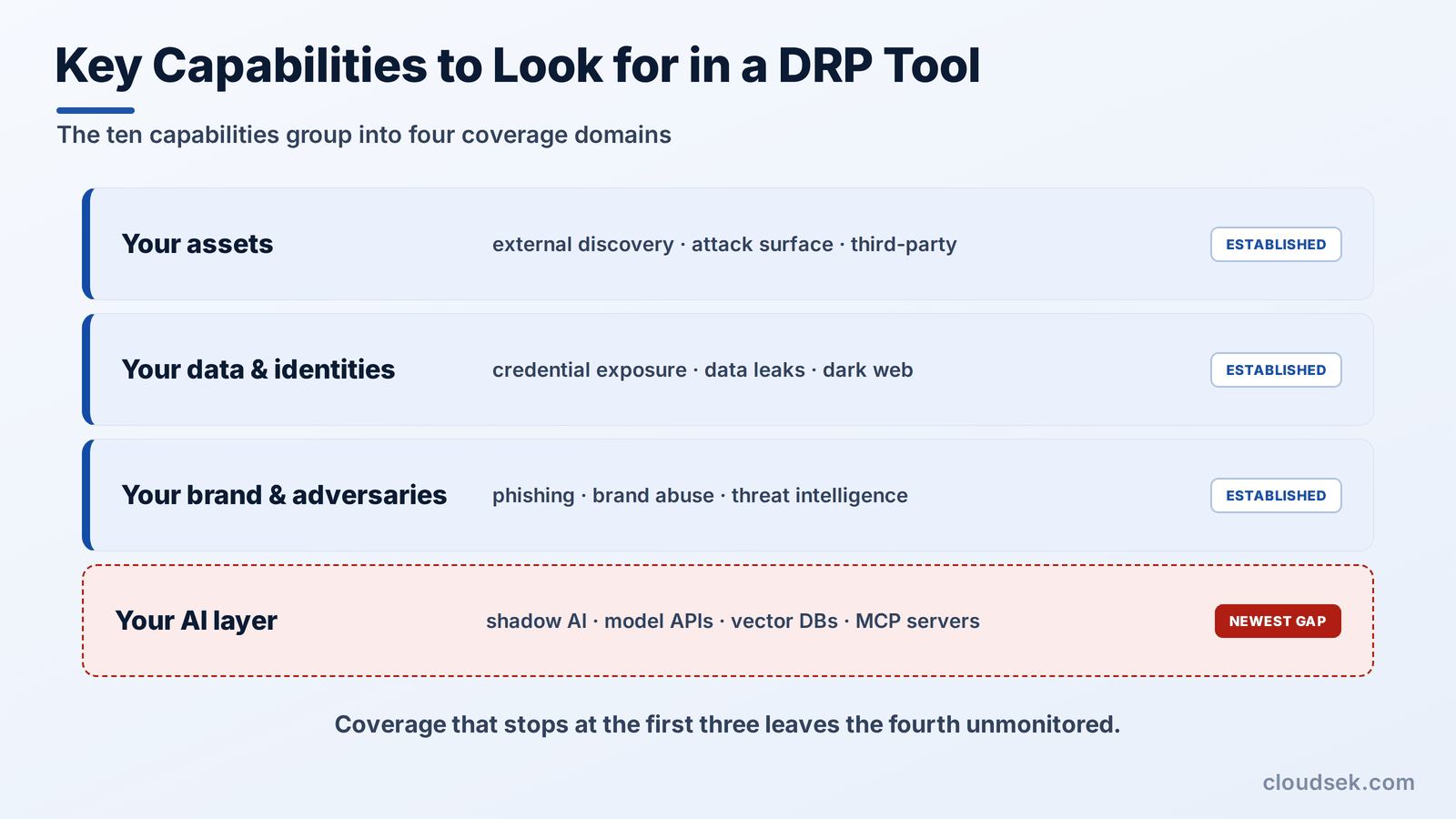
Several capabilities determine how effectively a digital risk protection solution identifies, prioritizes, and reduces external cyber risks.
External asset discovery helps identify websites, domains, cloud resources, and internet-facing infrastructure connected to a business. Complete awareness of these resources reduces blind spots that could increase exposure.
Business growth, cloud adoption, and new technology deployments often introduce previously unknown systems. Discovery accuracy and asset mapping create a clearer picture of the external environment.
Credential exposure monitoring identifies usernames, passwords, access keys, and authentication tokens that appear in breach datasets or underground marketplaces. Prompt identification reduces the likelihood of unauthorized account access.
Compromised login information frequently becomes an entry point for fraud, ransomware, and unauthorized activity. Alert precision and contextual intelligence improve remediation efforts and incident prioritization.
Phishing detection uncovers fraudulent domains, spoofed websites, and deceptive campaigns designed to collect sensitive information. Rapid identification limits opportunities for cybercriminals to target employees, customers, and partners.
Lookalike domains often imitate trusted organizations to increase credibility among potential victims. Domain analysis and campaign tracking improve investigation and takedown efforts.
Data leak detection identifies sensitive information exposed through breach repositories, public storage locations, and unauthorized sharing channels. Rapid awareness reduces the risk of regulatory issues and operational disruption.
Confidential records can become accessible through accidental exposure or malicious activity. Detection accuracy and risk prioritization help focus attention on the most critical incidents.
Dark web monitoring provides insight into underground communities where stolen information, corporate data, and illicit services are exchanged. Access to these sources improves awareness of emerging cybercrime activity.
Discussions within underground forums often reveal compromised accounts, leaked records, and planned attacks. Broader intelligence collection creates a deeper understanding of potential exposure.
Brand abuse detection identifies unauthorized use of company names, logos, domains, and digital identities. Timely recognition reduces opportunities for impersonation, fraud, and customer deception.
Fake websites and rogue social media profiles can damage credibility and erode trust. Investigation capabilities and broad source coverage improve response effectiveness.
Threat intelligence coverage determines the quality and depth of information available for risk assessment. Rich intelligence sources provide valuable context about adversaries, tactics, and emerging attack patterns.
Broader intelligence collection improves decision-making during investigations and remediation activities. Contextual enrichment also helps separate critical findings from low-priority observations.
Third-party risk visibility reveals weaknesses introduced through vendors, suppliers, service providers, and external partners. Greater awareness of external dependencies improves overall resilience.
Interconnected business relationships can create additional exposure beyond internal environments. Continuous assessment helps identify vulnerabilities associated with external ecosystems.
Attack surface monitoring tracks changes across publicly accessible infrastructure and exposure points. Continuous observation improves awareness of assets that may increase organizational risk.
Infrastructure changes can introduce vulnerabilities without immediate recognition. Ongoing assessment helps identify security gaps before they become attractive targets.
Emerging threat detection focuses on identifying new attack techniques, evolving cybercrime activity, and developing security risks. Immediate awareness improves preparedness and strategic planning.
Predictive analytics and trend analysis provide insight into changes occurring across the cyber landscape. Forward-looking intelligence enables faster adaptation to evolving attack methods.
CloudSEK’s AIVigil approach to Digital Risk Protection focuses on securing the AI layer that traditional monitoring often misses. It discovers exposed AI infrastructure across the internet, including shadow AI tools, unmanaged models, AI APIs, vector databases, MCP servers, and agentic workflows that can quietly expand an organization’s attack surface.
Unauthorized AI systems, leaked platform keys, exposed integrations, and misconfigured databases can give attackers new ways to enter, manipulate, or extract sensitive information. Continuous exposure monitoring brings these hidden risks into view before they lead to data poisoning, intellectual property theft, or unauthorized access.
AI-layer findings become more valuable when they connect with XVigil and Nexus AI, where external threat signals such as dark web chatter, leaked credentials, and attacker activity are correlated with exposed assets. Combined attack path intelligence turns scattered risks into validated priorities, allowing security teams to focus on the issues most likely to cause real impact.
CloudSEK’s XVigil platform stands out as a powerful solution with a comprehensive deep and dark web monitoring module that offers all these features and more. Our superpower lies in working with companies to understand their specific needs and providing them with actionable intelligence to combat current cyber threats and prepare for future ones.
Book a demo today to see how XVigil can help protect your organization.
Protect your organization from external threats like data leaks, brand threats, dark web originated threats and more. Schedule a demo today!
Schedule a Demo
.png)