🚀 A CloudSEK se torna a primeira empresa de segurança cibernética de origem indiana a receber investimentos da
Leia mais
.avif)

Threat intelligence prevents cyber attacks and ransomware by identifying threats before execution and enabling immediate defensive actions. Security teams use analyzed threat data to block malicious activity and reduce system exposure, and the stakes for acting early keep rising: Sophos's State of Ransomware 2025 report found the share of attacks that reach full encryption has fallen to 50 percent, the lowest in six years, while attacks that skip encryption entirely and extort victims on stolen data alone doubled from 3 to 6 percent.
Attackers exploit hidden vulnerabilities, move laterally across networks, and deploy techniques designed to evade detection. Advanced monitoring and correlation of threat signals expose these patterns and stop attacks before they escalate.
Ransomware operations depend on rapid encryption and data exfiltration to maximize impact. BlackFog's Q3 2025 research found that 96 percent of ransomware attacks now involve data exfiltration, meaning detection has to catch the theft, not just the encryption, to prevent systems from being locked and sensitive data from being compromised.
Early-stage attack prevention relies on visibility, behavioral context, and the ability to act on intelligence before exploitation occurs.

Diverse data streams such as endpoint activity, network telemetry, and external intelligence feeds contribute to a unified threat view. A broader collection ensures visibility into both internal anomalies and external attacker movements.
Telemetry from user behavior, system processes, and communication patterns provides the raw foundation for detection. Strong data diversity improves the ability to identify subtle and early-stage attack signals.
Detection relies on analyzing indicators of compromise across multiple layers, including network activity, host behavior, and system-level changes. Each layer reveals different aspects of the attacker's presence and intent.
Network indicators may expose command-and-control communication, while host indicators highlight unauthorized execution or persistence mechanisms. Behavioral indicators further reveal patterns such as privilege escalation or abnormal access flows.
Continuous observation across systems enables immediate visibility into suspicious actions as they occur. Rapid detection prevents attackers from establishing persistence within the environment.
Streaming data analysis allows security teams to react to anomalies without delay. Faster intervention significantly reduces the window of opportunity for attackers.
Deviations from normal activity often reveal threats that bypass traditional detection methods. Behavioral analysis focuses on how users and systems interact rather than relying only on known signatures.
Unusual access patterns, unexpected process execution, and irregular data movement highlight potential compromise. Context-driven detection strengthens defense against previously unseen attack techniques.
Isolated alerts rarely provide a complete picture of an attack. Correlation connects events across endpoints, networks, and users to reveal coordinated activity.
Linked signals expose attack chains such as reconnaissance followed by lateral movement. Clear context enables faster and more accurate decision-making during incidents.
Unpatched systems and misconfigurations create entry points for attackers. Identifying these weaknesses early reduces exposure to exploitation.
Proactive assessment highlights risks before they are actively targeted. Strengthened systems limit the number of viable attack paths available to adversaries.
Speed plays a critical role in stopping threats before damage occurs. Automated actions such as access restriction, process termination, or network isolation reduce response time significantly.
Consistent execution of response actions ensures threats are contained without delay. Reduced reliance on manual intervention improves overall security efficiency.
Evolving attack techniques require constant refinement of detection capabilities. Updated intelligence ensures systems remain aligned with current threat behavior.
New insights improve protection against threats like phishing and malware by adapting detection logic. Continuous learning keeps defenses effective against emerging cyber risks.
Ransomware prevention depends on detecting attacker behavior before encryption begins and disrupting the attack chain at critical stages.
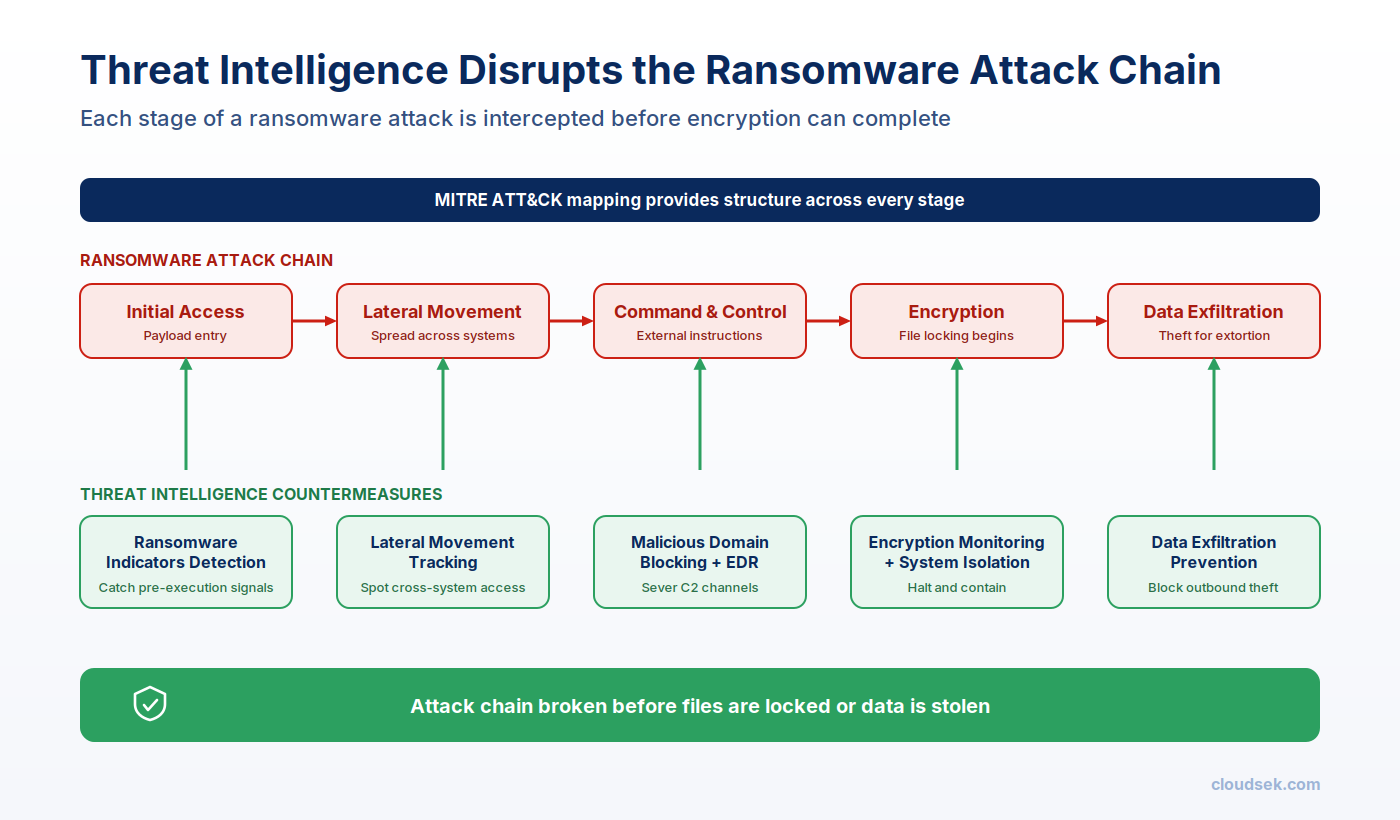
Early warning signals emerge through ransomware-specific patterns such as suspicious execution flows and unauthorized access attempts. Recognition of these indicators helps identify threats before payload activation.
Pre-execution signals often include abnormal script activity and unauthorized privilege usage. Timely detection at this stage prevents ransomware from initiating its core functions.
Encryption activity creates distinct patterns that differ from normal system operations. Monitoring tools track rapid file modifications and unusual encryption processes across endpoints.
Sudden spikes in file access and transformation indicate potential ransomware execution. Early interruption of these processes prevents widespread data locking.
Attackers often move across systems to expand access before launching ransomware. Tracking internal movement reveals how threats propagate within the network.
Unusual authentication attempts and cross-system access patterns signal lateral movement. Detecting this behavior early helps contain the threat before it reaches critical assets.
Ransomware relies on external communication channels to receive commands and transmit data. Blocking these connections disrupts the attacker's control over infected systems.
Threat intelligence identifies suspicious communication patterns linked to command infrastructure. Preventing these connections weakens the attack and limits its effectiveness.
Attack techniques can be mapped using frameworks like the MITRE ATT&CK Framework to understand how ransomware operates. Mapping provides structured insight into attacker behavior across different stages.
Every technique reveals a step in the attack lifecycle, from initial access to execution. Better visibility into these stages improves detection and prevention strategies.
Endpoint-level visibility plays a critical role in identifying ransomware activity. Integration with endpoint detection systems allows monitoring of processes, file changes, and system interactions.
Detailed endpoint insights expose malicious execution patterns in real time. Strong endpoint coverage enhances the ability to stop ransomware at its source.
Containment becomes essential once suspicious activity is confirmed. Isolating affected systems prevents ransomware from spreading across the network.
Segmentation limits access between systems and reduces overall impact. Rapid isolation ensures critical infrastructure remains protected.
Modern ransomware attacks often include data theft before encryption. Preventing unauthorized data transfer reduces the risk of double extortion.
Monitoring outbound traffic helps identify unusual data movement patterns. Blocking these transfers protects sensitive information from exposure.
Ransomware groups are evolving by adopting advanced tactics, scalable business models, and stealth techniques to increase attack success and financial gain.

Double Extortion Tactics. Modern ransomware campaigns no longer rely only on encryption but also involve data theft before execution. Attackers use stolen data as leverage, threatening public exposure to force payment, a shift that has made double extortion the default rather than the exception across the ecosystem.
Ransomware-as-a-Service (RaaS). The rise of Ransomware-as-a-Service enables affiliates to launch attacks without developing their own malware. This model increases attack volume by distributing tools, infrastructure, and support across cybercriminal networks.
Advanced Evasion Techniques. Sophisticated methods such as fileless execution and obfuscation help ransomware bypass traditional defenses. These techniques reduce detection by avoiding known signatures and blending into normal system processes.
Faster Encryption Mechanisms. Encryption routines have become more efficient to minimize detection windows. Rapid execution ensures systems are locked before defensive actions can interrupt the attack.
Data Exfiltration and Leak Platforms. Dedicated leak sites are used to publish stolen data if victims refuse to comply. Public exposure increases reputational damage and adds pressure beyond operational disruption.
Living-off-the-Land Techniques. Attackers leverage legitimate system tools to carry out malicious actions without introducing new software. This approach makes detection harder by mimicking normal administrative behavior.
AI-Driven Attack Automation. Use of artificial intelligence and automation enhances reconnaissance, phishing, and attack execution. Intelligent systems improve targeting accuracy and allow ransomware groups to scale operations efficiently.
Most of the detection stages above depend on one thing: knowing what to look for before an attack reaches an organization's own network. A ransomware group's infrastructure, affiliate activity, and target selection are usually visible externally well before the first suspicious process runs on an endpoint.
CloudSEK Threat Intelligence tracks ransomware groups and their tactics, techniques, and procedures directly, along with exploited CVEs and malware campaigns tied to specific industries and regions. That gives a security team the MITRE ATT&CK-mapped context described above before a group's known behavior shows up inside their own environment, rather than reconstructing it after containment has already started.
Because ransomware prevention depends on correlating weak signals quickly, an unpatched CVE, a leaked credential, a domain associated with a known affiliate, CloudSEK Nexus AI connects those signals into a validated attack path. That turns isolated indicators into a prioritized answer to the question every one of the eight prevention stages above depends on: which weakness is an active ransomware group actually likely to use next.
Proactive threat detection reduces the window attackers rely on to execute and expand their operations. Intelligence-driven security enables faster decisions and limits the impact of evolving cyber threats.
Strong prevention depends on visibility across systems, accurate analysis of threat behavior, and the ability to respond without delay. Organizations that integrate these capabilities build a more resilient and adaptive security posture.
Ransomware risks continue to grow with advanced tactics focused on encryption and data extortion. Intelligence-led defense strategies help stop these attacks and protect critical data from compromise.
Threat intelligence analyzes data from multiple sources to identify patterns linked to malicious activity. Actionable insights allow security teams to block threats before they escalate.
Detection of pre-execution behavior and suspicious system activity allows intervention before encryption begins. Disrupting attack chains prevents ransomware from locking files.
Indicators of Compromise are signals such as unusual behavior, unauthorized access, or suspicious communication patterns. These indicators help identify potential security breaches.
Behavioral analysis detects anomalies that do not match known attack signatures. Pattern recognition helps uncover previously unseen threats based on activity rather than predefined rules.
Real-time monitoring and automated actions enable immediate response to detected threats. Faster reactions reduce the chances of attackers gaining control or spreading within systems.
Ransomware relies on stealth and rapid execution to cause damage. Threat intelligence disrupts these stages by detecting suspicious behavior and blocking attack progression.
