🚀 A CloudSEK se torna a primeira empresa de segurança cibernética de origem indiana a receber investimentos da
Leia mais
.avif)

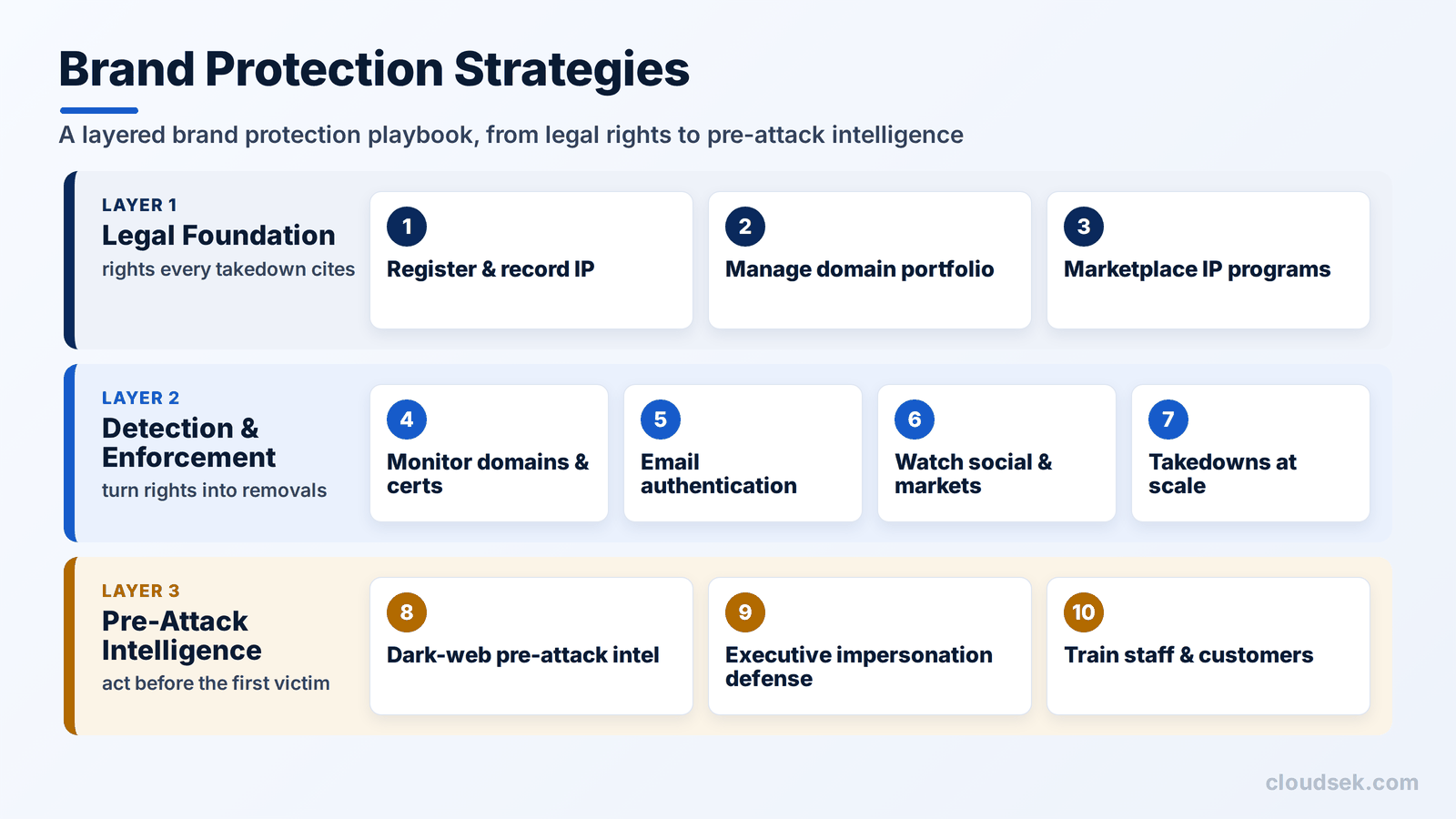
Brand protection strategies are the coordinated legal, technical, and organizational measures a company uses to stop attackers and counterfeiters from exploiting its name, logo, domains, products, and executives. Effective programs layer 10 such strategies across three tiers: a legal foundation, continuous detection and enforcement, and pre-attack intelligence.
WIPO's Arbitration and Mediation Center recorded an all-time high of cybersquatting cases filed in 2025, with more than 6,200 proceedings administered under the UDRP and related mechanisms, driven in large part by AI-assisted infringement.
Brand protection is the discipline of defending a company's identity and intellectual property against misuse, spanning trademark enforcement, anti-counterfeiting, fraud prevention, and impersonation defense. Brand protection treats every place a customer encounters the brand as a surface an attacker exploits, which is why the discipline now sits with security teams as much as with legal teams.
Online brand protection is the digital subset, focused on lookalike domains, phishing sites, fake social profiles, fraudulent apps, scam ads, and counterfeit e-commerce listings. Digital risk protection, or DRP, is the technology category that operationalizes it: platforms that monitor external channels, detect impersonation, and drive takedowns.
Three terms, one hierarchy. Brand protection names the discipline, online brand protection names its digital half, and DRP names the tooling, and buyers searching any of the three want largely the same program described below.
Nine threat types account for nearly all brand abuse, and each maps to specific strategies in the layers below. Attackers chain them: one campaign pairs a typosquatted domain, a fake social profile, and a paid ad, so single-channel defenses miss most of the activity.
Legal rights come first because every takedown, dispute, and customs seizure cites them. Three strategies build the foundation.
Trademark registration in every jurisdiction of manufacture, sale, and planned expansion is the prerequisite for enforcement anywhere. The Madrid Protocol streamlines multi-country filing through a single application, and recording registered marks with customs authorities authorizes border seizure of counterfeit shipments.
Scale justifies the paperwork. The OECD and EUIPO estimate global trade in counterfeit goods at 467 billion US dollars, or 2.3% of world imports, which is the market a registered and recorded trademark portfolio pushes back against.
Defensive registration of high-risk variants, common typos, key country-code extensions, and priority new gTLDs denies attackers their lowest-cost infrastructure. Registry locks on crown-jewel domains block unauthorized transfers.
Disputes handle what registration misses. A UDRP complaint transfers or cancels an infringing domain in roughly two months with a success rate above 80%, while the URS suspends a clear-cut infringement faster and cheaper but returns the domain to the market at expiry. Transfer beats suspension for domains worth keeping, which is why the UDRP dominates filing volume.
Amazon Brand Registry, eBay VeRO, and equivalent programs on regional marketplaces give rights holders direct reporting lanes, proactive matching against registered marks, and faster listing removal than generic abuse forms. App store equivalents accept trademark evidence against cloned apps. Enrollment costs little and converts every later counterfeit report from a cold complaint into a verified rights-holder action.
Legal rights without detection protect nothing, since attackers register infrastructure faster than any manual review finds it. Four strategies convert rights into removals.
Certificate Transparency logs expose every SSL certificate issued for lookalike domains within minutes of issuance, which is frequently days before a phishing campaign launches. Passive DNS correlation then links one detected domain to the attacker's wider infrastructure, so enforcement targets the cluster rather than a single site.
Watchlists drive the matching: brand strings, homoglyph and Punycode variants, product names, and executive names, scored against registrar reputation, MX records, and hosting patterns. Variants follow known patterns, so a watchlist for microsoft.com covers rnicrosoft.com with rn imitating m, micros0ft.com with a zero, and Cyrillic lookalikes that render identically in a browser bar. High-risk hits route to takedown before weaponization.
SPF, DKIM, and DMARC together stop attackers from sending mail as the exact brand domain. Deployment runs as a ladder: publish SPF and DKIM, set DMARC to monitoring (p=none) to collect reports, then advance through quarantine to reject as legitimate senders are accounted for.
DMARC aggregate reports double as threat intelligence, revealing which infrastructure attempts to spoof the domain. BIMI then displays the verified brand logo in supporting inboxes, turning authentication into a visible trust signal.
Impersonation concentrates where customers already are: fake support accounts on social platforms, cloned apps in official and third-party stores, and counterfeit listings on marketplaces. Image hashing detects logo and product-photo reuse at scale, metadata scanning flags apps that mimic naming conventions, and fake app detection and takedown workflows extend the same discipline across mobile, desktop, and web clones.
A takedown is a formal removal request to a registrar, host, platform, or ad network, and its speed decides how many customers a scam reaches. Strong requests bundle evidence: URLs, WHOIS records, HTTP headers, screenshots, certificate chains, and the trademark basis.
Automation carries the volume. Detections flow into case queues with evidence attached, notices localize to the provider's jurisdiction and policy, and repeat infrastructure feeds back into detection.
Providers act quickest on reports from parties with established trust, which makes service selection part of this strategy. Evaluate brand protection services on 5 criteria: channel coverage breadth, detection accuracy, takedown speed and provider relationships, evidence-package quality, and integration with existing ticketing and SIEM workflows.
Layers 1 and 2 act on visible abuse. Layer 3 acts earlier, during preparation, and prepares the humans attackers target.
Brand-targeted campaigns leave traces before launch. Phishing kits impersonating a specific brand sell on criminal forums, leaked customer credentials circulate in combolists, and cloned-site templates trade on Telegram, all before the first victim clicks.
Monitoring those sources moves defense from the campaign stage to the preparation stage. CloudSEK's investigation of CEO impersonation fraud targeting IT companies documents the pattern: attackers assemble executive names, roles, and contact details from public sources, then run urgency-driven WhatsApp lures, and the assembly stage is observable ahead of the first message.
Executive identities function as brand assets with signing authority, which makes executive impersonation a uniquely high-stakes impersonation class. Voice cloning and synthetic video now require seconds of public source material. Defense therefore covers the full trail: fake executive profiles, lookalike domains carrying executive names, and leaked executive credentials.
Verification protocols close the loop. Payment and data-release requests route through a second, pre-agreed channel, so no single voice, video call, or message authorizes them.
Employees encounter impersonation first, through spoofed messages and fraudulent calls, and customers encounter it through fake promotions and support accounts. Training tied to live campaigns against the organization outperforms generic awareness content. A published page listing every official domain, app, handle, and support number gives customers a verification point before they engage, and turns each reported fake into a detection signal.
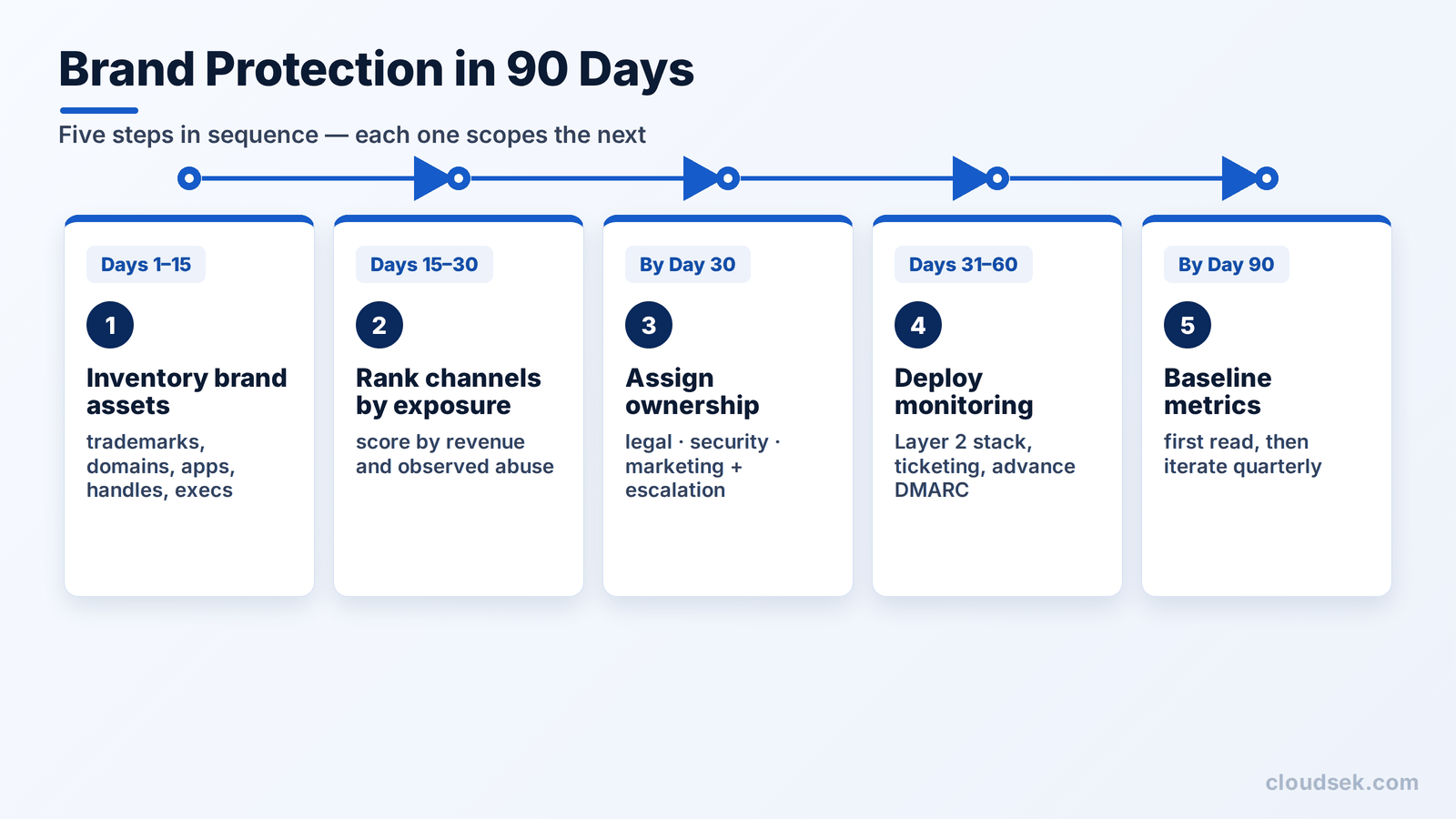
To build a brand protection program, run five steps in sequence, since each step scopes the next.
Six metrics separate a working program from a busy one. Leading indicators predict exposure, lagging indicators price it.
AI industrialized the offense. Generative models produce pixel-accurate cloned storefronts, fluent phishing copy in any language, and synthetic executive voices from seconds of audio, so campaign cost collapsed while volume and quality rose together. WIPO attributes part of the record 2025 cybersquatting caseload to exactly this shift.
Defense answers with the same tooling. Image-similarity models catch logo reuse that string matching misses, classifiers score newly registered domains at issuance, and clustering ties domains, profiles, ads, and wallets into single campaigns so one takedown request addresses the whole funnel. Advantage follows whichever side operationalizes the models faster, which for defenders means automation from detection through enforcement rather than AI-assisted detection feeding a manual queue.
Most brand protection tooling watches for live abuse. The earlier signals- phishing kits for sale, leaked credentials, impersonation infrastructure under assembly- sit on sources few marketing or legal teams reach: criminal forums, paste sites, Telegram channels, and dark web markets.
CloudSEK XVigil monitors those sources alongside the visible surface. Detection spans impersonated and typosquatted domains, fake and outdated apps across official and third-party stores, fraudulent social pages, fake customer-care numbers, and executive impersonation assets, with end-to-end takedown support through registrar and platform channels.
Placement in the stack is specific. XVigil covers Layer 2 detection and enforcement and supplies the Layer 3 intelligence that most point tools omit, prioritizing findings by exploitability and attacker intent, and Nexus AI correlates brand-abuse signals with the wider external threat picture. Legal foundation work in Layer 1 stays with counsel, which a monitoring platform complements rather than replaces.
What is the difference between brand protection and trademark protection?
Trademark protection secures legal rights to names and logos, while brand protection covers the full defense: trademark enforcement plus detection, takedowns, anti-counterfeiting, and impersonation response.
Who owns brand protection in an organization?
Brand protection in an organization is owned jointly: legal owns rights and disputes, security owns detection and takedowns, and marketing owns official channels, connected through a named escalation path.
How long does a takedown take?
How long a takedown takes depends on channel: hours to days for phishing sites backed by strong evidence, days to weeks for social profiles and apps, and roughly two months for a UDRP transfer.
Do small businesses need brand protection strategies?
Yes, small businesses need brand protection strategies. Attackers impersonate any brand with paying customers, and free controls such as DMARC, platform IP programs, and defensive registrations cover the basics.
Is gray-market selling illegal?
Gray-market selling of genuine goods is generally legal in most jurisdictions, and enforcement instead relies on contract terms with distributors, warranty policies, and marketplace listing rules.
What does a brand protection service cost?
A brand protection service costs low thousands of dollars annually for monitoring-only tools, rising to six figures for enterprise platforms with unlimited takedowns, scaling on channels and enforcement volume.
