🚀 CloudSEK featured in the 2026 Frost Radar™!
Read more
.avif)

Digital risk protection (DRP) is a proactive cybersecurity approach that continuously identifies, monitors, analyzes, and mitigates external cyber threats targeting an organization’s digital presence, internet-facing assets, users, brand identity, and sensitive information across public environments.
DRP helps organizations detect phishing campaigns, leaked credentials, fake domains, ransomware activity, impersonation attacks, exposed cloud assets, and malicious infrastructure operating outside traditional enterprise networks.
DRP platforms identify internet-facing assets such as domains, cloud services, APIs, mobile applications, social media accounts, and external infrastructure connected to business operations.
Continuous monitoring scans dark web forums, public repositories, phishing infrastructure, social platforms, malicious domains, and underground communities for cyber threats targeting the organization.
DRP solutions detect leaked credentials, fake websites, impersonation campaigns, ransomware activity, exposed assets, and fraudulent digital content across external environments.
Threat intelligence analysis connects detected risks with threat actors, attack campaigns, malicious infrastructure, and exposure severity to improve risk visibility and prioritization.
Real-time alerts help security teams investigate external threats quickly, prioritize remediation actions, and reduce operational risks linked to phishing, fraud, identity exposure, and internet-facing attacks.
These are the major risks from which digital risk protection (DRP) protects:
Attackers frequently create fake domains, spoofed websites, fraudulent emails, and impersonation campaigns that mimic trusted brands or executives to steal credentials, financial data, and sensitive business information from employees and customers.
Leaked credentials, compromised employee accounts, exposed customer identities, and authentication data often appear across dark web forums, breach repositories, and underground marketplaces after phishing attacks or data breaches.
Public-facing cloud services, APIs, applications, databases, and unmanaged infrastructure can become major attack entry points when organizations fail to monitor external exposure continuously across digital environments.
Threat actors and ransomware groups actively target internet-facing systems, exposed credentials, vulnerable infrastructure, and third-party services to gain unauthorized access and disrupt business operations.
Vendors, SaaS providers, contractors, and connected third-party services often introduce indirect cyber risks through shared access, external integrations, and interconnected infrastructure across enterprise ecosystems.
Cybercriminals exploit trusted brand identities through fake mobile applications, fraudulent social media accounts, counterfeit websites, and online scams designed to deceive customers and conduct financial fraud.
Digital risk protection improves external threat visibility by continuously monitoring internet-facing environments, analyzing malicious activity, and identifying cyber risks targeting digital ecosystems.
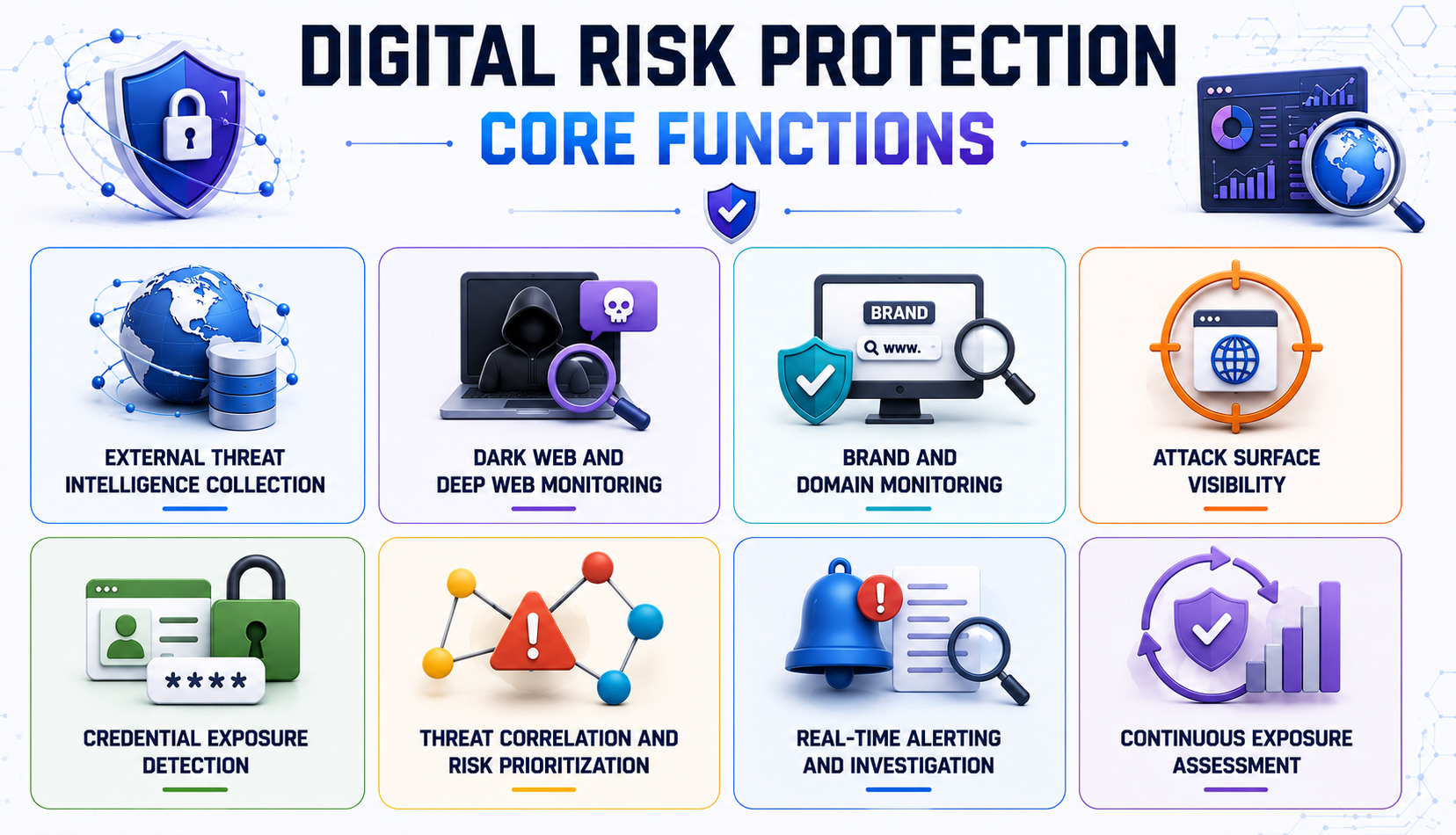
DRP collects threat intelligence from public sources, dark web forums, breach repositories, social platforms, malicious infrastructure, and underground communities to identify external threats targeting organizations.
Continuous dark web monitoring helps organizations detect leaked credentials, stolen data, compromised accounts, ransomware discussions, and threat actor activity circulating across hidden online communities.
Brand monitoring capabilities identify fake domains, phishing websites, impersonation campaigns, spoofed communication, and unauthorized digital assets misusing trusted brand identities.
DRP platforms improve visibility into exposed cloud assets, public APIs, internet-facing applications, misconfigured systems, and unmanaged infrastructure connected to enterprise operations.
Credential monitoring helps organizations identify leaked employee accounts, compromised user credentials, authentication abuse risks, and exposed identities before attackers exploit them.
Threat correlation connects detected risks with active threat actors, ransomware groups, phishing campaigns, malicious infrastructure, and exposure severity to improve security prioritization.
Real-time alerting helps security teams investigate external threats quickly, respond to high-risk incidents faster, and reduce operational impact linked to phishing, fraud, and impersonation activity.
Continuous exposure assessment helps organizations track changing attack surfaces, newly exposed assets, third-party risks, and evolving digital threats across internet-facing environments.
Digital risk protection has become essential because modern cyber threats increasingly target internet-facing systems, digital identities, cloud environments, and external business operations outside traditional security boundaries.
The following reasons make DRP essential in today’s digital environment:
Organizations continuously expand their digital presence through cloud infrastructure, SaaS applications, APIs, remote access systems, mobile platforms, and customer-facing services that increase external cyber exposure across public environments.
Cybercriminals increasingly use phishing infrastructure, fake websites, impersonation campaigns, and fraudulent communication to steal credentials, financial data, and sensitive information from employees and customers.
Cloud platforms and SaaS environments often introduce exposed assets, insecure integrations, weak access controls, and publicly accessible services that attackers actively scan for exploitation opportunities.
Threat actors frequently target employee accounts, customer identities, privileged credentials, and authentication systems because compromised identities often provide direct access into enterprise environments.
External cyber threats spread rapidly across internet-facing environments, which makes delayed detection a major risk for operational continuity, customer trust, and incident response effectiveness.
Organizations handling sensitive customer data, financial information, and digital services face increasing compliance requirements related to cybersecurity governance, fraud prevention, and data protection.
Phishing attacks, ransomware activity, credential leaks, and online fraud frequently create financial losses, operational disruption, legal liabilities, and reputational damage across business operations.
Customers expect organizations to secure digital interactions, online services, payment systems, and internet-facing platforms against impersonation attacks, fraud campaigns, and identity-related threats.
Digital risk protection (DRP), Attack Surface Management (ASM), and Threat Intelligence focus on different areas of cybersecurity visibility and risk management.
DRP focuses on detecting external threats targeting digital identities, internet-facing assets, leaked credentials, and brand exposure. ASM focuses on identifying and monitoring exposed assets across public-facing infrastructure. Threat Intelligence focuses on collecting and analyzing threat data related to attackers, malware, ransomware groups, and malicious activity.
Organizations use DRP to identify external cyber threats earlier, reduce internet-facing exposure, and improve visibility into malicious activity targeting digital operations.
Digital risk protection helps organizations identify fake domains, phishing websites, spoofed login pages, and fraudulent communication used by attackers to steal credentials and sensitive information from employees and customers.
Continuous credential monitoring helps security teams detect exposed employee accounts, compromised customer credentials, and leaked authentication data circulating across dark web forums and breach marketplaces.
Organizations use DRP to detect counterfeit websites, unauthorized mobile applications, cloned portals, and fraudulent online assets impersonating trusted brands across internet-facing environments.
Threat intelligence capabilities help organizations monitor ransomware groups, malicious infrastructure, data leak sites, and cybercriminal activity targeting enterprise systems and digital assets.
Digital risk protection identifies impersonation attempts targeting executives, finance teams, and business leaders through fraudulent emails, spoofed communication, and business email compromise campaigns.
Organizations use DRP to track vendor exposure, compromised third-party services, insecure external integrations, and supply chain risks connected to business operations and digital ecosystems.
Continuous brand monitoring helps organizations detect fake social media accounts, online scams, impersonation campaigns, and malicious digital content that may damage customer trust and business reputation.
Industries with large digital ecosystems, internet-facing infrastructure, customer-facing services, and sensitive data benefit significantly from continuous external threat monitoring and digital risk visibility.
Banks, payment platforms, insurance providers, and financial institutions face constant threats from phishing attacks, credential theft, ransomware activity, online fraud, and executive impersonation targeting financial transactions and customer accounts.
Healthcare organizations manage sensitive patient information, connected medical systems, cloud platforms, and third-party services that attackers frequently target through ransomware attacks, exposed assets, and identity-based threats.
Retail businesses and e-commerce platforms face growing risks from fake websites, payment fraud, credential stuffing attacks, phishing campaigns, and malicious activity targeting customer accounts and digital payment systems.
Technology companies and SaaS providers operate internet-facing applications, APIs, cloud environments, and customer platforms that require continuous monitoring for exposed assets, credential leaks, and external cyber threats.
Government agencies and public sector organizations often face advanced cyber threats targeting public infrastructure, citizen data, digital services, and operational systems through phishing, ransomware, and nation-state activity.
Manufacturing companies and supply chain environments rely heavily on connected systems, third-party vendors, cloud infrastructure, and operational technology that increase exposure to ransomware attacks, vendor compromise, and operational disruption.
Organizations without digital risk protection often struggle to identify external cyber threats, monitor internet-facing exposure, and maintain visibility across rapidly expanding digital environments.
Here are some common problems organizations face without a DRP solution:
Many organizations lack continuous visibility into phishing infrastructure, malicious domains, fake applications, exposed cloud assets, and online threats operating outside traditional enterprise networks.
External cyber threats often remain undetected for long periods when organizations fail to monitor public-facing environments, dark web activity, impersonation campaigns, and internet-facing infrastructure continuously.
Compromised employee accounts, leaked credentials, exposed authentication data, and stolen customer identities frequently circulate across breach repositories and underground forums without timely detection.
Attackers increasingly misuse trusted brand identities through fake websites, fraudulent social media accounts, phishing campaigns, and online scams that damage customer trust and business reputation.
Cloud platforms, SaaS applications, APIs, and internet-facing services often create unmanaged exposure when organizations lack centralized visibility into external infrastructure and digital assets.
Security teams face delays in threat investigation and incident response when external cyber risks, malicious infrastructure, and internet-facing exposure remain outside centralized monitoring processes.
Phishing attacks, ransomware activity, fraud campaigns, credential theft, and digital impersonation frequently lead to operational disruption, financial losses, legal exposure, and long-term reputational damage across business operations.
Modern Digital risk protection depends on integrated technologies that improve visibility into external threats, internet-facing exposure, malicious infrastructure, and digital risks across connected environments.
Threat intelligence platforms collect and analyze data related to phishing campaigns, ransomware groups, malicious domains, threat actors, and cybercriminal activity targeting enterprise systems and digital identities.
External attack surface management improves visibility into internet-facing assets, exposed cloud infrastructure, APIs, applications, domains, and unmanaged systems connected to business operations.
Dark web monitoring helps organizations identify leaked credentials, stolen customer data, compromised accounts, ransomware discussions, and malicious activity circulating across underground communities.
AI-driven analysis improves threat detection by correlating phishing activity, malicious infrastructure, credential exposure, behavioral patterns, and external cyber risks across large digital environments.
Brand monitoring technologies detect fake websites, impersonation campaigns, fraudulent mobile applications, spoofed communication, and unauthorized digital assets misusing trusted brand identities.
Identity monitoring solutions help organizations identify exposed employee accounts, authentication abuse, privileged access risks, and leaked credentials before attackers exploit compromised identities.
Cloud exposure monitoring improves visibility into misconfigured storage, publicly accessible services, exposed APIs, insecure cloud assets, and internet-facing infrastructure across distributed environments.
Automated risk correlation helps security teams prioritize external threats by connecting exposure data, threat intelligence, attack activity, and operational impact across digital ecosystems.
CloudSEK XVigil helps organizations strengthen digital risk protection through continuous monitoring of external cyber threats, internet-facing exposure, and malicious activity targeting digital ecosystems. Here are the features of XVigil:
Digital risk protection is important because it helps organizations identify external cyber threats, reduce internet-facing exposure, protect digital identities, and improve visibility into phishing attacks, credential leaks, and online fraud activity.
DRP monitors domains, cloud assets, APIs, mobile applications, social media accounts, leaked credentials, internet-facing systems, SaaS platforms, and external digital infrastructure connected to business operations.
Digital risk protection improves incident response by helping security teams identify external threats earlier, investigate malicious activity faster, and prioritize remediation actions based on exposure severity and operational risk.
Traditional cybersecurity mainly focuses on protecting internal networks and endpoints, while Digital risk protection focuses on external cyber threats targeting internet-facing assets, digital identities, cloud environments, and public-facing infrastructure.
Yes. Digital risk protection monitors fake social media accounts, impersonation campaigns, fraudulent pages, malicious links, and online scams targeting trusted brands and customer interactions.
Yes. Small and mid-sized businesses frequently face phishing attacks, credential theft, online fraud, and exposed cloud infrastructure risks that require continuous external threat visibility and monitoring.
Book a demo today to see how XVigil can help protect your organization.
Proactively monitor and defend your organization against threats from the dark web with CloudSEK XVigil.
Schedule a Demo

