🚀 A CloudSEK se torna a primeira empresa de segurança cibernética de origem indiana a receber investimentos da
Leia mais
.avif)

CloudSEK BeVigil is best for vulnerability management across the external attack surface because it continuously discovers exposed, forgotten, and shadow assets and identifies vulnerabilities and misconfigurations affecting them. Tenable One Vulnerability Management uses Nessus-based scanning to assess vulnerabilities across enterprise infrastructure at scale.
Technical severity alone does not determine remediation priority. Active exploitation, reachability, asset criticality, and attack-path relevance can change which issues require attention first. Unknown internet-facing assets, enterprise-scale assessment, remediation execution, cross-team ownership, and adversary-informed prioritization each create a different buying requirement.
The feature set extends from asset discovery through technical verification.
We checked product pages, technical documentation, release notes, and packaging information. Release notes helped resolve renamed or retired capabilities. Roadmap-only features were excluded from the comparison.
Scope mattered because a capability shown at the platform level may not belong to the product being evaluated. Add-ons, integrations, and broader modules were kept separate from the core offering.
Claims about accuracy, performance, ROI, or overall effectiveness stayed attributed to the vendor rather than treated as independent proof. Coverage limits, deployment requirements, and subscription dependencies were included when they changed what a customer would receive.
Coverage separates some products; prioritization and remediation separate others.
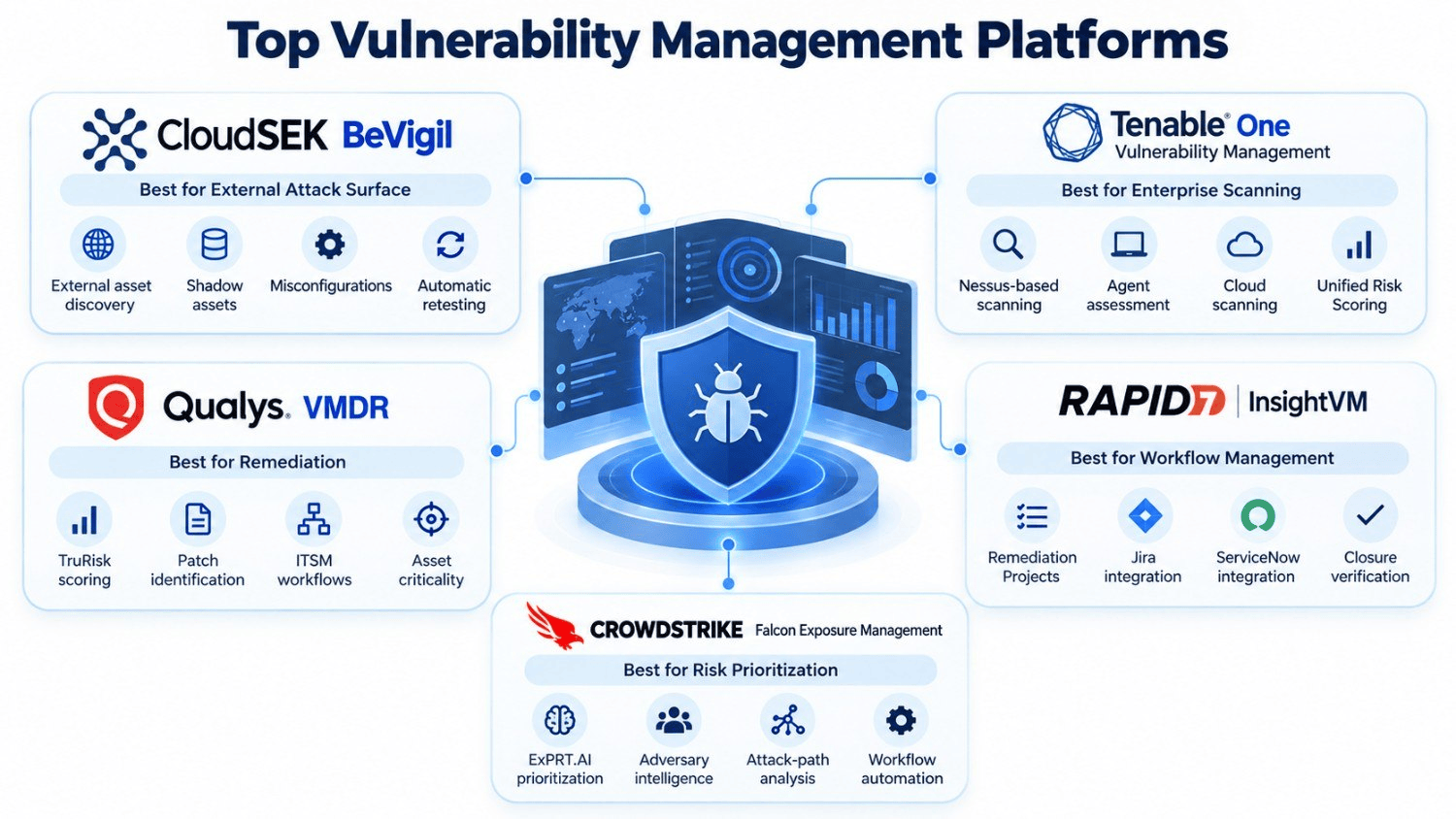
CloudSEK BeVigil adds external asset discovery to vulnerability management by continuously identifying internet-facing infrastructure, including forgotten assets and shadow IT. It checks those systems for vulnerabilities and misconfigurations that may otherwise sit outside the organization’s internal inventory.
Assessment covers web applications, mobile applications, APIs, cloud environments, CVEs, DNS, SSL/TLS, and network services. These eight surfaces represent the applications, services, configurations, and known vulnerabilities exposed to the public internet. An exploitable weakness on any of them can become an initial access vector when an attacker can reach it.
Exploitability and reachability help narrow which weaknesses should move up the remediation queue. BeVigil data can feed into Nexus AI to show whether one issue may contribute to a broader attack path, while CloudSEK Threat Intelligence can add context around exploited CVEs. Remediation guidance and retesting help confirm what changed after a fix, but CloudSEK does not perform the remediation itself, and BeVigil does not replace authenticated internal endpoint or network vulnerability assessment.
Core Capabilities
Nessus-based network scanners, agents, cloud scanners, and credentialed assessment give Tenable One Vulnerability Management several ways to examine infrastructure across large enterprise environments. The same collection model covers known infrastructure and assets discovered later.
Tenable Research adds vulnerability intelligence and risk-scoring information to the scan results. Current product material still references VPR. Newer release notes use Unified Risk Scoring, formerly VPR v2, so the terms should not be treated as interchangeable. Remediation scans revisit supported targets after a fix and can move a finding to Fixed when the vulnerability is no longer detected. Vulnerability Management is sold on its own or within Tenable One, so functionality from the wider suite should not be assumed to come with the standalone offering.
Core Capabilities
Risk-based ordering, patch identification, and ITSM handoff form the remediation path in Qualys VMDR. TruRisk, Qualys Detection Score, threat indicators, and asset criticality influence which vulnerabilities are addressed first.
ServiceNow and other ITSM workflows carry selected tasks into systems already used to assign and track work. VMDR identifies applicable patches, but deployment requires the relevant Qualys Patch Management subscription.
Core Capabilities
Remediation Projects in Rapid7 InsightVM assign and track vulnerability work across teams. Static projects hold a fixed scope; dynamic projects change as matching findings appear or disappear.
Owners, assignees, and due dates keep responsibility attached to the work. Jira and ServiceNow integrations move tasks into existing ticketing systems.
Technical verification is handled separately from task completion. A solution reported as applied enters Awaiting Verification; a later scan determines whether the finding moves to Closed or returns to Open. Active Risk uses inputs that include CVSS, CISA KEV, and Rapid7 research. InsightVM provides the vulnerability-management technology behind Exposure Command, which adds wider attack-surface, cloud, and application information.
Core Capabilities
Risk-Based Vulnerability Management in CrowdStrike Falcon Exposure Management uses adversary intelligence and attack-path analysis to inform which vulnerabilities move higher in the remediation queue. ExPRT.AI combines vulnerability data with attacker intelligence. Attack-path analysis shows how an exposure relates to other reachable systems.
Continuous monitoring covers on-premises, cloud, and hybrid environments. CAASM and ITAM add asset inventory data. Automation links prioritized exposures with remediation workflows. CrowdStrike documents these functions, but claims of superior performance or effectiveness remain vendor claims unless independently validated.
Core Capabilities
The five products do not arrive at remediation priority from the same evidence.
Severity, exploitation probability, known exploitation, exposure, and business importance answer different questions.
Remediation order depends on how those signals intersect in the local environment. An exposed weakness tied to a critical asset may rank above a technically severe issue on an isolated system with no relevant attacker activity.
Use the proof of concept to test discovery, prioritization, handoff, and closure against controlled cases with known outcomes.
Leave a controlled asset out of the supplied inventory. Success means the discovery method identifies it without manual entry. Visibility that stops at the provided inventory exposes the coverage limit.
Compare a high-severity vulnerability with little exploitation or exposure evidence against a lower-severity issue with stronger reachability or exploitation signals. The result needs to show why one ranks above the other instead of defaulting to raw severity.
Handoff quality becomes visible when a finding moves to another operational team. Check whether assignment, ticket creation, supporting details, and status updates survive the transfer. Manual copy and paste creates friction at every stage. Lost ownership or stale status shows where the workflow breaks.
Remediate one vulnerability during the POC and keep its original record in place. Run the normal reassessment process after the change. A closed ticket records workflow status, not technical resolution. Verification requires another check of the affected asset. Without reassessment, the platform has not shown that the weakness is gone.
An asset type outside the documented scope reveals whether the platform reports a blind spot or creates the impression of complete visibility.
CloudSEK BeVigil and Tenable One Vulnerability Management solve different visibility problems: BeVigil covers attacker-visible external assets, whereas Tenable handles broad enterprise assessment. Qualys VMDR and Rapid7 InsightVM address different parts of remediation, with Qualys linking findings to patch action and InsightVM organizing ownership and verification. CrowdStrike Falcon Exposure Management becomes relevant when adversary intelligence and attack-path analysis need to influence priority.
None of the five replaces the others across every use case. Final selection rests on matching one documented strength to the requirement that matters most, then confirming the same capability in the POC and licensed package.
A vulnerability scanner identifies and assesses weaknesses, while a vulnerability management tool adds prioritization, ownership, remediation tracking, and verification. Scanning produces the findings; vulnerability management carries them through to resolution.
No. Some platforms use agents; others collect data through scanners, cloud connectors, passive sensors, external discovery, or a mix of methods. The collection model depends on the assets in scope and the visibility required.
Assessment frequency depends on how quickly the environment changes and how vulnerability data is collected. Continuous discovery or monitoring can identify changes as they occur. Scheduled scans remain useful for assessments performed at defined intervals. Frequently changing or critical assets may require reassessment more often than stable systems.
