🚀 CloudSEK featured in the 2026 Frost Radar™!
Read more
.avif)

Vulnerability management is the continuous practice of discovering security weaknesses across an environment, ranking them by real risk, fixing or mitigating them, and confirming the fix held.
Discovery stopped being the hard part years ago. A mid-sized estate produces tens of thousands of findings per scan cycle, and remediation capacity covers a fraction of them, so the program lives or dies on how well it decides what to fix this week.
That decision has changed shape over the past year. Severity scores alone no longer justify a deadline, and the current reference model, even in federal policy, ranks work by exploitation evidence and exposure instead.
The lifecycle runs as six repeating stages, and each one feeds the next instead of closing the process out.
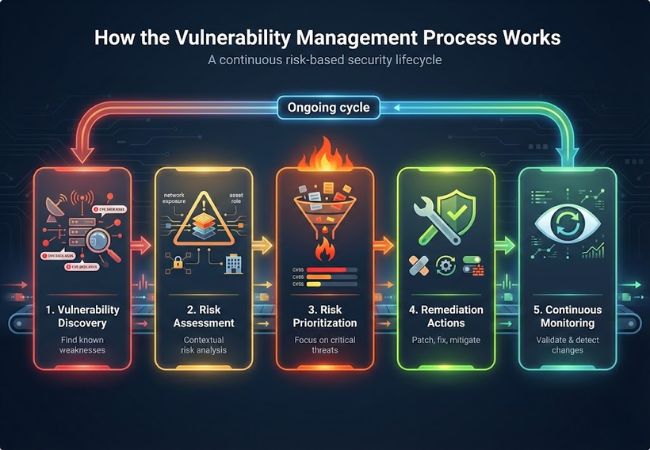
Programs that skip validation accumulate silent debt over time. Failed patches, rolled-back changes, and reimaged machines quietly restore vulnerabilities that the dashboard still counts as closed.
Prioritization combines four independent signals, and technical severity is the weakest of the four when taken alone.
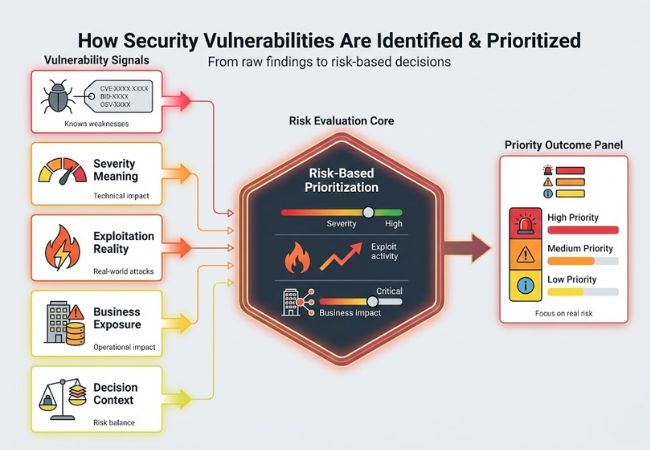
Put together, those four explain why a medium-severity flaw on an internet-facing payment gateway outranks a critical one on an isolated lab box every time.
Federal policy now codifies exactly that logic, which makes it a useful reference model for organizations carrying no mandate of their own.
CISA issued BOD 26-04 in June 2026, replacing the flat KEV deadlines of BOD 22-01 with a graduated model built on four binary variables. The directive asks whether the asset is publicly exposed, whether the CVE appears in the KEV catalog, whether an attacker can automate the full exploit chain, and whether exploitation grants total or partial control of the system.
Those four variables combine into five remediation tiers, running from three calendar days at the top to fix-on-next-upgrade at the bottom. CISA's implementation guidance reserves the three-day deadline, together with forensic triage for signs of prior compromise, for a vulnerability on a publicly exposed asset that grants total control and can be automated end to end.
Two details in that model matter for any organization copying it. CVSS scores are no longer required for prioritization at all, and asset exposure is the single variable that no outside party can supply, because it rests on an asset inventory only the organization itself holds.
The window between public disclosure and a working exploit keeps compressing, and the cause is no longer purely human skill.
Cloud Security Alliance researchers found that AI systems generate working exploits for newly disclosed CVEs in 10 to 15 minutes, at roughly a dollar per attempt, the trend CISA cited when setting a three-day tier.
Monthly patch cycles were designed for a slower disclosure environment, and they still suit the bulk of findings. What they cannot absorb is a three-day deadline, so programs need a separate emergency path that moves one finding from intelligence to production fix within days, with pre-approved change authority and a named decision maker.
Exposure management describes where most mature programs are heading, since it links a vulnerability to the attack path it opens instead of treating it as an isolated ticket.
A working program rests on three capability groups, and a weakness in any one of them caps what the other two achieve.
• Asset coverage: A current inventory spanning on-premises systems, cloud accounts, remote endpoints, containers, and the internet-facing assets discovered through external attack surface management, reconciled often enough that new deployments appear within days.
• Scanning depth: Authenticated scans for accurate version detection, unauthenticated scans that reproduce the attacker's view, and agents on laptops that rarely sit on the corporate network long enough for a scheduled scan.
• Exploitation intelligence: Feeds that flag active exploitation, exploit code availability, and actor interest in specific products, which is where threat intelligence earns its place inside the remediation workflow rather than beside it.
• Risk scoring: A documented model that combines severity, exploitation evidence, exposure, and asset value into one ranked queue, applied consistently across scanners so a finding carries the same priority whichever tool reported it.
• Ownership mapping: Every asset tied to the team that patches it, agreed before findings arrive instead of negotiated per ticket, with a named fallback owner for assets whose team has dissolved or moved on.
• Workflow integration: Findings that become tickets in the systems engineering teams already work in, with status flowing back automatically so the security dashboard and the engineering backlog never disagree.
• Validation and reporting: Rescanning that confirms closure before a ticket closes, plus reporting that separates technical detail for engineers from trend and exposure data for leadership.
Most vulnerability management programs fail on coverage well before they fail on process, and that failure stays invisible from inside the dashboard.
The findings that matter live on the assets nobody scanned, which means the metrics look healthy precisely because the risky systems are missing from the denominator. Six gaps account for the majority of those blind spots.
Patching covers one option among several, and the alternatives keep the queue moving when a patch is unavailable or disruptive to apply.
Exceptions deserve the same scrutiny as any open finding, and they need an owner, a mitigation, a review date, and a stated business reason. An exception without an expiry date is a vulnerability with paperwork attached, and estates carrying hundreds of them have effectively redefined their risk appetite without anyone approving the change.
Raw finding counts belong nowhere near a board report, whatever the chart looks like. That number falls when scanning breaks and rises when coverage improves, so it moves in the wrong direction for entirely good reasons, and leadership ends up rewarding the failure mode.
Auditors request the same three artifacts regardless of which framework applies: scan coverage records showing which assets were in scope and when, remediation timelines measured against the organization's own policy, and documented exceptions carrying named approvals and review dates.
What is the difference between vulnerability management and vulnerability assessment?
An assessment is a point-in-time evaluation producing a report. Vulnerability management is the continuous program that acts on those findings and verifies closure.
How does vulnerability management differ from penetration testing?
Penetration testing proves exploitability by attacking a defined scope. Vulnerability management identifies and tracks weaknesses continuously across the whole estate.
How often should vulnerability scans run?
Weekly for internet-facing assets, at least monthly internally, and immediately after significant changes. Compliance frameworks set quarterly as the floor, not the target.
Who owns vulnerability management in an organization?
Security owns discovery, prioritization, and reporting. Infrastructure, application, and cloud teams own remediation for the assets they run.
Can vulnerability management be automated?
Partly. Scanning, ticket creation, enrichment, and validation automate well, while exception decisions and change scheduling still need people.
What is a false positive in vulnerability scanning?
A reported vulnerability that does not exist on the asset, produced by banner-based version detection or a backported patch the scanner cannot see.
Does vulnerability management cover zero-days?
Not at discovery. It covers them once a CVE and detection exist, so zero-day response starts with mitigation and monitoring instead.
What tools do vulnerability management programs use?
Network and agent-based scanners, cloud and container scanners, application testing tools, ticketing systems, and an aggregation layer that unifies the scoring.
Is CVSS still useful?
Yes, as one input. It describes technical impact well, and it says nothing about exposure, exploitation, or what the asset means to the business.
Internal scanners cover the assets the configuration database already knows about, which is the population least likely to surprise anyone.
The systems attackers reach first are the ones nobody registered: a forgotten subdomain, an acquired company's mail gateway, a staging environment that stayed online months after the project closed.
CloudSEK BeVigil scans from the internet inward, fingerprinting internet-facing infrastructure and checking it across web applications, mobile apps, APIs, cloud, CVE, DNS, SSL, and network surfaces, then ranking what it finds by exploitability instead of severity alone.
That output feeds the same queue as internal scan data, with one difference worth noting: exposure is the variable CISA says nobody else can determine for an organization, and outside-in discovery is how it gets determined.
