🚀 A CloudSEK se torna a primeira empresa de segurança cibernética de origem indiana a receber investimentos da
Leia mais
.avif)

AI in cybersecurity is the use of artificial intelligence techniques—including machine learning, generative AI, and AI agents—to detect threats, prioritize risk, analyze security data, and automate or assist with security response. AI in cybersecurity now occupies three roles at once. It defends, it arms attackers, and it forms an attack surface of its own.
Security leaders treat that third role as the newest of the three. In the World Economic Forum's Global Cybersecurity Outlook 2026, 94% of the 804 respondents ranked AI first among the forces reshaping cybersecurity, and 87% placed AI-related vulnerabilities at the head of risks that grew during 2025.
Three terms describe the three roles, and vendors use them inconsistently enough that buyers conflate them.
Confusing the first two produces the common enterprise failure: a security team buys AI-powered detection and assumes it covers the AI systems the business itself deploys. Endpoint agents and cloud posture scanners inspect infrastructure rather than model behavior.
AI works in cybersecurity by converting security telemetry into mathematical representations, learning what normal looks like, and flagging deviation. Signature tools compare artifacts against a list of known-bad values, so they detect only what somebody catalogued already. Learned models score unfamiliar artifacts on resemblance.
Production deployments run five stages in sequence:
Several AI and machine-learning techniques are used across cybersecurity, depending on the task.
Supervised learning trains on labeled examples, so gradient-boosted trees or random forests learn which feature combinations separate malicious files from benign ones. Unsupervised learning drops the labels, using clustering and isolation forests to baseline a user, host, or segment and score how far new activity sits from it.
Each approach fails differently. Supervised models may struggle with threats that differ significantly from their training data, while unsupervised models surface novelty at the cost of noise. Baselining matters because most enterprise attacks involve legitimate tools used illegitimately, which no signature describes.
Deep learning stacks many layers so the model learns features rather than receiving them from an engineer.
Sequence architectures handle order instead of snapshots. A long short-term memory network scores whether a chain of API calls, process spawns, and command-line arguments resembles known intrusion behavior, which is how fileless attacks are often caught without a payload on disk.
Natural language processing gave security tools their first reliable read on text, parsing tone, urgency cues, and sender history to score business email compromise attempts that carry no attachment and no link.
Large language models extended that reach across unstructured security data. Analysts use them to summarize incident timelines, translate detection logic between query languages, and explain obfuscated commands. Output quality depends on retrieval grounding, because ungrounded models invent plausible detail.
Graph analytics models an environment as nodes and edges rather than rows of alerts. Identities, credentials, hosts, and cloud roles become nodes, permissions become edges, and shortest-path computation produces the attack paths reachable from a single stolen credential.
Reinforcement learning trains an agent through reward rather than labels, which suits automated adversary emulation. Reinforcement learning has cybersecurity applications, but it is less common in everyday security operations than other machine-learning approaches.
Generative models produce content rather than scores. Defensive use covers synthetic training data for rare classes, natural-language querying of security data, detection-rule drafting, and phishing simulation.
Agentic AI adds tool use and multi-step planning on top of generation. A defensive agent pulls context from several systems, tests a hypothesis, and drafts a containment plan unprompted. Permissions govern the risk, since an agent holding credentials inherits every system those credentials reach.
Seven applications account for most enterprise value from AI in cybersecurity. Each solves a volume problem that predates AI, and each degrades when the underlying telemetry is poor.
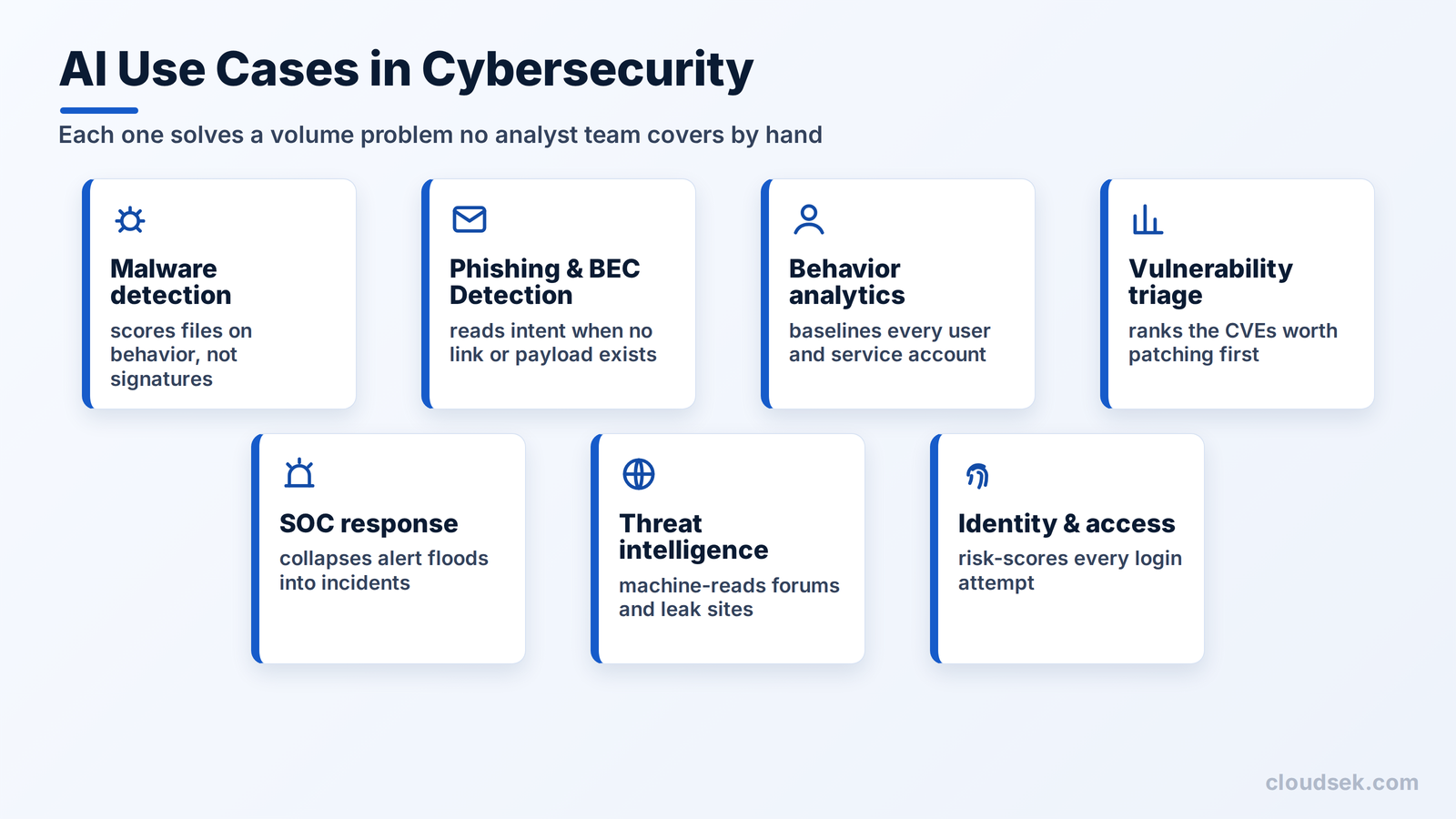
Modern endpoint security combines signatures with behavioral analysis, reputation, heuristics, and machine-learning techniques to help identify new or modified malware that does not exactly match a known signature.
Reputation lists miss newly registered domains and compromised legitimate senders, and business email compromise frequently involves neither a link nor an attachment. Language models score each message against the historic communication graph of the organization.
A first-time sender requesting a bank-detail change, phrased with time pressure and matching a finance-approver role, scores high even when every technical indicator is clean. Homoglyph domains and reply-chain hijacking are detected in the same pass.
User and entity behavior analytics uses behavioral analysis, statistics, machine learning, and other techniques to identify unusual activity, giving each user, service account, and device a rolling baseline of login geography, working hours, data volumes, application usage, etc.
Deviation surfaces the two cases signatures never catch: a valid credential in an attacker's hands, and an employee exfiltrating data before resignation. Non-human identities matter more each year, since service accounts and API keys outnumber human accounts in most cloud estates.
Published CVEs pass 40,000 per year, so the operative question is which handful carry real exploitation probability. The Exploit Prediction Scoring System (EPSS) estimates the likelihood that a vulnerability will be exploited in the wild within the next 30 days. Pairing EPSS with CISA's Known Exploited Vulnerabilities catalog reduces the queue to a ranked shortlist.
Discovery moved from theory to record in 2025. Google's Big Sleep agent, built by DeepMind and Project Zero, found CVE-2025-6965 in SQLite versions before 3.50.2, a memory-corruption flaw known to threat actors and unpatched. Google reported that Big Sleep discovered the vulnerability after threat intelligence indicated it was known to threat actors and at risk of exploitation.
DARPA measured the same capability competitively. In the scored final of its AI Cyber Challenge at DEF CON 33, seven autonomous systems worked across 54 million lines of open-source code. Those systems identified 86% of planted vulnerabilities against 37% at the 2024 semifinals, and patched 68% of what they found.
Security operations centers drown in alert volume long before they drown in incidents. AI compresses that volume through correlation, grouping thousands of raw signals into a handful of clustered incidents with a suggested narrative and severity.
Response automation follows the same logic. Isolating a host, disabling an account, or blocking a hash executes in seconds through a playbook, while decisions with business impact stay behind human approval.
AI Threat intelligence involves reading more sources than any team reads manually: criminal forums, ransomware leak sites, paste sites, encrypted channels, and code repositories. Language models handle the translation, deduplication, and relevance scoring that once consumed analyst days.
Filtering carries the value. A leaked credential set matters when the domain belongs to the organization, and a ransomware announcement matters when the group targets that sector. Continuous dark web monitoring pairs machine collection with that filtering step so analysts receive organization-specific findings instead of a raw feed.
Behavioral biometrics such as keystroke cadence and pointer movement authenticate continuously through a session rather than once at login, closing the window that session hijacking exploits.
Risk-based authentication scores each attempt on device fingerprint, network reputation, travel plausibility, and historic pattern, then steps up verification only where the score warrants it. Liveness detection carries an added burden, since generative models produce convincing synthetic faces and voices for enrollment fraud.
Six key benefits explain why security budgets keep moving toward AI-driven tooling.
Five techniques dominate the criminal playbook in 2026.
Generative models removed the two constraints that limited phishing quality: language fluency and research effort. A model that ingests a target's public profile, employer, and vendor relationships produces thousands of tailored lures for the cost of a generic one, and criminal marketplaces sell purpose-built variants such as WormGPT and FraudGPT.
Modern voice-cloning systems can create convincing synthetic speech from relatively small amounts of source audio, which public earnings calls and conference recordings supply for any executive.
A Hong Kong finance employee at engineering firm Arup transferred roughly 25 million US dollars in 2024 after a video conference in which every other participant, including the chief financial officer, was a deepfake. Voice cloning has since become routine in vishing and helpdesk-reset fraud, where a cloned voice defeats knowledge-based verification.
Code-generation models compress malware development from a specialist skill to a prompting exercise, since obfuscation routines, packers, and command-and-control scaffolding are well represented in training data. Guardrails slow this rather than stopping it, because attackers split a task into innocuous fragments or run open-weight models locally.
Researchers have documented ransomware prototypes that call a language model at runtime to regenerate their own routines on each execution, which defeats hash-based and structural detection simultaneously.
Models correlate subdomain records, certificate transparency logs, code repositories, job listings, and breach dumps into a target profile in minutes, work that consumed days of analyst time before.
Agentic AI marks the current frontier, because an agent plans, calls tools, evaluates results, and adapts without a human issuing each instruction. Anthropic reported in late 2025 that a state-linked group used its coding agent in a cyber-espionage campaign targeting roughly 30 organizations.
Operational tempo is the significant detail. An agent sustains a campaign across many targets at once, which changes the defender's arithmetic rather than only the attacker's toolkit.
Every AI system an organization deploys becomes an asset an attacker studies. NIST cataloged this class in Adversarial Machine Learning: A Taxonomy and Terminology of Attacks and Mitigations (AI 100-2e2025), separating attacks on predictive AI into evasion, poisoning, and privacy categories and adding a distinct set for generative systems.
Six attack families matter operationally, and each targets a different layer of the AI stack.
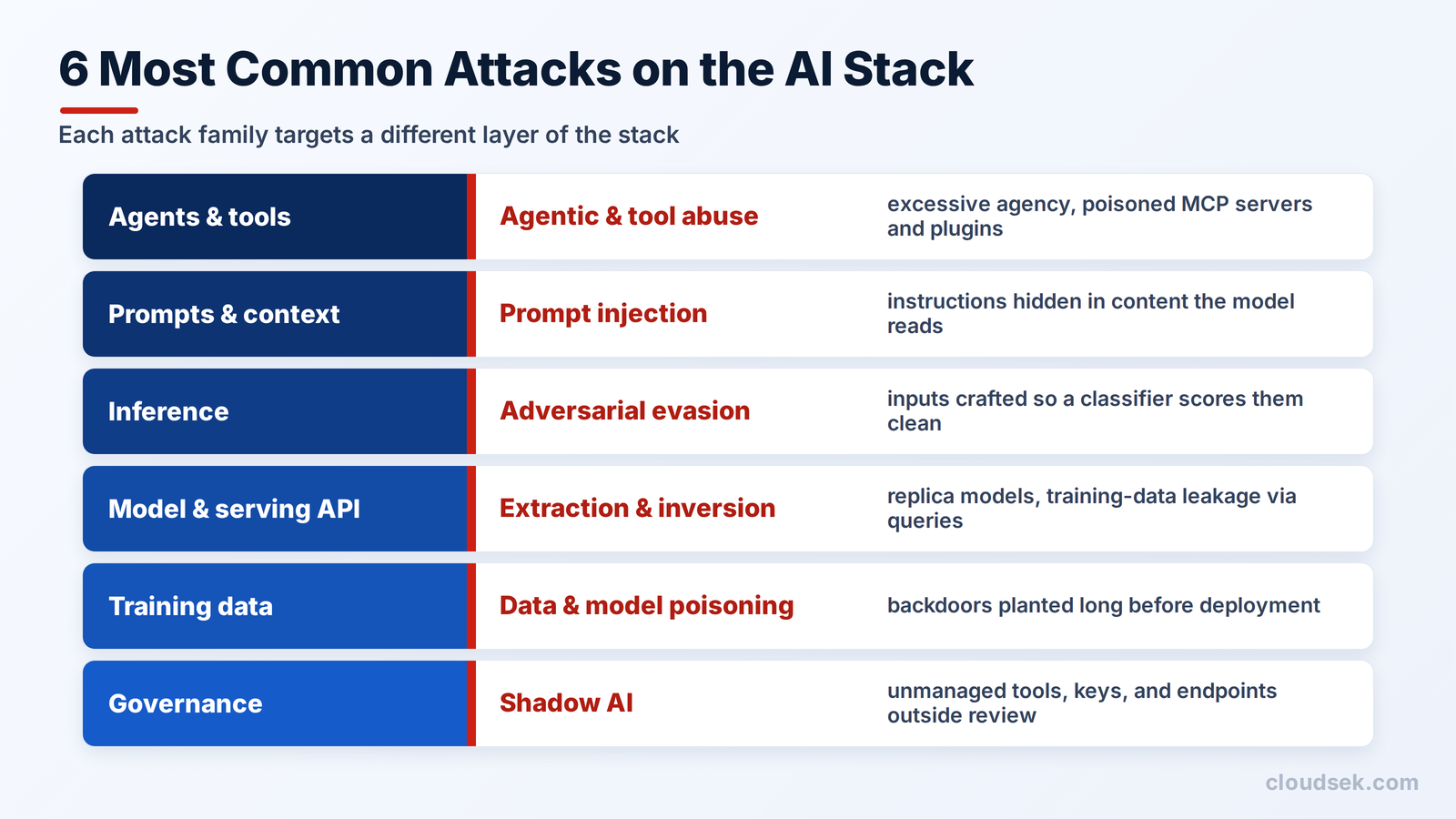
Prompt injection exploits an architectural property rather than a coding error. Prompt injection occurs when malicious instructions in user input or external content influence an AI system to ignore its intended instructions or perform unintended actions.
Direct injection happens when a user types input that overrides the system prompt, extracts hidden instructions, or unlocks restricted behavior. Jailbreaking is a related technique that attempts to bypass an AI model's safety restrictions.
Indirect injection is the enterprise concern because the payload arrives through content the model reads rather than the attacker's own session. Hidden instructions sit in a web page, a shared document, a support ticket, or an email the assistant summarizes.
Consequences scale with permissions. An assistant with mailbox and file access that follows injected instructions exfiltrates data without malware, without stolen credentials, and without triggering any endpoint control.
Poisoning attacks the training stage instead of inference. An adversary who influences a training corpus, fine-tuning set, or retrieval index shifts model behavior long before deployment.
Clean-label poisoning is harder to catch, since injected samples carry correct labels and pass casual review. Backdoor poisoning embeds a trigger phrase that produces attacker-chosen output only when present, leaving normal behavior intact during testing.
Model extraction attempts to reproduce a model's behavior through systematic querying of its interface. Inversion and membership inference attack the training data instead, revealing whether a specific record appeared in training.
Evasion crafts inputs a model misclassifies while a human sees nothing unusual, and equivalent techniques exist for images, audio, text, and binaries. Attackers append benign-looking sections, adjust entropy, or pad imports until a malware classifier scores a sample as clean, which is why layered detection outperforms any single model.
Agentic systems expand the blast radius because the model holds credentials and executes actions. Excessive agency, where an agent receives broader tool permissions than its task requires, converts a single successful injection into privileged access across connected systems.
Connective infrastructure carries its own risk. Model Context Protocol servers, agent plugins, and skill marketplaces are software dependencies, and 2026 produced documented cases of poisoned packages, unauthenticated MCP endpoints exposed to the internet, and tool descriptions crafted to hijack agent behavior.
Shadow AI refers to AI tools and services used without the organization's knowledge or approval. These can include consumer AI applications, external model APIs, agents, and internally deployed AI systems that bypass security review.
Defensive AI carries its own failure modes, separate from attacks aimed at AI systems. Six limitations shape realistic expectations.
Eight tool categories embed AI as a core function rather than a marketing label. Category boundaries blur in practice, since platform vendors bundle several together.
To implement AI in cybersecurity, run seven steps in sequence rather than starting from a product demonstration. Sequence matters because the common failure is a capable tool deployed against an undefined problem.
Governance frameworks give security teams a shared vocabulary for AI risk and a defensible position with auditors. Six reference points carry practical weight.
1. AI for cybersecurity — Nexus AI
Nexus AI brings together security signals from across CloudSEK’s platform (XVigil, BeVigil, SVigil, AIVigil, Threat Intelligence) and uses Raciocínio baseado em IA para conectar descobertas individuais a potenciais caminhos de ataque. Ajuda as equipes de segurança a entender como um invasor pode encadear vulnerabilidades, ativos expostos, credenciais vazadas e outros riscos — e o que priorizar.
2. Cibersegurança para IA — AIVigil
AIVigil protege a superfície de ataque de IA descobrindo infraestruturas de IA, como APIs de IA, modelos, agentes, servidores MCP, bancos de dados vetoriais e IA sombra. Identifica exposições, configurações incorretas, credenciais vazadas e outros riscos específicos de IA, além de ajudar a avaliar como eles podem ser explorados.
Em termos simples:
O Nexus AI usa IA para entender e prever ataques. O AIVigil protege os sistemas de IA que os invasores podem visar.
Cada um dos três papéis está seguindo uma direção previsível. A IA defensiva evolui de auxiliar analistas para executar respostas limitadas, a IA ofensiva avança da geração de conteúdo para a operação autônoma, e a superfície de ataque de IA cresce no mesmo ritmo da adoção corporativa.
Sistemas de agentes em ambos os lados definem a próxima fase. Os defensores ganham agentes de investigação que extraem contexto e elaboram planos de contenção, enquanto os invasores ganham agentes que sustentam campanhas simultâneas sem a necessidade de um operador. O ataque na velocidade da máquina contra a aprovação na velocidade humana é a lacuna que força a próxima rodada de mudanças arquiteturais.
Três mudanças se seguem. A governança de identidade não humana torna-se uma disciplina de primeira classe, as listas de materiais de IA (AI BOMs) juntam-se às listas de materiais de software (SBOMs) como uma expectativa de aquisição, e os testes adversários de modelos juntam-se aos testes de intrusão como um requisito de auditoria recorrente.
O que não muda é a disciplina fundamental. Inventário de ativos, privilégio mínimo, cobertura de logs, higiene de patches e julgamento humano em pontos de decisão cruciais determinam os resultados exatamente como antes. A IA eleva o teto do que uma equipe de segurança alcança e o piso do que um invasor alcança, o que deixa os fundamentos como o fator decisivo.
É mais provável que a IA transforme os cargos de cibersegurança do que os elimine completamente. Ela pode automatizar tarefas repetitivas enquanto aumenta a demanda por habilidades como busca de ameaças, engenharia de detecção, resposta a incidentes e segurança de IA.
As habilidades necessárias em cibersegurança de IA combinam fundamentos de segurança com alfabetização de dados: segurança de rede e nuvem, Python, estatística, noções básicas de aprendizado de máquina, testes adversários e familiaridade com as estruturas OWASP e MITRE ATLAS.
Sim, pequenas empresas podem usar ferramentas de cibersegurança com IA. Produtos de endpoint, e-mail e identidade entregues via nuvem incorporam IA por padrão, com preços por usuário e sem a necessidade de equipe de ciência de dados.
Os setores bancário, de saúde, telecomunicações, governo e tecnologia dependem fortemente de IA na cibersegurança, impulsionados por dados regulamentados, grandes infraestruturas externas e ataques constantes de agentes maliciosos motivados financeiramente ou ligados a Estados.
A automação executa regras predefinidas da mesma forma todas as vezes. Sistemas de IA conseguem aprender padrões a partir de dados e fazer previsões ou recomendações, enquanto a automação geralmente segue regras e fluxos de trabalho preestabelecidos.
As obrigações de IA e cibersegurança na Índia derivam atualmente de várias leis e estruturas regulatórias sobrepostas, em vez de uma única lei de segurança de IA, incluindo os requisitos do CERT-In, a estrutura de Proteção de Dados Pessoais Digitais e regras específicas de cada setor.
