🚀 CloudSEK featured in the 2026 Frost Radar™!
Read more
.avif)

Data exfiltration is the unauthorized transfer or theft of sensitive data from an organization’s systems, devices, cloud environments, or networks. Attackers steal this data to gain financial value, disrupt operations, conduct espionage, or sell sensitive information on cybercriminal marketplaces.
Cybercriminals, insider threats, and advanced threat groups use malware, phishing attacks, stolen credentials, cloud compromises, and unauthorized access techniques to exfiltrate sensitive data outside enterprise environments without detection.
Modern data exfiltration attacks often exploit cloud platforms, SaaS applications, remote work environments, and identity systems because organizations store and transfer large amounts of sensitive information digitally.
Data exfiltration attacks follow a structured process in which attackers gain access to systems, identify valuable information, and exfiltrate sensitive data from the organization without authorization.
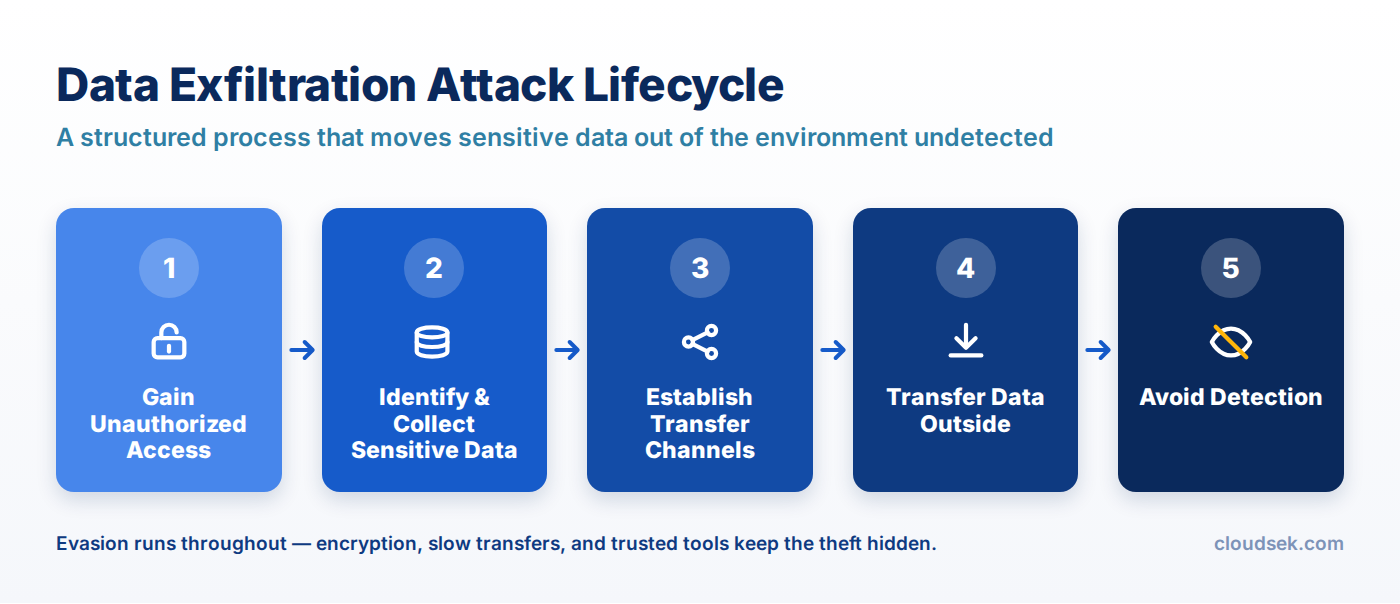
Attackers first gain access to enterprise systems using phishing attacks, stolen credentials, malware infections, weak passwords, or insider abuse. Compromised accounts and infected devices enable attackers to gain access to the environment and sensitive systems or data repositories.
After gaining access, attackers search for valuable data such as customer records, financial information, intellectual property, login credentials, healthcare records, and confidential business files. Attackers often target centralized databases, cloud storage, file servers, SaaS platforms, and employee devices that contain large volumes of sensitive information.
Attackers create methods to move stolen data outside the organization without attracting attention. Common exfiltration channels include cloud storage uploads, email transfers, encrypted outbound traffic, remote command-and-control servers, and unauthorized file-sharing services.
Attackers transfer sensitive data to external destinations they control. These transfers may involve large outbound data movement, hidden network traffic, compressed files, or encrypted communication designed to avoid security monitoring and blend with normal network activity.
Attackers use multiple techniques to avoid detection during data exfiltration. Common evasion methods include encrypting stolen data, transferring files slowly over time, compressing data into archives, disguising malicious traffic as legitimate activity, and abusing trusted tools already present inside the environment.
Attackers use multiple data exfiltration techniques to steal sensitive information from enterprise systems, cloud environments, user accounts, and network infrastructure without authorization.
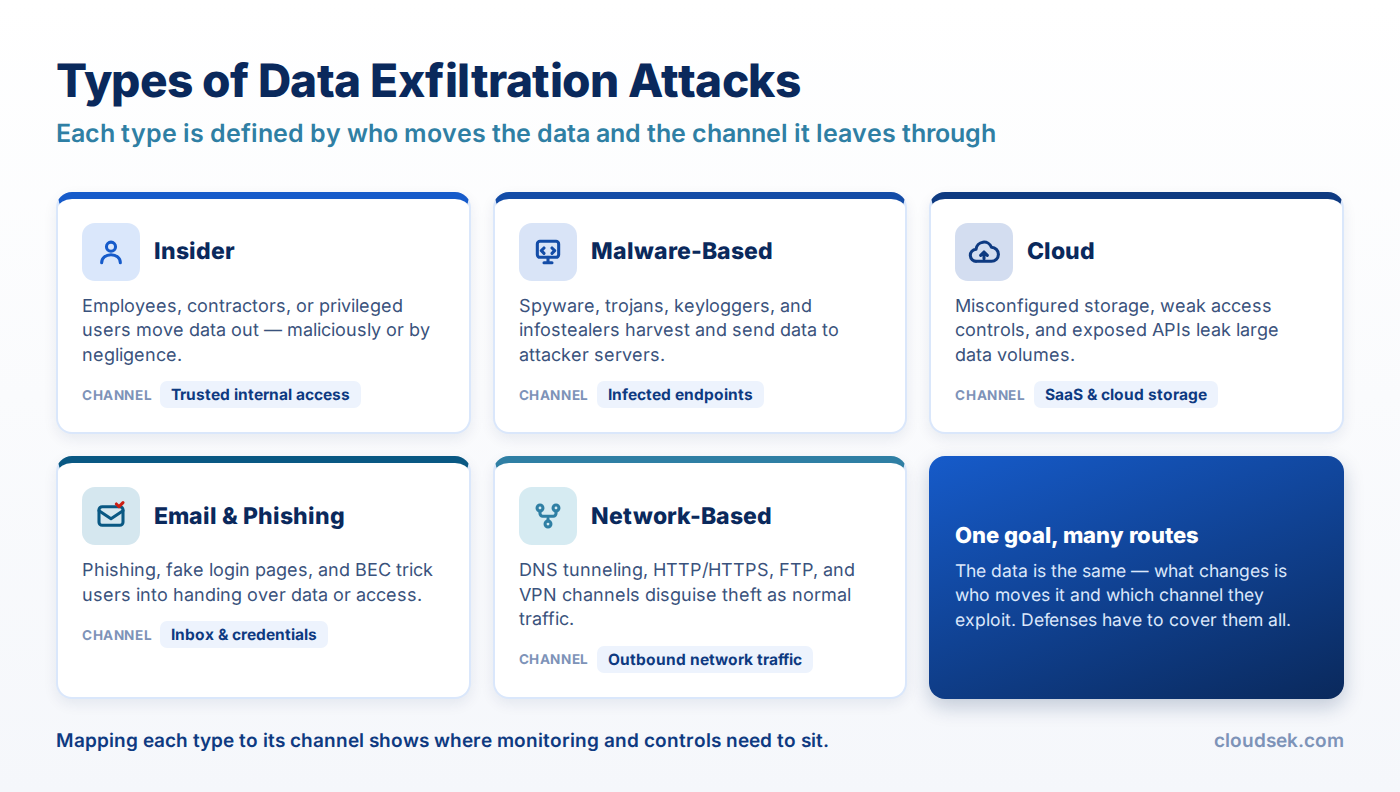
Here are the most common types of data exfiltration:
Insider data exfiltration occurs when employees, contractors, or privileged users intentionally or accidentally transfer sensitive data outside the organization. Malicious insiders may steal intellectual property, customer data, or confidential business information for financial gain, while negligent insiders often expose data through insecure sharing or unauthorized storage practices.
In malware-based data exfiltration, threat actors use malicious software such as spyware, trojans, keyloggers, and infostealers to collect and transfer sensitive information from compromised systems. These attacks often capture login credentials, financial records, browser data, and confidential files before sending them to attacker-controlled servers.
Cloud data exfiltration targets cloud storage platforms, SaaS applications, and cloud workloads that contain sensitive enterprise data. Attackers exploit misconfigured cloud storage, compromised user accounts, weak access controls, and exposed APIs to download or transfer large volumes of data from cloud environments.
In Email and phishing-based exfiltration, attackers use phishing emails, malicious attachments, fake login pages, and business email compromise techniques to steal sensitive information. Attackers often trick users into revealing credentials, transferring confidential files, or granting unauthorized access to enterprise accounts and systems.
Network-based data exfiltration transfers stolen data through network communication channels such as DNS tunneling, HTTP or HTTPS traffic, FTP transfers, and VPN connections. Attackers disguise exfiltration traffic as legitimate network activity to avoid detection while moving sensitive information outside the organization.
In a data exfiltration attack, attackers primarily target sensitive business and personal information that provides financial value, operational advantage, or long-term strategic benefit.
Personally identifiable information (PII) includes names, addresses, phone numbers, email addresses, Social Security numbers, and other personal records linked to individuals. Attackers steal PII to commit identity theft, financial fraud, phishing attacks, and account takeover activities.
Financial and payment data includes credit card details, banking information, transaction records, payroll data, and financial statements. Cybercriminals target this information to conduct fraudulent transactions, steal money, or sell payment data on underground marketplaces.
Intellectual property and business data include source code, product designs, trade secrets, research documents, internal communications, and strategic business plans. Competitors, insider threats, and nation-state attackers often target this data to gain financial, technological, or competitive advantage.
Login credentials and authentication data include usernames, passwords, API keys, access tokens, and authentication cookies. Attackers use stolen credentials to gain unauthorized access to enterprise systems, cloud environments, applications, and sensitive business accounts.
Healthcare and government data include medical records, patient information, classified documents, operational records, and confidential public-sector information. This data carries high black-market value because it contains long-term personal, financial, and operational details that attackers can exploit for fraud, espionage, or extortion.
Data exfiltration creates serious financial, operational, legal, and reputational damage because stolen sensitive information often affects customers, employees, business operations, and long-term organizational trust.
Data exfiltration often leads to direct financial losses caused by fraud, ransom payments, legal claims, business interruption / downtime, and incident recovery efforts. Organizations frequently spend significant resources on forensic investigations, security remediation, regulatory response, and infrastructure restoration after a major data theft incident.
The global average cost of a data breach was USD 4.4 million in 2025 despite a 9 percent year-on-year reduction, highlighting the still significant financial impact of modern data exfiltration attacks.
Data exfiltration can trigger regulatory penalties when stolen information includes protected customer, financial, healthcare, or government data. Organizations that fail to secure sensitive information may face compliance violations under regulations such as GDPR, HIPAA, PCI DSS, and other data protection laws.
Reputation damage is a major consequence of data exfiltration because customers expect organizations to protect sensitive information. Public disclosure of stolen data often reduces customer confidence, weakens brand reputation, and increases customer churn after security incidents become public.
Data exfiltration attacks frequently disrupt normal business operations during containment, investigation, and recovery activities. Security teams may isolate systems, restrict access, suspend services, or shut down parts of the environment temporarily to prevent additional data theft.
Intellectual property theft allows attackers or competitors to gain unauthorized access to valuable business information such as source code, research data, product designs, and confidential strategies. Loss of intellectual property can reduce competitive advantage and create long-term financial impact for organizations.
Many ransomware groups now steal sensitive data before encrypting systems to increase extortion pressure on victims. Attackers threaten to leak stolen information publicly unless organizations pay ransom demands, creating additional legal, financial, and reputational risks after data exfiltration incidents.
Data exfiltration attacks often create unusual network, user, and system activity that indicates sensitive information is moving outside the organization without authorization. Here are those signs of data exfiltration:
Unusual outbound network traffic is one of the most common signs of data exfiltration. Large volumes of outbound communication, unexpected connections to external servers, or encrypted traffic sent to unknown destinations often indicate attackers transferring stolen data outside the environment.
Large or unexpected file transfers may indicate unauthorized movement of sensitive information. Attackers often transfer compressed archives, database exports, backups, or confidential documents from internal systems to external storage platforms or remote servers.
Repeated access to sensitive files can indicate attackers collecting valuable information before exfiltration occurs. Unusual access to customer records, financial documents, source code repositories, or confidential business files often signals suspicious activity inside enterprise systems.
Suspicious cloud storage activity includes unusual downloads, unauthorized file sharing, unexpected uploads, or excessive data movement across cloud platforms and SaaS applications. Compromised cloud accounts frequently enable attackers to access and transfer sensitive enterprise data.
Unauthorized privilege escalation occurs when attackers gain higher access permissions to sensitive systems or data repositories. Unexpected administrative access, account permission changes, or abnormal privilege usage often indicate attempts to access protected information for exfiltration.
Abnormal login or user behavior includes unusual login locations, impossible travel activity, repeated failed authentication attempts, or access outside normal working hours. These behaviors often indicate compromised accounts being used to collect or transfer sensitive data.
Unusual endpoint or system activity may indicate attackers preparing data for exfiltration. Sudden file compression, unauthorized archive creation, disabled security tools, unexpected process execution, or abnormal CPU and memory usage often signal attempts to collect and transfer sensitive information secretly.
Organizations can reduce data exfiltration risks by strengthening access controls, monitoring sensitive data movement, and improving visibility across endpoints, cloud platforms, networks, and user activity.
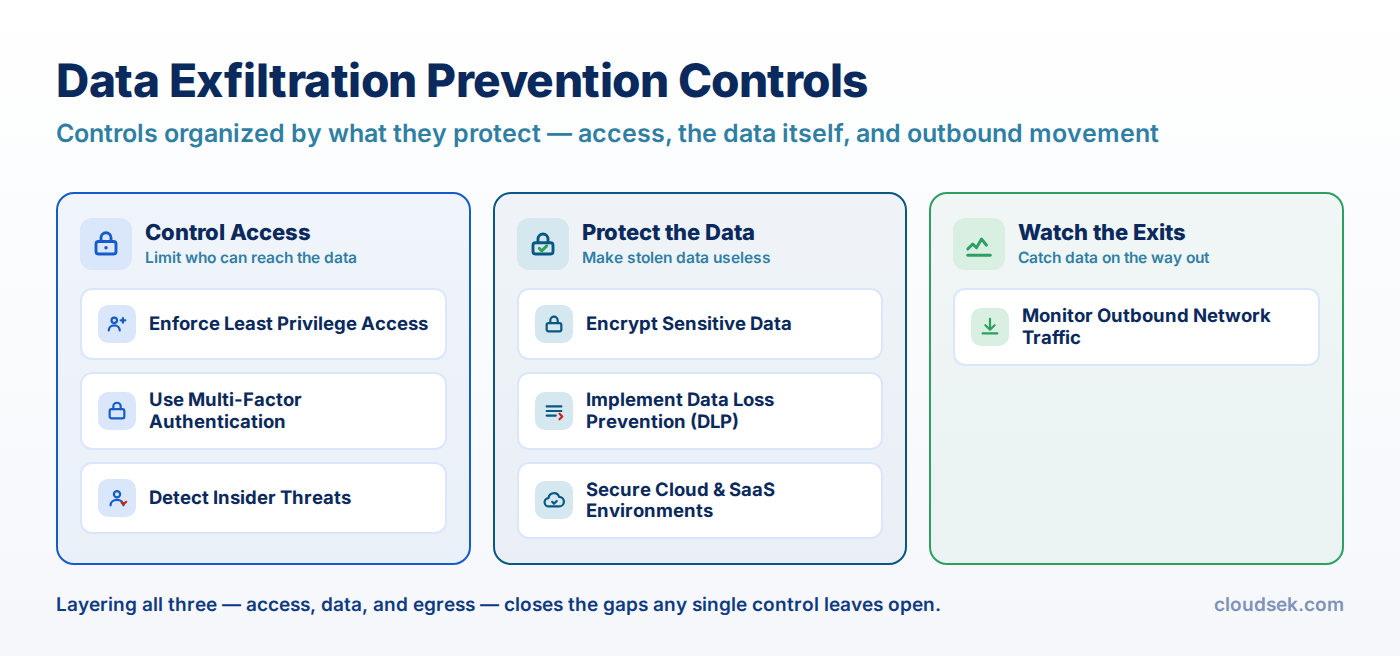
The following strategies are best for preventing data exfiltration attacks:
Data Loss Prevention (DLP) solutions monitor, detect, and block unauthorized movement of sensitive information across endpoints, email systems, cloud storage, and networks. DLP best practices and policies help organizations prevent users and attackers from transferring confidential data outside approved environments.
Continuous monitoring of outbound network traffic helps security teams identify suspicious data transfers, unauthorized external connections, and abnormal communication patterns. Monitoring outbound traffic improves visibility into hidden exfiltration activity before attackers steal large volumes of sensitive information.
Least privilege access limits user permissions to only the systems and data required for specific job functions. Restricting unnecessary access reduces the amount of sensitive information attackers can reach if accounts or devices become compromised.
Multi-factor authentication (MFA) strengthens account security by requiring additional identity verification beyond passwords. MFA reduces the risk of unauthorized access caused by stolen credentials, phishing attacks, and compromised user accounts.
Encryption protects sensitive data by making stolen information unreadable without authorized decryption keys. Organizations should encrypt data both at rest and during transmission to reduce exposure during storage, sharing, and network communication.
Continuous insider threat monitoring helps organizations identify suspicious employee behavior, unauthorized file access, unusual downloads, and abnormal data transfers. Early detection reduces the risk of malicious insiders or compromised accounts stealing sensitive information.
SaaS and cloud security controls help prevent unauthorized access to sensitive enterprise data stored across cloud platforms and applications. Organizations should secure cloud storage, monitor SaaS activity, enforce strong access policies, and identify misconfigurations that expose sensitive information. Here are the best cloud security tips that help to secure the cloud environment.
Fast detection and response help organizations reduce the impact of data exfiltration by identifying suspicious data movement early and stopping attackers before large-scale data theft occurs.
Continuous security telemetry monitoring helps organizations track network activity, user behavior, file access, endpoint events, and cloud activity in real time. This visibility improves the ability to identify suspicious actions linked to unauthorized data access or outbound data transfers.
Detecting abnormal data movement helps security teams identify unusual file transfers, unexpected outbound traffic, excessive downloads, and unauthorized cloud uploads. Behavioral monitoring and traffic analysis improve visibility into exfiltration attempts that bypass traditional security controls.
Continuous monitoring of dark web forums, underground marketplaces, and encrypted platforms such as Telegram helps organizations identify stolen data, leaked credentials, and attacker discussions related to their environment. Early detection enables faster incident validation, supports forensic investigations, and helps security teams initiate remediation before exposed data is further distributed or monetized.
This complements the existing response-focused controls by extending visibility beyond the organization's perimeter to where attackers often advertise, trade, or leak stolen information.
Security teams should investigate suspicious user activity such as repeated access to sensitive files, unusual login locations, abnormal working hours, and unauthorized privilege usage. Early investigation helps organizations identify compromised accounts, insider threats, or malicious activity before data theft escalates.
Isolating compromised devices, user accounts, and cloud sessions helps prevent attackers from continuing unauthorized access or transferring additional data. Rapid containment limits attacker movement across the environment and reduces the overall impact of exfiltration incidents.
Blocking malicious outbound connections prevents attackers from communicating with external servers used for data transfer or command-and-control activity. Security teams often block suspicious IP addresses, domains, unauthorized protocols, and abnormal outbound traffic patterns during incident response.
Incident response and recovery activities help organizations investigate the attack scope, identify affected systems, remove malicious access, and restore secure operations. Recovery efforts often include forensic analysis, credential resets, security remediation, compliance reporting, and long-term monitoring after the incident.
CloudSEK helps organizations reduce the risk and impact of data exfiltration by identifying the exposures attackers exploit, predicting how they can be chained into attack paths, securing AI environments, and detecting stolen data after it leaves the organization.
Together, these capabilities complement traditional DLP and security monitoring tools by preventing attacker access through predictive attack path intelligence and providing early visibility into externally leaked data before it can be further exploited or monetized.
Data exfiltration involves intentional and unauthorized theft of sensitive information by attackers or malicious insiders. Data leakage usually happens accidentally through human error, misconfigurations, or insecure data-sharing practices.
Data exfiltration is the unauthorized transfer or theft of sensitive data from an organization’s systems. A data breach is a broader security incident where sensitive information becomes exposed, stolen, accessed, or disclosed without authorization. Data exfiltration is often one stage of a larger data breach.
Attackers commonly steal customer records, financial information, login credentials, healthcare records, intellectual property, business documents, API keys, and confidential enterprise data.
Insider-driven data exfiltration occurs when employees, contractors, or privileged users intentionally or accidentally transfer sensitive information outside the organization without authorization.
Organizations use Data Loss Prevention (DLP) tools, SIEM platforms, endpoint detection and response (EDR) solutions, cloud security tools, firewall controls, and user behavior analytics solutions to reduce data exfiltration risks.
Yes. Attackers often use encrypted traffic to disguise stolen data and avoid security monitoring because encrypted communication makes malicious outbound transfers harder to inspect.
Modern ransomware groups often steal sensitive data before encrypting systems. Attackers use the stolen information to pressure organizations with extortion threats and public data leaks if ransom demands are not met.
