🚀 CloudSEK featured in the 2026 Frost Radar™!
Read more





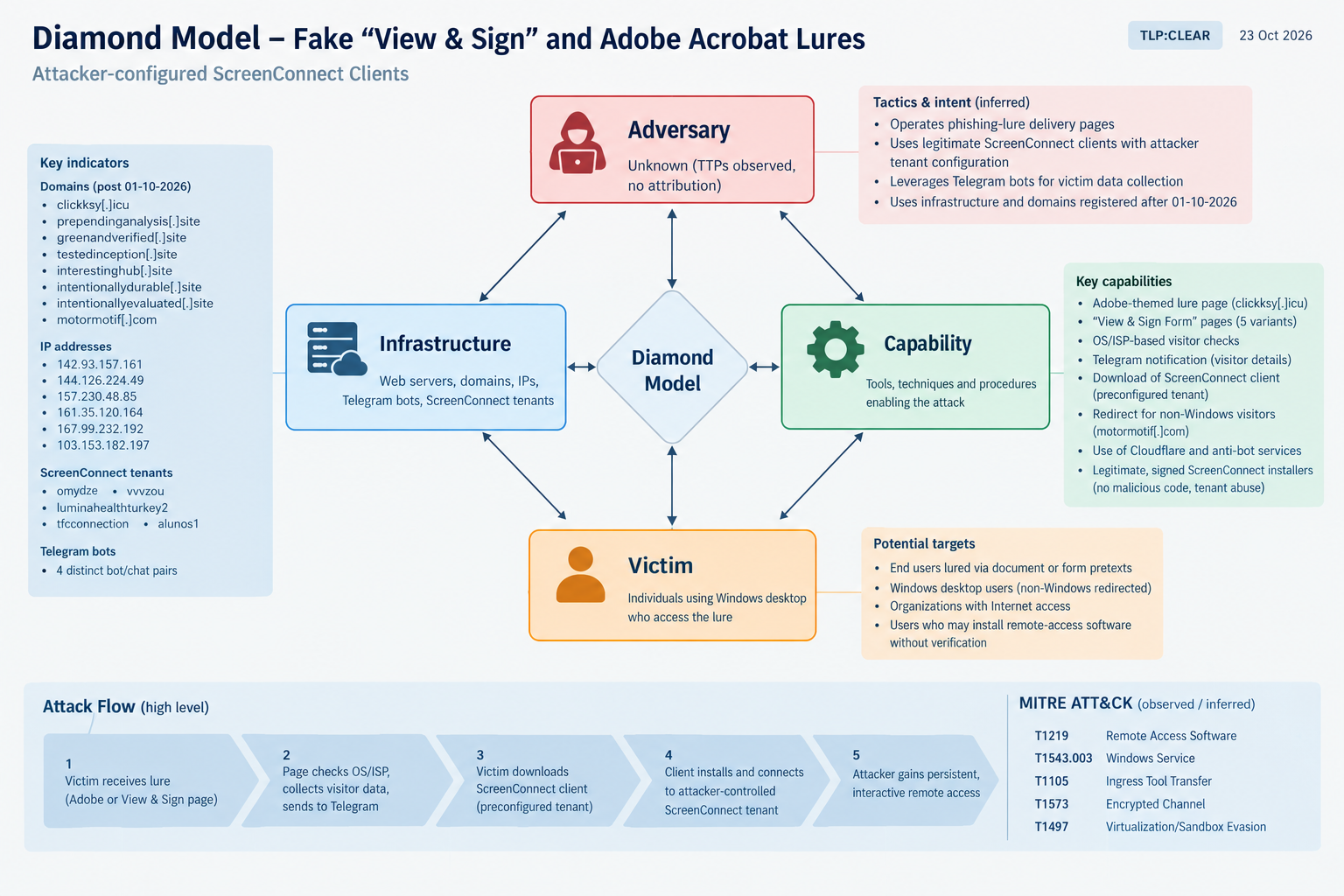
CloudSEK's Global Threat Intelligence platform, GTI, identified an Adobe Acrobat Reader-themed lure hosted at clickksy[.]icu was associated with downloads of two genuine, digitally signed ConnectWise ScreenConnect installers configured to connect to separate ScreenConnect Cloud tenants, omydze and vvvzou. The installers were not identified as trojanized; the risk stems from their preconfigured remote-access settings. If installed, they could establish persistent remote access for an external operator.
Analysis of 8 other URLs identified a related cluster of “View & Sign Form” pages. Five distinct page variants shared near-identical JavaScript and a common background image. The pages profiled visitors, sent visitor details to Telegram bots, applied operating-system and ISP-based checks, and automatically downloaded ScreenConnect clients configured for different tenants. One page redirected non-Windows visitors to the Adobe-themed URL, providing a link between the two delivery patterns.
The evidence supports a shared delivery technique, but it does not establish the identity or number of operators. Defenders should prioritize identifying unauthorized ScreenConnect tenant configurations and unexpected ScreenConnect services rather than relying on file hashes alone.
1. How the delivery pages operate
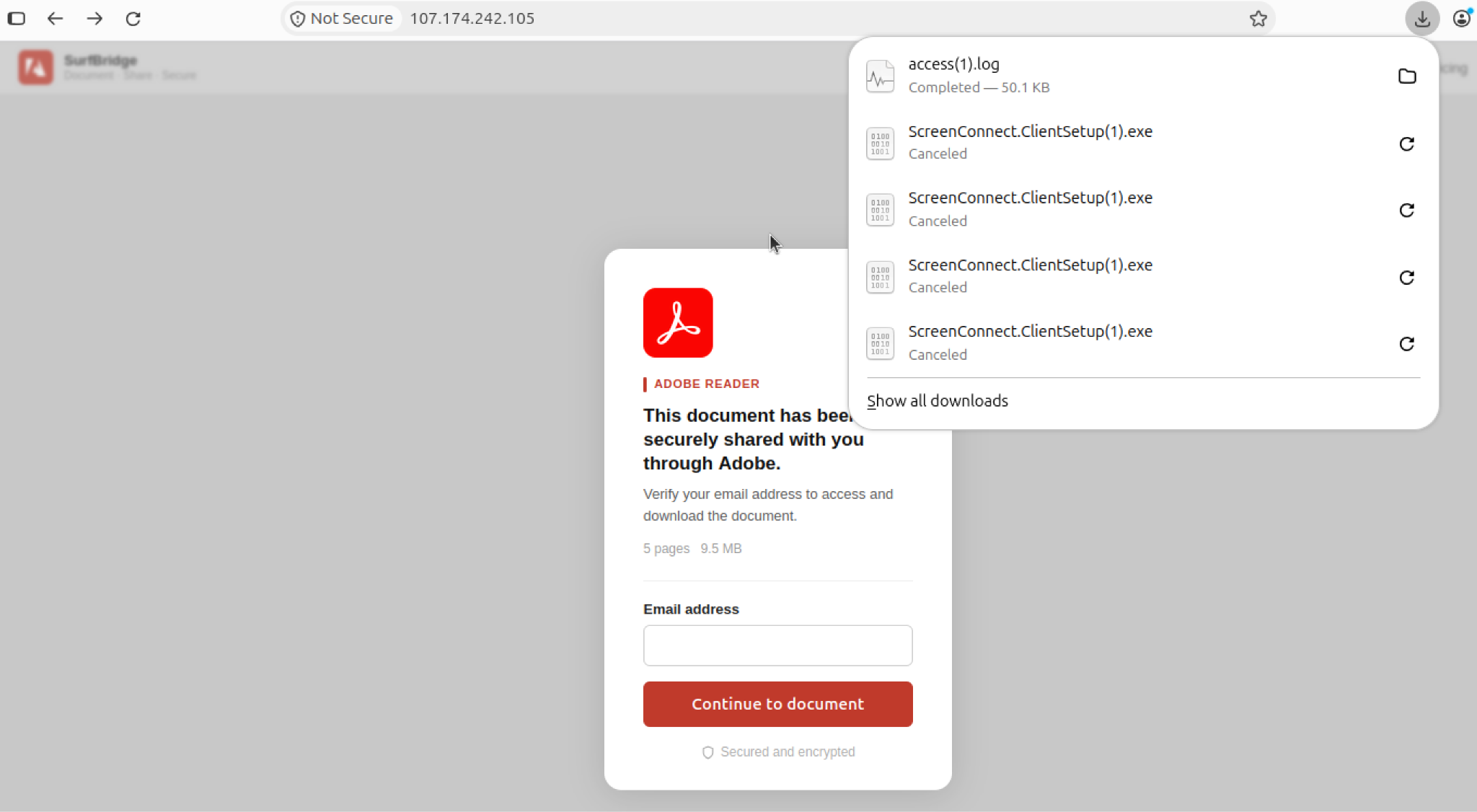
The “View & Sign Form” & “Sign in to view document” pages present a document-review or information-download pretext. Their observed behavior includes:
The ISP-based restrictions are consistent with an attempt to reduce exposure to automated analysis environments, although their intent cannot be established conclusively from the page behavior alone. Telegram notification occurs before the ISP restriction, meaning the page can report visits even when it does not deliver the installer.
The pages use labels such as “Reference Information” and “Candidate Information downloaded successfully.” These labels are consistent with a document-review or recruitment-themed pretext, but the original messages or links used to direct victims to the pages were not identified.
2. Infrastructure and tenant relationships
Five origin IPs were associated with the observed page variants.
Several additional .site domains returned page bodies identical to those on the origin servers, consistent with Cloudflare proxying. This relationship is inferred from matching page content and certificate information rather than direct access to proxy configuration.
The ScreenConnect tenants observed across the investigation were omydze, vvvzou, luminahealthturkey2, tfcconnection, and alunos1. Three clients downloaded during follow-up collection contained tenant-specific relay and fingerprint configurations. Their signatures were not independently verified during that follow-up, so those files should not be described as signature-validated.
3. Redirect and filtering behavior
Some pages redirected non-Windows visitors through motormotif[.]com/falscon. The page used a Google-like loading screen and an anti-bot challenge before forwarding to a fake identity-verification page.
The final destination returned HTTP 404 during collection, so its intended purpose could not be confirmed. This path may represent a separate phishing branch, but that assessment remains tentative.
The Adobe-themed domain clickksy[.]icu was registered on 2 October 2026 and had a wildcard Let’s Encrypt certificate issued on the same day. Requests during collection received a Cloudflare challenge, preventing direct retrieval of the page. Consequently, its full behavior and the precise relationship between the page and the two locally analyzed installers could not be independently confirmed from page content.
4. Technical behavior and MITRE ATT&CK mapping
The two locally analyzed Adobe-lure packages were configured to install a ScreenConnect Client (<fingerprint>) service that starts automatically and runs as LocalSystem. The packages also registered an sc-<fingerprint> URL protocol handler and included standard ScreenConnect Backstage components.
No credential capture was observed. The presence of vendor credential-provider components alone does not demonstrate credential theft.
Observed behavior and static configuration are consistent with the following MITRE ATT&CK techniques:
Note: No Windows execution or dynamic endpoint analysis was performed. These mappings should therefore be treated as assessments based on static configuration and observed web-page behavior.
5. Potential impact
No victim compromise was confirmed during this investigation. However, executing a client configured for an unauthorized tenant could provide an external operator with persistent, interactive access to a Windows system.
Depending on tenant permissions and subsequent operator activity, this access could support data theft, exposure of user sessions, lateral movement, or delivery of additional tools.
Valid vendor signatures do not make a remote-management client safe when it has been configured to connect to an unapproved tenant. Blocking only installer hashes is also unlikely to be sufficient because different tenants can generate different client builds.
The following indicators are included based on the investigation’s post-1 October 2026 observations and available registration, certificate, and modification-date evidence. These dates do not necessarily establish the exact first day each service was hosted.
Locally analyzed Adobe-lure packages
Follow-up installers — configuration extracted; signatures not independently verified


