🚀 CloudSEK featured in the 2026 Frost Radar™!
Read more
.avif)

Security analytics is the practice of analyzing security data to identify malicious activity and assess risk within digital and cloud environments. Related security events are examined together to understand their significance rather than as isolated alerts.
Security data is generated by networks, systems, applications, and user actions during normal operation. Viewing this information in combination makes abnormal or attack-related behavior easier to recognize.
A clear picture of ongoing security activity is formed through analysis of recorded evidence. That picture reflects what is occurring across the environment without describing specific tools, techniques, or response actions.
Security analytics works by collecting and analyzing security data from across an environment to identify patterns, anomalies, and potential threats. It connects related events and adds context to turn raw security data into actionable insights for detection and investigation.
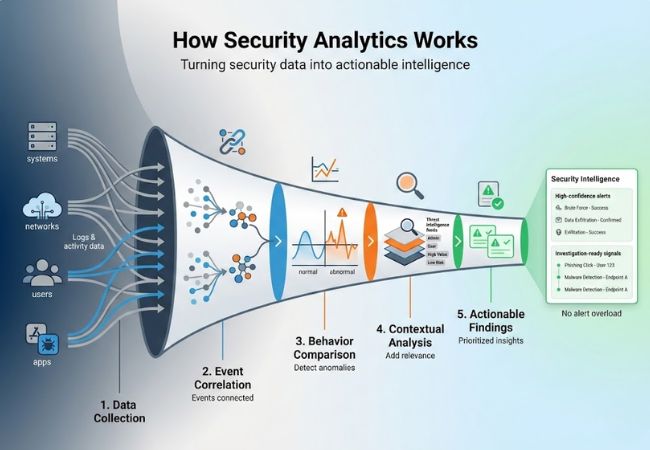
Security data analytics is the examination of security-related data to understand its structure, quality, and relevance within cybersecurity operations. The term refers to working with security data as data, before it is interpreted as threats or incidents.
Relevant data includes logs, records, and activity produced by systems, networks, applications, and identities. Analysis at this stage focuses on accuracy, consistency, and completeness rather than conclusions or response actions.
Within cybersecurity programs, this discipline forms the data foundation that higher-level security analytics relies on. The scope remains limited to preparing and understanding security information without extending into detection logic or threat interpretation.
The evidence of most breaches is already in the logs just scattered across systems no one connected in time. Security analytics matters because it closes that gap, turning disconnected data into decisions before an incident escalates.
Security analytics brings information from different security sources together, giving organizations a consolidated view of their security environment.
Automated processing allows security teams to analyze large volumes of logs, alerts, and event data quickly. It helps identify relevant patterns and anomalies without requiring analysts to manually review every event.
Standardized analysis applies the same rules and criteria when evaluating security data. This helps teams follow consistent investigation methods, prioritize events systematically, and reduce variations caused by manual analysis.
Automation reduces repetitive analysis tasks, allowing security professionals to spend more time on investigation, response, and other higher-value activities.
Security analytics enables organizations to examine past security activity and identify recurring patterns, trends, and changes over time.
Insights from analyzed security data can help organizations identify operational gaps and refine their security processes and controls.
Security analytics relies on multiple categories of data produced by digital systems and recorded user activity.
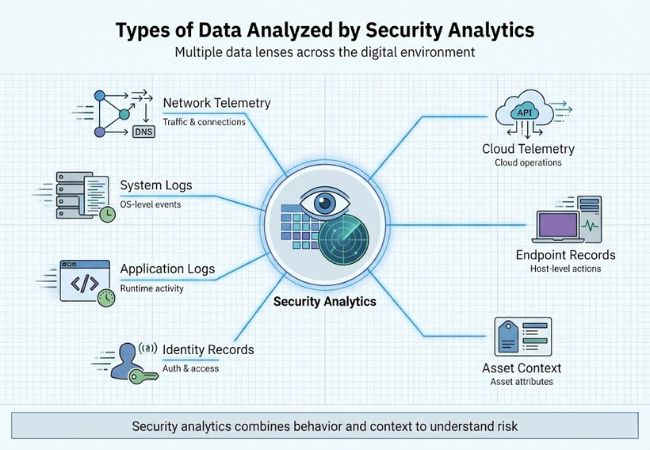
Network telemetry includes records describing connections, traffic flow, and communication paths between systems. Common examples include flow logs, DNS records, and connection metadata.
System logs record operating system events, service activity, and system-level changes. Time-stamped entries provide evidence of how systems function over time.
Application logs capture events generated during software execution. Typical entries include errors, transactions, and configuration-related records.
Identity records document authentication attempts, access approvals, and session activity. User and service account interactions with resources appear within these records.
Endpoint records describe activity occurring on servers, workstations, and virtual machines. Examples include process execution events and file-level changes.
Cloud telemetry originates from cloud platforms, APIs, and managed services. Recorded activity reflects workload operations and configuration states.
Asset context data describes characteristics such as system role, ownership, location, and sensitivity. Descriptive attributes define assets without expressing behavior or intent.
Security analytics interprets threat behavior by placing observed security activity into structured adversary and behavioral contexts.
Observed actions are aligned with known attacker techniques and tactics to determine intent. Frameworks such as MITRE ATT&CK provide a shared reference for categorizing adversary behavior.
Individual security events are connected into ordered activity chains. Sequence-level visibility reveals progression patterns that single events cannot show.
Normal user and system behavior is established from historical activity. Deviations from established baselines highlight potentially malicious behavior without relying on static rules.
Threat intelligence supplies external knowledge about active campaigns, tools, and techniques. Contextual alignment connects internal activity with real-world threat behavior.
Multiple signals are evaluated together to assess likelihood rather than certainty. Confidence scoring reduces misclassification and limits false escalation.
SIEM and security analytics get used as synonyms they aren't. The SIEM is the plumbing that collects and normalizes the data; analytics is the intelligence that decides what the data means.
Security analytics supplies validated, context-rich findings that drive incident response actions and automation workflows.
Security Analytics focuses on analyzing security data to identify threats, anomalies, and patterns, while SIEM focuses on collecting, centralizing, and monitoring logs and security events. Although they overlap, their primary purposes differ.
Security analytics provides a way to understand security activity based on actual data rather than isolated alerts or assumptions. Clear visibility into how systems, users, and environments behave allows security teams to reason about risk with accuracy.
As organizations operate across on-premise and cloud environments, consistent analysis of security data becomes essential. Security analytics remains a practical requirement for maintaining awareness of security conditions over time.
Security analytics is used to understand security activity and risk by analyzing security-related data. The goal is to identify meaningful signals within large volumes of recorded activity.
Traditional monitoring focuses on individual alerts and predefined rules. Security analytics examines related activity together to provide context and deeper understanding.
Threat detection is one application, but security analytics also supports investigation, risk assessment, and visibility across environments. Its scope extends beyond identifying attacks.
Security analytics applies to both on-premise and cloud environments. Cloud-specific data sources are analyzed using the same analytical principles.
Security analytics does not replace SIEM systems. SIEM provides data collection and management, while analytics focuses on interpretation and insight.
Machine learning can enhance security analytics but is not mandatory. Rule-based and statistical methods are also commonly used.
