🚀 CloudSEK featured in the 2026 Frost Radar™!
Read more
.avif)

Cyberattacks are not random events driven by technology alone. Behind every breach, ransomware incident, or data leak is a threat actor making deliberate choices about targets, techniques, and timing. Understanding who carries out cyberattacks is essential for predicting how attacks unfold and why certain organizations are repeatedly targeted.
Industry incident analyses consistently show that the majority of successful cyberattacks involve human-operated threat actors rather than automated exploits, underscoring the importance of focusing on attacker behavior, intent, and patterns. By examining threat actors instead of isolated technical flaws, organizations gain clearer insight into risk and improve their ability to prevent, detect, and respond to real-world attacks.
A threat actor is an individual, group, or organization that deliberately conducts malicious cyber activity against systems, networks, users, or data. Threat actors initiate and control attacks with a clear objective, such as financial gain, disruption, espionage, or influence, and they actively adapt their methods to bypass defenses.
In cyberattacks, threat actors play the central role of decision-makers and operators. They choose targets, select techniques, adapt tactics based on defenses, and determine how long an attack persists. Every major incident—whether ransomware, data theft, or service disruption—originates from a threat actor planning and executing actions to achieve a desirable outcome.
Understanding threat actors benefits organizations by improving security decision-making. When defenders know who is likely to attack, they can better anticipate how attacks will occur, which assets are most at risk, and where defenses should be strengthened first.
Threat actors are classified into distinct types based on intent, capability, and affiliation. Each type behaves differently and poses a different level of risk.
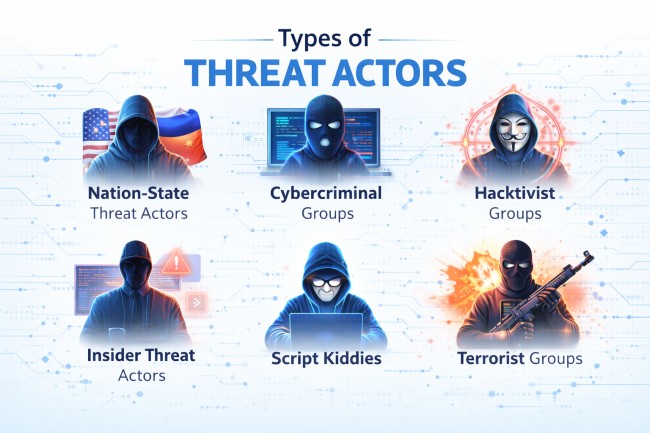
Here is a comparison table to understand in a better way:
Threat actors select targets based on value, accessibility, and potential impact. Large enterprises and government agencies are frequent targets because they hold sensitive data, intellectual property, and critical systems.
Critical infrastructure, including energy, healthcare, and transportation, attracts attackers due to its high disruption potential.
Small and medium-sized businesses are targeted for weaker defenses, while individual users and executives are targeted for credentials, fraud, or access to larger organizations.
Third-party vendors and supply chains have become high-value targets because they provide indirect access to primary organizations. By compromising a trusted partner, threat actors bypass perimeter defenses and move laterally into more secure environments. According to Research, organizations worldwide experienced an average of 1,248 cyberattacks per week in 2023, representing a 7% year-over-year increase, indicating how widespread and continuous threat actor activity has become.
Threat actors rely on a small set of proven techniques to gain access, expand control, and achieve their objectives. Each technique targets a different weakness, such as human trust, weak authentication, exposed software, or poor visibility.
Here are 7 commonly observed techniques:
Phishing is a deception method that delivers a malicious link, attachment, or login page that looks legitimate. The goal is to make a person take an action the attacker needs, such as entering a password, approving a login prompt, or opening a file that runs code. Social engineering is broader than email and relies on manipulation through urgency, fear, authority, or familiarity.
Common examples include “urgent invoice” emails, fake IT support calls, and impersonation of a manager or vendor. This technique works because it targets human decision-making, which bypasses many technical controls.
Credential theft focuses on obtaining valid usernames, passwords, tokens, or session cookies. Once valid credentials are in hand, attackers log in like a normal user and avoid noisy exploitation attempts. Credentials are stolen through phishing, password reuse from old breaches, malware that captures keystrokes, or token theft from browsers.
Account abuse then follows: attackers access email, VPN, cloud consoles, and internal apps, change forwarding rules, create new users, or enroll new MFA devices. This technique is effective because most environments trust authenticated sessions by default.
Malware is software that performs unauthorized actions such as spying, stealing data, or opening a backdoor. Many attackers deploy malware only after they confirm value in the environment, because early malware use increases detection risk.
Ransomware is a specialized form that encrypts files and systems to force payment, often after attackers steal data for double extortion. Before encryption, attackers typically disable security tools, delete backups, and spread to file servers and domain controllers to maximize impact. This technique causes operational downtime and financial pressure, making it one of the most damaging attack paths.
Exploitation uses weaknesses in software, services, or configurations to gain access without valid credentials. Vulnerabilities can be unpatched security flaws, insecure default settings, exposed management interfaces, or weak access controls. Attackers scan for known vulnerable versions, then use an exploit to execute code, bypass authentication, or escalate privileges.
Exploitation is common against internet-facing systems because those systems provide a direct path into an organization. This technique succeeds when patching is delayed, and exposure is not tracked continuously.
Lateral movement is the process of moving from one compromised system to another system inside the same environment. The goal is to reach high-value targets such as domain controllers, database servers, cloud admin accounts, and sensitive file stores.
Attackers move laterally by reusing stolen credentials, abusing remote tools like RDP, SMB, WinRM, or SSH, and exploiting trust relationships between systems. They often “live off the land” by using legitimate administrative tools so their actions look like normal IT activity. Lateral movement turns a small foothold into a broad compromise.
Command-and-control, or C2, is how attackers remotely manage compromised systems. Once a system is infected or accessed, it needs a way to receive instructions and send results back. C2 traffic is often encrypted and designed to blend into normal web traffic using HTTP/HTTPS, DNS, or cloud services.
Attackers may use scheduled “beaconing,” where the compromised system checks in at regular intervals to reduce suspicious traffic spikes. Effective C2 gives attackers persistence and remote control, which enables long-term operations.
Data exfiltration is the unauthorized collection and transfer of sensitive information out of the organization. Attackers look for customer data, financial records, source code, credentials, and internal communications, then compress and stage it for export. Exfiltration often uses common tools and protocols to blend in, such as HTTPS uploads, cloud storage sync, or encrypted archives moved through remote connections.
Extortion follows when attackers threaten to leak the data publicly, sell it, or report it to regulators unless payment is made. This technique increases pressure even when ransomware encryption fails or is stopped.
Threat actor activity is best understood through real incidents where intent, technique, and impact are clearly visible. The following examples show how different threat actors operate and the scale of damage they cause.
Equifax breach (2017)
A cybercriminal threat actor exploited an unpatched web application vulnerability to gain access to Equifax systems. After initial access, attackers moved laterally and exfiltrated sensitive data, exposing personal information of approximately 147 million individuals. This attack highlighted how vulnerability exploitation combined with weak detection leads to massive data loss.
Target data breach (2013)
Attackers associated with organized cybercrime conducted reconnaissance on Target’s third-party vendors and compromised an HVAC contractor. Stolen credentials were used to access internal systems, resulting in the theft of over 40 million payment card records. The incident demonstrated how supply-chain targeting enables indirect access to well-defended organizations.
Colonial Pipeline ransomware attack (2021)
A financially motivated ransomware group used compromised VPN credentials to access Colonial Pipeline’s network. The attack forced a shutdown of fuel operations across the U.S. East Coast and led to a $4.4 million ransom payment, showing how credential abuse can disrupt critical infrastructure without exploiting technical flaws.
Lazarus Group campaigns (multiple years)
This nation-state threat actor has conducted long-term cyber operations targeting financial institutions and technology companies. Reported campaigns have resulted in billions of dollars in stolen funds, demonstrating how state-backed actors combine persistence, advanced tooling, and strategic targeting.
Conti operations (2020–2022)
Conti targeted enterprises globally using ransomware and data extortion. Victims included healthcare providers and large corporations, with individual ransom demands reaching tens of millions of dollars. The group’s activity showed how organized cybercriminals operate like businesses, with dedicated roles and repeatable attack playbooks.
Understanding threat actors becomes clearer when they are compared with related security concepts. Each concept answers a different question in the attack model.
Organizations identify threat actors by analyzing patterns of behavior rather than single events. Individual alerts rarely provide enough context, but repeated actions across time reveal how an attacker operates, what they target, and why they persist.
One key method is examining tactics, techniques, and procedures (TTPs). Threat actors tend to reuse the same methods, tools, and workflows across attacks. Consistent use of certain phishing styles, malware families, lateral movement methods, or command-and-control patterns helps link separate incidents to the same actor or group.
Infrastructure reuse provides another strong signal. Attackers often reuse domains, IP ranges, hosting providers, or cloud services across campaigns. When security teams correlate this infrastructure with known attack activity, they can attribute new incidents more accurately.
Threat intelligence and historical data complete the picture. By comparing current activity with past campaigns, organizations can identify recurring timelines, targeting preferences, and operational habits. This context allows defenders to move from reacting to alerts toward anticipating attacker behavior.
Effective defense focuses on reducing the attacker's advantage and limiting how far an attack can progress. Each control below addresses a specific part of how threat actors operate.
Threat intelligence provides context about active threat actors, their tools, and their preferred targets. By integrating intelligence into security operations, organizations can recognize known attack patterns earlier and respond with informed decisions instead of generic alerts.
Threat actors start by looking at what is exposed to the internet. Reducing the attack surface by removing unused systems, securing cloud assets, and closing unnecessary services limits what attackers can discover and exploit during reconnaissance.
Many attacks succeed through stolen or abused credentials. Strong authentication, least-privilege access, and continuous monitoring of account activity reduce the effectiveness of credential-based attacks and lateral movement.
Threat actors leave behavioral signals as they move through environments. Monitoring endpoints and network traffic for abnormal activity, such as unusual process execution or unexpected connections, helps detect attacks before major damage occurs.
Prepared response plans limit the impact when attacks occur. Clear roles, tested procedures, and fast containment reduce downtime, prevent attacker persistence, and shorten recovery time.
CloudSEK helps organizations counter threat actors by providing continuous visibility into external threats and attacker behavior. CloudSEK’s Attack Surface Intelligence identifies exposed assets, shadow IT, misconfigured cloud resources, and third-party risks that threat actors actively scan and exploit.
Through Threat Intelligence and Digital Risk Protection, CloudSEK tracks real threat actor infrastructure, campaigns, leaked credentials, and early indicators of targeting across the open, deep, and dark web. This intelligence allows security teams to understand who is targeting them, why they are being targeted, and how attacks are likely to unfold—enabling faster prioritization, earlier intervention, and reduced attacker dwell time.
