🚀 CloudSEK featured in the 2026 Frost Radar™!
Read more
.avif)

Malware analysis is the process of examining malicious software to understand how it works, what it does, and how it affects systems to prevent cyber threats.
Malware analysis focuses on breaking down suspicious files, code, or programs to identify their behavior. Security teams study how the malware enters a system, what actions it performs, and how it spreads. This helps in identifying threats quickly and taking the right action.
The process is used across endpoints, networks, and cloud environments. Analysts investigate malware samples in controlled environments to avoid damage. By understanding the structure and behavior of malware, organizations can detect similar threats and block future attacks.
Malware analysis plays a key role in cybersecurity operations. It helps in threat detection, incident response, and security improvement. Clear insights from analysis allow teams to reduce risk and strengthen overall system protection.
Malware analysis provides the following key benefits that improve threat detection and security response.
Malware analysis identifies new and unknown threats that do not match existing signatures. Analysts study behavior and patterns to detect hidden or advanced malware. This improves detection accuracy against evolving attacks.
According to AV-TEST Institute, over 560,000 new pieces of malware are detected every day, highlighting the massive scale of emerging threats and the need for continuous malware analysis to ensure effective detection and response.
Malware analysis provides detailed insights into how an attack works. Security teams use this information to act quickly and contain threats. Faster response reduces damage and limits spread.
Malware analysis reveals system weaknesses and attack methods. Organizations update security controls based on these findings. Stronger defenses reduce the chances of similar attacks.
Malware analysis helps predict and prevent future threats. Patterns and indicators from past attacks guide proactive security measures. This reduces long-term risk and improves overall resilience.
Malware analysis generates indicators such as malicious IPs, domains, and file signatures. These indicators feed into threat intelligence systems. Updated intelligence improves detection across networks and endpoints.
Malware analysis includes 3 main types that differ in execution method, depth of inspection, and level of behavioral visibility.
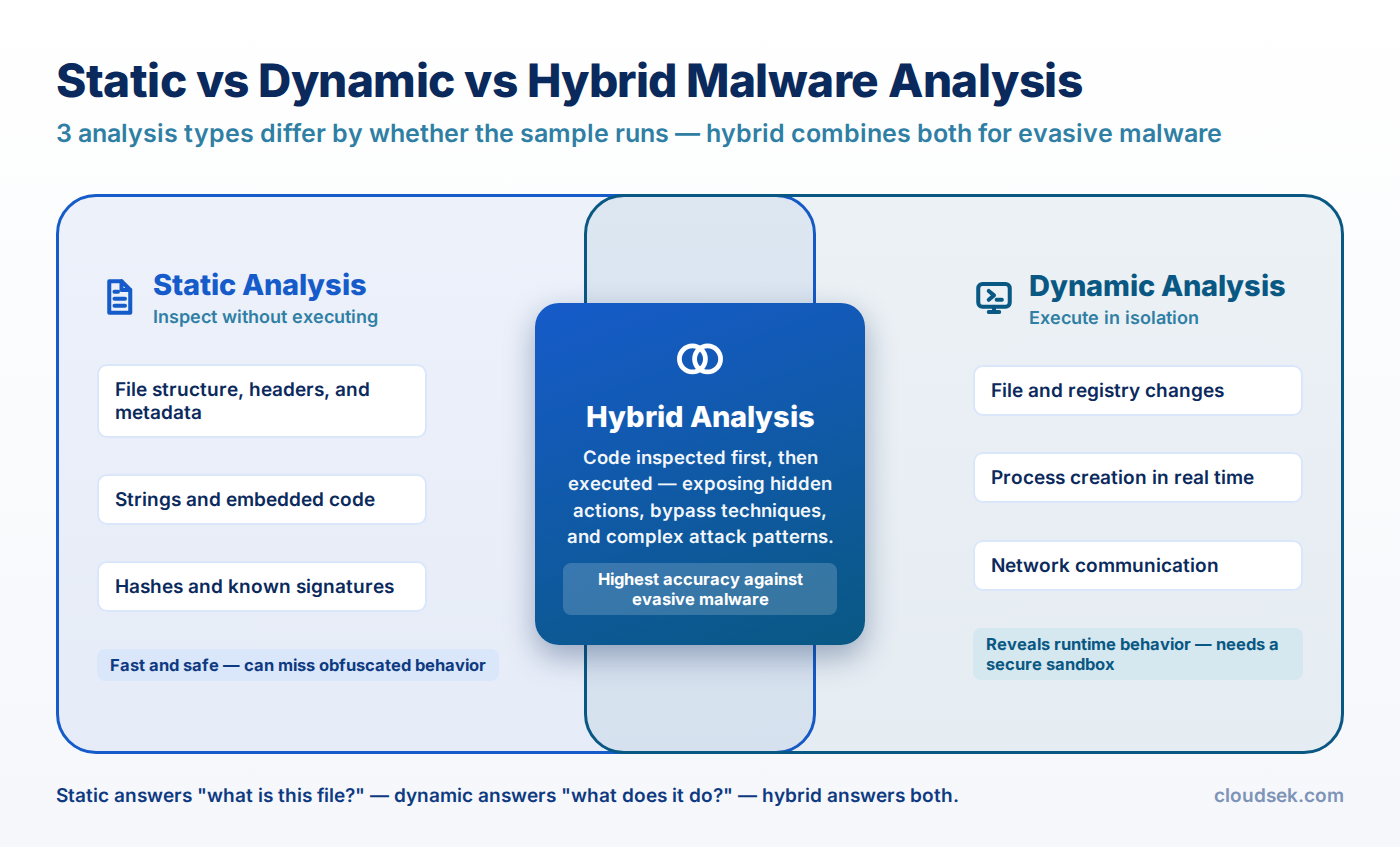
Static analysis examines malware without executing it. Analysts inspect file structure, headers, strings, metadata, and embedded code. Tools such as disassemblers and hash analysis help identify known signatures and suspicious patterns. This method is fast and safe, but it may not reveal hidden or obfuscated behavior used by advanced malware.
Dynamic analysis runs malware in a controlled environment, such as a sandbox or virtual machine. Analysts observe real-time behavior, including file changes, registry modifications, process creation, and network communication. This method reveals how malware interacts with the system during execution. It provides deeper visibility into actual behavior but requires secure isolation to prevent system damage.
Hybrid analysis combines static and dynamic methods to provide a complete view of malware. Analysts first inspect the code and then execute it to observe behavior. This approach detects hidden actions, bypass techniques, and complex attack patterns. Hybrid analysis improves accuracy and helps identify advanced or evasive malware more effectively.
Malware analysis uses 4 core techniques that uncover hidden behavior, detect patterns, and reveal how threats operate across systems.
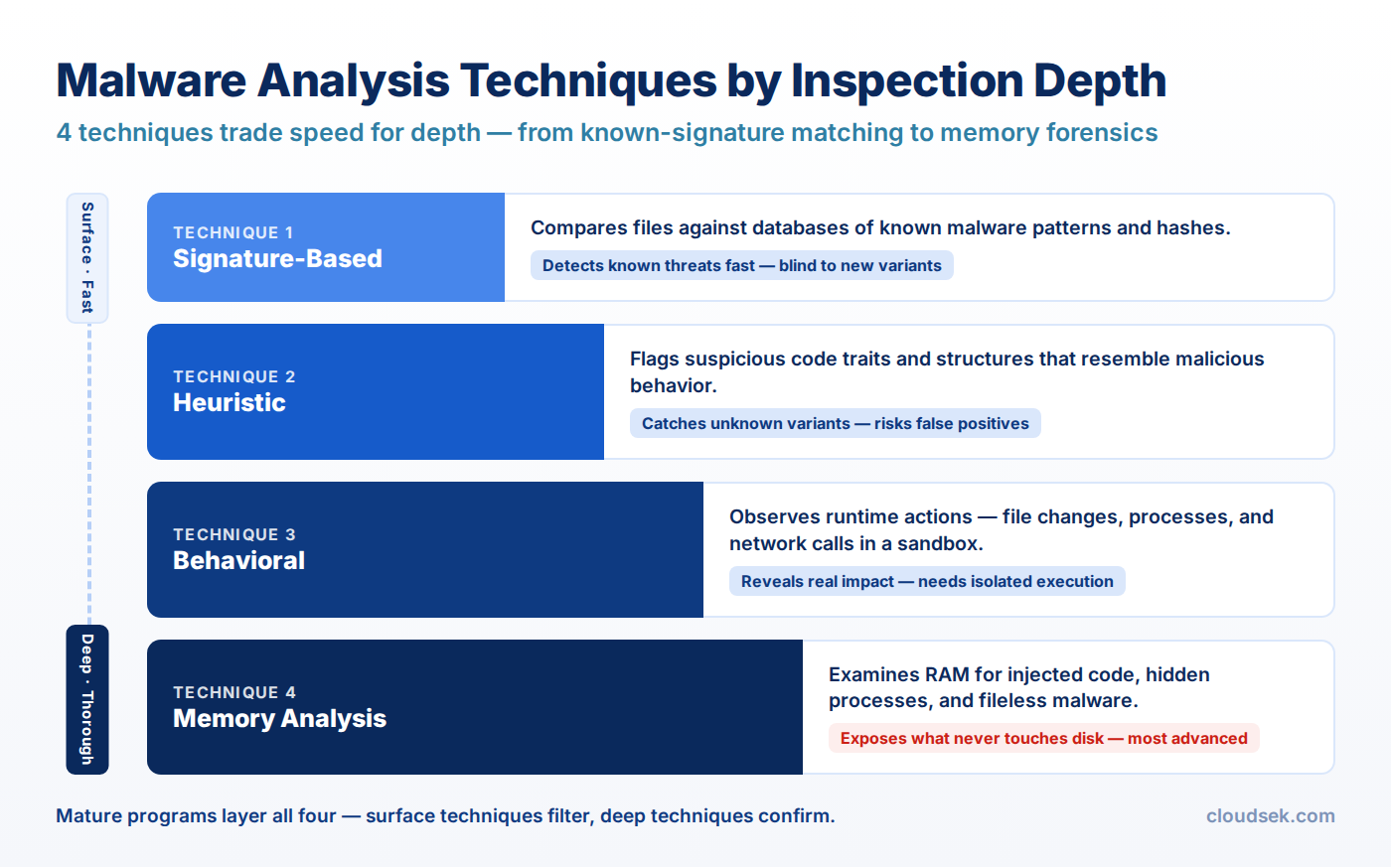
Signature-based analysis compares malware against known identifiers such as file hashes, byte patterns, and digital signatures. Security tools scan files and match them with threat databases. This method provides fast detection of known malware, but it fails when malware is modified, encrypted, or newly created.
Heuristic analysis examines code structure, instructions, and behavior patterns to detect suspicious characteristics. It looks for unusual API calls, abnormal file operations, or known malicious logic. This approach detects new or unknown threats by identifying similarities with existing malware techniques, even when exact signatures do not exist.
Behavioral analysis focuses on how malware behaves during execution. Analysts run the sample in a sandbox or controlled environment and monitor actions such as file creation, registry changes, process spawning, and network communication. This technique reveals real-world impact and identifies threats based on activity rather than static code.
Memory analysis inspects system memory to detect hidden or advanced threats. Analysts examine RAM to identify injected code, in-memory execution, and hidden processes that do not exist on disk. This method detects fileless malware and advanced attacks that avoid traditional detection methods.
Malware analysis follows 5 structured stages that help identify, examine, and fully understand malicious software, from detection through analysis to reporting.
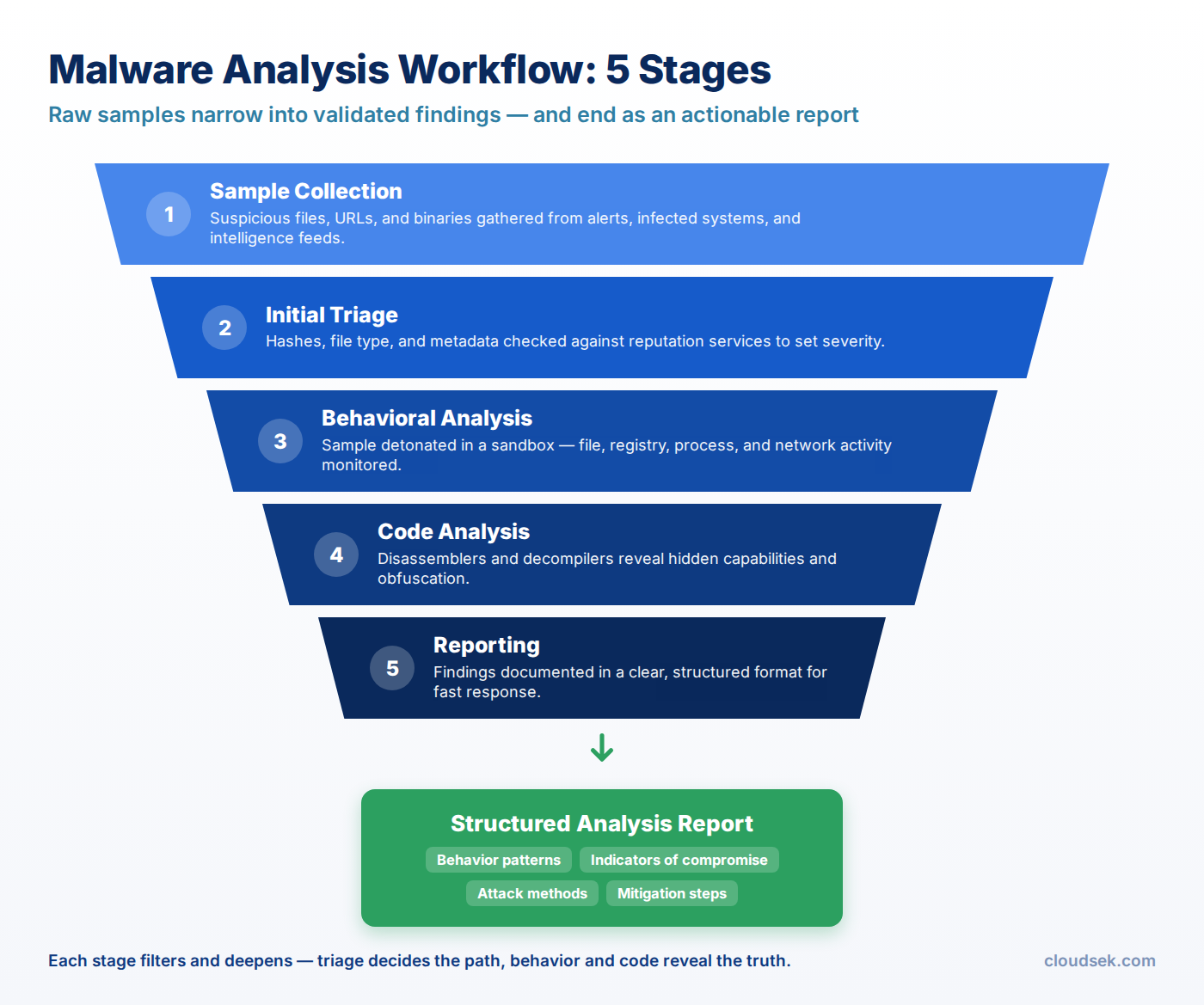
Malware analysis starts with a sample collection that involves gathering suspicious files, URLs, or binaries from alerts, infected systems, or threat intelligence feeds. Analysts ensure samples are safely stored and handled in isolated environments. Proper collection preserves file integrity and supports accurate analysis.
In this stage, security teams perform a quick assessment to classify the malware. Analysts check file hashes, size, type, signatures, and basic metadata. Reputation services and threat databases help identify known threats. This step determines severity and defines the next analysis approach.
After a quick assessment, analysts perform Behavioral analysis and run malware in a controlled sandbox or virtual machine. They monitor system activity such as file creation, registry changes, process execution, and network communication. This stage reveals how the malware interacts with the system and identifies its real-world impact.
After conducting behavioral analysis, analysts perform code analysis, which involves examining the internal structure and logic of the malware. They use tools such as disassemblers and decompilers to study instructions, functions, and embedded payloads. This step reveals hidden capabilities, obfuscation techniques, and attack mechanisms used by the malware.
In the end, the analyst documents all findings in a clear and structured format. They include behavior patterns, indicators of compromise, attack methods, and mitigation steps. Detailed reports help security teams respond quickly, improve defenses, and prevent similar threats in the future.
Malware analysis is used in the following key scenarios to detect threats, investigate attacks, and strengthen security across systems.
Malware analysis plays a critical role during security incidents. Analysts examine malicious files to understand how the attack happened, what systems were affected, and how it spread. This insight helps teams contain the threat, remove malware, and prevent further damage.
Malware analysis helps identify and classify different types of malware, such as ransomware, trojans, or spyware. Analysts study behavior and code patterns to determine the malware family and attack method. Accurate classification improves malware detection and supports faster mitigation.
Malware analysis produces valuable threat intelligence data. Analysts extract indicators such as malicious IP addresses, domains, file hashes, and behavioral patterns. This information is shared across security systems to improve detection and prevent similar attacks.
Malware analysis supports security research by revealing new attack techniques and vulnerabilities. Analysts study how malware exploits system weaknesses. This knowledge helps organizations fix vulnerabilities and improve their overall security posture.
Malware analysis helps test and improve security tools such as antivirus and detection systems. Analysts use real malware samples to evaluate detection accuracy. Continuous testing ensures tools remain effective against new and evolving threats.
Malware analysis uses specialized tools that enable safe execution, deep inspection, reverse engineering, and memory-level investigation of malicious software.
Sandboxing tools run malware in an isolated environment, such as a virtual machine. These tools monitor behavior without risking real systems. Analysts track file activity, registry changes, process execution, and network communication in real time.
Disassemblers convert compiled malware into readable assembly code. Debuggers allow analysts to execute code step by step and observe how it behaves. These tools help uncover hidden logic, obfuscation techniques, and attack mechanisms.
Network monitoring tools capture and analyze traffic generated by malware. Analysts observe communication with external servers, command-and-control activity, and data exfiltration attempts. This helps identify attacker infrastructure and malicious connections.
Threat intelligence platforms provide data on known threats, including malicious IPs, domains, and file signatures. Analysts use this information to compare malware behavior with existing patterns. Updated intelligence improves detection accuracy and investigation speed.
Reverse engineering frameworks help break down complex malware into understandable components. These tools assist in analyzing binaries, unpacking obfuscated code, and identifying hidden payloads. They provide deeper insights into advanced malware techniques.
Memory forensics tools analyze data stored in system memory during malware execution. Analysts detect in-memory threats, injected code, and hidden processes. These tools are critical for identifying fileless malware and advanced persistent threats.
Organizations must follow these key practices for malware analysis that ensure safety, accuracy, and reliable investigation of malicious software.
Malware must be analyzed in isolated environments such as sandboxes or virtual machines. These environments prevent malware from spreading to real systems. Controlled setups ensure safe execution and accurate observation.
Malware should never run on live or production systems. Executing malicious code in real environments can cause data loss and system compromise. Dedicated analysis systems reduce this risk.
Malware samples must be stored, transferred, and accessed in secure environments. Restricted access prevents accidental execution or leakage. Proper handling reduces the risk of unintended exposure.
Analysis results must be verified using multiple methods or tools. Cross-checking behavior, indicators, and outputs improves accuracy. Validation ensures reliable conclusions and avoids false assumptions.
Clear documentation records behavior, indicators, and analysis results. Analysts maintain detailed reports with steps, observations, and conclusions. Proper documentation supports incident response and future investigations.
Updated tools improve detection and analysis accuracy. Security tools, databases, and environments must stay current with the latest threats. Regular updates ensure effective analysis against evolving malware.
Traditional malware analysis examines malicious code after it reaches an endpoint or sandbox. CloudSEK is an AI-native predictive cyber intelligence platform that identifies attack paths and initial access vectors before they are exploited.
CloudSEK Threat Intelligence tracks threat actors, actively exploited CVEs, and malware activity. This provides visibility into the specific tactics, techniques, and procedures (TTPs) adversaries use to deliver malicious payloads prior to a perimeter breach.
Next, the XVigil platform strengthens this process by providing visibility into external threat signals, leaked data, suspicious domains, and underground activity linked to malware distribution or attacker infrastructure.
Nexus AI correlates these external threat signals into a unified attack graph. It maps exactly how an attacker chains vulnerabilities and external exposures to execute a specific malware campaign.
This architecture enables security operations teams to move from reactive, post-infection analysis to identifying and disrupting malware attack chains before execution.
The main goal is to understand how malware works and how to stop it.
Security analysts and researchers perform malware analysis.
Malware analysis time depends on complexity and depth. Simple samples take minutes, while advanced malware may take hours or days.
Malware analysis is legal when performed in controlled environments for security purposes. Unauthorized use or distribution of malware is illegal.
Malware analysis studies behavior and impact, while reverse engineering focuses on code structure. Both methods work together to understand threats completely.
Malware analysis detects zero-day threats through behavior and heuristic techniques. It does not rely only on known signatures.
Small businesses benefit from malware analysis to detect and respond to threats early. Early detection reduces damage and improves overall security.
