🚀 A CloudSEK se torna a primeira empresa de segurança cibernética de origem indiana a receber investimentos da
Leia mais
.avif)

Modern enterprises face increasing insider threat risks because organizations rely heavily on remote work, cloud platforms, SaaS applications, third-party vendors, and distributed access environments. Insider threats can lead to financial loss, regulatory penalties, operational disruption, reputational damage, and large-scale data breaches if organizations fail to detect suspicious user activity early.
The trajectory keeps climbing. The 2026 Ponemon Institute Cost of Insider Risks Global Report, sponsored by DTEX, put the average annual cost of insider risk at $19.5 million per organization, up from $17.4 million the year before. Containment time actually improved, dropping to 67 days from 81, but only 13 percent of incidents were contained within 30 days, and cost still triples for organizations that take more than 90 days to contain an incident.
An insider threat is a cybersecurity risk caused by a trusted individual who misuses authorized access to compromise systems, steal sensitive data, disrupt operations, or expose confidential information. Insider threats commonly involve employees, contractors, vendors, business partners, or anyone with legitimate access to enterprise systems and data.
Insider threats differ from external cyberattacks because the attacker already has approved access inside the organization. This access allows insiders to bypass many traditional security controls and interact directly with sensitive applications, cloud environments, customer records, intellectual property, and internal systems.
Insider threats may involve intentional actions such as data theft and sabotage or unintentional actions such as accidental data exposure, weak password practices, or security policy violations.
Insider threats occur when trusted individuals misuse authorized access to enterprise systems, sensitive data, applications, or networks for malicious, negligent, or unauthorized activities.
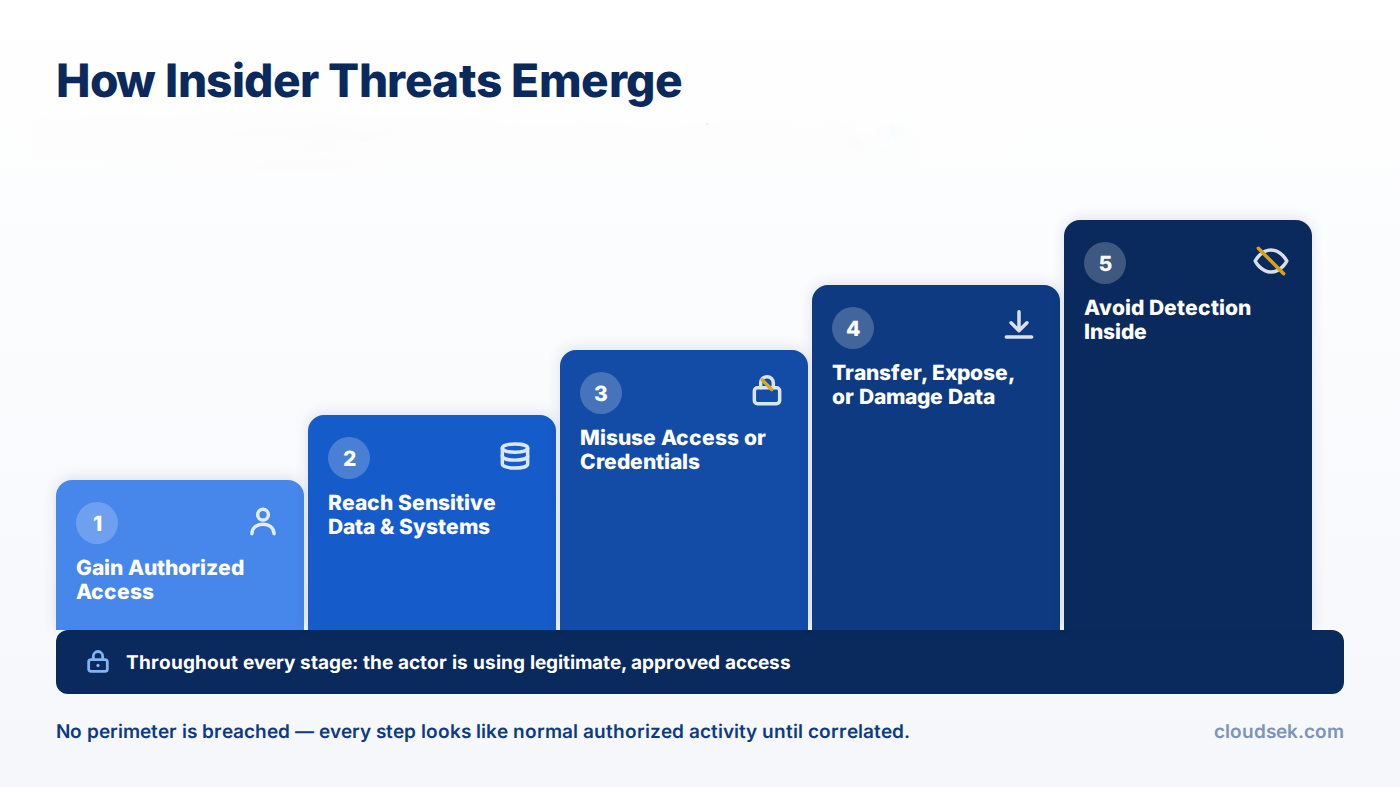
Employees, contractors, vendors, and business partners often receive authorized access to enterprise systems, cloud applications, databases, and internal networks to perform their job responsibilities. This trusted access creates opportunities for insiders to interact directly with sensitive resources without bypassing external security controls.
Insiders frequently have access to valuable business assets such as customer records, financial information, intellectual property, healthcare data, source code, and cloud environments. Privileged users and third-party vendors may access even more critical systems depending on their operational roles inside the organization.
Insider threats occur when trusted users misuse their access intentionally or unintentionally. Common activities include unauthorized downloads, data theft, privilege abuse, sharing confidential files, bypassing security policies, or using credentials in ways that violate organizational security controls.
Malicious or negligent insiders may transfer sensitive data outside the organization, expose confidential information publicly, sabotage systems, delete critical files, or share credentials with unauthorized individuals. These actions often create serious operational, financial, and regulatory consequences for organizations.
Throughout all of this, detection stays difficult precisely because insiders use legitimate credentials and approved systems. Many avoid notice by blending suspicious actions into normal operational behavior, transferring data gradually, or working entirely inside applications the organization already trusts.
Insider threats can be categorized into different types based on user intent, access privileges, operational behavior, and the way trusted access is misused inside enterprise environments.
These involve individuals who intentionally misuse authorized access to steal data, commit fraud, sabotage systems, or conduct corporate espionage. Employees, contractors, or privileged users may target customer records, intellectual property, financial systems, or confidential business information for personal, financial, or competitive gain.
Negligent insider threats occur when trusted users unintentionally expose systems or sensitive data through careless actions and weak security practices, weak passwords, accidental file sharing, insecure cloud usage, falling for phishing attacks, or ignoring organizational security policies.
Compromised insider threats occur when attackers gain access to legitimate employee or vendor accounts through phishing, credential theft, malware infections, MFA fatigue attacks, or account takeover techniques, then abuse those accounts to move through enterprise environments while appearing as a trusted user. That compromise frequently starts outside the organization entirely: platforms like XVigil monitor the dark web for exposed employee credentials, catching the exposure before it becomes an actual account takeover, since a login the organization eventually treats as an insider incident often has an earlier, external origin.
Vendors, contractors, suppliers, consultants, and external partners with authorized access to enterprise systems and sensitive data fall into this category, and weak third-party security controls, excessive permissions, or compromised partner accounts can expose organizations to data theft, operational disruption, and supply chain-related attacks.
This is the layer platforms like SVigil are built to watch, tracking vendor and supply chain exposure continuously rather than only at onboarding, since a partner account inside the trust boundary can carry access that mirrors a full-time employee's.
Insider threats often create unusual user activity, abnormal access behavior, and suspicious data movement before a major security incident occurs. Several signals tend to show up ahead of that point:
Insider threats create serious operational, financial, legal, and reputational damage for organizations across all industries.
Data breaches sit at the center of most of it. Insider threats frequently lead to unauthorized access, exposure, or theft of financial records, intellectual property, healthcare data, login credentials, and confidential business documents, and from there the damage spreads into direct financial loss: fraud, operational downtime, legal claims, regulatory fines, and the incident recovery costs that come with all of it.
Intellectual property theft carries its own weight separately, since trusted users with the right access can walk off with source code, product designs, trade secrets, or strategic plans in a way that erodes competitive advantage for years, not just the immediate quarter. Regulatory exposure follows a similar path: incidents touching protected customer, healthcare, financial, or government data can trigger violations under GDPR, HIPAA, PCI DSS, and similar frameworks.
The remaining two categories are less about data and more about disruption and trust. Malicious insiders can sabotage operations directly, deleting files, disabling systems, or interfering with infrastructure, while public disclosure of any insider incident tends to damage customer confidence, business partnerships, and long-term brand credibility well beyond the incident itself.
Organizations can reduce insider threat risks by combining continuous monitoring, strong access controls, behavioral analytics, and security awareness practices across enterprise environments:
Monitor user and entity behavior. Continuous monitoring surfaces abnormal file access, unusual login behavior, excessive downloads, and unauthorized privilege usage before they escalate into a major incident.
Enforce least privilege access. Limiting employees, contractors, and vendors to only what their job actually requires reduces the blast radius if any single account is misused or compromised.
Implement multi-factor authentication. MFA blocks unauthorized access even when credentials are stolen through phishing or compromise.
Monitor data movement and file activity. Tracking downloads, uploads, and outbound transfers across endpoints, cloud platforms, email, and external storage catches data theft as it happens, not after.
Conduct security awareness training. Regular training on phishing, social engineering, and safe data handling reduces the negligent incidents that make up the majority of insider risk cost.
Secure third-party and vendor access. Continuous monitoring of vendor activity, strict access controls, and limited permissions reduce supply chain-related insider risk, the same layer third-party risk platforms are built to watch.
Modern cybersecurity platforms combine behavioral analytics, monitoring, and automated detection to identify insider threats earlier, and most mature programs run several of these together rather than relying on one:
User and Entity Behavior Analytics (UEBA) analyzes user behavior, device activity, and access patterns to catch unusual logins, excessive file access, privilege abuse, and behavioral shifts. Data Loss Prevention (DLP) monitors and controls the movement of sensitive information across endpoints, email, cloud platforms, and networks to stop unauthorized file sharing and exfiltration before it completes.
Security Information and Event Management (SIEM) platforms centralize logs from across the enterprise to correlate suspicious activity and speed up investigation, while Endpoint Detection and Response (EDR) does the same at the device level, watching laptops, servers, and workstations for malicious processes and abnormal file activity.
Identity Threat Detection and Response (ITDR) focuses specifically on identity-related attacks and suspicious authentication behavior, compromised accounts, privilege escalation, and credential abuse. AI-driven threat detection ties much of this together, analyzing large volumes of telemetry to surface hidden patterns, cut false positives, and catch behavioral anomalies that manual monitoring tends to miss.
Financial motives, employee dissatisfaction, human error, weak security awareness, excessive access permissions, phishing, credential theft, and poor access control management all contribute to insider risk.
Industries handling large amounts of sensitive data and privileged access face the highest exposure. Healthcare and pharma carry the highest average insider cost, followed by technology and software, according to Ponemon and DTEX's 2026 research.
67 days on average as of the most recent Ponemon/DTEX research, down from 81 days the year before, though only 13 percent of incidents are contained within 30 days. Cost roughly triples for incidents that take longer than 90 days to contain.
No. Contractors, vendors, business partners, and former employees whose access wasn't fully revoked can all pose insider risk, which is why third-party and offboarding controls matter as much as monitoring current staff.
$19.5 million per organization annually as of the 2026 Ponemon Institute Cost of Insider Risks Global Report, up from $17.4 million the year before, with cost varying significantly by how quickly the incident is contained.
