🚀 A CloudSEK se torna a primeira empresa de segurança cibernética de origem indiana a receber investimentos da
Leia mais
.avif)

Threat intelligence automation is a cybersecurity capability where systems process threat data streams using artificial intelligence and machine learning to generate immediate security decisions. Data from Open Source Intelligence, internal logs, and external intelligence feeds flows through automated pipelines that eliminate manual handling.
Security environments produce continuous telemetry across endpoints, cloud infrastructure, and network layers, making manual correlation ineffective. Automated systems evaluate indicators of compromise and behavioral patterns simultaneously to improve detection speed and reduce Mean Time To Detect and Mean Time To Respond.
Traditional threat intelligence workflows depend on analyst-driven investigation, which delays response during active attacks. Automated execution replaces these delays by enriching, validating, and triggering actions instantly across integrated security systems.
Security teams face increasing pressure as threat volume, complexity, and response expectations continue to rise across modern environments, making automation essential for timely decision-making.
Threat intelligence automation works by continuously pulling data from sources such as Open Source Intelligence feeds, internal logs, and external threat intelligence platforms. Incoming data is structured and normalized so systems can process it instantly without manual filtering.
Analysis begins as systems correlate Indicators of Compromise with behavioral patterns across networks, endpoints, and cloud environments. Machine learning models and detection rules evaluate this data in real time to identify suspicious activity and assign priority based on risk.
Response execution happens through integrated platforms like SIEM and SOAR, where predefined playbooks trigger immediate actions. Alerts, threat containment, and incident workflows are handled automatically, reducing delays between detection and response.
Threat intelligence automation is driven by a layered technology stack where each system performs a specific role in data processing, analysis, and response.
Modern security systems rely on multiple interconnected layers to transform raw threat data into actionable decisions.
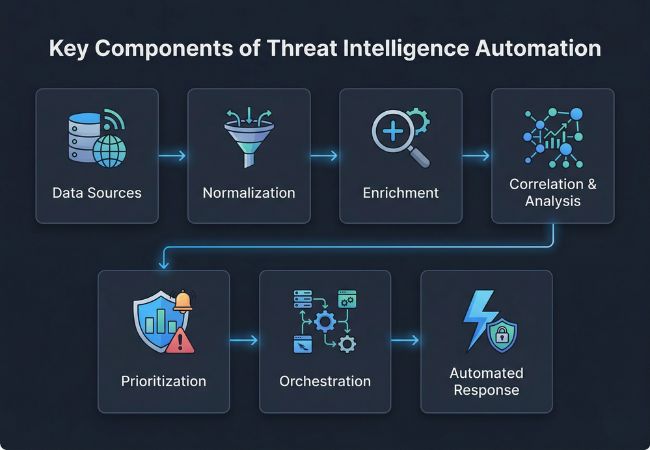
Data collection begins with inputs from open-source intelligence, internal logs, threat feeds, and underground sources. These inputs provide continuous signals about attacker behavior, vulnerabilities, and emerging risks.
Incoming data from different formats is standardized into a consistent structure for processing. Normalization removes inconsistencies and ensures compatibility across systems.
Enrichment adds context such as reputation, geolocation, and classification to raw indicators. This process converts isolated data points into meaningful intelligence for analysis.
Correlation connects patterns across endpoints, networks, and user activity to detect anomalies. Analytical models evaluate relationships between events to identify potential threats accurately.
Prioritization ranks threats based on severity, risk level, and potential impact. This helps teams focus on critical incidents instead of being overwhelmed by low-value alerts.
Integration enables communication between monitoring tools and response systems across the security stack. Orchestration ensures that detection, analysis, and response processes function as a unified workflow.
Response mechanisms execute predefined actions such as alerting, blocking, or isolating affected assets. Automated execution reduces delays and limits the time attackers have to exploit systems.
Automation improves speed, scale, and efficiency in cybersecurity operations, but limitations in integration, data quality, and implementation can impact outcomes if not managed properly.
Automation handles repetitive tasks such as alert triage, IOC correlation, and data enrichment, reducing the workload placed on security teams. Repetitive, low-value work often leads to analyst fatigue and turnover, making automation essential for operational efficiency.
Real-world incidents analyzed by CloudSEK show how attackers exploit small gaps such as exposed credentials and misconfigurations to gain rapid access to sensitive systems. These scenarios highlight the need for automated detection and response to identify threats before they escalate into full-scale breaches .
Human expertise remains essential for interpreting complex threats, especially in novel attack scenarios and strategic analysis. Automation delivers speed and scale, while analysts provide judgment, context, and decision-making that machines cannot replicate.
Security teams can manage threat intelligence manually or through automation, but differences in speed, scale, and efficiency significantly impact overall security outcomes.
Organizations apply automated threat intelligence across multiple security functions to improve detection, response, and risk management in real-world environments.
Security operations teams use automation to monitor alerts continuously across endpoints, networks, and cloud systems. Automated triage reduces noise and helps analysts focus on high-priority threats. Know More: SOC best practices.
Incident response workflows trigger predefined actions such as isolating compromised systems or blocking malicious activity. Automatic execution reduces response time and limits the impact of security incidents.
Threat hunting teams use automated intelligence to identify hidden threats and suspicious patterns across large datasets. Continuous analysis improves detection of advanced and previously unknown attack techniques.
Financial systems use automation to detect fraudulent transactions and abnormal user behavior in real time. Early detection helps prevent financial loss and protects sensitive customer data.
Security teams use automated intelligence to identify and prioritize vulnerabilities based on risk level and exploitability. This approach ensures critical weaknesses are addressed before attackers can exploit them.
Automated systems monitor underground forums, leaked databases, and external channels for exposed credentials and threats. Early detection of external risks helps organizations respond before damage occurs.
Cloud environments generate large volumes of telemetry that require automated analysis for effective monitoring. Automation ensures consistent protection across dynamic and distributed infrastructure.
Automated systems analyze emails, URLs, and files to detect phishing attempts and malicious payloads. Rapid identification helps prevent credential theft and malware infections across organizations.
Selecting the right platform depends on how effectively it processes intelligence, integrates with existing systems, and supports real-time decision-making.
Platforms should support diverse intelligence sources, including internal logs, external feeds, and threat intelligence services. Broader coverage improves visibility across different attack surfaces and reduces blind spots.
Os dados de ameaças devem ser analisados e acionados instantaneamente para evitar que os invasores explorem vulnerabilidades ativas. O processamento atrasado aumenta o risco ao estender a janela entre a detecção e a resposta.
A compatibilidade com as ferramentas de segurança existentes garante uma troca perfeita de dados em todo o ambiente. Uma integração deficiente cria silos onde a inteligência não pode acionar ações efetivas.
Os fluxos de trabalho personalizados permitem que as organizações definam ações de resposta com base na gravidade e no contexto da ameaça. Os manuais flexíveis melhoram a consistência e reduzem a dependência da intervenção manual.
Os sistemas devem lidar com o aumento dos volumes de dados sem degradar o desempenho à medida que a infraestrutura cresce. A escalabilidade limitada resulta em ameaças perdidas e em análises mais lentas.
Painéis claros e dados confiáveis sobre ameaças melhoram a tomada de decisões durante incidentes ativos. Inteligência inconsistente ou de baixa qualidade leva a falsos positivos e respostas ineficazes.
O CloudSEK oferece automação de inteligência de ameaças por meio de plataformas orientadas por IA que processam grandes volumes de dados de ameaças externas e internas. Sua abordagem de IA contextual conecta coleta, análise e resposta de dados em um fluxo de trabalho automatizado contínuo.
Sistemas automatizados monitoram fontes superficiais, profundas e escuras da Web para detectar vazamentos de dados, credenciais expostas e ameaças emergentes em tempo real. Os modelos de aprendizado de máquina correlacionam esses dados para gerar pontuações de risco e priorizar incidentes, permitindo que as equipes se concentrem em eventos críticos de segurança.
Os fluxos de trabalho integrados permitem ações automatizadas, como remoção de domínios maliciosos, bloqueio de ameaças e ativação de playbooks de resposta em sistemas conectados. Plataformas como xVigil e BeVigil ampliam essa capacidade protegendo riscos digitais externos e ecossistemas móveis por meio de inteligência e análise contínuas.
As organizações enfrentam grandes volumes de dados de ameaças que não podem ser processados manualmente em tempo real. A automação melhora a velocidade de detecção e reduz o risco de atraso na resposta durante ataques ativos.
Os sistemas de automação processam dados de registros, feeds de ameaças, atividades de rede e fontes externas de inteligência. Isso inclui indicadores, padrões comportamentais e sinais de ambientes internos e externos.
A automação reduz o risco identificando e respondendo às ameaças no início do ciclo de vida do ataque. Ele não pode evitar todos os ataques, mas limita significativamente o impacto por meio de detecção e resposta mais rápidas.
Organizações de todos os tamanhos podem usar a automação de acordo com suas necessidades de segurança e infraestrutura. Plataformas escaláveis permitem que equipes menores melhorem a eficiência sem grandes investimentos em recursos.
Equipes pequenas se beneficiam reduzindo a carga de trabalho manual e se concentrando em ameaças críticas em vez de tarefas repetitivas. A automação permite que recursos limitados lidem com grandes volumes de dados de segurança de forma eficaz.
O tempo de implementação varia de acordo com a complexidade da infraestrutura e os requisitos de integração. A implantação básica pode levar semanas, enquanto a integração total entre os sistemas pode levar vários meses.
A detecção automatizada fornece análises consistentes e rápidas em grandes conjuntos de dados. Analistas humanos adicionam contexto e validação mais profundos, tornando uma abordagem combinada mais eficaz do que qualquer um dos métodos isoladamente.
Uma plataforma de inteligência contra ameaças (TIP) se concentra em coletar, enriquecer e gerenciar dados de ameaças. Uma plataforma SOAR automatiza as ações de resposta executando fluxos de trabalho com base nessa inteligência.
