🚀 CloudSEK featured in the 2026 Frost Radar™!
Read more
.avif)

AI in threat detection is the use of machine learning models to identify malicious activity from behavior and context, rather than from signatures that describe attacks somebody has already seen.
Coverage at volume explains the adoption. A mid-sized enterprise generates tens of millions of security events a day across endpoints, identity, network, and cloud, and no hand-written rule set keeps pace with that, nor with attackers who change infrastructure weekly.
It costs judgment in exchange. Models produce scores, not verdicts, and a score without context becomes one more alert in a queue that is already overloaded.
Signature and rule-based detection answers one question well: has this exact thing been seen before? AI-based detection answers a different one: does this activity resemble how attacks behave, or how this environment normally behaves?
That shift matters because most intrusions now run on legitimate tooling and valid accounts. An attacker who signs in with stolen credentials, runs PowerShell, and copies files to cloud storage triggers no signature at any step, and every one of those actions is ordinary in isolation. What gives the intrusion away is the combination, the sequence, and the deviation from that account's established pattern.
Rules keep their place in that stack. They are fast, cheap, explainable, and precise for known-bad conditions, so mature detection programs run rules and models side by side instead of replacing one with the other.
Machine learning is a subset of AI, and in threat detection it does almost all the work.
Nearly every product feature marketed as AI runs on supervised classifiers, anomaly models, or clustering, with large language models added recently for triage and summarization.
The distinction matters during evaluation, because the word AI covers everything from a statistical baseline computed over a rolling week to a transformer model reading alert text. A vendor whose anomaly detection is a standard-deviation threshold on login counts is selling something real, and something far simpler than the label suggests.
Two questions settle it: which model family produces this detection, and what data was it trained on? Answers that stay abstract point to thresholds wearing a marketing label.
AI threat detection relies on a set of core concepts that explain how intelligent systems identify malicious activity beyond traditional rule-based methods. These concepts define how threats are recognized, evaluated, and surfaced.
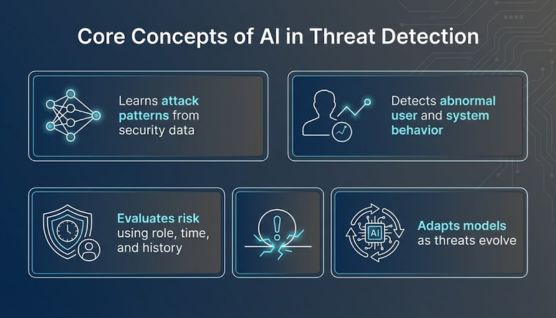
Machine learning allows threat detection systems to learn patterns from security data instead of following manually defined rules. This enables detection logic to improve over time as new activity and outcomes are observed.
Rather than focusing on known attack signatures, behavior analysis looks at how users, devices, and applications normally operate. Deviations from expected behavior help reveal suspicious or malicious activity.
Anomaly detection identifies activity that falls outside normal behavioral patterns learned by the system. This concept is critical for detecting unknown threats and zero-day attacks that lack existing signatures.
Context awareness ensures that activity is evaluated based on factors such as user role, access level, timing, and historical behavior. This reduces incorrect detections by distinguishing risky behavior from legitimate actions.
Continuous learning allows detection models to adjust as environments and attack techniques change. By updating their understanding automatically, AI systems remain effective without constant manual tuning.
AI detection arrives as a feature of other tools, not as one product. It appears at six points in a typical stack, each analyzing a different signal.
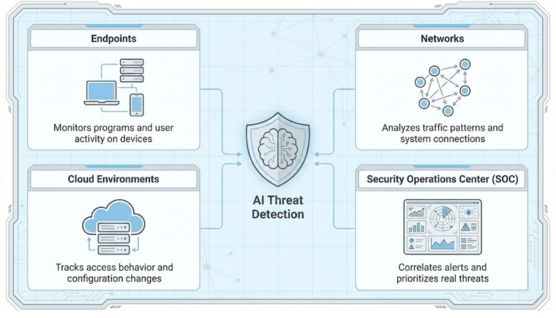
That last point matters more than vendors admit. Detection quality in a SOC is limited less by what fires and more by how many alerts an analyst reads in a shift.
Detection problems call for eight distinct model families, and the failure modes vary as much as the strengths.
Vendor marketing rarely names which of these runs under a feature. Asking that question during an evaluation reveals more about detection behavior than any accuracy claim on a data sheet.
AI threat detection earns its place on volume, behavioral drift, and variants of known attack families. It struggles wherever context lives outside the data.
Models catch credential abuse that unfolds across systems, the staging that precedes encryption in ransomware campaigns, and exfiltration that breaks a host's normal egress pattern.
Variants of known malware families fall out of the same analysis, as do internet-facing assets appearing where none existed yesterday, and the overlap with external attack surface management. Each pattern shows up clearly in telemetry, the raw material models depend on.
Detection misses the slow and the subtle. A single authorized action by a compromised insider looks identical to legitimate work, and business logic abuse, such as a finance workflow bent toward fraud, involves no technical anomaly at all.
No model detects activity on systems that produce no logs either, so edge appliances and unmanaged devices stay blind spots regardless of AI investment.
Zero-day exploitation falls between those two cases in practice. Models rarely recognize the exploit itself, and they do catch what follows it, such as a web server spawning a shell, the practical detection point for a zero-day attack.
False positives come from arithmetic before they come from bad engineering. Malicious events are rare, and rare events punish even accurate models.
One illustration makes the arithmetic concrete enough to act on. A model reviewing 10 million events a day at 99.9% accuracy still misclassifies 10,000 of them. If 50 of those events are genuinely malicious, analysts face thousands of false alerts for every real finding, and the queue collapses under its own weight.
Three fixes hold up in production, and each attacks a different part of the problem. Correlation raises the bar by requiring several weak signals before an alert fires. Context, such as asset criticality and user role, turns a score into a priority. Feedback closes the loop, since analyst dispositions retrain the model on what this environment actually considers normal.
Concept drift erodes all three of those fixes over time. A new VPN vendor, an office move, or a cloud migration changes baselines, and detections tuned to last quarter's normal start firing on this quarter's routine work.
An alert that says "anomalous behavior, score 0.87" gives an analyst nothing to investigate. Explainability techniques exist to answer why the model scored an event the way it did.
Two methods dominate in practice, both borrowed from machine learning research. SHAP, built on Shapley values from game theory, attributes a score to each input feature, showing that the logon country, the hour, and the volume of files accessed drove the result. LIME builds a simple, readable model around one prediction and reports the local rules that approximate it.
Both have limits worth knowing before promising auditors anything. Feature attributions approximate model behavior rather than proving causation, explanations shift when inputs correlate, and neither method makes a deep model genuinely transparent.
What analysts actually need lives one level lower: the raw events behind the score, the baseline the model compared against, and the window it used. A detection that surfaces those three things survives investigation, a regulator asking how an automated action was decided, and the review that follows any wrongful account lockout.
Detection models run as software, and attackers treat them as targets, not just obstacles.
Prompt injection deserves particular care as agentic tooling reaches the SOC. Any pipeline where a model both reads untrusted content and takes action needs the same scrutiny given to code execution, along with tight scoping of what the agent can change, covered further in AI supply chain security.
Both sides adopted AI, and the attacker side moved faster in the areas that matter. IBM's Cost of a Data Breach Report 2026 recorded AI-driven attacks rising 56% year over year and adding roughly $1 million to the average breach.
Automation now reaches into the intrusion itself, not only its preparation. MITRE ATT&CK catalogs a China-nexus espionage campaign, tracked as C0062, in which an AI agent executed an estimated 80% to 90% of tactical operations against roughly 30 targets, including reconnaissance, exploitation, lateral movement, and credential harvesting.
For defenders, this compresses timelines instead of changing techniques. Reconnaissance and exploitation that once took an advanced persistent threat operator days now run in hours, which shortens the window in which detection has to work.
Defensive adoption follows the same curve at a slower pace. IBM's 2026 report found half of surveyed organizations running AI agents somewhere in the SOC, while only 18% pointed them at vulnerability management, the function that closes the gaps attackers reach through.
Most failed rollouts fail the same way: detections go live everywhere at once, alert volume triples, and analysts start ignoring the new source. A staged rollout avoids that.
Detection programs measure outcomes per detection, not aggregate alert counts.
The same IBM report puts a number on the payoff. Extensive use of security AI and automation correlated with breach costs $1.93 million lower and lifecycles 65 days shorter.
Only about a third of organizations reported using it that extensively across the full security lifecycle, which says more about operational maturity than about the technology.
Models rank probability, and analysts decide meaning. That difference holds across every deployment, no matter how mature the tooling.
Consider a model reporting that an account behaved unusually. An analyst establishes whether the finance director was traveling, whether the migration project explains the data movement, and whether the activity fits a campaign that threat analysis flagged as targeting the sector last month. The same judgment sets the response, since disabling the wrong account during quarter-end close causes its own incident.
Everything above describes detection inside the environment, where the attack has already arrived. Attacks start outside it, in leaked credentials, exposed assets, impersonating domains, and criminal forums where access to a network gets advertised before anyone uses it.
CloudSEK Nexus AI applies the same correlation logic to that external data, connecting signals from digital risk, threat actor activity, the external attack surface, AI systems, and third-party ecosystems into validated attack paths instead of isolated alerts.
External correlation complements internal detection instead of competing with it. EDR sees the process that ran; external correlation shows the exposed credential and the broker listing that put an attacker in a position to run it.
No. AI detection runs inside those platforms and alongside rule-based logic, adding behavioral coverage while signatures keep catching known threats cheaply.
Partly. Models read metadata such as flow size, timing, destination, and TLS fingerprints, while payload inspection still requires decryption at a proxy.
Baselines need several weeks of clean telemetry, and precision improves for months afterward as analyst feedback accumulates.
Yes, through managed detection services and cloud platforms, where the provider carries the model tuning and retraining burden.
