🚀 A CloudSEK se torna a primeira empresa de segurança cibernética de origem indiana a receber investimentos da
Leia mais
.avif)

Artificial intelligence in threat intelligence refers to the use of intelligent algorithms to detect, analyze, and respond to cyber threats across complex digital environments. Systems process large volumes of structured and unstructured security data to identify patterns linked to malicious activity.
Machine learning models enhance threat analysis by continuously learning from historical and real-time data inputs. These systems reduce manual investigation and improve detection accuracy across network, endpoint, and cloud environments.
AI-driven threat intelligence platforms integrate with systems like SIEM and security operations workflows to provide real-time insights. Enhanced visibility and faster correlation enable organizations to shift from reactive defense to proactive threat management. Google Threat Intelligence reported in September 2026 that adversaries are moving from basic prompting toward agentic AI. In one Q2 2026 case, Google observed a threat actor compromise a cloud resource and execute an agent-enabled credential-harvesting campaign in less than six hours.
AI in threat intelligence relies on a combination of data processing layers, analytical models, and supporting systems that enable detection, correlation, and interpretation of security events.
Learning models operate on historical and real-time datasets to uncover relationships between behaviors and attack patterns. Detection improves as more data becomes available, with similarities across incidents becoming easier to recognize instead of relying on static signatures.
Large portions of threat intelligence exist in unstructured formats such as reports and external discussions. Within this data, AI extracts entities and intent, connecting textual information directly to observable threat activity.
Patterns in user and system activity form the basis for identifying abnormal behavior. Over time, AI gives those patterns meaning, helping deviations stand out in context rather than appearing as isolated signals.
Security data moves through stages such as collection, normalization, and transformation before reaching analysis layers. The effectiveness of AI depends heavily on how that data is prepared, since poor input limits the ability to uncover meaningful patterns.
Detection systems combine multiple data sources to uncover relationships between events. Hidden correlations surface as AI processes interactions across datasets instead of treating signals independently.
Response workflows depend on coordinated execution of actions triggered by detection outcomes. AI improves signal prioritization, ensuring higher-risk activity receives attention without unnecessary delay.
External data sources provide indicators, attack patterns, and infrastructure details related to adversary activity. Integration with internal observations strengthens how AI associates ongoing behavior with known threat patterns.
Machine learning and artificial intelligence expand detection capability by interpreting relationships within security data that are not captured through static rules.
Artificial intelligence is transforming threat intelligence by shifting cybersecurity from reactive detection to proactive and predictive threat management.
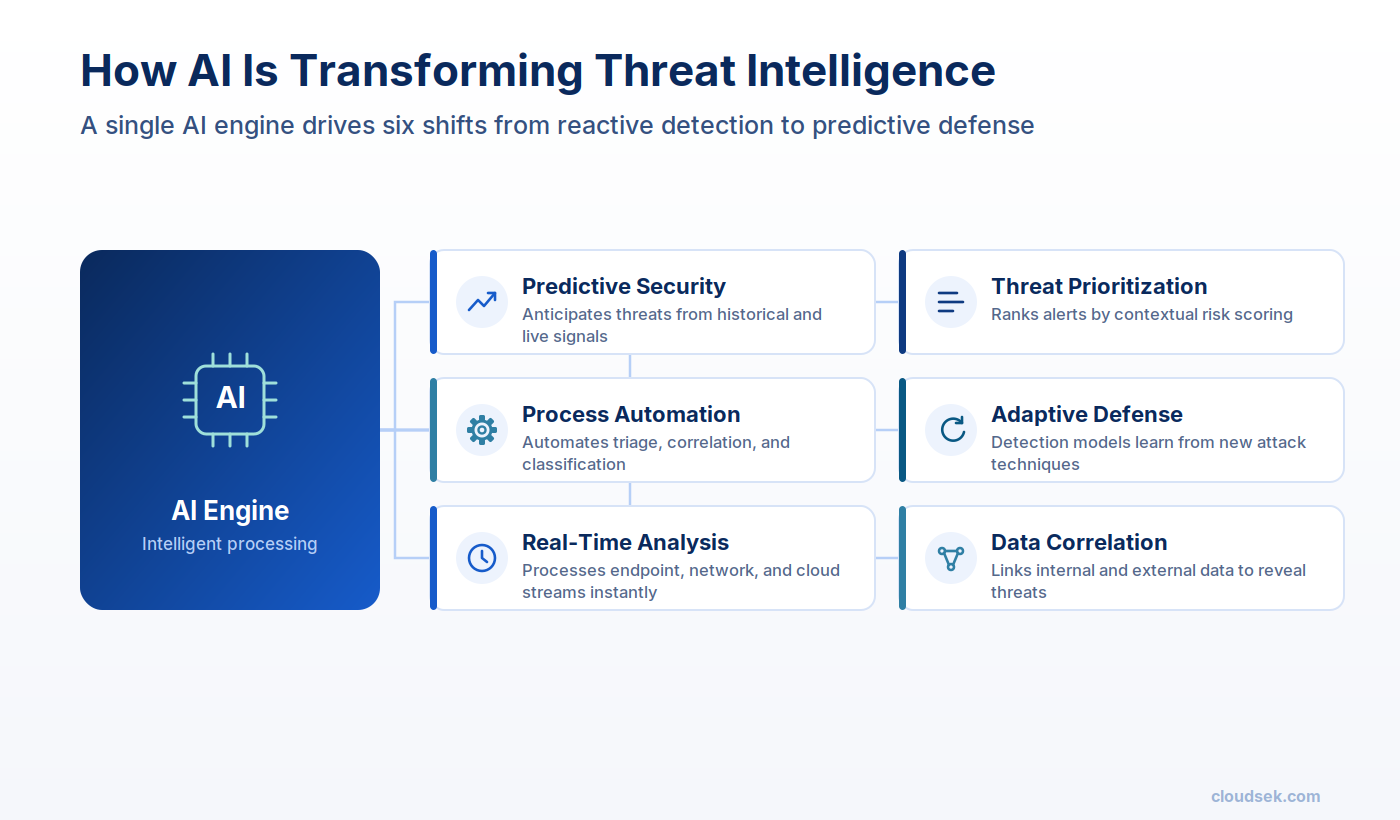
AI supports multiple threat intelligence workflows where large-scale data interpretation and rapid response are essential.
Threat detection at an initial stage depends on identifying subtle changes across systems, user behavior, and external intelligence sources, where AI enables recognition of patterns that are difficult to detect through manual analysis.
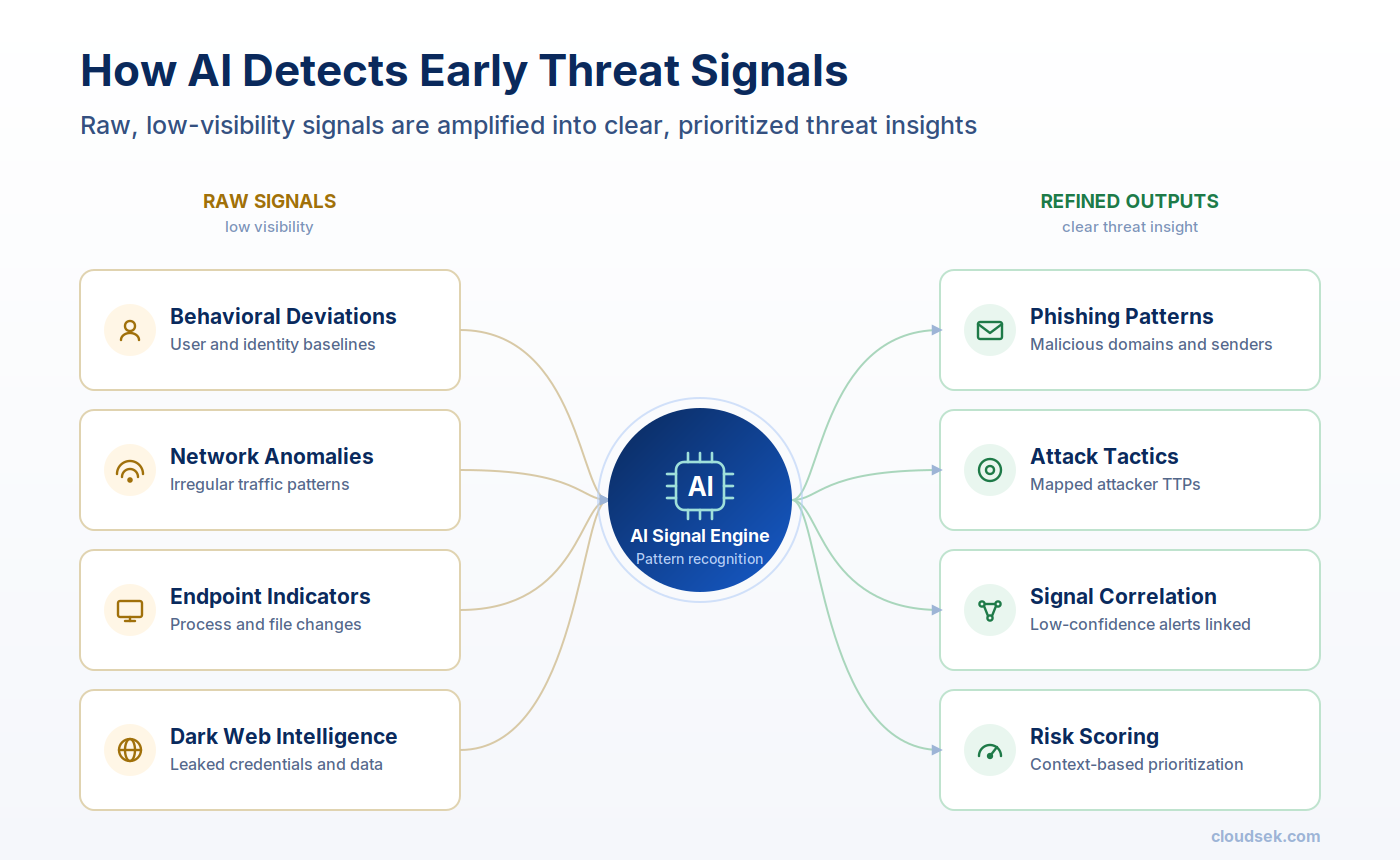
User activity baselines are built using authentication logs, access patterns, and identity behavior across systems monitored in a Security Operations Center. Unusual actions such as impossible travel logins or sudden privilege escalation are identified through models that learn normal behavior and highlight deviations linked to potential compromise.
Traffic inspection within Security Information and Event Management and network monitoring tools reveals irregular communication patterns like unexpected outbound connections or DNS anomalies. Detection improves as AI evaluates how traffic behaves over time, uncovering subtle shifts that indicate command-and-control activity.
Endpoint Detection and Response (EDR) systems track process execution, file changes, and memory behavior across devices. Suspicious sequences such as abnormal process chains or hidden persistence mechanisms are surfaced when AI analyzes relationships between processes rather than isolated events.
External monitoring platforms scan dark web forums, leak sites, and marketplaces for exposed credentials and organizational data. Large volumes of unstructured content are processed using AI techniques to extract relevant signals and connect them to potential attacker activity.
Email security systems analyze headers, sender domains, and redirection chains to uncover phishing infrastructure. Recognition of subtle variations in spoofed domains and campaign behavior becomes more effective as AI learns from evolving attack patterns.
Threat intelligence models map attacker behavior using tactics, techniques, and procedures (TTPs). AI connects patterns across incidents, helping identify ongoing campaigns and associate them with known threat actors.
Multiple low-confidence alerts across endpoints, networks, and external feeds are combined to form meaningful threat insights. Correlation improves when AI connects Indicators of Compromise (IoCs) and Indicators of Attack (IoAs) across different systems, revealing coordinated activity.
Threat signals are evaluated using contextual factors such as asset criticality, user roles, and behavioral deviation levels. Prioritization becomes more accurate as AI identifies relationships between signals and highlights risks that indicate active exploitation.
AI strengthens threat intelligence capabilities but also introduces operational and technical limitations that organizations must manage carefully.
Selection depends on how effectively a platform processes security data, supports decision-making, and fits within existing operational environments.
Coverage reflects the range of internal and external sources included in analysis. Broader visibility improves the chances of identifying relevant threat signals before escalation.
Performance is tied to how patterns, anomalies, and relationships are identified within large datasets. Strong detection reflects both model quality and how effectively it operates in real-world conditions.
Modern security environments consist of multiple tools working together. Seamless integration reduces operational friction and improves coordination across systems.
Detection without action limits effectiveness during active threats. Platforms that support automated or guided response improve reaction time and reduce manual effort during incidents.
Interface design influences how quickly insights can be interpreted during analysis. Structured dashboards and organized data presentation reduce complexity during investigations.
Consistency in performance remains critical under high data volume conditions. Stable operation ensures detection and analysis remain dependable over time.
CloudSEK is an AI-native predictive cyber intelligence platform, so AI is not an add-on to its threat intelligence but the core of how it works. CloudSEK Threat Intelligence uses AI to curate reporting from credible sources and turn large volumes of threat data into contextual, industry-tailored intelligence, tracking threat actors, exploited CVEs, malware, and ransomware activity relevant to a specific organization.
Dark web coverage feeds this picture. XVigil monitors deep and dark web forums, marketplaces, and paste sites for leaked credentials and exposed data, and AI helps match those exposures to an organization's own identities and assets rather than treating them as isolated mentions.
Correlation is where the approach comes together. Instead of treating alerts separately, CloudSEK Nexus AI connects global attack trends, threat actor activity, external exposure, and internal signals into validated attack paths, giving security teams a view of how weaknesses chain into a real intrusion. That same correlation supports predictive defense, surfacing signals such as exploited vulnerabilities, active attack vectors, and industry-specific targeting so teams can act before a threat fully develops.
Threat prioritization is based on factors such as asset relevance, attack context, and risk scoring models. AI helps rank threats by analyzing how different signals relate to potential impact on the organization.
Yes, AI connects external intelligence such as dark web data or global attack trends with internal activity, helping teams understand whether outside threats are relevant to their environment.
Unstructured data from reports, forums, and intelligence feeds is processed using techniques that extract meaningful entities and relationships, turning raw information into usable insights.
AI assists in mapping behaviors, infrastructure, and attack patterns to known threat actors, making it easier to understand adversary tactics and potential targets.
Early warning comes from identifying weak signals such as emerging vulnerabilities, attack discussions, or unusual activity patterns that indicate potential future attacks.
AI supports integration by connecting data across multiple systems and sources, enabling a unified view of threats instead of isolated insights.
