🚀 CloudSEK featured in the 2026 Frost Radar™!
Read more
.avif)

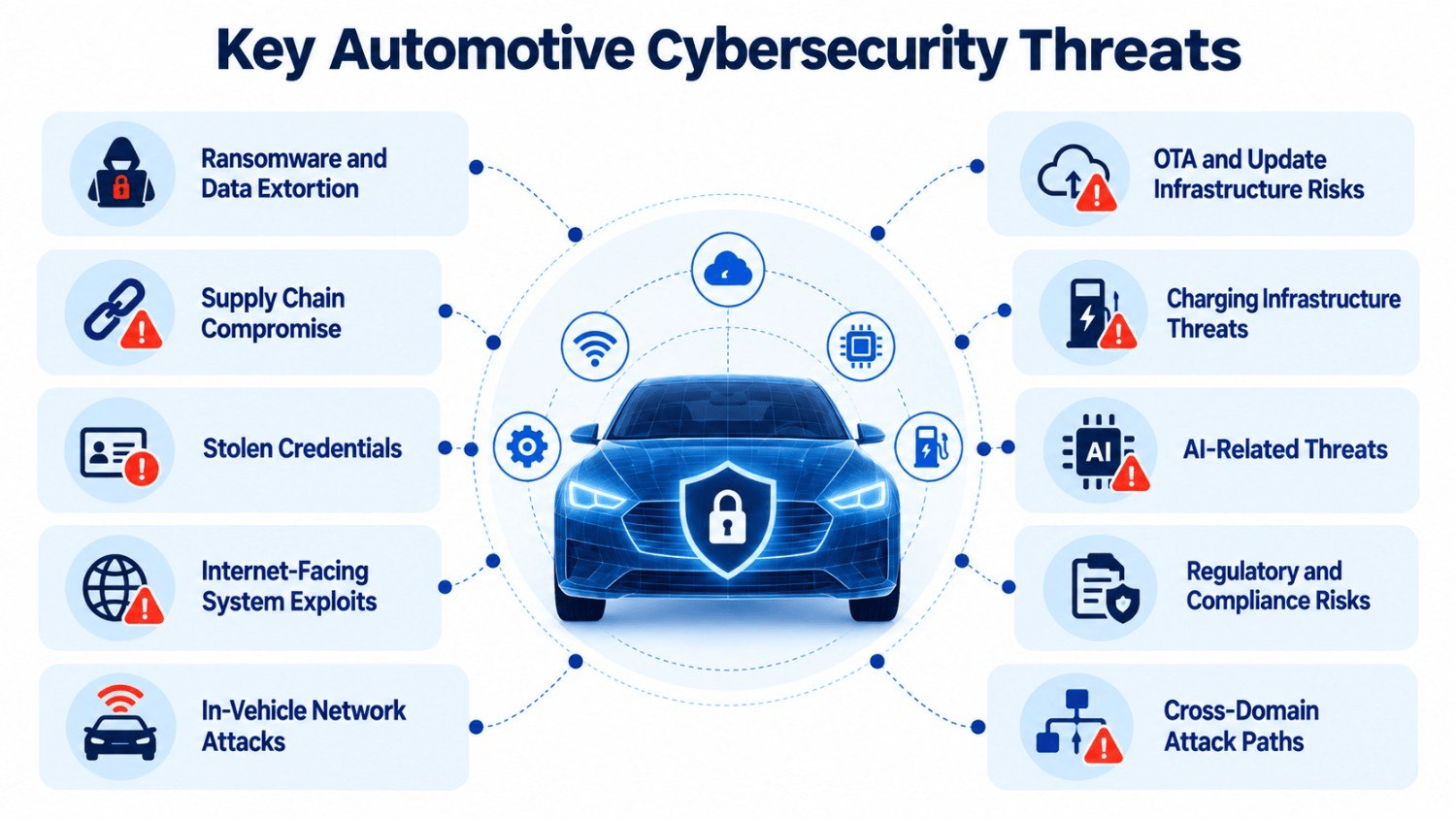
Automotive cyber risk in 2026 can originate far outside the vehicle. A stolen account, vulnerable public-facing service, or compromised supplier dependency may provide access through enterprise or manufacturing systems first. OTA infrastructure, charging networks, wireless interfaces, and in-vehicle communication create security boundaries around vehicle operation. AI-dependent automotive systems add questions around model behavior, adversarial inputs, and supporting infrastructure.
Threat category alone does not determine priority. Teams need to know whether an exposed asset or identity can be reached, used for initial access, and linked to a business, manufacturing, service, or vehicle function. An observable exposure does not prove exploitation, but a plausible path from exposure to a business or vehicle function gives teams a stronger basis for prioritizing investigation.
Automotive cybersecurity is the protection of automotive electronic systems, software, communications, control functions, users, and data across the vehicle lifecycle. Vehicle cybersecurity is the vehicle-specific part of the discipline, focused on digital and electronic systems within or directly connected to the vehicle. Automotive cybersecurity also covers the external digital infrastructure required to develop, operate, update, charge, and service vehicles.
The categories below cover the principal automotive cybersecurity threats discussed in this article. Numbering is for readability and does not indicate prevalence or severity.
Ransomware affecting business or manufacturing systems is enough to disrupt production even if vehicle electronics remain untouched. Encryption interrupts operations, while data extortion adds pressure by threatening publication of stolen data.
Cartrack disclosed a ransomware incident affecting certain systems on August 26, 2026. Its platform returned to service within five hours, and a September 10 update said personal information obtained during the incident might have appeared on the threat actor’s restricted site. The five-hour recovery period applies only to Cartrack; the incident shows how business interruption and data exposure can occur together after an earlier compromise.
Automotive products incorporate code, firmware, libraries, and externally developed components originating beyond direct OEM oversight. Supplier relationships also introduce maintenance privileges and downstream dependencies, so supply-chain compromise involves both technology provenance and organizational trust.
An August 2026 analysis in Computers & Security reverse-engineered Android Automotive OS firmware from four leading OEMs. Firmware images contained 100 to 137 known CVEs, including 24 critical vulnerabilities in one image and 60 high-severity findings in another. Shared vulnerable packages appeared across manufacturers, and the team successfully triggered a selected CVE during testing. The numbers quantify inherited component weaknesses; they do not represent successful supplier breaches.
Three review questions follow from the evidence:
A leaked username-and-password pair becomes security-relevant if the associated account still holds legitimate permissions. Employee, administrator, cloud, supplier, and VPN accounts carry varying privilege levels.
Türkiye’s Personal Data Protection Authority, the KVKK, reported on August 5, 2026, that a Hyundai Motor Türkiye breach potentially affected up to 422 people and exposed usernames and passwords. SQL injection was identified as the intrusion vector, placing the credentials among the breached data instead of the cause of the incident. Account validity and privilege determine their subsequent security significance.
Public applications, APIs, VPN gateways, and cloud platforms create technical exposure if an externally available service contains a usable vulnerability or unsafe configuration. Internet-facing exploitation requires both external availability and a weakness suitable for abuse.
A Software Quality Journal paper published on September 12, 2026, analyzed 413 automotive software vulnerabilities. HIGH findings represented 44.8% of the dataset and CRITICAL findings 16.3%, with external applications forming the largest category. The records cover 2022 through September 2024, so the percentages characterize the historical dataset.
Connected-vehicle functions often rely on telematics platforms, mobile applications, APIs, account systems, and cloud services outside the car. Authorization failures at this layer can expose commands, surveillance media, or remote functions while internal vehicle-network control remains a separate issue.
At USENIX Security 2026, Cloud-Native Carjacking: Fleet-wide Compromise via Telematics Authorization Failures documented previously unknown flaws in telematics systems used by three major OEMs. Starting from a seed vehicle, the team demonstrated cross-vehicle privilege escalation enabling remote vehicle control, surveillance-media retrieval, and spoofed commands without physical contact with the victim car.
The controlled research demonstration shows how authority granted by off-board services can influence connected-vehicle functionality.
OTA distribution has a privileged role because the vehicle is expected to accept and execute approved software delivered by the update process. Package integrity, signing, build security, authorization, and version management determine whether the delivered software remains trustworthy.
The delivery path can be represented as:
developer or supplier → build environment → distribution service → authenticated package → vehicle
A failure during build, signing, or distribution may alter the package ultimately delivered to the vehicle. In September 2026, ITU-T Study Group 17 issued the ninth revised baseline for X.ota-sec, addressing security measures for connected-vehicle OTA updating.
EV charging joins the car with charging hardware, local wireless communication, remote management, customer services, and the surrounding energy environment. A charger flaw may influence device behavior, data handling, or software maintenance inside the same cyber-physical system.
The NIST National Vulnerability Database lists CVE-2026-22099 for affected EVbee DC Quick Charging equipment. Information supplied by the Dutch Institute for Vulnerability Disclosure (DIVD) states that the Bluetooth interface lacked authentication, permitting sensitive-data retrieval, station rebooting, and submission of a firmware-update URL. DIVD, acting as the CVE Numbering Authority, assigned a CVSS v4.0 score of 8.7 HIGH. NVD displays the CNA-provided score; the record does not include a separate NVD assessment.
Cellular, Wi-Fi, Bluetooth, telematics, and V2X provide remote communication paths to connected vehicles. Interface weaknesses can affect network identity, fallback behavior, signaling, or message trust.
A USENIX WOOT 2026 paper tested LTE connectivity in two production Tesla models, a Model 3 and a Cybertruck. Testing demonstrated IMSI catching, rogue-base-station attachment and hijacking, insecure fallback, silent SMS injection, and broadcast-message spoofing. The scope is limited to the vehicles and conditions examined, so the results do not describe every Tesla or the wider automotive fleet.
Inside the vehicle, ECU trust, message handling, segmentation, and separation of safety-relevant functions determine how malicious traffic interacts with internal communications. In-vehicle network attacks concern message manipulation and internal control after the vehicle boundary has already been crossed.
A September 2026 MSTE-CAN paper evaluated four malicious CAN injection classes: denial of service, fuzzy attacks, gear spoofing, and RPM spoofing. Its detector recorded 99.96% accuracy, a 0.0295% false-positive rate, and 1.1341 ms inference time on the Car-Hacking dataset. The performance figures belong to the detector; the experiment documents several malicious CAN message behaviors under an assumed internal-network condition.
AI-dependent automotive functions introduce security questions beyond conventional software vulnerability management. Manipulated physical input can change how a perception model interprets its surroundings even without a traditional software exploit.
September 2026 research titled Cracks in the vision system: Vandalism-induced occlusion attacks in autonomous vehicles evaluated physical occlusion against seven object detectors. Using a 600-image BDD100K subset and 80 real-world photographs from 16 vandalized vehicle scenes, the experiment found that 30% lens-level occlusion reduced YOLOv8l [email protected] from about 0.49 to 0.32, a relative decline of roughly 35%. The result demonstrates adversarial degradation under experimental conditions, not attack prevalence among deployed automated vehicles.
The automotive attack surface spans vehicle electronics, connected services, enterprise platforms, production systems, supplier dependencies, and charging infrastructure. The boundaries differ by domain.
An enterprise application, telematics backend, charging station, and internal ECU do not sit behind the same security boundary.
MITRE ATT&CK defines Initial Access as the set of techniques used to get into a target system or network. For automotive organizations, the key question is which outside-facing condition can be turned into a valid point of entry.
Possible starting points include a valid credential, internet-facing application, remote service, phishing target, supplier connection, or software-delivery channel.
Initial Access is complete once the identity, session, payload, or software package is accepted and places the adversary inside the target environment.
Ransomware, data theft, service interruption, and vehicle-related effects belong to the impact stage that follows.
Impact varies with the asset and function affected.
Severity alone does not determine priority; feasibility and likely consequence need to be considered together.
Automotive security teams should prioritize threats that combine feasible exploitation with a credible route to material business or vehicle harm. Severity alone is insufficient; external accessibility, account authority, adversary activity, and downstream effect provide stronger decision context.
Assess whether an account, service, supplier connection, or interface is exposed under conditions an attacker could plausibly use. An issue isolated behind restrictive controls warrants less immediate attention than one open to external interaction.
An exposed weakness is not automatically actionable. Confirm that an account remains valid, a vulnerability is usable, a configuration permits abuse, or a trusted relationship carries meaningful permissions.
Confirmed exploitation in the wild increases urgency. CISA’s Known Exploited Vulnerabilities catalog identifies vulnerabilities with documented real-world use. Authoritative reporting on ransomware, malware, or threat actors can raise investigative urgency without proving a particular automotive organization was targeted.
Assess what lies beyond the exposed account, application, or supplier connection. A limited application or supplier account can connect to production systems, cloud resources, connected services, or vehicle-related functions. The authority held at that point and its dependencies shape the possible downstream effect.
Several moderate weaknesses become more serious as part of a plausible sequence. For example, a compromised supplier identity followed by remote access and elevated permissions presents a different risk from any condition viewed alone.
Final priority should reflect exploitability, asset importance, operational effect, safety relevance, and current adversary activity. A feasible route to material harm deserves faster attention than an isolated high-severity alert with little plausible connection to a damaging outcome. Remediation can then focus on the sequences most capable of affecting business or vehicle operations.
CloudSEK, an AI-native predictive cyber intelligence platform, combines externally observed findings so analysts can test whether separate observations belong to the same attack path.
XVigil covers organization-specific digital exposure and leaked credentials. BeVigil contributes findings from the external attack surface. CloudSEK Threat Intelligence adds exploited-CVE, malware, ransomware, and threat-actor context. SVigil provides third-party relationship data, while AIVigil covers enterprise AI applications, APIs, and supporting infrastructure.
Nexus AI performs the cross-module correlation. For example, a supplier credential identified by XVigil could be linked with an internet-facing asset from BeVigil, exploitation context from Threat Intelligence, and the corresponding vendor relationship in SVigil. The example is illustrative, not a reported automotive incident. Analysts can then investigate the linked supplier identity, exposed asset, exploitation context, and vendor dependency as one attack path.
Automotive cybersecurity governance in 2026 spans engineering, type approval, software maintenance, supply-chain eligibility, and incident response. A vehicle program spanning multiple markets can fall under more than one regulatory regime.
ISO/SAE 21434:2021 remains the main engineering reference for cybersecurity risk management in road-vehicle electrical and electronic systems. Its systematic review is underway, while development programs continue to use the 2021 edition. A second edition is planned for publication around 2029.
Two companion documents address assurance and validation. ISO/SAE 8475 covers Cybersecurity Assurance Levels and Targeted Attack Feasibility and has reached the final approval stage. ISO/SAE TR 8477 has progressed to draft Technical Report status and focuses on cybersecurity verification and validation methodology.
UN Regulation No. 155 links vehicle type approval to a manufacturer's Cyber Security Management System (CSMS). Approval depends on demonstrating an organized process for managing vehicle cybersecurity, not only controls implemented inside the vehicle.
GRVA amendment work in 2026 focuses on multi-stage vehicles. A base vehicle may later receive a crane, specialist body, or another substantial modification from a secondary manufacturer. Proposed Types A, B, and C classify the extent of change and would set the threshold for separate CSMS certification. The categories remain proposals rather than adopted obligations.
R155 expansion work also covers motorcycles and quadricycles. The proposed scope would bring CSMS requirements into homologation for both vehicle classes.
UN Regulation No. 156 governs vehicle software updates through a Software Update Management System (SUMS).
SUMS covers how updates are assessed, documented, controlled, and delivered throughout the vehicle lifecycle. OTA deployment falls within SUMS, but the regulation also applies to software changes delivered through other methods.
The U.S. Department of Commerce Connected Vehicles Rule restricts specified vehicle connectivity system hardware and software, along with automated driving system software, for covered transactions involving defined ties to China or Russia.
Software prohibitions begin with Model Year 2027. Vehicle programs entering that model year need to resolve software origin, supplier relationships, maintenance ownership, and source-code control during 2026.
March 17, 2026, is the legacy-software cutoff. Covered software designed or developed before the date receives exempt treatment only if continued maintenance, patching, and source-code modification were transferred to non-covered entities within the applicable period.
BIS also issued General Authorization No. 3 (GA3), establishing a Trusted Supplier mechanism linked to the Approved Supplier Registry. Qualifying participants can use the mechanism for specified declaration and conformity procedures under the rule.
The Connected Vehicle Security Act of 2026 remains a Senate proposal. It seeks to place related supply-chain restrictions into federal law and add statutory enforcement authority.
GB 44495 and GB 44496 became mandatory national standards in China in January 2026.
The standards set China-specific cybersecurity testing and data-security requirements for vehicles sold in the country. Work completed for ISO/SAE 21434 or UNECE approval does not automatically demonstrate conformity with the Chinese framework. Affected vehicle programs must be assessed against the domestic rules independently.
CERT-In Guidance CISG-2026-03 calls for continuous automated security testing and a six-hour reporting window for covered cybersecurity incidents.
OEMs and connected-vehicle service providers need incident workflows capable of identifying a reportable event and completing notification within six hours.
Cybersecurity concerns malicious or unauthorized access and manipulation. Functional safety deals with hazards caused by malfunctioning behavior. The disciplines intersect when a cyber event affects a safety-relevant function.
Request evidence covering software or component provenance, foundational security practices, resilience, lower-tier dependencies, and relevant assurance artifacts. The goal is to verify how a supplier substantiates its security claims, not simply whether policies exist.
No. Cybersecurity responsibilities continue after deployment as vehicle software, connected services, and operational dependencies change over time.
A vulnerability is a weakness. It becomes part of an incident after evidence shows actual or imminent compromise in the applicable context. Discovery does not prove exploitation or compromise.
