Ransomware Threat Intelligence: A Complete Guide

Ransomware threat intelligence tracks extortion groups, their tactics, leak sites, and victims to predict and disrupt attacks. Learn the types, sources, and uses.
Published on
Tuesday, July 7, 2026
Updated on
July 7, 2026

Ransomware threat intelligence is the collection, analysis, and delivery of data on ransomware groups, their tactics, their infrastructure, and their victims, used to predict and disrupt attacks before encryption begins. It is a focused branch of cyber threat intelligence built around the extortion ecosystem. 

In 2025, 138 ransomware groups claimed more than 7,300 victims, a 45 percent rise in a single year, which is why this discipline has become central to enterprise defense.

This guide explains what ransomware threat intelligence is, why it matters, its four types, what it tracks, where it comes from, how security teams use it, and how it differs from general threat intelligence.

What is Ransomware Threat Intelligence?

Ransomware threat intelligence is the practice of gathering and analyzing information about ransomware operators and turning it into action that reduces risk. It tracks who the active groups are, how they break in, what vulnerabilities they exploit, which sectors they target, and where they publish stolen data. The output ranges from executive-level trend reports to machine-readable indicators that feed detection systems.

It is a specialized subset of broader threat intelligence. General threat intelligence covers every category of adversary, from nation-state espionage to commodity malware. Ransomware threat intelligence narrows the lens to the extortion economy: ransomware-as-a-service operators, their affiliates, the dark web leak sites where they name victims, and the negotiation and payment patterns that define how attacks end. This focus is what lets it deliver early warning that generic feeds cannot.

The people who rely on it span the security organization. Security operations teams use it to tune detection, threat intelligence analysts use it for attribution, incident responders use it to understand the group they are facing, and chief information security officers use it to brief leadership on sector risk. Third-party risk teams use it to judge which vendors are most exposed.

Why Ransomware Threat Intelligence Matters

Ransomware threat intelligence matters because the threat is large, growing, and changing shape. Beyond the sheer volume of victims and active groups, the way attacks work has shifted in ways that reward early intelligence and punish a purely reactive defense.
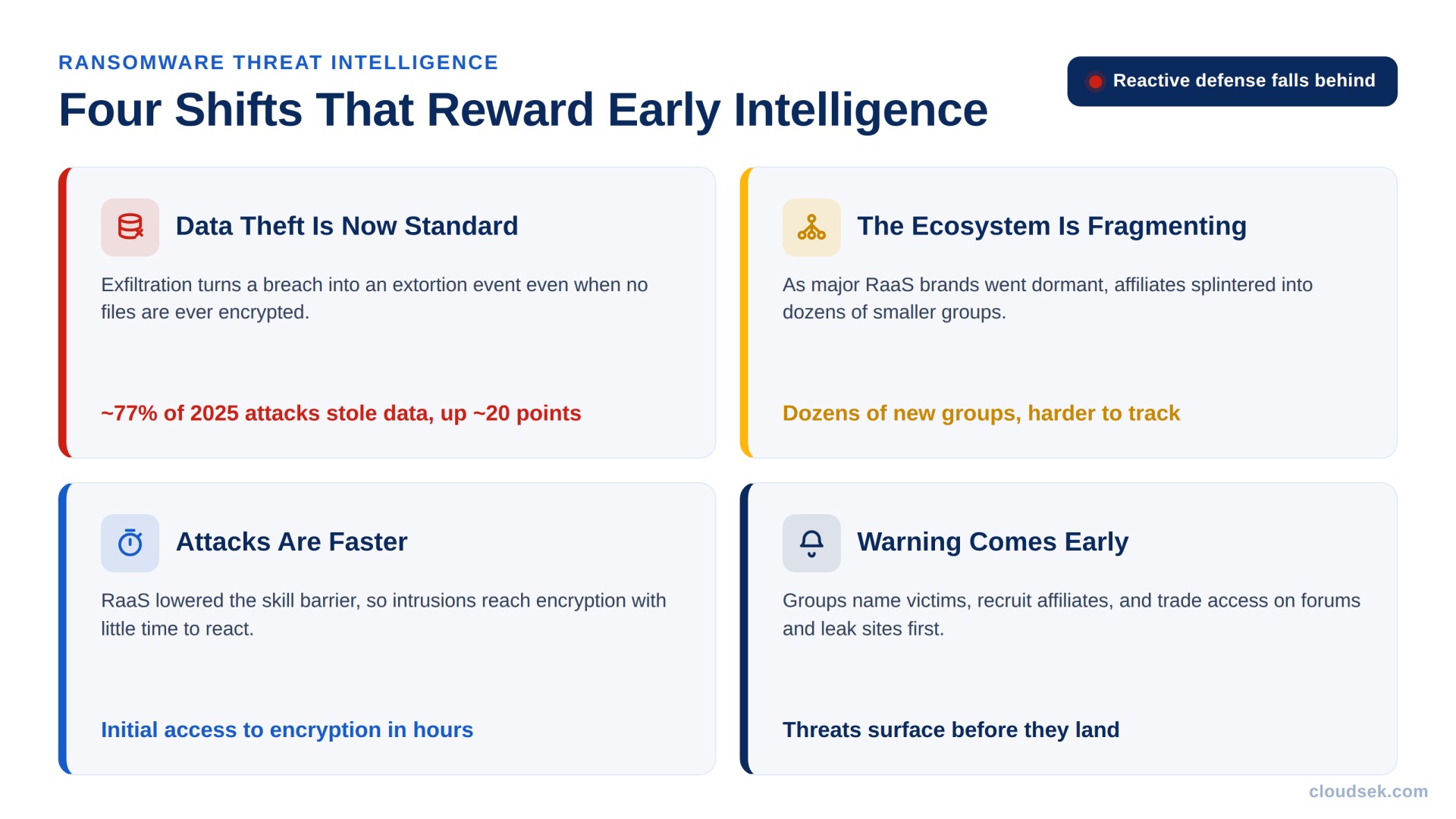
why ransomware threat intelligence matters
  • Data theft is now standard. Roughly 77 percent of ransomware attacks in 2025 involved data exfiltration, up about 20 points from the prior year, so a breach is an extortion event even when files are never encrypted.
  • The ecosystem is fragmenting. As major ransomware-as-a-service brands closed or went dormant, affiliates splintered into dozens of smaller groups, making the landscape harder to track without dedicated intelligence.
  • Attacks are faster. Ransomware-as-a-service has lowered the skill barrier, so the window from initial access to encryption is often measured in hours, leaving little time for a reactive response.
  • Warning often comes early. Groups announce victims, recruit affiliates, and trade access on forums and leak sites, which means intelligence can surface a threat before it reaches the organization.

Types of Ransomware Threat Intelligence

Ransomware threat intelligence is delivered in four types, each serving a different audience and purpose.

  1. Strategic. High-level analysis for executives and decision-makers, covering group activity, sector targeting, and the economics of extortion. It guides budget and risk decisions rather than daily operations.
  2. Tactical. The tactics, techniques, and procedures of specific groups are often mapped to the MITRE ATT&CK framework, so defenders can recognize how a given operator behaves.
  3. Operational. Campaign-level insight into active operations and imminent threats, such as a group actively targeting a sector or exploiting a specific vulnerability right now.
  4. Technical. Machine-readable indicators of compromise, including file hashes, malicious IP addresses, domains, and ransom-note signatures that feed directly into detection tools.

What Ransomware Threat Intelligence Tracks

Effective ransomware threat intelligence monitors six categories of activity that together describe the full extortion lifecycle.

  • Ransomware groups and RaaS operators. Active groups, their branding, their leak-site infrastructure, and the ransomware-as-a-service programs that rent tools to others.
  • Affiliates. Independent actors who carry out attacks under a RaaS program often reuse access bought from initial access brokers.
  • Tactics, techniques, and procedures. How groups gain initial access, move laterally, escalate privileges, exfiltrate data, and deploy encryption.
  • Exploited vulnerabilities. Specific CVEs that groups weaponize for initial access, including the mass-exploitation campaigns that drive sudden victim spikes.
  • Leak sites and victim postings. The dark web leak sites where groups name victims, publish stolen data samples, and set extortion deadlines.
  • Negotiation and payment data. Ransom demands, communication patterns, and payment trends that reveal how a group operates once an attack succeeds.

Where Ransomware Threat Intelligence Comes From

Ransomware threat intelligence draws from sources that are distinct from generic threat feeds because the extortion ecosystem operates in its own venues. Most of these sit on the deep and dark web, which is why external threat intelligence collection is central to the discipline. The main sources appear below.

Source What It Provides
Dark Web Leak Sites Victim disclosures, stolen data samples, and extortion deadlines published by ransomware groups.
RaaS Forums and Recruitment Boards Affiliate recruitment, feature announcements, and the trade of compromised network access.
Telegram and Encrypted Channels Group communications, victim shaming, and public claims of responsibility.
Negotiation Portals Ransom demands, payment behavior, and direct attacker communication patterns.
Incident Response Forensics Confirmed tactics, techniques, and indicators of compromise gathered from real-world investigations.
OSINT and Information Sharing Corroboration, threat advisories, and intelligence shared by ISACs, CERTs, and open-source researchers.

Monitoring these venues is continuous rather than periodic. Aggregated dark web Telegram channels that mirror ransomware operations let analysts identify new victims and anticipate sector-specific targeting as it develops.

How Ransomware Threat Intelligence is Used

Security teams put ransomware threat intelligence to work in five main ways, spanning prevention, detection, and response.

  • Early warning of targeting. Matching an organization's profile (its industry, region, technology stack, and exposed vulnerabilities) against the groups actively targeting those traits, so teams harden defenses before an attack.
  • Detection engineering. Feeding group-specific indicators and techniques into SIEM and EDR rules so the security stack recognizes a known operator's behavior early in the attack chain.
  • Leak-site monitoring. Watching for the organization or its vendors to appear on a leak site, which sometimes provides the first sign of a breach before any public disclosure.
  • Third-party risk assessment. Judging which vendors and partners are most likely to be hit, since a supplier's ransomware incident can disrupt the organizations that depend on it.
  • Incident response and negotiation. Informing response with knowledge of the specific group's history, typical demands, and whether it honors agreements, which shapes containment and negotiation decisions.

Ransomware Threat Intelligence vs. General Threat Intelligence

Ransomware threat intelligence and general threat intelligence share methods but differ in scope, sources, and output. The table below summarizes the distinction.

Aspect Ransomware Threat Intelligence General Threat Intelligence
Scope The extortion ecosystem: ransomware groups, affiliates, and RaaS programs All adversary types, from nation-state actors to commodity malware
Primary Sources Leak sites, RaaS forums, negotiation portals, and Telegram channels Broad feeds, malware analysis, vulnerability data, and OSINT
Primary Output Early warning of extortion, group TTPs, and leak-site exposure alerts General indicators, adversary trends, and risk context

Ransomware threat intelligence is best understood as a deep specialization within threat intelligence, not a separate field. It applies the same analytical discipline to a single, high-impact threat where speed and source access decide whether an organization learns of a campaign in time to act.

How CloudSEK Threat Intelligence Delivers Ransomware Threat Intelligence 

Ransomware moves faster than any periodic report can keep up with, so CloudSEK Threat Intelligence treats it as a live feed rather than a quarterly summary. The platform monitors global ransomware activity with real-time alerts and impact assessments, identifies the sectors and vulnerabilities under active targeting, and tracks a database of more than 30,000 threat actors alongside the CVEs they are actively exploiting. Visibility is tailored to a customer's industry and region, so an alert reflects the groups that actually threaten that organization rather than the landscape at large.

That focus turns raw monitoring into lead time. When a group names a victim, weaponizes a new vulnerability, or steps up activity against a sector, the signal reaches defenders while there is still room to patch, reset access, and harden exposed systems. CloudSEK's own research into operators such as the Qilin ransomware group shows the depth behind those alerts, tracing attack agendas, techniques, and leaked data across the open, deep, and dark web so security teams can act before an intrusion escalates into encryption or extortion.

Frequently Asked Questions

What is the difference between ransomware threat intelligence and ransomware detection?

Ransomware threat intelligence is external knowledge about groups, tactics, and victims that predicts and contextualizes attacks. Detection is the internal capability that identifies an attack in progress. Intelligence makes detection sharper by telling it what to look for.

How does ransomware threat intelligence provide early warning before an attack?

It monitors leak sites, forums, and Telegram channels where groups recruit affiliates, trade access, and name victims. These signals often appear before a target is breached or publicly disclosed, giving defenders time to harden systems and reset exposed access.

What are ransomware leak sites, and why do they matter?

Ransomware leak sites are dark web pages where groups publish data stolen from victims who refuse to pay. They matter because they reveal which organizations have been hit, what data is exposed, and which groups and sectors are most active.

Can ransomware threat intelligence predict which organizations will be attacked?

It cannot name a date, but it can estimate likelihood. By matching an organization's industry, region, technology, and exposed vulnerabilities against the groups actively targeting those traits, it identifies which organizations and vendors face elevated risk.

What is RaaS, and why does it complicate ransomware threat intelligence?

Ransomware-as-a-service rents attack tools to affiliates who split the proceeds with developers. It complicates intelligence because affiliates launch many small, short-lived operations, fragmenting the landscape into dozens of groups that are harder to track.

How does ransomware threat intelligence help during an active incident?

It identifies the group behind the attack and supplies its known tactics, typical ransom demands, and history of honoring agreements. That context shapes containment priorities and informs negotiation decisions during a live incident.

Related Posts
Ransomware Threat Intelligence: A Complete Guide
Ransomware threat intelligence tracks extortion groups, their tactics, leak sites, and victims to predict and disrupt attacks. Learn the types, sources, and uses.
What is Domain Takedown? Process, Timeline, and Legal Routes
Domain takedown removes malicious domains from the internet through evidence-backed requests to registrars and hosts. Learn the process, timeline, and legal routes.
Fake App Detection and Takedown: How It Works
Fake app detection finds mobile apps impersonating a brand; takedown removes them. Learn the detection signals, the takedown process, and how to protect customers.

Start your demo now!

Schedule a Demo
Free 7-day trial
No Commitments
100% value guaranteed

Related Knowledge Base Articles

No items found.