🚀 CloudSEK featured in the 2026 Frost Radar™!
Read more
.avif)

CloudSEK SVigil suits security-led programs that need continuous third-party cyber intelligence, while SAP Ariba Supplier Risk serves procurement-led supplier evaluation. The contrast matters because the two products answer different operating questions.
A security finding may prompt investigation, while supplier records can influence approval or reassessment in procurement. The right product depends on the operational question a team needs to answer, not the length of its feature list.
Supply chain risk management software helps organizations identify, assess, monitor, prioritize, or govern exposure arising through suppliers and related external dependencies. Depending on the requirement, that work may involve cyber intelligence, supplier analysis, screening, assessments, workflow coordination, or governance. Start with the evidence your team needs and the action that should follow from it.
We evaluated each platform by the supplier or third-party problem it addresses and the inputs used to assess it. We also examined how findings are generated and refreshed, from external intelligence and business records to questionnaires, supplier submissions, recurring evaluations, and event-driven updates.
Vendor claims were not treated as independent proof of superior effectiveness. A product remained on the shortlist only when its distinct use case was clear and the available sources substantiated its role in the comparison.
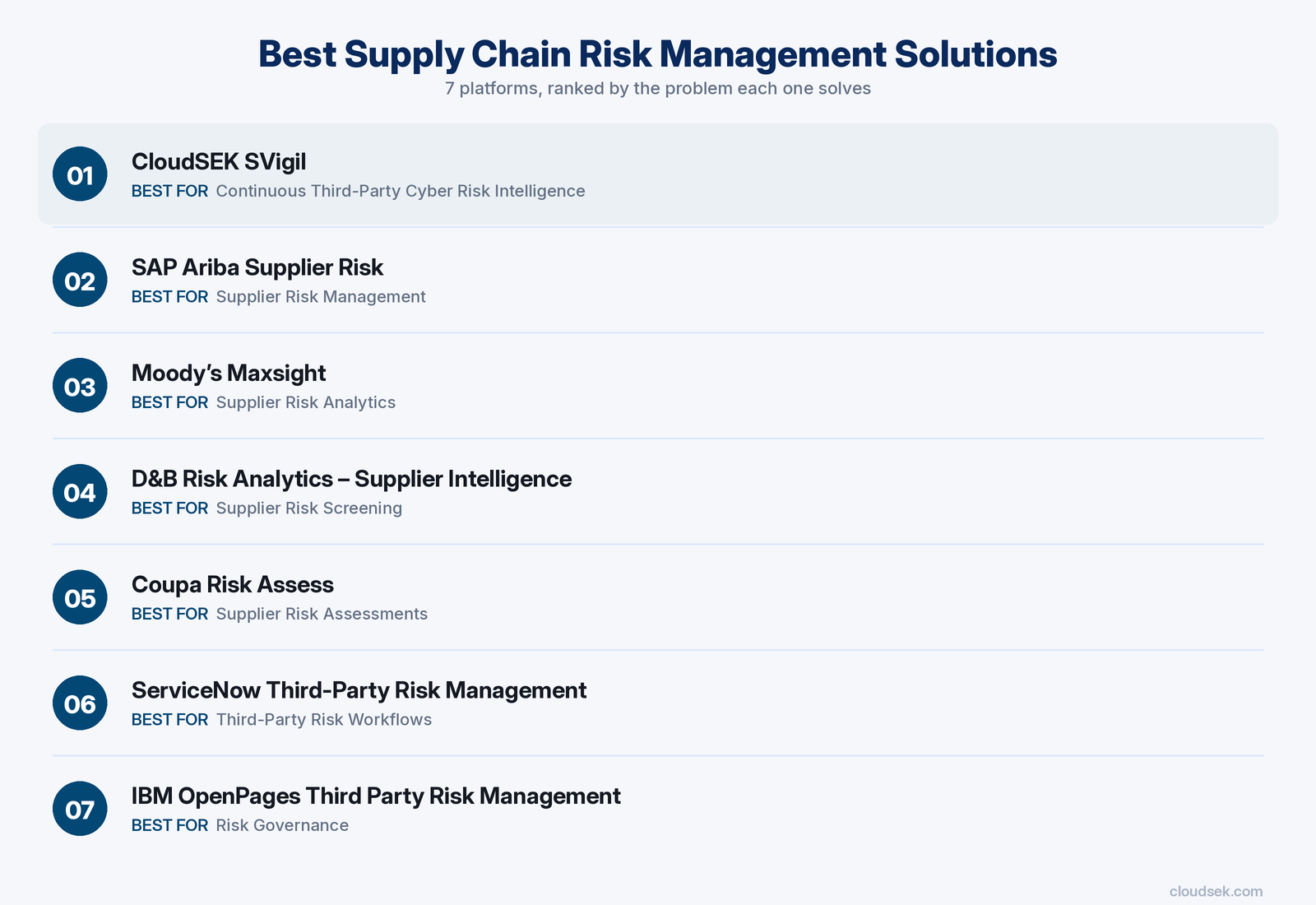
The seven products address distinct points in the supply-chain risk process, from external cyber exposure through sourcing, analytics, screening, assessment, remediation, and governance.
CloudSEK SVigil tracks changes in third-party cyber posture after onboarding. Internet-facing assets, vulnerabilities, leaked credentials, and software or service dependencies show where an external provider may introduce an initial access vector. Fourth-party connections extend that visibility beyond direct vendors to technology providers deeper in the supply chain.
When SVigil identifies a finding, Nexus AI correlates it with signals from other CloudSEK sources. Exploitability and attacker behavior indicate whether the weakness is isolated or sits within a potential attack path. Security teams can then focus investigation on vendor-driven entry points connected to an attack chain.
CloudSEK’s August 2026 research on the LiteLLM supply-chain attack described it as the largest AI infrastructure supply-chain breach of 2026. The report said the incident potentially exposed more than 2,500 companies and 434,000 CI/CD pipelines globally. The case illustrates why downstream technology dependencies matter even when they sit several layers away.
Cyber exposure is only one part of deciding whether a supplier is acceptable. SAP Ariba Supplier Risk brings due diligence findings, external incidents, and engagement data into the procurement process. Inherent risk captures the pre-control state, while residual risk reflects what remains after control effectiveness is considered.
Supplier Risk Exposure API v3 added Overall Inherent Risk and Overall Residual Risk fields in 2026. Procurement teams can compare both states alongside existing exposure data when deciding whether an engagement should proceed, be reassessed, or require additional controls.
A supplier may remain acceptable to procurement even as its financial strength or operational condition deteriorates. Moody’s Maxsight combines ownership, geopolitical exposure, sanctions, sustainability, compliance data, and cyber indicators with those business conditions to form a broader analytical profile. Portfolio data then shows how one company compares with the wider supplier base.
Moody’s published 2026 research on interconnected supplier ecosystems and ongoing visibility. The Maxsight page also lists a 2026 Chartis FCC50 recognition in the “Holistic Risk Platform” category. That recognition is treated here as vendor-reported information rather than independent evidence of product performance.
Predictive analytics can identify entities that are more likely to deteriorate over time. Configurable checks and smart policies apply internal tolerance thresholds, while credit, geopolitical, and operational measures add separate analytical dimensions. Monitoring and reporting draw attention to developments that warrant deeper analysis.
Broader analytics may describe a supplier from several angles, but screening narrows the decision to identity, viability, and eligibility. D&B Risk Analytics – Supplier Intelligence uses D-U-N-S-linked data to establish identity. Financial health, ownership, sanctions information, operational indicators, and predictive scores then inform whether the company remains commercially suitable.
D&B introduced a more customizable Risk Analytics dashboard in 2026 and currently demonstrates AI Assistant and AI Analyzer functionality for Supplier Intelligence. Screening also continues after onboarding through several capabilities:
Passing a screening check does not always complete the review. Coupa Risk Assess links suppliers, relationships, and engagements to evaluation programs governed by frameworks, regulations, scoring configurations, and timelines. Evaluators and approvers contribute KPIs, comments, scores, and supporting material as the review progresses.
The Risk Assess REST API was updated in July 2026 and exposes supplier details alongside evaluation scores, comments, and attachments. The API fields document what was reviewed, which program applied, and what information informed the outcome. Screening establishes commercial eligibility; Coupa records how a specific supplier or engagement was formally assessed.
An assessment may uncover an issue that still needs to be assigned, remediated, and closed. ServiceNow Third-Party Risk Management coordinates that work across reviewers, issue owners, and remediation teams. Due-diligence requests, findings, tasks, and follow-up activity move through defined states so responsibility remains visible from onboarding through retirement.
In 2026, ServiceNow expanded the software supply-chain side of that process with an SBOM Smart Assessment template, assessment automation, AI-assisted questionnaire drafting, and SBOM collection linked to third-party engagements. Software-component findings can therefore enter the same due-diligence and remediation process instead of being handled separately.
Closing an issue does not end the need for oversight. IBM OpenPages Third Party Risk Management connects vendors with controls, KRIs, regulations, locations, contracts, criticality, and the risks those controls are intended to address. Assurance evidence ties the external party to the governance relationships used for ongoing oversight.
IBM released OpenPages 9.2.1 on July 23, 2026, with broader AI-assisted governance and administration updates across the OpenPages environment. Because 9.2.1 is an OpenPages-wide release, not every enhancement should be attributed specifically to the TPRM module.
Contracts, internal documentation, supporting files, and information from outside providers can be maintained within a common repository. Connectors may also bring in third-party ratings while keeping the original provider as the source. Reporting combines those inputs with control coverage, accountability, criticality, and assurance status.
A strong evaluation narrows the buying requirement in stages, from the exposure that matters most to whether the software fits the organization’s operating process.
Start with the consequence the organization is trying to control. Cyber exposure, financial deterioration, operational disruption, geopolitical pressure, compliance failures, sustainability concerns, and continuity problems require different evidence and lead to different business outcomes. Once the risk domain is clear, attention shifts to how far through the supply chain that exposure may extend.
Direct suppliers may be enough for some programs, while critical services often depend on Tier 2 or Tier 3 providers, fourth parties, or deeper sub-tier relationships. Coverage should reach the point where an indirect disruption could still affect operations. Greater depth adds value only when those downstream dependencies can be observed well enough to assess their potential impact.
A supplier profile captured at onboarding may remain usable for months, while exposed infrastructure, sanctions activity, or financial distress can change much faster. Scheduled reassessments, recurring scans, event-triggered updates, and continuous monitoring suit different rates of change. Claims of “continuous” coverage should be checked against the actual refresh interval so the underlying data reflects current conditions.
Fresh findings still need an order of attention. Severity, criticality, expected impact, confidence, business context, and defined thresholds determine what moves forward first. If a score drives prioritization, the buyer should be able to see which inputs shaped it and why one item outranked another.
Once priority is established, trace the underlying data back to its source. Native collection, commercial feeds, questionnaires, supplier submissions, imported ratings, public-source intelligence, and customer-owned records carry different levels of independence and traceability. A result that can be corroborated is easier to defend during escalation, rejection, audit, or regulatory review.
A material finding should lead to a clear outcome, whether that means investigation, approval, rejection, corrective action, remediation, reassessment, escalation, or an approved exception. Ownership belongs with the person or function responsible for carrying that outcome forward.
The next step is confirming how relevant data and status changes reach existing procurement, risk, or workflow systems. Native connectors, APIs, webhooks, feeds, export/import processes, and custom integrations support different levels of automation and maintenance. Evaluate the handoff between source and destination systems, including which fields are exchanged, in which direction, and how updates are handled. An available API does not automatically provide the same automation, maintenance, or support model as a maintained native connector.
A proof of concept should reproduce a supplier scenario the organization expects to encounter in production. Add a real supplier and surface the required evidence. Verify its source and freshness, apply the product’s prioritization logic, carry the result into the expected action, and inspect the audit or reporting output. The evaluation is meaningful only when the full path can be observed under realistic conditions rather than inferred from a feature demonstration.
Supply-chain problems become expensive when a change at one provider reaches the business before the organization understands what happened.
CloudSEK SVigil makes the most sense when supply-chain risk is primarily a cybersecurity concern. It tracks changes across vendors and downstream dependencies, then uses Nexus AI to connect relevant findings with exploitability and possible attack paths. The key question is not simply whether a supplier passed an assessment. It is whether a change in external posture could create a route into the organization.
SAP Ariba Supplier Risk brings supplier exposure into procurement decisions, Moody’s Maxsight provides multidimensional supplier analysis, and D&B Supplier Intelligence focuses on identity and commercial screening. Coupa Risk Assess handles structured evaluations, ServiceNow TPRM carries resulting work through review and remediation, while IBM OpenPages TPRM supports the controls and assurance required for formal oversight.
Supplier risk focuses on organizations that provide goods or services, while third-party risk also includes contractors, partners, consultants, processors, and other external entities. Use supplier-risk processes for sourcing relationships. Use broader third-party risk management when the program must also cover other external parties.
No. Supply chain risk management identifies and addresses potential problems, while resilience is the ability to continue operating or recover after disruption. Use risk management to reduce exposure before an event, then test whether operations can continue or recover if one occurs.
No. A score reflects the data and methodology behind it, not proof that a vendor is free from vulnerabilities, financial issues, or operational weaknesses. Review the inputs behind the score, check how current they are, and investigate material findings before making a supplier decision.
Usually not. They add risk-specific monitoring, assessment, analysis, or governance around supplier relationships and may integrate with procurement or ERP systems. Before buying, confirm which system will remain the system of record and what data needs to pass between them.
Fourth-party risk arises through the vendors, service providers, or technology dependencies used by a direct supplier. Map the downstream providers supporting critical services, then determine whether disruption or compromise at that layer could affect your operations.
