🚀 CloudSEK featured in the 2026 Frost Radar™!
Read more
.avif)

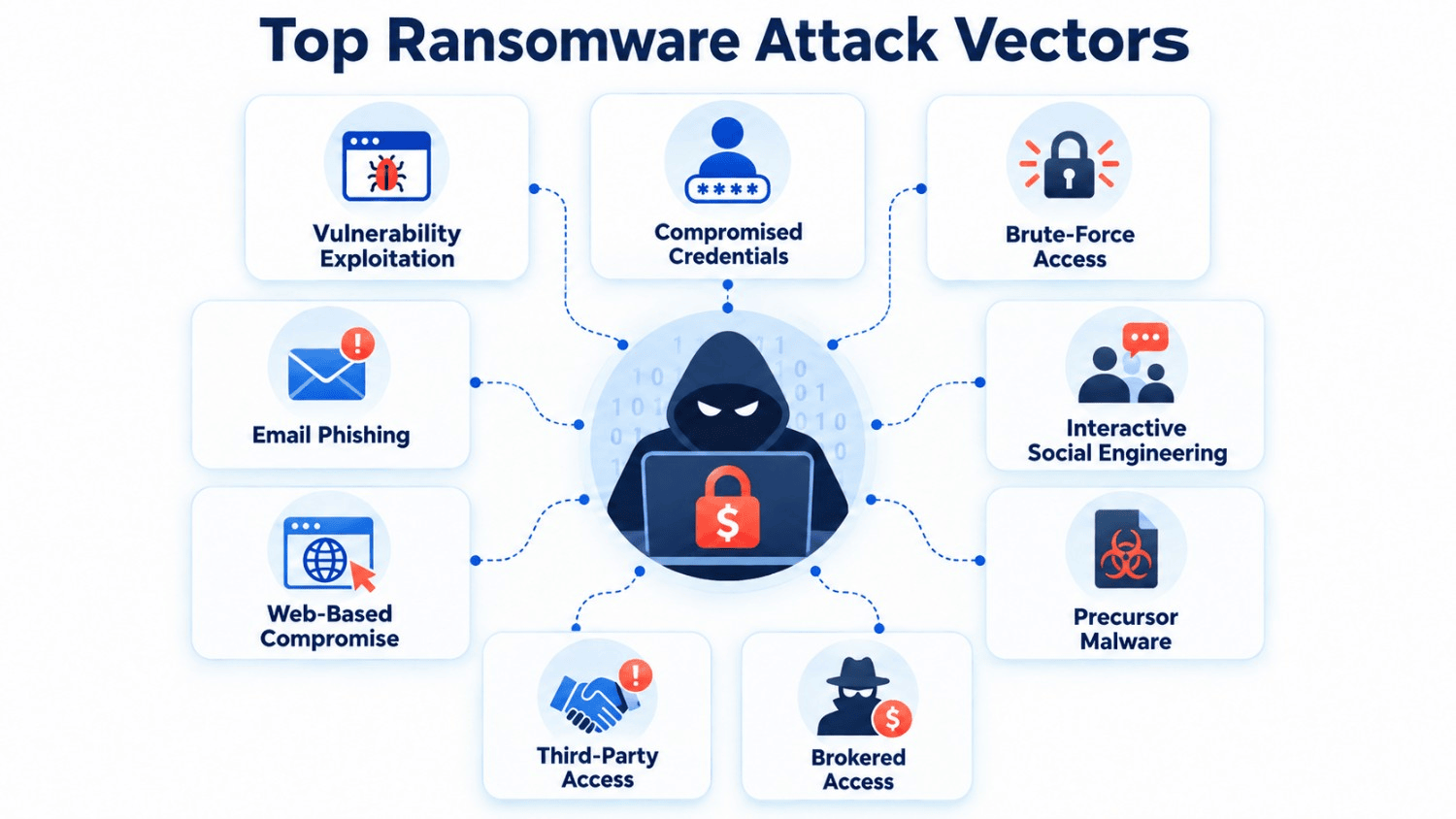
Ransomware attackers in 2026 commonly enter environments through vulnerability exploitation, compromised credentials, brute-force access, email phishing, interactive social engineering, web-based compromise, precursor malware, third-party access, and brokered access.
An exposed RDP service alone does not reveal the underlying vector. Stolen credentials and repeated password guessing can both lead through RDP even though the methods are different.
Ransomware vectors are classified by the mechanism used to gain unauthorized entry, rather than by the protocol, service, or communication channel involved.
A ransomware attack vector is the mechanism an adversary uses to obtain the unauthorized entry or execution needed to begin an intrusion that may later culminate in ransomware deployment.
Evidence of exposure is not evidence of compromise. An exposed service, leaked credential, or vulnerable asset may create an opportunity for attack. None of those conditions alone proves exploitation, credential use, or an established foothold.
A ransomware intrusion can begin with an exposed weakness, a compromised identity, a manipulated user, a trusted external relationship, or a foothold established earlier by another actor.
Internet-facing systems expose software to probing from outside the network. VPN appliances, firewalls, edge systems, and public applications become viable targets when a flaw in the deployed version allows unauthorized execution or system control.
Rapid weaponization makes these weaknesses difficult to treat as routine patching issues. In its August 2026 Medusa update, CISA, the FBI, and HHS reported that the actors monitor vulnerability announcements and can weaponize newly announced exploits within 24 hours. Investigators also observed exploitation before public diclosure.
A vulnerable version represents an opportunity, not proof of compromise. Reachability establishes whether outside actors could target the system. Configuration and telemetry then help determine whether the flaw was exploitable in that environment and whether exploitation occurred.
A working credential removes the need to exploit software at all. With a valid password, token, or session secret, an intruder can authenticate through the same process used by the legitimate account owner.
Those secrets often surface before any suspicious login appears. Infostealer logs, previous breaches, phishing activity, and underground markets can expose authentication material while the account remains active. The March 2026 INC Ransom advisory from the ASD ACSC, CERT Tonga, and New Zealand NCSC reports that affiliates often obtain valid-account credentials from initial-access brokers and use compromised accounts against victim environments.
Finding the secret outside the organization confirms credential exposure. A suspicious or successful sign-in provides separate evidence that the credential was used for authentication.
An attacker without a valid secret has to discover one. Classic brute force concentrates attempts against a single account, while password spraying distributes likely passwords across multiple identities.
Authentication records capture the progression. Repeated failures followed by a successful sign-in tie the guessing attempts to eventual authentication.
A July 2026 U.S. DOJ indictment alleges that Medialand infrastructure supported criminal groups engaged in malware, ransomware, and brute-force attacks. The indictment does not establish password guessing as the cause of a ransomware intrusion at a named victim, so it documents the capability without proving a specific ransomware intrusion chain.
Email phishing relies on the recipient taking an action that benefits the attacker. A convincing message can lead to a fake sign-in page or persuade the user to open content that executes attacker-controlled code.
Those interactions produce two distinct outcomes:
Anthropic reported in September 2026 that it disrupted AI-assisted phishing workflows covering domain registration, infrastructure setup, message delivery, and monitoring of successful compromises. Device-code phishing was the primary technique in the case, and more than 20 organizations appeared across planning, reconnaissance, and live activity. The report is not ransomware-specific, so it illustrates current phishing operations rather than ransomware prevalence.
Email phishing still relies on the recipient acting on a message. Interactive social engineering keeps the attacker involved while a trusted person or support process is manipulated. A help-desk agent might be persuaded to reset an account, while an employee approves an MFA request or changes a recovery setting.
A July 2026 U.S. DOJ complaint involving Scattered Spider alleges that members obtained employee-account entry under fraudulent pretenses before encryption, data theft, and extortion followed. Those allegations have not been established as findings of guilt. The alleged sequence centers on manipulation of a trusted workflow rather than delivery of a conventional malicious payload.
A user can be drawn into an intrusion without an inbox or live conversation. Search results, advertisements, fake installers, and compromised websites introduce malicious content into ordinary browsing activity. A deceptive download or fake update can then lead to code execution or credential theft.
DNS and browsing history identify the destination. Download provenance identifies the retrieved file, while execution telemetry establishes whether it actually ran.
In June 2026, Eurojust reported that SocGholish used compromised websites to present fake browser updates. The resulting foothold was later used for crimes that included ransomware installation.
Ransomware can arrive well after the first malicious program. A loader brings in additional software. A stealer collects credentials, while a backdoor or remote-access tool preserves a way back into the system.
A September 2026 DOJ sentencing release describes a Conti participant who admitted being directed to develop a loader used to bring in programs required for further malicious attacks. The publication is recent, but the underlying conduct occurred mainly between 2020 and 2022. It supports the progression from an earlier malware infection to later ransomware activity, not a claim about 2026 prevalence.
The first malware alert deserves attention for what remains after the initial infection. Persistence, beaconing, stolen credentials, or remote capability can support later activity even if ransomware is not deployed soon afterward.
Not every foothold starts on infrastructure owned directly by the victim. Vendors, MSPs, subsidiaries, and service providers often hold trusted accounts or administrative connections that reach customer resources.
A supplier incident becomes a third-party entry problem only when compromised accounts or connections still provide reach into the downstream environment. The connection might involve a vendor account, remote-management privilege, trusted VPN connection, or another administrative dependency.
Navient's July 2026 disclosure illustrates the boundary. A law firm serving Navient suffered ransomware, and an unauthorized actor obtained Navient-related borrower data held by the firm. Navient reported no unauthorized entry into its own systems, so the incident represents third-party ransomware exposure without proving a supplier-to-customer network pivot.
Third-party access depends on a legitimate business relationship. Brokered access replaces that trust relationship with a criminal transaction. One actor compromises an account or machine and then transfers the established foothold to another group that intends to carry the intrusion further.
Court records cited in a March 2026 U.S. DOJ sentencing release describe the Mario Kart botnet selling entry to compromised machines to groups that typically conducted ransomware extortion. One ransomware distributor paid more than $1 million for botnet entry. The underlying conduct occurred between 2017 and 2021, so the case demonstrates the criminal handoff model rather than current 2026 attack volume.
The technical compromise happens first; the criminal transfer happens later. The ransomware operator joins only after another actor establishes the foothold.
RDP and VPN often appear in ransomware attack-vector lists, but they are usually better understood as remote-access surfaces. They identify where an attacker connects, while the underlying vector explains how unauthorized use became possible. Stolen credentials, password guessing, vulnerability exploitation, or previously brokered control can each enable unauthorized use of these services.
An exposed RDP server does not reveal the cause of the intrusion. A stolen password points to compromised credentials, while a failure-to-success pattern from repeated guesses points to brute-force access. RDP is the service used in both cases, not the vector itself.
VPN infrastructure can be abused through valid credentials or exploitation of the appliance itself. The first points to an identity problem; the second points to a software weakness. Separating the surface from the vector identifies the condition that enabled the intrusion.
Finding a ransomware entry path requires connecting external exposure with evidence that an attacker could turn it into a foothold. An exposed asset, leaked credential, or trusted connection becomes actionable only after teams establish what it reaches and whether the underlying weakness can be exercised.
Prioritize exposures that an attacker can exploit or abuse to gain meaningful privilege, especially when current threat activity and weak controls create a clear progression toward critical systems.
Six questions help determine which exposures deserve attention first:
An exposed VPN appliance running an exploitable version should move up the queue when current threat reporting confirms active exploitation and the appliance connects to sensitive internal resources. Successful exploitation would give the attacker a foothold closer to high-value systems than the severity rating alone reveals.
A leaked password carries less immediate risk after the credential has been rotated, associated sessions have been terminated, and stronger authentication protects the account. The historical exposure remains relevant to investigation, but the original authentication opportunity has been removed.
A ransomware entry path can involve a vulnerable public asset, leaked credentials in underground channels, or a vendor relationship that extends trusted connectivity into the organization. CloudSEK correlates these external indicators so security teams can see which weaknesses, identities, and dependencies could contribute to initial access.
Each module contributes a different source of evidence. BeVigil maps internet-facing assets and identifies vulnerabilities or misconfigurations that could support exploitation. XVigil surfaces organization-linked credential leaks and digital-risk findings tied to compromised identities or brokered access. CloudSEK Threat Intelligence provides context on exploited CVEs, ransomware activity, malware, and threat actors. SVigil covers vendors and supply-chain dependencies that could introduce third-party risk.
Nexus AI correlates those findings in a predictive attack graph. A leaked credential gains significance when it maps to a reachable login or privileged identity, while a vendor-related weakness can be evaluated alongside the external assets and threat context surrounding it. Connecting those relationships helps teams separate isolated exposures from combinations that could enable ransomware initial access.
