🚀 أصبحت CloudSek أول شركة للأمن السيبراني من أصل هندي تتلقى استثمارات منها
اقرأ المزيد


Security awareness training is a structured educational program that teaches employees, contractors, and vendors to recognize, avoid, and report cyber threats such as phishing, social engineering, and unsafe data handling. Its purpose is behavior change, turning the workforce from a prime entry point into an active layer of defense.
Guidance for the discipline is codified at the federal level. NIST SP 800-50 Rev. 1, updated in September 2024 as Building a Cybersecurity and Privacy Learning Program, distinguishes broad awareness for every worker, role-based training tied to job duties, and deeper education for specialists, and folds privacy into the same program.”
Effective programs treat people as defenders rather than a weak link. Technical controls stop most attacks, yet the ones that reach an inbox depend on a human decision, and training shapes that decision at the moment it matters.
Attackers target people because manipulating a person is cheaper and more reliable than discovering a software flaw. A convincing phishing email, a spoofed executive request, or a malicious attachment bypasses firewalls and endpoint tools by exploiting judgment instead of code, which is the gap awareness training closes.
Consistency is what makes it work. A single annual session fades quickly, while frequent, short training paired with simulations is widely associated with lower click rates over time.
Reporting speed matters as much as recognition. Training shortens the gap between an employee spotting something wrong and flagging it, which often decides whether an incident stays contained or becomes a breach, and faster reporting hands responders more time to act.
Business email compromise shows how training turns knowledge into a decision at the point of attack. The scam runs in four moves, and awareness gives an employee a place to break the chain at each one.
Trained employees interrupt this at the pressure stage. A verification-first habit, confirming any payment or data request through a known second channel, defeats the scam even when the impersonation is flawless, which is why finance and executive-support roles receive this scenario directly.
A working program produces five measurable benefits beyond the rationale for running one.
Effective programs cover the threats employees actually encounter, matched to the behavior each one requires. Eight topics form the core curriculum.
Programs deliver content through several formats, and the better programs blend them so knowledge turns into practiced behavior. Each format sits at a different point between passive learning and active social engineering practice.
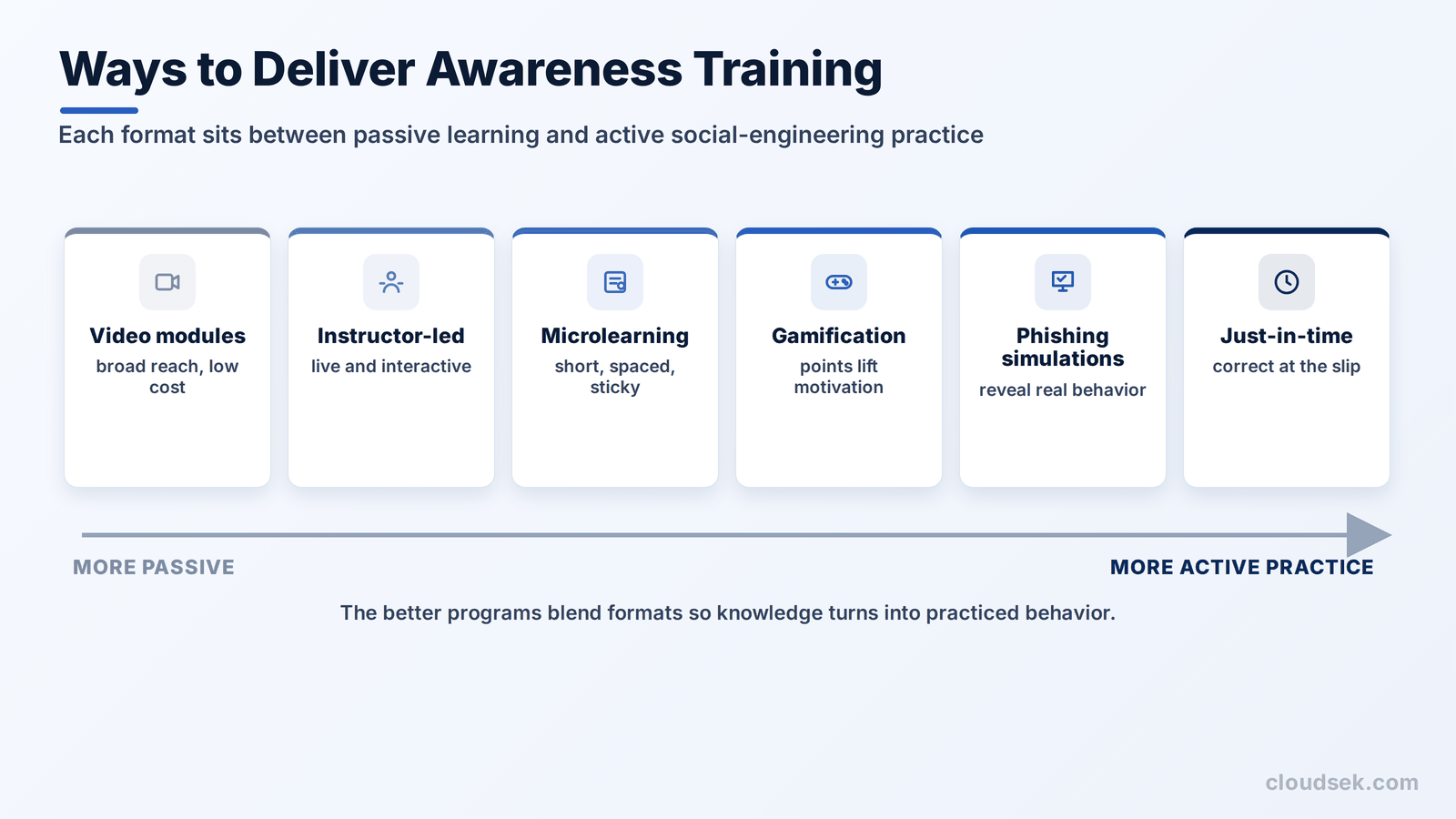
Live workshops put an instructor in front of employees for lessons and open discussion. Engagement runs high, and questions get answered in the moment, though the format scales poorly across distributed sites and its effect fades without reinforcement.
Recorded lessons deliver consistent content to a whole workforce at low cost. Reach is broad, and messaging stays uniform, yet passive watching produces weaker retention than active practice.
Microlearning breaks content into focused units a few minutes long, delivered regularly through the year. Spaced repetition drives strong retention per minute spent, and short modules fit into a workday without disruption.
Simulations send safe, realistic mock attacks to measure how employees respond under pressure. They reveal genuine behavior rather than recall, and a failed simulation becomes an immediate, blame-free teaching moment.
Gamification adds points, badges, and scenario challenges to lift motivation. Participation and completion climb, though weak design risks trivializing real threats when the mechanics overshadow the lesson.
Just-in-time training delivers a micro-lesson at the moment an employee slips, such as clicking a simulated lure. Correcting behavior at the point of risk outperforms a generic module delivered weeks later.
To build a security awareness program, run six steps as a repeating cycle rather than a one-time rollout, mirroring the lifecycle model the NIST guidance describes.
Generic training resonates less than content matched to the threats a person actually faces. Effective programs segment by role and by sector.

Finance and executive-support staff need payment-verification and BEC scenarios, developers need secure-coding and access-management content, and IT administrators need training on privileged-access and credential handling. Matching the lesson to the daily task lifts both relevance and retention.
Healthcare training addresses patient-data handling and the pressure to bypass controls in urgent care settings, financial services emphasizes fraud and transfer verification under heavy regulation, and manufacturing extends awareness to operational technology and intellectual-property theft. Sector-specific risk shapes which threats the curriculum weights.
Completion rates prove attendance, not learning, so effective measurement tracks behavior. Six metrics show whether training changes what employees do.
Six best practices separate programs that change behavior from those that only satisfy an auditor.
Many organizations run security awareness training because regulation requires it, and a documented program supplies the evidence auditors expect. Federal cybersecurity guidance and the frameworks below treat workforce training as a baseline control.
Artificial intelligence dismantled the old advice to watch for typos and clumsy grammar. Machine-written phishing messages now read as fluent, personalized, and timely, and deepfake audio and video impersonate executives convincingly enough to authorize fraud.
Training adapted in response. Spotting spelling errors gave way to a verification-first habit, confirming unusual payment and data requests through a second channel regardless of how polished the message looks. Lures like QR-code phishing, which is already common, and AI-generated voice calls now belong in the curriculum.
Security awareness training lowers the odds that an employee falls for a lure. A complementary defense lowers the number of lures that reach employees in the first place by watching the external sources attackers draw on to build those lures.
Each stage of the BEC chain above leaves an external trace. At the reconnaissance stage, CloudSEK XVigil detects leaked employee credentials and compromised mailboxes circulating on the deep and dark web. At the impersonation stage, it detects lookalike domains, fake apps, and executive impersonation, with takedown support. BeVigil flags misconfigured SPF and DMARC records that let attackers spoof an organization’s own email domain, and SVigil catches the same weakness in suppliers, whose domains are a common BEC disguise. CloudSEK Threat Intelligence adds which campaigns are active in a sector right now, so training scenarios can mirror the lures employees are actually likely to see.
Placement stays honest. CloudSEK does not deliver awareness training; it reduces the external exposure that feeds the attacks, training prepares people to resist, and the two work as complementary halves of human-risk defense.
The difference is scope: security awareness training builds broad threat recognition for every employee, while security training teaches role-specific technical skills to specialists. Awareness training shapes culture; security training builds capability.
Security awareness training should be conducted continuously, with short modules throughout the year rather than a single annual session, since frequent reinforcement sustains recognition as attacker tactics change.
Yes. PCI DSS and HIPAA require security awareness training, ISO/IEC 27001 requires it for certification, and regulations like GDPR expect staff awareness as part of demonstrating accountability.
Security awareness training should cover phishing, social engineering, passwords and MFA, data handling, safe browsing, physical and device security, remote work, and incident reporting, matched to each role's risk.
Security awareness training reduces risk most when it runs continuously with realistic simulations and fast reporting. Its effect varies by program design, and it works best as one layer alongside technical controls such as MFA and email filtering, not as a standalone defense.
A phishing simulation is a safe, controlled mock phishing attack an organization sends to its own employees to measure who recognizes the threat and to deliver targeted training to those who do not.
