🚀 CloudSEK featured in the 2026 Frost Radar™!
Read more
.avif)

Business Email Compromise (BEC) is a form of cybercrime involving fraudulent emails used to trick organizations into transferring funds or exposing sensitive data. Executive, vendor, or finance identities are often impersonated to exploit trust within business communication.
BEC attacks rely on social engineering, targeting human decision-making instead of system vulnerabilities. Techniques such as email spoofing, credential theft, and account takeover enable the delivery of convincing and context-aware messages.
Financial fraud, data theft, and unauthorized transactions represent the primary outcomes of these incidents. BEC is not a marginal threat: the FBI's 2025 IC3 report recorded $3.046 billion in BEC losses, making it the second-most costly crime category the FBI tracks, behind only investment fraud. Organizations with structured approval workflows, vendor payments, and email-driven operations face higher exposure due to predictable communication patterns, making manipulation easier during routine decision-making.
Business email compromise works by blending fraudulent intent into everyday email interactions, making malicious requests appear as part of normal business operations. It follows four stages:
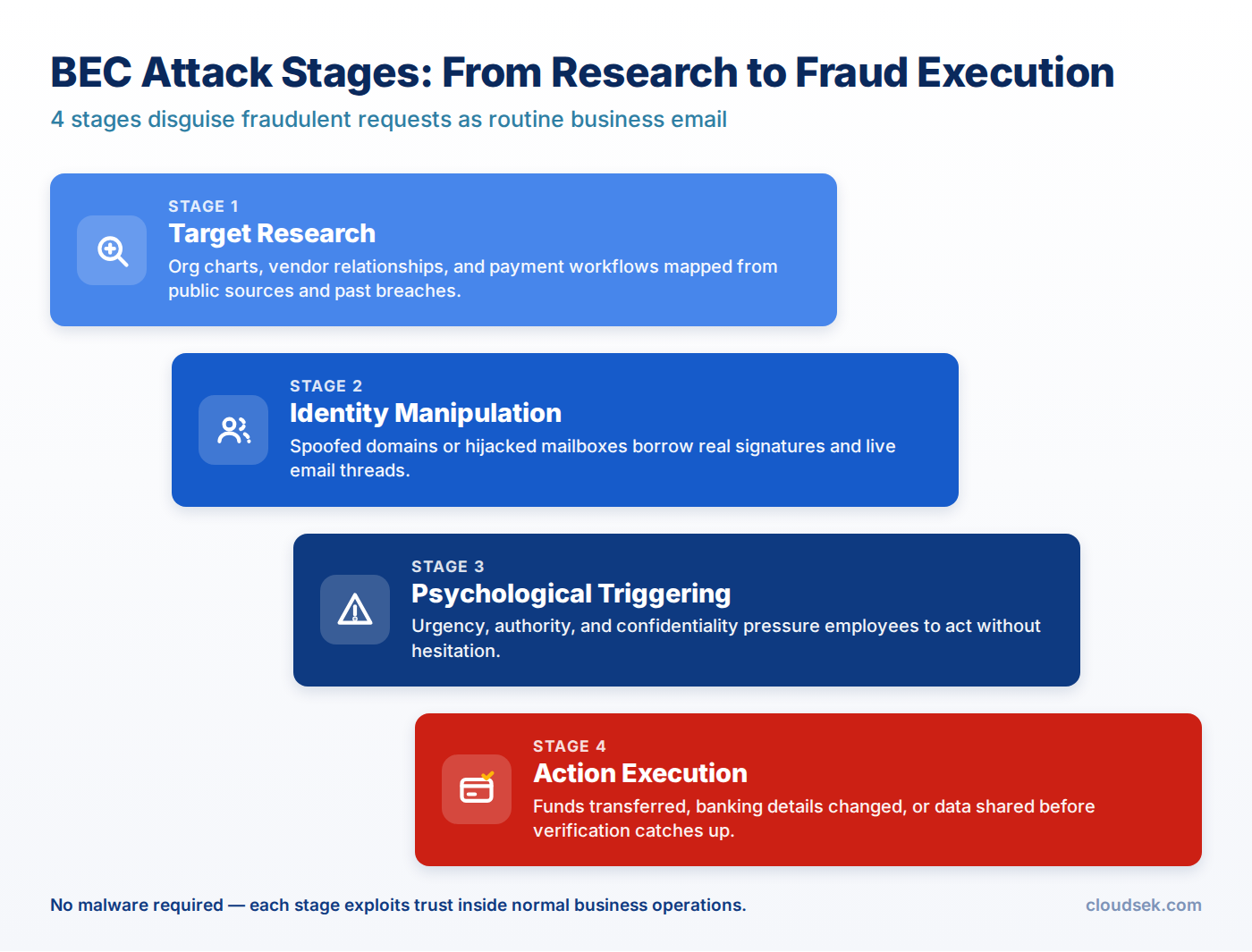
Organizational structures are analyzed to identify employees involved in payments, approvals, and sensitive data handling. Attackers commonly build these target lists by scraping LinkedIn for senior employees, then using commercial sales-intelligence and lead-generation tools to pull personal phone numbers and email addresses, data that CloudSEK has also observed resold on dark web forums after being scraped. Insights gathered this way help map communication patterns, vendor relationships, and internal workflows.
CloudSEK's investigation into a CEO impersonation campaign documents this reconnaissance mechanism in detail.
Impersonation is executed using email spoofing or by gaining access to legitimate email accounts through stolen credentials. Real domains, signatures, and existing email conversations add a layer of authenticity that makes detection difficult.
Employee responses are influenced through social engineering, using urgency, authority, or confidentiality as pressure points. Requests are framed within familiar business contexts, reducing hesitation and increasing compliance.
Final steps involve transferring funds, updating banking details, or sharing confidential information based on deceptive instructions. Quick execution combined with delayed verification allows these actions to be completed before warning signs are recognized.
Different forms of Business Email Compromise emerge based on who is being impersonated and which part of a company's workflow is targeted.
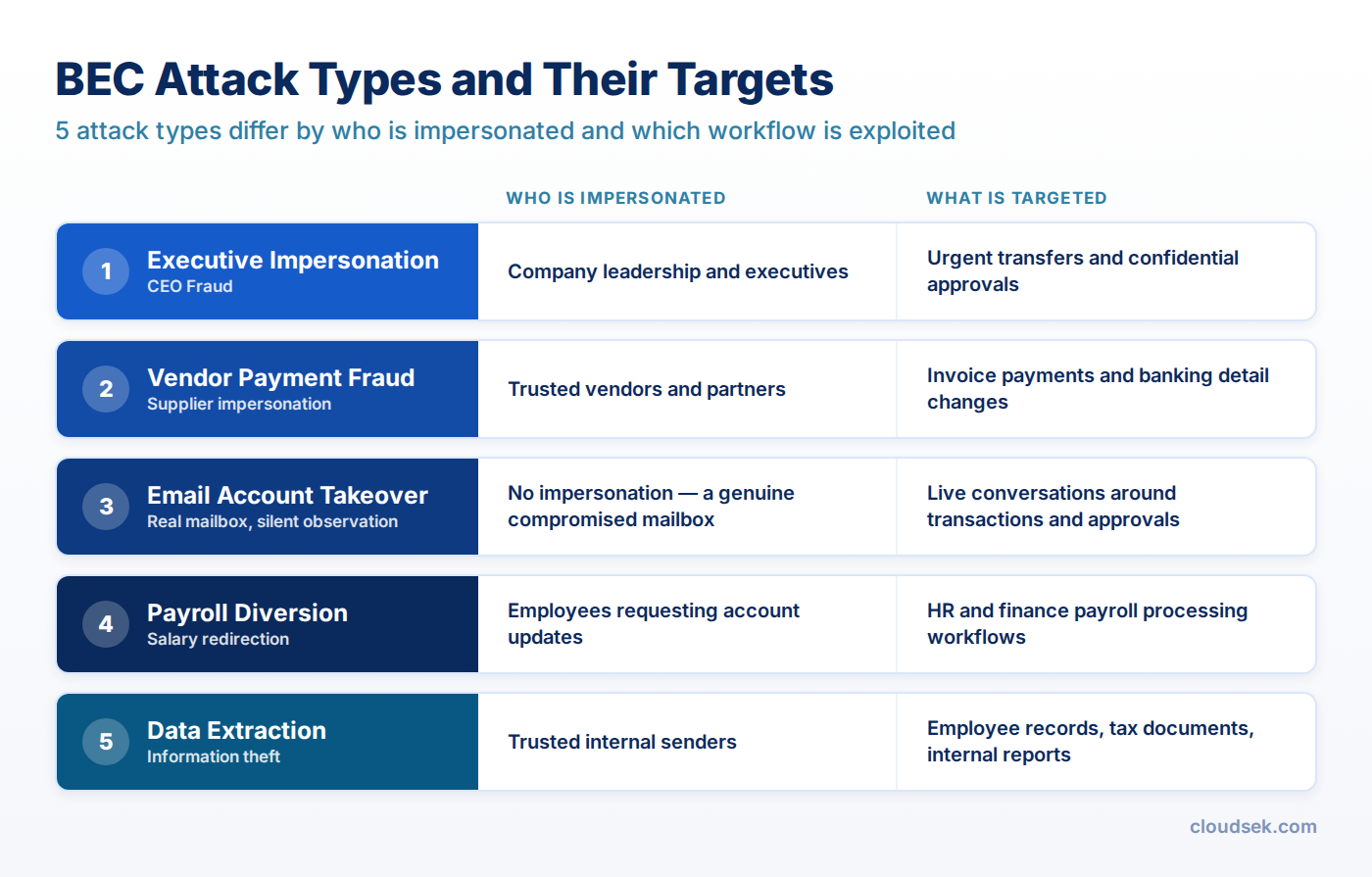
Requests coming from “leadership” rarely get questioned, which makes executive impersonation one of the most effective BEC tactics. Messages usually carry urgency around approvals, confidential deals, or last-minute financial transfers, pushing employees to act quickly.
This tactic is not limited to email. CloudSEK has investigated cases where scammers impersonated a CEO over WhatsApp instead, messaging employees' personal phone numbers directly and using the executive's publicly available photo as the profile picture to add credibility before requesting gift card purchases or wire transfers.
Recent campaigns have become more structured, often simulating full approval chains instead of single emails. Fortra's research, cited by APWG, identified a threat group called Scripted Sparrow sending an estimated 6 million targeted emails per month by posing as executive coaching and leadership consultancies, with fake approval-chain invoice threads as its core technique.
Payment-related emails blend easily into routine operations, especially in organizations handling frequent invoices and supplier transactions. Familiarity with vendor communication is exploited by posing as trusted partners and inserting requests to update banking details or reissue payments.
Damage tends to be high because these requests align with ongoing financial activity rather than appearing unusual. APWG's Q4 2025 Phishing Activity Trends Report recorded a 136 percent surge in wire-transfer BEC attempts compared to the prior quarter, a rise APWG attributes largely to the Scripted Sparrow campaign described above.
Access to a legitimate mailbox changes the nature of the attack completely, shifting it from deception to silent observation. Internal conversations are monitored, patterns are learned, and responses are inserted at moments when transactions or approvals are expected.
This level of access significantly increases success rates since messages no longer look suspicious. The FBI's 2025 IC3 report tracked account takeover as its own crime category for the first time, recording $359.7 million in direct ATO losses, a figure the FBI itself notes understates its true impact since ATO is frequently the access method behind BEC, investment fraud, and other categories tracked separately.
Payroll systems create predictable opportunities, especially when employee details or salary accounts need updates. Routine processes are leveraged by sending requests that appear legitimate, often targeting HR or finance teams responsible for processing payments.
Campaigns of this type have targeted specific sectors through compromised accounts at trusted institutions, using those accounts to send convincing phishing emails to a wide pool of connected users across partner organizations.
Not every BEC attempt focuses on immediate financial gain; some aim to collect information that can be reused later. Requests for employee records, tax documents, or internal reports often appear legitimate, especially when sent from a trusted-looking source.
Long-term impact comes from how that data is reused across multiple attempts, since previously exposed personal data can be repackaged and combined with newer tooling to enable more advanced follow-on attacks such as account takeover and fraudulent account creation.
Risk associated with BEC grows from its ability to merge seamlessly into everyday communication, allowing malicious intent to move through trusted business workflows without immediate suspicion:
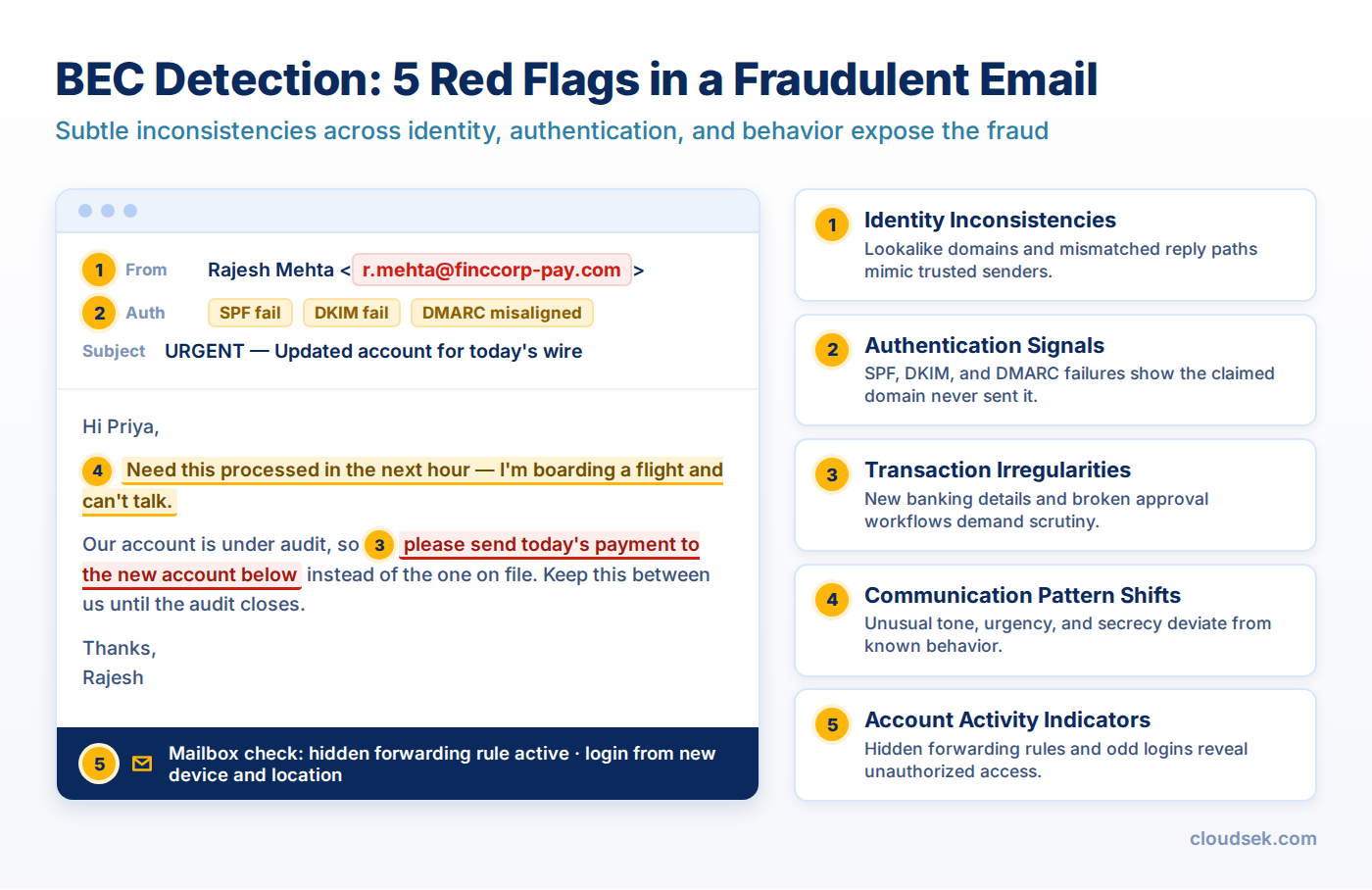
Detection depends on identifying subtle inconsistencies across communication, system signals, and transaction behavior that do not align with normal business activity.
Prevention requires strengthening identity validation, securing email communication, and controlling financial workflows to reduce exposure across business operations:
Protection against BEC relies on combining multiple security layers that monitor identity, communication behavior, and data movement across systems:
• Identity protection systems: strong authentication and session monitoring, including multi-factor authentication, prevent unauthorized access even when credentials are exposed.
• Communication pattern analysis: tools that track message flow, response timing, and interaction history flag irregular behavior within ongoing conversations.
• User behavior analytics: baselining how users normally access systems and approve transactions makes it possible to detect account misuse as an anomaly.
• Data protection controls: data loss prevention mechanisms restrict unauthorized sharing of financial data, employee records, and internal documents.
• Centralized monitoring systems: security information and event management solutions correlate logs across systems to detect coordinated activity.
BEC is unusual among cyberattacks because the email itself is rarely the vulnerability. There is no malware to catch and no exploit to patch, only a message that borrows enough real trust signals, a real domain, a real executive's name, a real vendor relationship, to pass as legitimate. Stopping it means disrupting those trust signals before an attacker can borrow them, not scanning the message after it lands. CloudSEK addresses three of those trust signals directly:
XVigil detects newly registered lookalike domains and fake executive profiles as they are built, moving them into takedown while a campaign is still being assembled and before it is used to send fraudulent messages.
The same XVigil platform monitors the dark web for exposed employee credentials, flagging a compromised mailbox before an attacker can turn a stolen login into a real account takeover.
SVigil tracks exposure across an organization's vendor relationships, since vendor payment fraud succeeds precisely because the request looks like it came from a partner the finance team already trusts. In one documented case, SVigil flagged a vendor's SPF record set to a soft fail rather than a hard fail on the primary domain of a logistics SaaS provider, a gap that would have let attackers send perfectly spoofed emails from that trusted domain.
CloudSEK's own assessment of the exposure named business email compromise as one of the direct risks: an attacker could impersonate the vendor's CEO and request an urgent wire transfer from a partner's finance team, with the email appearing completely legitimate.
None of this replaces email filtering or approval workflows, it runs earlier, closing off the impersonation infrastructure and leaked access an attacker needs before a single fraudulent message is ever written.
BEC attacks focus on manipulating communication rather than exploiting software vulnerabilities. Messages are crafted to appear legitimate, making detection more dependent on human judgment than technical controls.
Industries handling frequent financial transactions, such as finance, real estate, healthcare, and manufacturing, face higher exposure. Complex vendor networks and approval chains increase the risk of manipulation.
Detection can take days or even weeks, especially when communication appears normal. Delayed discovery often happens after funds are transferred or sensitive data has already been shared.
Strong internal controls such as approval hierarchies and transaction validation reduce the likelihood of unauthorized actions. Clearly defined workflows limit the chances of decisions being made without verification.
Yes, many incidents occur without direct system intrusion. Manipulated communication alone can lead to financial loss or data exposure.
Funds are quickly moved across multiple accounts, often across different regions, making tracking complex. Limited technical indicators and delayed reporting further complicate investigation efforts.
