Deep Web vs Dark Web: What Are The Key Differences?

The Deep Web contains non-indexed but legal content, while the Dark Web is intentionally hidden and accessed using anonymity tools.
Published on
Tuesday, February 3, 2026
Updated on
February 3, 2026

Key Takeaways:

  • The Deep Web includes non-indexed but normal, legal content, while the Dark Web consists of intentionally hidden networks that require special tools to access.
  • Everyday activities like checking email, logging into accounts, or accessing banking services fall into the Deep Web because they require restricted access.
  • Anonymity is the core design goal of the Dark Web, which changes how access works and why it attracts both legitimate and risky use.
  • That difference in purpose explains why the Deep Web feels normal and widely used, while the Dark Web comes with higher security and legal concerns.

What Is the Surface Web?

Surface Web is the part of the internet that is openly accessible and indexed by search engines. Any website that loads in a regular browser without requiring a login, payment, or special software belongs to this layer.

Examples include news websites, blogs, public company pages, and open forums that are meant to be discovered through search results. Search engines scan and index this content so users can find it through keywords and links.

Many people mistake the Surface Web for the entire internet, even though it represents only a small portion of online content. Recognizing this limitation helps explain why deeper and less visible layers of the web exist.

What Is the Deep Web?

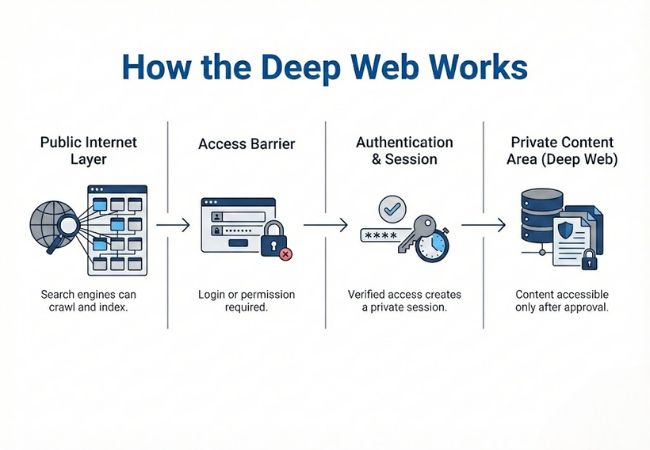
Deep Web is the part of the internet that is not indexed by search engines and requires restricted access. Pages behind logins, passwords, or permissions fall into this category even though they load through regular browsers.

Email inboxes, online banking portals, subscription platforms, private cloud storage, and internal dashboards all exist within the Deep Web. These areas are kept out of search results to control access and protect sensitive information.

Most online activity takes place within the Deep Web as a normal part of using the internet. Viewing it as a functional privacy layer helps separate it from the idea of secrecy or hidden networks.

How the Deep Web Works?

how the deep web works

Deep Web works by limiting access to content through verification rather than hiding it from the internet entirely. Pages remain unseen in search results because viewing them requires approval first.

Login systems check credentials such as passwords or account permissions before granting entry. After access is approved, temporary sessions allow users to navigate private areas without making the content public.

Search engines may detect the existence of these pages but cannot read what sits behind access barriers. This structure allows private information to stay protected while functioning as part of normal internet activity.

What Types of Content Found on the Deep Web?

Most Deep Web content exists to manage access to information that is personal, sensitive, or context-specific.

  • Personal accounts: Email inboxes, social media profiles, and user dashboards appear here first, since everyday online activity usually begins with logging in to private accounts.
  • Subscription services: Streaming platforms, paid tools, and member-only websites follow naturally, as access is limited to users with active accounts or permissions.
  • Financial platforms: Online banking portals, payment systems, and billing accounts rely on restricted access to protect transactions and financial records.
  • Medical records: Patient portals, health reports, and appointment systems stay hidden from search engines to meet privacy and regulatory requirements.
  • Academic databases: Research journals, digital libraries, and scholarly archives are placed behind institutional or paid access to control distribution.
  • Internal systems: Employee portals, intranets, and administrative tools sit deeper within the Deep Web, supporting internal operations rather than public use.

Pros and Cons of the Deep Web

Pros Cons
Protects personal, financial, and organizational data through restricted access Depends on platforms to manage and secure user data properly
Supports everyday activities like email, banking, subscriptions, and work tools Content cannot be discovered without direct access or credentials
Easy to access using regular browsers after login Access is lost if credentials are compromised or forgotten
Generally secure when used on trusted platforms Vulnerable to breaches if security practices are weak
Fully legal and essential for modern internet use Often misunderstood due to the term “hidden”
Familiar interfaces and reliable performance Limited visibility outside authenticated environments

What Is the Dark Web?

Dark Web is intentionally hidden and inaccessible through standard browsers or search engines. Access requires specialized software that alters how connections are routed and identified.

Anonymity replaces access control as the primary design goal, which separates it from login-based private systems. Both users and site operators remain difficult to trace, changing how information is published and accessed.

Visibility is reduced by design rather than by permission settings, limiting indexing, monitoring, and oversight. That structural difference explains why the Dark Web operates under different risks and use patterns than the Deep Web.

How the Dark Web Works?

how the dark web works

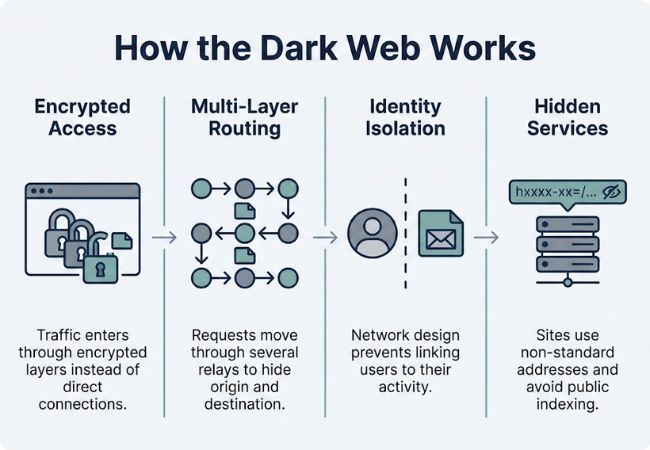
Dark Web works by routing connections through multiple layers of encrypted relays instead of direct paths. This routing method prevents network observers from linking users to destinations.

Specialized software manages these connections and separates identity from activity. Requests move across distributed nodes, making traffic analysis and tracking difficult.

Sites operate on non-standard addresses that avoid traditional indexing and discovery. Combined with layered routing, this setup removes conventional visibility and shifts control away from centralized systems. 

What Types of Content Exist on the Dark Web?

Content on the Dark Web reflects how anonymity changes communication, organization, and exchange.

  • Anonymous discussions: Forums and message boards appear first, allowing people to talk freely without linking identity to opinions or participation.
  • Private communication: Messaging tools and collaboration spaces build on this anonymity, enabling direct interaction without exposing metadata or personal details.
  • Whistleblowing channels: Secure drop sites extend private communication further by allowing sensitive information to be shared without revealing the source.
  • Hidden marketplaces: Exchange-focused platforms emerge next, using anonymity to trade goods and services outside traditional identity and payment systems.
  • Leaked information: Data dumps and exposed records often circulate through these spaces, shared or analyzed with little regard for attribution.
  • Experimental platforms
    Privacy-first projects and alternative services appear alongside everything else, testing new ways to publish or operate without central oversight. 

Risks Posed by the Dark Web

Dark Web risks stem from anonymity removing friction, allowing harmful activity to grow faster and spread wider than on the open web.

  • Ransomware operations: Leak sites and underground forums allow ransomware groups to coordinate attacks and apply pressure on victims, a trend reflected in the rise from 2,825 reported ransomware complaints in 2023 to 3,156 in 2024, as recorded by the FBI’s Internet Crime Complaint Center.
  • Large-scale fraud: Scam networks exploit hidden identities and cryptocurrency payments to reach victims across borders, contributing to 859,532 reported internet crime complaints and losses exceeding $16 billion, according to recent FBI reporting.
  • Phishing campaigns: Ready-made phishing kits and stolen credentials circulate through hidden channels, enabling rapid reuse at scale, which aligns with Singapore’s 49% year-over-year increase in phishing cases in 2024, reported by the Cyber Security Agency of Singapore.
  • Drug trafficking networks: Market-style platforms streamline distribution by connecting buyers and sellers directly, a pattern seen in Canadian investigations where networks were shipping hundreds of packages weekly, leading to seizures of 75 kilograms of narcotics and thousands of tablets, as documented by the Royal Canadian Mounted Police.
  • Cross-border crime: Global coordination becomes easier when identity and location are obscured, illustrated by a joint operation that resulted in 270 arrests and over $200 million in assets seized, alongside large quantities of drugs and firearms, reported by the U.S. Department of Justice.
  • National-level disruption: Extortion campaigns tied to hidden services increasingly affect public institutions and infrastructure, with 7,122 cyber incidents recorded in a single year and 343 assessed as high impact, according to New Zealand’s Government Communications Security Bureau.

Pros and Cons of the Dark Web

Pros Cons
Strong anonymity with reduced identity and location tracking High potential for misuse due to lack of accountability
Enables private communication in sensitive situations Increased exposure to harmful or malicious actors
Allows access under censorship or heavy surveillance Requires special software and technical knowledge
Supports whistleblowing, journalism, and privacy-focused use cases Frequently associated with illegal markets and content
Limits conventional monitoring and tracking High risk of malware, scams, and unsafe services
Freedom from centralized control Slower connections and unstable platforms

Slower connections and unstable platforms

What Are The Key Differences Between Deep Web & Dark Web?

The real difference between the Deep Web and the Dark Web becomes clear when looking at how people encounter them, use them, and deal with the consequences.

Everyday Presence

Deep Web use blends into normal internet behavior, often without conscious awareness. Dark Web use stands apart as a deliberate choice that requires preparation and intent.

Usage Intent

Deep Web activity supports routine tasks like communication, work, and transactions. Dark Web activity usually serves specific needs where remaining unidentified matters more than convenience.

Responsibility Shift

Deep Web environments place responsibility on platforms to manage security and access. Dark Web environments shift that responsibility almost entirely to the individual user.

Exposure Change

Deep Web limits interaction to known systems and authenticated spaces. Dark Web removes many of those boundaries, increasing contact with unknown actors and unpredictable content.

Skill Requirement

Deep Web interaction demands little more than basic account management. Dark Web navigation requires technical awareness to avoid security, privacy, and legal risks.

Outcome Impact

Deep Web mistakes tend to stay contained within accounts or services. Dark Web mistakes can extend further, affecting personal safety, data exposure, or legal standing.

What Are The Dark Web and Deep Web Similarities?

Both the Deep Web and the Dark Web share core characteristics related to visibility, access control, and privacy, even though they serve very different purposes.

Similarity Area How It Applies to the Deep Web How It Applies to the Dark Web
Search engine exclusion Content does not appear in search results because it sits behind logins, permissions, or restricted views Content is deliberately blocked from indexing to avoid discovery and tracking
Restricted access Access is limited to authorized users through credentials or account verification Access is limited to users with specialized software and network configurations
Privacy focus Privacy protects personal, financial, and organizational data during normal use Privacy protects identity, location, and activity from monitoring or surveillance
Non-public content Pages are not intended for public viewing or broad distribution Pages are intentionally hidden from public visibility and discovery
User intent required Users must actively log in or authenticate to view content Users must intentionally install tools and seek out hidden services
Data sensitivity Information often includes emails, transactions, records, or internal systems Information often involves anonymous communication, disclosures, or exchanges
Misunderstood nature Often mistaken as suspicious despite being routine and legal Often assumed to be entirely illegal despite mixed use cases
Security dependence Safety depends on how well platforms secure accounts and data Safety depends largely on user behavior and technical awareness
Controlled environments Access rules define who can see or interact with content Network design limits who can locate or interact with content
Layered internet structure Exists beyond the publicly visible web layer Exists deeper within hidden network layers

What Are the Common Misconceptions About the Deep Web and Dark Web?

Confusion around the Deep Web and Dark Web usually comes from assuming that anything hidden from search engines is illegal or dangerous.

Common Belief Reality in Practice
The Deep Web is illegal The Deep Web is mostly made up of private, everyday services like email, banking, and work platforms
The Dark Web is only used for crime The Dark Web supports both illegal activity and legitimate use cases such as journalism and whistleblowing
Hidden means dangerous Content is often hidden simply to control access or protect privacy
Search engines show the whole internet Search engines only index a small portion of publicly accessible content
Using anonymity tools is always illegal Anonymity tools are legal in many countries, while misuse determines legality
Ordinary users never touch the Deep Web Most users access the Deep Web daily without realizing it
Dark Web and Deep Web are interchangeable They operate differently and serve different purposes despite both being non-indexed
Privacy equals wrongdoing Privacy is a normal requirement for communication, transactions, and data protection

Final Thoughts

The Deep Web and the Dark Web differ mainly in how access is controlled and why content is hidden. One exists to protect routine online activity, while the other prioritizes anonymity over visibility.

Private accounts, financial services, and internal systems rely on the Deep Web to function securely every day. The Dark Web, on the other hand, is used selectively in situations where identity protection becomes a primary concern.

Clear distinction between these layers removes unnecessary fear and confusion about how the internet works. With accurate context, users and organizations can approach privacy, security, and risk with informed judgment rather than assumption.

Related Posts
What Is Credential Theft? How It Works, Detection, and Prevention
Credential theft is the unauthorized stealing of login credentials such as usernames, passwords, session tokens, or API keys that allow attackers to access systems using trusted identities.
What Is Social Engineering? The Complete Guide
Social engineering is a cyberattack that manipulates people into revealing sensitive information or granting unauthorized access.
What Is ARP Spoofing?
ARP spoofing is a network attack where false ARP messages link a false MAC address to a trusted IP address, redirecting local network traffic to an attacker’s device.

Start your demo now!

Schedule a Demo
Free 7-day trial
No Commitments
100% value guaranteed

Related Knowledge Base Articles

No items found.